Cecilie Bahnsen FW26 Bags

Cecilie Bahnsen FW26 Bags
Cecilie Bahnsen FW26 Bags Report

Cecilie Bahnsen positions the backpack as a primary bag vehicle for FW26, reworking utilitarian nylon constructions with tonal floral appliqué to sit at the intersection of technical outerwear and romantic occasion dressing. For buyers and product managers navigating the continued strength of both the outdoor-inspired category and the embellished bag segment, this collection proposes a credible way to occupy both lanes simultaneously.

Silhouettes and Shapes

All three bags operate within the backpack and crossbody silhouette family, rejecting top-handle or structured box shapes entirely. Bag 1 reads as a mid-volume drawstring backpack with a collapsed, cinched top and a rounded, pouched body. Bag 2 shifts toward a larger, more architectural backpack with a pronounced vertical strap system and multiple attachment points, sitting higher and flatter against the torso. Bag 3 is the smallest of the group. It's a compact crossbody with a zippered top closure and a single carabiner-style hook, functioning closer to a chest bag or adventure pouch than a traditional carry.
Materials and Hardware

The primary shell material across all three bags reads as a smooth, mid-weight nylon in a matte finish, consistent with technical outerwear fabrications rather than fashion-grade satin or leather. Navy clover appliqués are cut from a slightly stiffer, coated or bonded fabric, giving them enough rigidity to hold their shape and project away from the bag body. Hardware across all three pieces is matte black, covering buckles, D-rings, carabiner clips, zipper pulls, and adjustable sliders. The zipper tape on Bag 3 is also black, maintaining an all-matte hardware story with zero contrast metal.

Color Direction

The palette is monochromatic and tightly disciplined, built entirely around a deep midnight navy. No contrast colorways appear on any of the three bags. Tonal depth, not color contrast, creates the visual dimension since the flower appliqués match the shell fabric so precisely. This approach signals that Bahnsen is not chasing seasonal color pivots but instead building a signature material language that coordinates across her broader ready-to-wear in black sequin and pale ice blue.

Key Models and Details

A drawstring cinch at the top of Bag 1 features a secondary flap or fold, with adjustable webbing construction typical of outdoor pack engineering on the straps. Bag 2 amplifies the hardware vocabulary with visible D-ring loops and what appears to be a chest strap system, making it the most tactically complex of the three. What distinguishes Bag 3 is its carabiner top hook, a detail that allows the bag to be clipped onto outerwear or other bag straps. Buyers should flag this as a strong functional selling point for the outdoor-crossover consumer. The flower appliqués on all three avoid dimensional embroidery in favor of flat-cut appliqué, which significantly impacts production complexity and cost per unit.

Bag by Bag Highlights

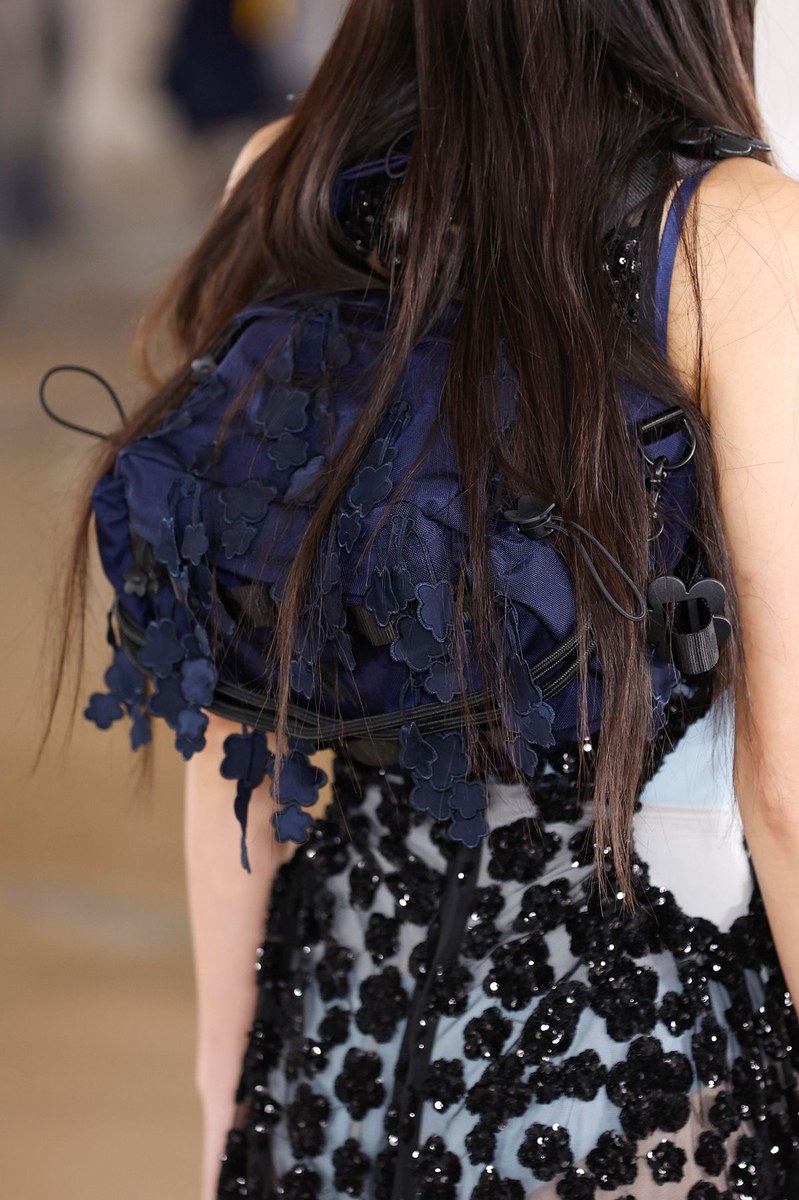
Bag 1 A mid-volume navy nylon drawstring backpack layered with tonal clover appliqués across its full face, styled over a black sequin dress to deliberately collapse the utility-versus-occasion boundary.

Bag 1
Bag 1

Bag 2 The largest silhouette in the group, this backpack carries a chest strap harness system and dense appliqué coverage concentrated on the front panel, making it the strongest candidate for a hero SKU in a technical fashion context.

Bag 2
Bag 2

Bag 3 The most compact and commercially accessible piece, this zippered crossbody with a single carabiner hook and sparse appliqué placement offers a lower price-point entry into the design language without sacrificing brand coherence.

Bag 3
Bag 3

Bag 1 The cinched drawstring closure creates a gathered, almost floral crown at the top, a construction detail that reinforces the appliqué motif at the structural level rather than purely at the surface level.

Bag 2 Appliqué density here is noticeably higher than on Bag 3, suggesting Bahnsen may be building a good, better, best embellishment tier within the same silhouette family.

Bag 3 The carabiner hardware is the most commercially transferable detail in the lineup, a closure type that references climbing and alpine gear and that resonates directly with the gorpcore adjacency driving accessories buys across multiple price tiers right now.

Operational Insights

Appliqué production: The tonal clover appliqués are flat-cut rather than embroidered or 3D-stuffed, which reduces embellishment labor cost but requires precise die-cutting and clean edge finishing to maintain shape integrity at scale. Buyers should request technical flat samples to assess whether factory partners can replicate the rigidity of the original.

Material sourcing: The nylon shell reads as a high-tenacity outerwear-grade fabric rather than a standard handbag lining nylon. Product managers should align with outerwear fabric mills rather than traditional leather goods suppliers when developing this category.

Hardware consistency: Matte black hardware runs without exception across all closures, rings, and zippers on all three bags. Buyers should specify a single hardware finish code early in development to avoid mixed-sheen issues that would break the tonal discipline of the design.

Silhouette tiering: The three bags suggest a natural size and price architecture, with Bag 3 as entry, Bag 1 as mid, and Bag 2 as top. Accessories directors can build a three-door buy around this range without cannibalizing price points.

Consumer positioning: The styling of these bags over sequin occasion dresses and heavy outerwear simultaneously signals two distinct end consumers, the embellished eveningwear buyer and the technical outerwear enthusiast. Retail placement and editorial strategy should address both rather than defaulting to one channel.

✦ This report was generated with AI — combining human editorial vision with Claude by Anthropic. Because the future of fashion intelligence is already here.