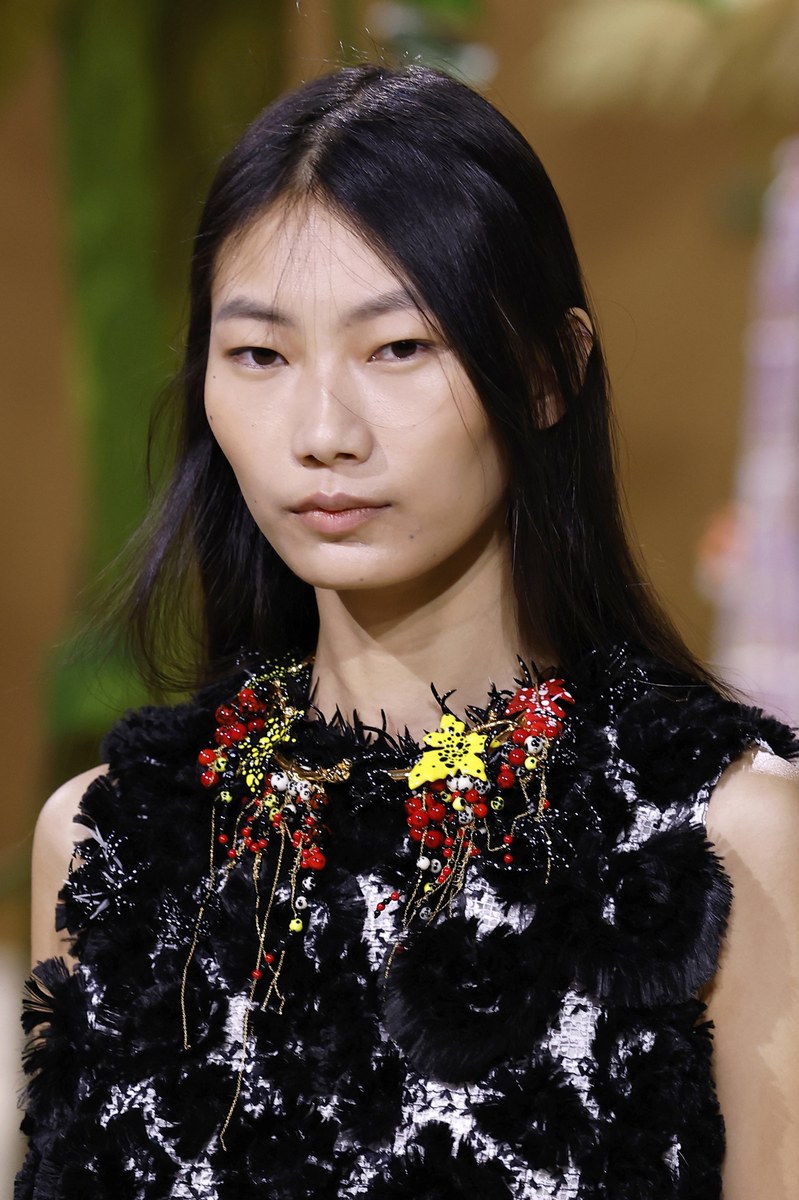
Cecilie Bahnsen FW26 Details
Cecilie Bahnsen FW26 Details Report
Cecilie Bahnsen FW26 builds its accessories language entirely around the collision of technical outerwear hardware and couture-adjacent textile construction, treating utility closures and floral organza as equally weighted design elements. For buyers and product managers, this signals a sustained commercial appetite for hybridized product that moves between activewear infrastructure and occasion dressing without resolving the tension between the two.
Category Overview
The collection works across two categories: belts and dress details. The boundary between them dissolves almost immediately. Harness straps, buckle systems, and woven webbing function simultaneously as structural garment components and standalone accessory statements, visible in Detail 1, Detail 10, and Detail 14. Dress details carry the heavier design investment, with broderie anglaise, floral organza appliqué, sequined embroidery, and puffer-fabric inserts all appearing as deliberate surface and volume decisions rather than trim. Every fastening mechanism stays exposed, reading as deliberate deconstruction of the dressed body.
Material and Construction
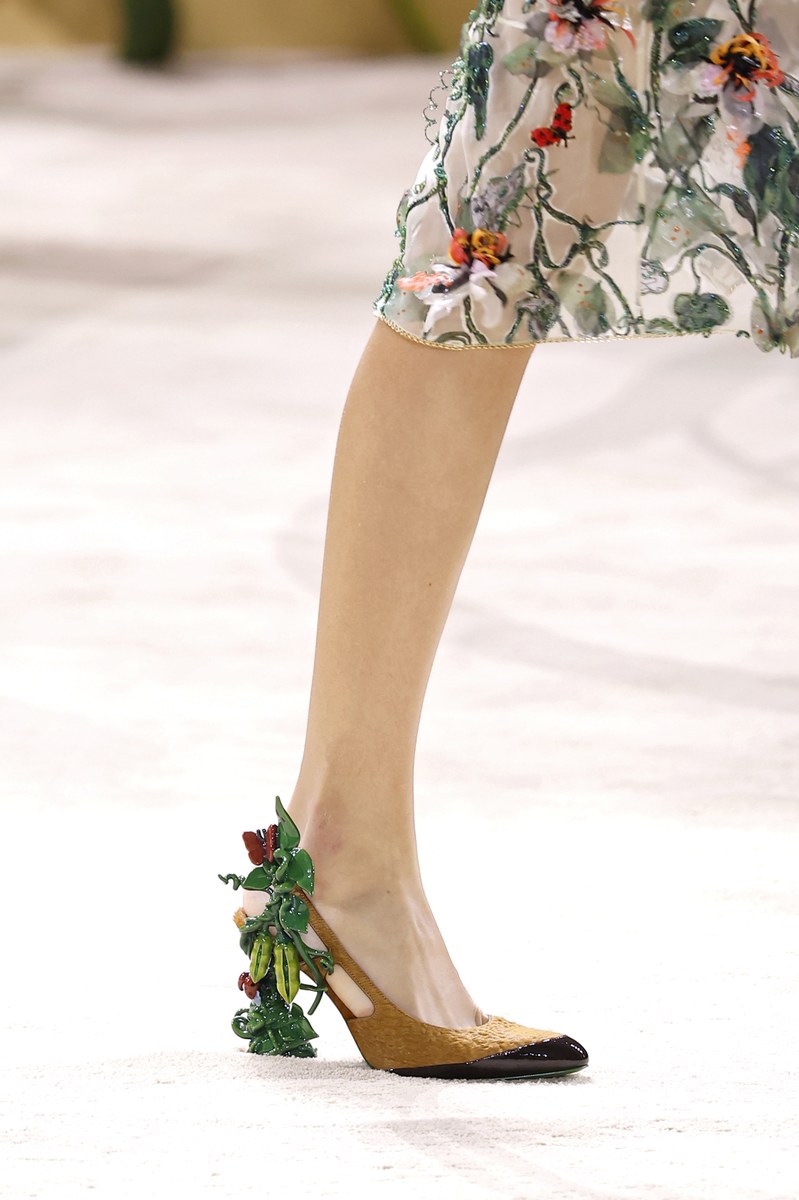
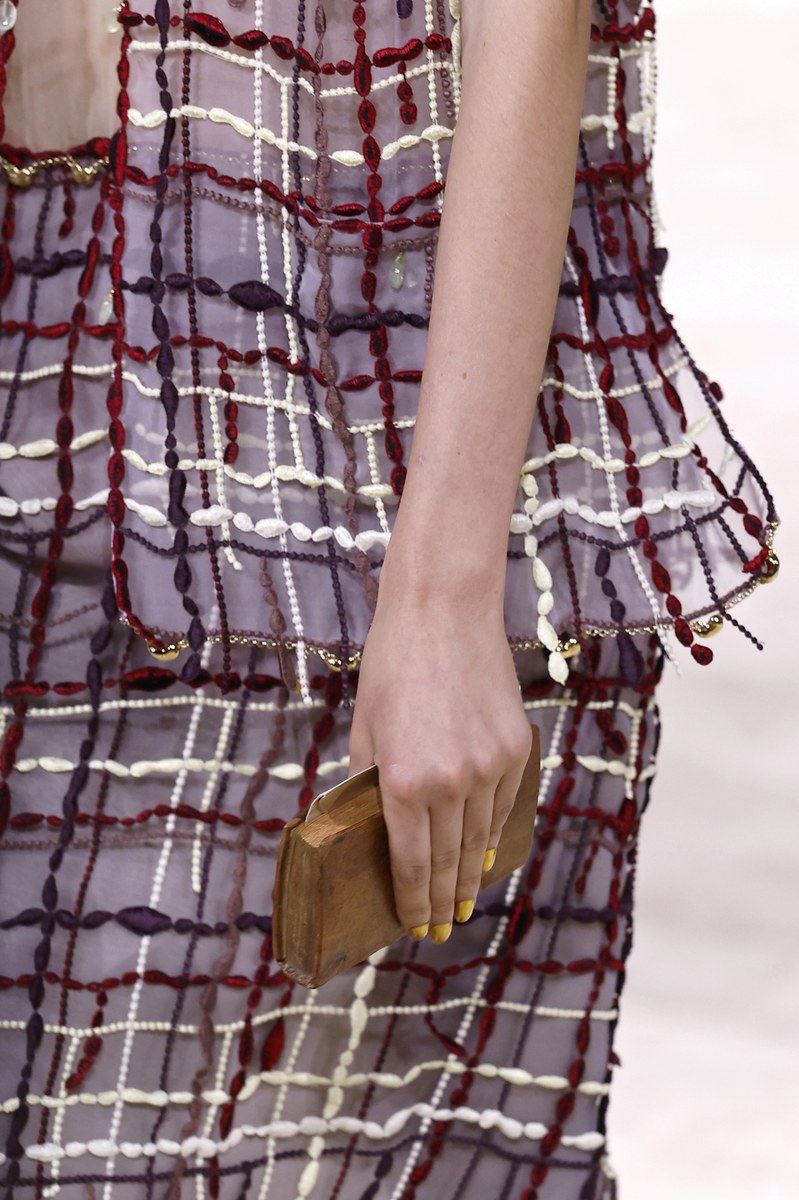
Woven nylon webbing in widths ranging from roughly 2cm to 5cm appears across Detail 1, Detail 10, Detail 12, and Detail 14, sourced in the same colorways as technical backpacking or climbing hardware. Quick-release plastic buckles, identifiable as the same pressfit clip format used in outdoor gear, anchor belts and harness configurations throughout, with Detail 10 and Detail 14 showing them in charcoal grey matte finish. Floral textiles run on sheer organza with raised satin-stitch outlines forming oversized flower clusters, broderie anglaise in cotton with scalloped edges, and dimensional appliqué petals in blush and pale grey organza, all seen across Details 2, 3, 6, 11, 17, and 19. Puffer fabric in high-gloss navy nylon appears in Details 9, 13, and 16, cut and tied as a sash or draped sleeve element, adding a quilted-channel construction detail that reads as both outerwear and accessory.
Color and Finish Direction
Navy, charcoal grey, and off-white dominate the palette, grounded by the dark outerwear pieces and the pale floral lace and organza textiles. Acid yellow and marigold function as the primary accent color, appearing in belt webbing in Detail 1, the ribbed sash in Detail 12, buckle details in Detail 20, and piping trim on the ruffled back piece in Detail 15. Blush pink and pale mint green operate as secondary accents, threading through rope closures, underlay fabrics, and petal appliqué in Details 3, 4, 8, and 17. Matte and high-gloss finishes split the collection cleanly, with the nylon puffer and lacquered navy in Details 13 and 16 sitting in direct contrast to the chalky, powdery surface of the broderie and organza pieces.
Key Pieces and Details
The harness-and-buckle belt system in Detail 1 and Detail 10 represents the most commercially transferable piece across the collection because it reads as a discrete accessory that can sit over multiple garment types. Both the structured back bustle in Detail 15, constructed from layered black floral organza with yellow and grey piping, and the powder-blue quilted lace bustle in Detail 11 demonstrate a volume accessory format that buying teams should recognize as a conversion challenge but a strong editorial driver. The ribbed yellow sash layered over a navy puffer in Detail 12 is the most immediately wearable and producible hybrid piece, simple in construction but high in visual impact. Detail 9 proposes a detachable mint-green puffer sleeve draped across a black satin column dress, something product managers could develop as a separate SKU.
Detail by Detail Highlights
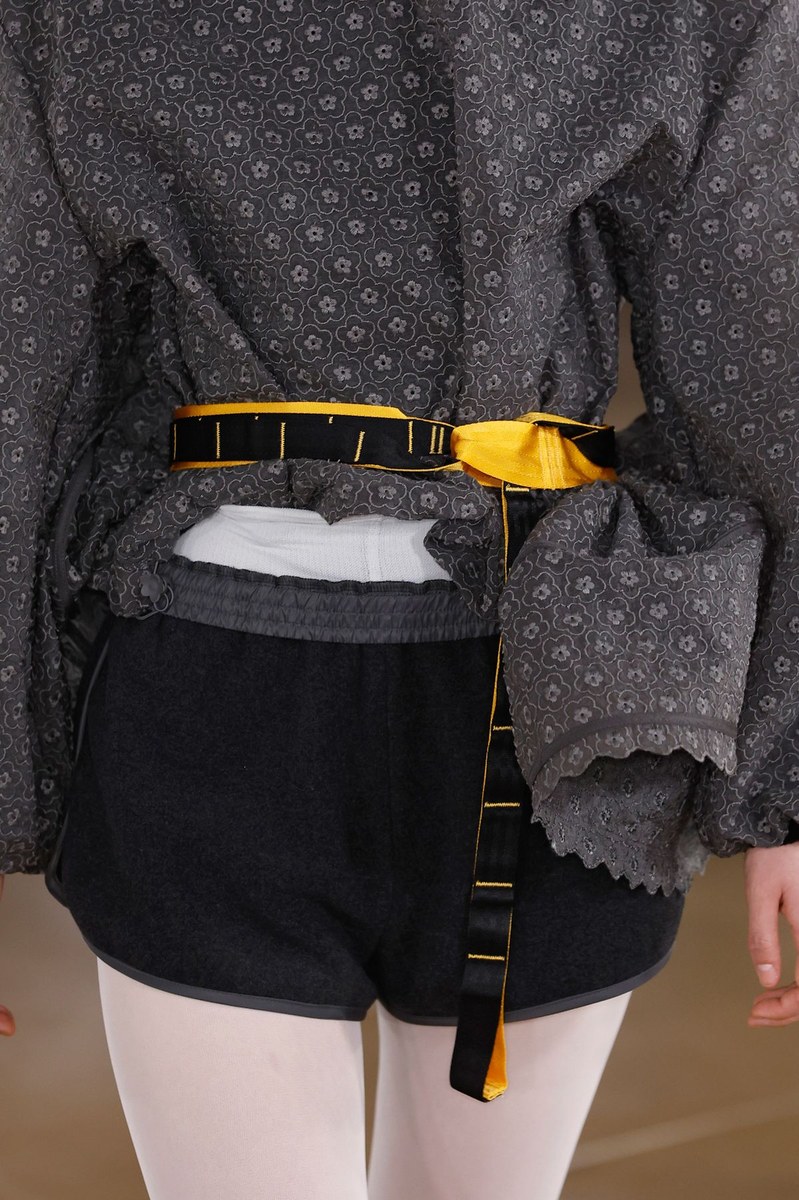
Detail 1 (Belt) A black nylon webbing belt threaded through a yellow satin ribbon tie sits low on the hip over layered dark florals, with visible metal bar hardware creating deliberate industrial contrast against the broderie fabric.
Detail 3 (Dress Detail) Pale blush organza floral appliqué panels sit over a grey stretch underlayer, laced through with navy and pale blue elastic cord threaded through white cylindrical stoppers, presenting a bodice construction that merges corsetry logic with climbing-gear mechanics.

Detail 9 (Dress Detail) A mint green satin puffer sleeve, fully detached from the garment beneath it, wraps across the shoulder and hangs over a sleeveless black satin dress, secured loosely and gathered at the cuff with a fine drawcord.

Detail 11 (Dress Detail) Pale blue broderie anglaise in large scalloped panels is structured with navy piping into a bustle-shaped back volume piece, worn over a dark floral skirt and positioned at hip level to read as both pocket and sculptural ornament.

Detail 15 (Dress Detail) Layers of black floral organza and embroidered net are cut and built into a back hip structure trimmed with high-visibility yellow ribbon piping and a single reflective grey cord, pulling references from outerwear safety trim into eveningwear construction.

Detail 19 (Dress Detail) A silver-ground floral brocade bodice is crossed with white grosgrain shoulder-straps and threaded with loose navy cord across the chest, with a grey woven belt buckled at the waist and a padded circular lace pod attached at the hip.

Detail 20 (Dress Detail) A deep navy ribbed knit zip-neck base carries large dimensional floral appliqués in the same navy coated fabric, with a zigzag white bungee cord running vertically through matte black cord-locks and a flat marigold webbing belt fastened with a plastic side-release buckle at the waist.

Detail 8 (Dress Detail) The back of a grey lace bodice panel is edged with red grosgrain tape from an integrated harness system, with pink sequined and crystal floral clusters filling the central back panel and white lacing threaded through bar closures on either side.

Operational Insights
Webbing hardware sourcing: Buyers should identify technical webbing and quick-release buckle suppliers used in the climbing and hiking category, as the hardware language across Details 1, 10, 12, and 14 points directly to outdoor-goods supply chains rather than traditional accessories trims manufacturers.
Detachable volume accessories: Bustles and sleeve forms in Details 9, 11, and 16 function as separable components. Product managers should evaluate whether these can be developed and sold as detachable accessories alongside core garments to expand average order value.
Broderie anglaise fabric direction: Scalloped broderie in navy, blush, and white across multiple details signals that broderie anglaise continues to hold commercial relevance into FW26. Fabric directors should confirm their cut-and-ship lead times on this construction given its recurrence across the full collection.
Accent color placement: Marigold and acid yellow appear exclusively as accent hardware, trim, and binding rather than as body color, which gives accessories directors a clear direction for adding pop colorways to otherwise tonal dark outerwear product without committing to a full color shift.
Hybrid product categorization: Retailers and buying teams will need to resolve how pieces like the puffer sash in Detail 13 and the lace bustle in Detail 11 are categorized at point of sale, since they do not resolve cleanly into either outerwear, accessory, or RTW. Incorrect categorization will affect placement, merchandising margins, and reorder logic.

More Details


✦ This report was generated with AI — combining human editorial vision with Claude by Anthropic. Because the future of fashion intelligence is already here.