Cecilie Bahnsen FW26 Women Looks Report

Cecilie Bahnsen FW26 Women Looks Report
Cecilie Bahnsen FW26 Women Looks Report

Paris Fashion Week

Cecilie Bahnsen FW26 stages a direct collision between technical outerwear construction and delicate balletic dressing, treating utility hardware and broderie anglaise as equal partners rather than contrasts. For buyers navigating a market where the activewear-luxury crossover has plateaued, this collection proposes a more emotionally charged version of that conversation.

Silhouette and Volume

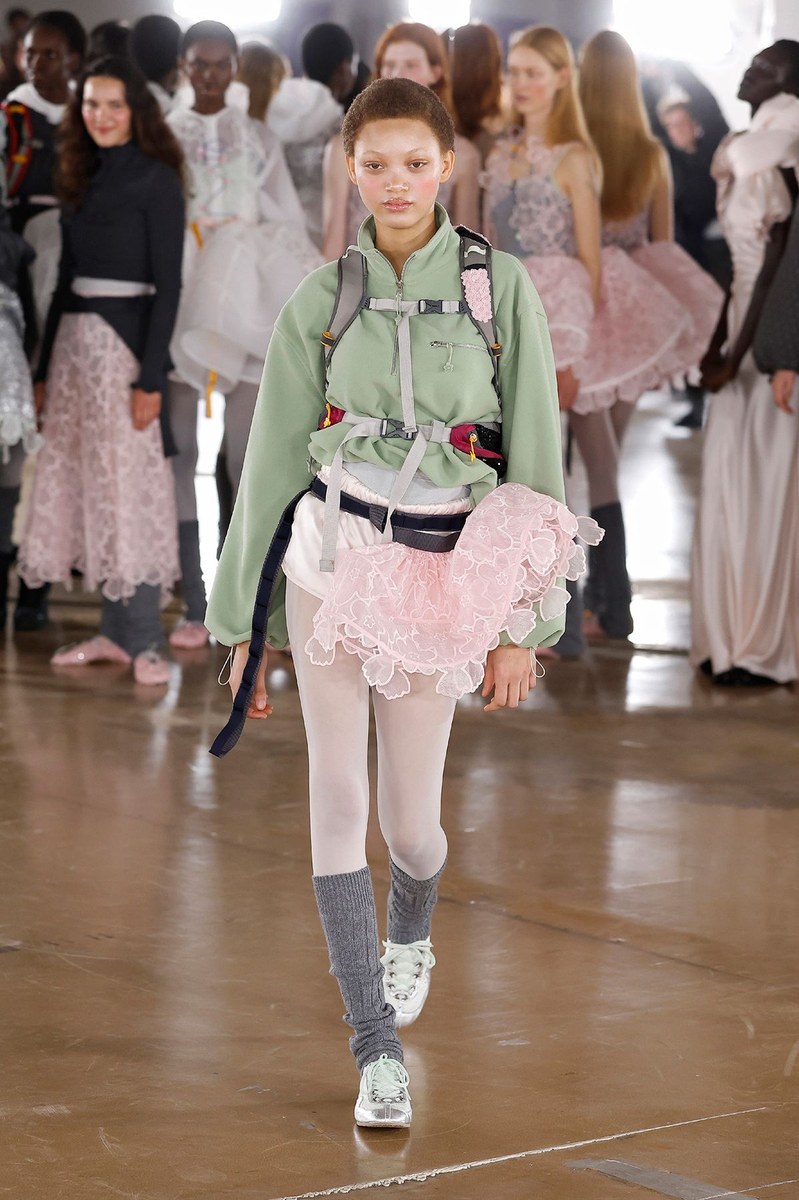
Two distinct poles structure the collection: floor-length ruched column dresses with a close, liquid drape, and short, explosively full skirts that push outward from the hip with structured organza or lace underlayers. Neither silhouette is transitional. Short looks carry real volume through stiffened broderie and layered tulle petticoat architecture, as in Looks 1, 4, 21 and 24, while Looks 2, 13, 26, 28 and 29 strip everything back to a minimal bias-influenced column with drawstring side ruching at the waist. Look 9 splits the difference, placing a voluminous white organza skirt beneath a lace-embroidered anorak top with corset-style lacing.
Look 9
Look 9

Color Palette

Blush pink and pale mint give way to silver-grey lace and white organza, then deepen into navy and black, with yellow nylon webbing belts and harness straps serving as the single sharp accent throughout. White-to-blush dominates the first half of the collection, creating a bleached, early-morning quality in Looks 2, 3, 5, 9 and 10. Navy consolidates the second half in Looks 20, 25, 32, grounding the more overtly sporty outerwear pieces. Black appears in Looks 13, 15, 17, 18, 19, 21 and 30, where it gives the broderie and sequined organza a harder, more eveningwear-adjacent reading.

Materials and Textures

Signature broderie anglaise fabric recurs in multiple colorways and scales, from fine white eyelet in Looks 7 and 8 to dense black floral cut-work in Looks 17 and 32, and behaves with enough body to hold the full skirt shapes without additional boning. Parachute nylon and quilted puffer fabrications appear in Looks 8, 15, 19, 20, 21, 22, 23, 24 and 25, bringing a matte, compressed weight that reads as outerwear-grade. Ruched column dresses in Looks 2, 13, 26, 28 and 29 use a fluid satin-backed jersey that pools and moves convincingly at floor level. Knit leg warmers in mid-grey marl pull through the footwear zone of nearly every look, adding a low-sheen matte texture that bridges the technical and the romantic registers.

Styling and Layering

Most looks build through superimposition rather than coordination, placing technical harness vests, padded jackets or rucksack-integrated body harnesses directly over lace dresses and organza skirts, as in Looks 1, 7, 8, 9, 12, 14 and 25. Knitwear appears as a layering element tied at the waist rather than worn as intended, visible in Looks 5 and 19, reinforcing a studied dishevelment. Footwear stays consistently ballet flat or low sneaker, either in sparkle fabric or pale satin with ribbon lacing, worn over the grey knit leg warmers that appear in close to two-thirds of the collection. Rucksacks, worn front-loaded or in standard configuration, recur as a structural accessory in Looks 1, 8, 12, 18, 25 and 32, functioning as both product and silhouette modifier.

Look by Look Highlights

Look 1 Anchors the collection's thesis immediately, placing a sage green fleece zip-up with a full rucksack harness over a pink broderie mini skirt, with white tights and grey leg warmers completing a look that has direct buy-now relevance for multi-brand activewear-adjacent floors.

Look 1
Look 1

Look 9 Delivers the most commercially translatable version of the utility-over-romantic concept, with white broderie lace anorak top, yellow drawstring ribbons and a voluminous organza skirt that photographs well and reads clearly in a product shot.

Look 17 Stands as the evening anchor, a floor-length black sequined broderie gown with visible buckle hardware at the waist that converts the dress into something with a harder edge and avoids the purely bridal read.

Look 17
Look 17

Look 24 Combines dark charcoal broderie anglaise with yellow technical lacing details on the bodice and a white-edged petticoat hem, making it the most costume-adjacent piece and the strongest candidate for editorial placement or brand campaign use.

Look 24
Look 24

Look 25 Makes the case for the puffer as a volume piece rather than a layering piece, swamping the body in oversized navy quilted nylon while a broderie skirt peeks below, paired with a matching navy broderie tote bag that represents a strong accessories lead.

Look 25
Look 25

Look 32 Closes the navy chapter with the most cohesive single look in the sportswear-ballgown hybrid category, a navy broderie jacket with white zigzag lacing over a full broderie skirt, yellow belt hardware and lace-up boots, with the matching navy broderie bag reinforcing a complete product group for buyers.

Look 32
Look 32

Look 2 Provides the commercial counterweight to the volume-heavy looks, a pale blush column dress with a puffer scarf knotted at the shoulder that carries eveningwear price architecture without requiring complex construction at the retail level.

Look 2
Look 2

Look 7 Translates the aesthetic into the most wearable single unit, a silver metallic bomber over a green utility vest with a white broderie mini skirt, white tights and silver sneakers, and it is the look most likely to move across multiple retail formats.

Look 7
Look 7

Operational Insights

Fabric sourcing: Broderie anglaise runs across at minimum five colorways and two scales of cut-work, so buyers commissioning exclusive colorways should engage early given the lead time implications of the eyelet embroidery process.

Product grouping: Looks 25 and 32 share a navy broderie bag that appears to be the same style, presenting a clear bag-and-separates grouping that style directors can use to build a navy capsule with outerwear, skirt, dress and bag from a single collection drop.

Price architecture: Column dresses in Looks 2, 13, 26, 28 and 29 require minimal construction relative to their visual impact and represent the most accessible price entry points into the collection, relevant for buyers targeting the contemporary luxury segment below the couture-adjacent pieces.

Footwear attachment: Grey leg warmer styling is specific enough to read as a collection signature and generic enough to source independently, making it a strong candidate for a branded accessory collaboration or an exclusive colorway for wholesale accounts.

Outerwear strategy: Puffer and technical jacket pieces in Looks 8, 15, 19, 20, 22, 23 and 25 carry standalone commercial viability outside the full runway styling context, and product managers should assess them as separates against their own outerwear margin targets rather than only as part of full look purchases.

Complete Collection

Look 3
Look 3
Look 4
Look 4
Look 5
Look 5
Look 6
Look 6
Look 8
Look 8
Look 10
Look 10
Look 11
Look 11
Look 12
Look 12
Look 13
Look 13
Look 14
Look 14
Look 15
Look 15
Look 16
Look 16
Look 18
Look 18
Look 19
Look 19
Look 20
Look 20
Look 21
Look 21
Look 22
Look 22
Look 23
Look 23
Look 26
Look 26
Look 27
Look 27
Look 28
Look 28
Look 29
Look 29
Look 30
Look 30
Look 31
Look 31

Fashion Designer

Cecilie Bahnsen was born in 1985 and grew up just outside Copenhagen, in a household where clothes mattered. Her mother had been a model and had a wardrobe Bahnsen describes as formative. One of her earliest memories is being dressed by her mother in beautiful night shirts, a masculine-feminine hybrid that would return explicitly in her first collection and again decades later. Summers at a family house where her grandmother embroidered flowers from the garden gave her a direct, physical relationship with needlework long before she thought about fashion as a career.

She studied at the Danish Design School before moving to London for a master's in womenswear at the Royal College of Art, then went directly to work, first at Erdem and then for John Galliano in Paris. Those years gave her two distinct educations running in parallel: Erdem's obsessive attention to printed textiles and the emotional charge of a dress, and Galliano's theatricality, his insistence that technique and feeling are the same thing when the work is serious. She returned to Copenhagen in 2015 and launched her label from a basement office, initially showing at London Fashion Week before breaking through at Paris, where she has been a regular on the official calendar since 2022.

Her references shift between cultures and centuries without obvious logic. A 1970s Japanese photographer who documented blind travelling musicians. James Turrell's light installations. Sofia Coppola's early films. Summer evenings by the Danish sea. What stays constant is the fabric: each season she designs new textiles from scratch with manufacturers in Italy and Switzerland, working with jacquard, organza, quilted silk and lace in combinations that don't exist until she invents them. The brand remains independently owned and based in Copenhagen's Østerbro neighborhood, with over thirty people in the studio.

"I have always been drawn to femininity and a romantic way of dressing. For me, there is power and strength in romance. I make clothes for women to feel comfortable, strong and independent."

"Embroidering and knitting with my grandmother in our summer house — she inspired me to work with my hands, and created the most beautiful embroideries of her flowers in the garden."

✦ This report was generated with AI — combining human editorial vision with Claude by Anthropic. Because the future of fashion intelligence is already here.