CFCL FW26 Bags

CFCL FW26 Bags

Cfcl FW26 Bags Report

Cfcl FW26 plants its flag firmly in textile-forward, construction-led bag design, with pleated fabrications, knotted closures, and oversized volumes driving every category from clutch to tote. For buyers navigating a market saturated with logo hardware and leather minimalism, this collection signals a credible alternative path built on material craft and sculptural handling.

Silhouettes and Shapes

Two poles define the collection: voluminous, unstructured shoulder totes and compact hand-carried clutches with knotted or gathered tops. Bag 4, Bag 8, Bag 10, Bag 15, and Bag 16 occupy the oversized tote register, with dropped bases, wide mouths, and enough interior volume to read as market or travel bags. Bags 2, 3, 5, 7, 11, 17, and 18 cluster around a wrist-carry clutch format, held flat against the palm or tucked under the arm. Between these two poles sit Bag 1 and Bag 9, a small top-handle bucket category with gathered ruched openings and flat woven handles that add structure without rigidity.
Materials and Hardware

Pleated technical fabric dominates the collection, appearing across Bags 1, 2, 3, 4, 9, and 19 in varying rib densities. The pleating is heat-set and consistent, which signals a proprietary or licensed performance textile rather than a standard woven. Bags 10, 14, and 15 introduce a metallic jacquard with an abstract brushstroke print, while Bags 5, 7, 17, and 18 use a crisp cotton poplin stripe in red and white. Breaking from fabric entirely, Bags 12 and 13 attach fringe made from rigid plastic or lacquered vinyl strips, a construction detail that reads as accessories-specific rather than repurposed from ready-to-wear.

Hardware is nearly absent across the full lineup. Bag 1 shows a small zipper pull in what appears to be matte gunmetal. A concealed zip in black appears on Bag 6. Visible logo hardware is deliberately absent throughout, placing all visual weight on material and silhouette.

Color Direction

Deep aubergine anchors the fall palette, appearing in Bag 1 and echoed in the garments surrounding Bags 3 and 9. Dark espresso brown runs through Bags 2, 3, and 4, holding a warm but somber base for the collection. Black appears in Bags 6, 9, 12, and 14, ranging from matte ribbed knit to high-gloss patent and lacquered fringe. The metallic silver and white brushstroke jacquard in Bags 10, 11, 15, and 14 provides the collection's only true light-reflective moment, functioning as an evening accent within an otherwise tonal, low-contrast palette. Red and white stripe is the sole graphic color entry, appearing in Bags 5, 7, 17, and 18 and likely corresponding to a spring carryover print.

Key Models and Details

The knotted-strap clutch emerges as the collection's most commercially legible silhouette. Bags 2, 3, 7, 11, 17, and 18 all share the same construction logic: a flat rectangular body with a fabric handle knotted and twisted at the center top, creating a gathered grip that functions as both closure and visual focal point. For wholesale, the red-and-white stripe version (Bags 5, 7, 17, 18) is likely the most accessible entry, given its graphic clarity and lower material complexity compared to the pleated or jacquard styles. The oversized tote in black-and-white stripe (Bags 8 and 16) uses a single knotted shoulder strap, an unusual structural choice that reduces hardware to zero and keeps production costs contained. Bag 13 represents the collection's highest editorial risk, with its dense fringe of mixed black and silver strips covering the entire body of a clutch, suggesting a limited-edition or runway-exclusive position rather than a core commercial style.

Bag by Bag Highlights

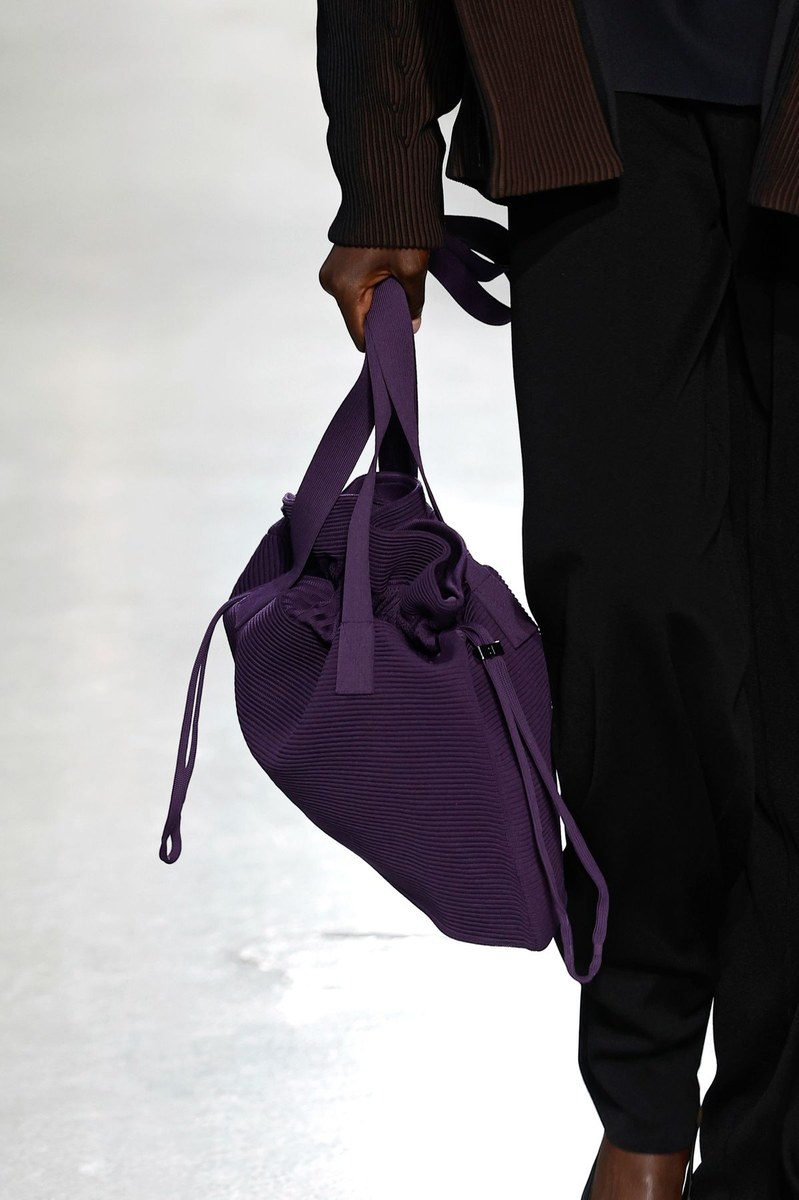
Bag 1 The aubergine pleated top-handle bucket with drawstring closures and a secondary zipper compartment offers buyers a rare multi-closure option in this category, broadening its functional appeal.

Bag 1
Bag 1

Bag 4 The oversized dark brown pleated shoulder tote, carried slung on one arm, establishes the collection's most wearable volume and would translate directly into a core carry for the contemporary market.

Bag 4
Bag 4

Bag 8 The black-and-white stripe tote with a single knotted strap carries a strong summer-resort visual but photographs as a year-round neutral, making it a strong candidate for a hero style across seasons.

Bag 8
Bag 8

Bag 9 The compact black ribbed pleated top-handle bucket mirrors Bag 1 in construction but shifts the color to black and reduces scale, giving buyers a good-better-best size pairing opportunity within the same mold.

Bag 9
Bag 9

Bag 11 The metallic brushstroke jacquard clutch in black and silver reads as an evening-specific option and would slot cleanly into holiday assortments without requiring a separate design investment.

Bag 11
Bag 11

Bag 13 The all-fringe silver-and-black clutch is a statement piece built from rigid strip applications and carries significant production complexity, best positioned as a capsule or made-to-order style rather than a volume buy.

Bag 13
Bag 13

Bag 17 The red-and-white stripe knotted clutch is the most immediately commercial silhouette in the lineup, with a recognizable construction, low hardware cost, and broad demographic appeal.

Bag 17
Bag 17

Bag 19 The sand-toned pleated small top-handle bag with ruffled open top and long drawstring ties signals a softer, more artisan direction and would perform well with buyers serving the Japanese domestic or design-forward European market.

Bag 19
Bag 19

Operational Insights

Fabric sourcing The heat-set pleated textile appearing in Bags 1, 2, 3, 4, 9, and 19 requires a supplier with technical pleating capabilities and consistent pleat registration across cut pieces. Confirm minimum order quantities for this fabric before committing to depth.

Size architecture Natural good-better-best laddering emerges here: the knotted clutch at entry level, the small top-handle bucket at mid tier, and the oversized tote at the top. Product managers can structure a three-door or three-price-point assortment without adding silhouettes.

Hardware dependency Near-total absence of metal hardware reduces material cost and lead time risk, but brand legibility rests entirely on fabric and silhouette recognition, a consideration for markets where logo or hardware signals drive purchase behavior.

Fringe construction Bags 12 and 13 use rigid plastic or lacquered strip fringe that will require separate QC protocols for attachment durability and shipping compression. Higher return risk exists if fringe strips detach at retail.

Stripe carryover The red-and-white poplin stripe in Bags 5, 7, 17, and 18 appears consistent with a spring or resort print, suggesting Cfcl may be positioning this fabric across seasons. Test the clutch style in spring and carry the same body into a fall colorway without resetting tooling or pattern costs.

Complete Collection

More Bags

More Bags

Bag 2
Bag 2
Bag 3
Bag 3
Bag 5
Bag 5
Bag 6
Bag 6
Bag 7
Bag 7
Bag 10
Bag 10
Bag 12
Bag 12
Bag 14
Bag 14
Bag 15
Bag 15
Bag 16
Bag 16
Bag 18
Bag 18

✦ This report was generated with AI — combining human editorial vision with Claude by Anthropic. Because the future of fashion intelligence is already here.