CFCL FW26 Women Looks Report

CFCL FW26 Women Looks Report
CFCL FW26 Women Looks Report

Paris Fashion Week

CFCL built this collection around a single conviction: that technical fabric engineering and sculptural volume can coexist without sacrificing wearability, moving from compressed wool geometries in the opening looks through liquid drape and, finally, to handcrafted fringe and metallic surface work. For buyers operating in the premium contemporary space, this progression from utility-adjacent outerwear to occasion-ready eveningwear gives the line genuine range across multiple selling floors.

Silhouette and Volume

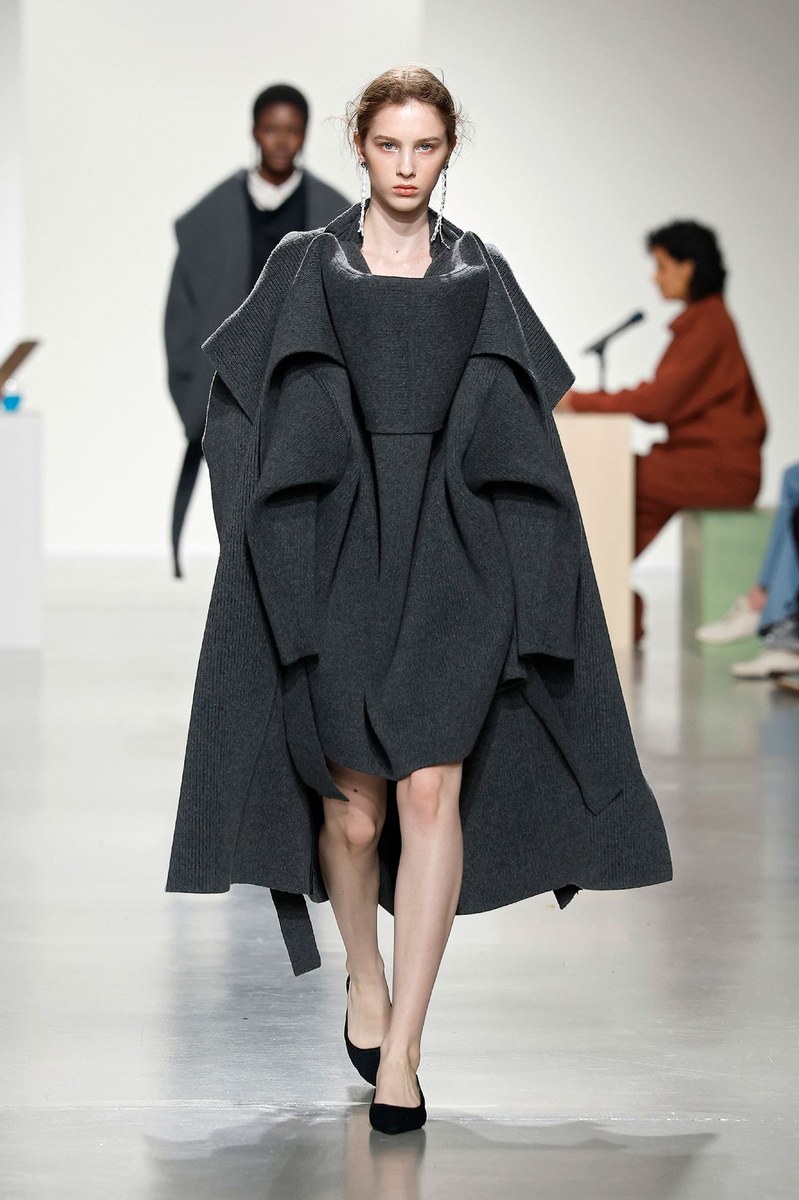
The opening moves boldly into extreme volume concentrated at the shoulder and collar. Look 1 and Look 2 showcase oversized wrap-coats that create broad, architectural trapezoids above the knee. By midcollection, the silhouette shifts to fluid, asymmetric drape across the body. One-shoulder and off-shoulder constructions in Looks 10, 16, and 18 generate movement rather than mass. The closing section tightens into column-length gowns and fringe-weighted skirts that elongate the figure through vertical texture rather than structured padding. Two registers run throughout: the cocoon and the column. Neither option wavers.
Look 1
Look 1

Color Palette

Charcoal grey, near-black, and dark chocolate brown open the collection in a narrow, muted range that establishes urban authority across the first twelve looks. Purple enters as a deep saturated violet in Look 10 and recurs through Looks 11, 13, 16, and 18, providing the collection's most consistent accent color and one with strong sell-through history in the premium knitwear market. Red arrives with impact in Looks 14, 16, and 20, always paired against black or lavender to prevent costume-like readings. The final third introduces silver and black metallic, carrying the collection into evening territory without jarring tonal shifts.

Look 10
Look 10

Materials and Textures

Technical polyester knit dominates the first half in a ribbed, medium-weight construction that holds sculptural shape while remaining lightweight. Looks 1 and 19 demonstrate this most clearly in their dramatic collar volumes. Woven woolens in dark grey and black appear in the outerwear silhouettes of Looks 9, 12, and 15, cut with a dense, slightly felted hand that gives those pieces the weight and drape authority buyers expect at higher price points. Metallic jacquard and sequined fabrics enter in Look 31 and accelerate through Looks 32, 35, and 39, with a paint-stroke print in silver on black that reads both graphic and luxurious at floor level. Fringe and tassel elements closing the collection, particularly in Looks 38, 41, and 43, combine soft fiber fringe with rigid metallic rods. The result is a layered surface that moves audibly as well as visually.

Look 31
Look 31

Styling and Layering

Layering in the first half functions as architecture. A knit dress worn beneath an oversized coat or wrap creates mass that reads as a single sculptural unit, as in Looks 1, 15, and 19. The middle section strips back to single-garment statements, relying on drape and cut alone to generate visual weight and considerably simplifying the production equation for buyers sourcing separates. Footwear splits between flat pointed-toe pumps and chunky lace-up sneakers or crepe-soled walkers, a pairing that reinforces the collection's dual proposition of eveningwear and elevated sportswear. Oversized unstructured bags appear as pleated totes in striped or metallic fabric that echo the garment language and read as strong accessory buys in their own right.

Look by Look Highlights

Look 1 The charcoal ribbed-knit wrap coat with its cascading layered lapels represents the collection's clearest ready-to-buy coat silhouette, with volume that photographs well and translates directly to the floor.

Look 9 The all-black belted cocoon coat with black faux-fur snood collar is a high-impact single-unit buy, combining outerwear and accessories into one transaction for the customer.

Look 9
Look 9

Look 13 The sleeveless purple tent dress with open side slits over red wide-leg trousers layers two bold separates that can sell together or apart, maximizing SKU flexibility.

Look 13
Look 13

Look 16 The red knit asymmetric dress with a draped purple scarf collar worn as a shoulder accent demonstrates how CFCL uses accessories to shift a single garment across multiple styling contexts.

Look 16
Look 16

Look 24 The lavender and bold red vertical-stripe drop-waist midi dress is the collection's most immediately commercial print piece, with clean construction and a strong color story that requires no additional styling effort on the floor.

Look 24
Look 24

Look 32 The all-over metallic paint-stroke sequined long-sleeve midi dress with high slit stands as the collection's strongest evening singular, with a body-conscious cut that contrasts directly with the volume-dominant opening.

Look 32
Look 32

Look 39 The cable-knit sweater in silver lurex yarn paired with a tiered silver metallic fringe midi skirt bridges the knitwear and eveningwear categories in one look, making it a natural candidate for a capsule buy.

Look 39
Look 39

Look 43 The black long-sleeve knit gown with asymmetric silver-tipped fringe draping one shoulder closes the collection with a piece that justifies a high price point through visible hand-craftsmanship and stage-ready impact.

Look 43
Look 43

Operational Insights

Technical knitwear depth: CFCL's core polyester ribbed-knit construction appears across coats, dresses, and separates, meaning buyers can build a coherent knitwear capsule from Looks 1, 2, 17, 19, and 27 that shares fabrication origin and simplifies sourcing conversations.

Color entry strategy: Purple and red function as the collection's two accent colors with the broadest repeat, appearing across tops, bottoms, outerwear, and accessories. Style directors can build floor sets around a clear color narrative without overcommitting to a single category.

Evening versus day split: The collection divides roughly into a daywear first half and an eveningwear second half, allowing multi-floor retailers to buy selectively by department without losing the brand's overall narrative coherence.

Fringe and metallic as price anchors: Handcrafted fringe pieces in Looks 38, 40, 41, 42, and 43 and metallic jacquard in Looks 31, 32, 34, and 35 carry the visual complexity that justifies premium retail pricing and should be positioned as statement buys rather than volume buys.

Accessory pull-through: Pleated oversized tote bags in striped, metallic, and solid colorways appear repeatedly as functional styling components, and their strong design continuity with the garment fabrics makes them viable as standalone accessory buys that drive incremental revenue without requiring additional floor space.

Complete Collection

Look 2
Look 2
Look 3
Look 3
Look 4
Look 4
Look 5
Look 5
Look 6
Look 6
Look 7
Look 7
Look 8
Look 8
Look 11
Look 11
Look 12
Look 12
Look 14
Look 14
Look 15
Look 15
Look 17
Look 17
Look 18
Look 18
Look 19
Look 19
Look 20
Look 20
Look 21
Look 21
Look 22
Look 22
Look 23
Look 23
Look 25
Look 25
Look 26
Look 26
Look 27
Look 27
Look 28
Look 28
Look 29
Look 29
Look 30
Look 30
Look 33
Look 33
Look 34
Look 34
Look 35
Look 35
Look 36
Look 36
Look 37
Look 37
Look 38
Look 38
Look 40
Look 40
Look 41
Look 41
Look 42
Look 42

Fashion Designer

Yusuke Takahashi was born in 1985 in Tokyo and grew up wanting to be an architect. Fashion came later, and sideways: he enrolled at Bunka Fashion Graduate University not because he had always dreamed of designing clothes, but because he was interested in space, objects and the Mingei tradition of Japanese craft, and Miyake Design Studio, known for collaborating with product designers and architects, seemed like a place where those instincts could find form. To get in, he taught himself computer knitting, a technique none of his classmates were pursuing, and won the Soen Prize, Japan's most prestigious student design competition. He passed a letter to Issey Miyake through a magazine editor at the final judging. He was hired before he graduated.

He spent a decade at Miyake Design Studio, the last seven years as director of Issey Miyake Men, presenting collections in Paris and traveling to production facilities across Japan and to over forty countries. The central lesson he absorbed was not technical but philosophical: that designing clothes means confronting society, and that this confrontation, sustained over time, is what produces a culture. In 2013 a factory collapse in Bangladesh killed over a thousand garment workers. Takahashi was in Paris finishing a collection. The two realities, the show and the catastrophe, existing simultaneously, shifted something in how he understood the job.

He founded CFCL, Clothing for Contemporary Life, in 2020, the same year his daughter was born. The timing was not coincidental. The brand's first signature piece, the Pottery Dress, made entirely from recycled plastic bottles and produced with zero cutting waste on a Shima Seiki Wholegarment machine, looks like it was formed on a wheel rather than sewn. His references span Joseph Beuys's 7000 Oaks, the 19th-century Mingei movement, the visual language of Japanese pottery glazes, and the structural thinking of architects like Herzog & de Meuron. Collections are numbered, not named by season. CFCL now shows at Paris Fashion Week and is certified B Corp, the first apparel company in Japan to achieve it.

"Issey Miyake taught me that designing clothes is confronting society, and it should be something that gives people hope."

"If you believe that the world would be a better place if everyone around you wore your clothes, then that's when it's time to start a brand."

✦ This report was generated with AI — combining human editorial vision with Claude by Anthropic. Because the future of fashion intelligence is already here.