Chanel FW26 Details
Chanel FW26 Details Report
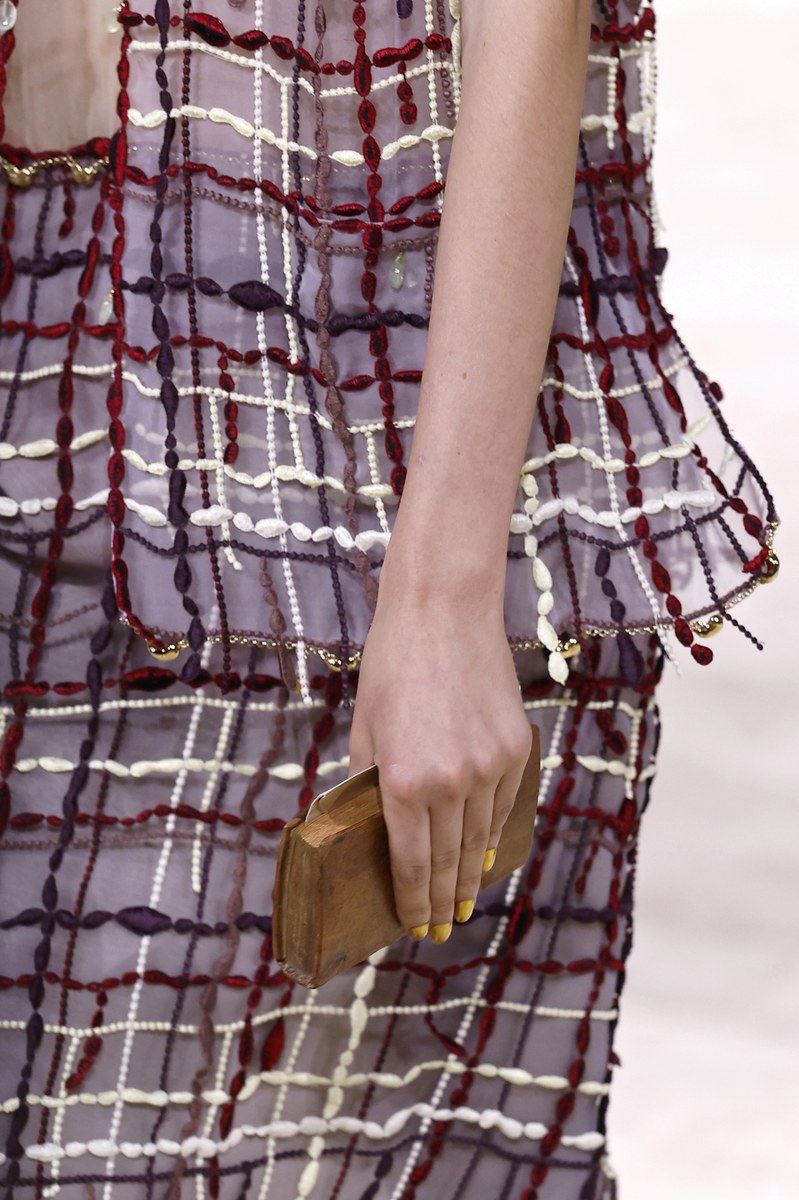
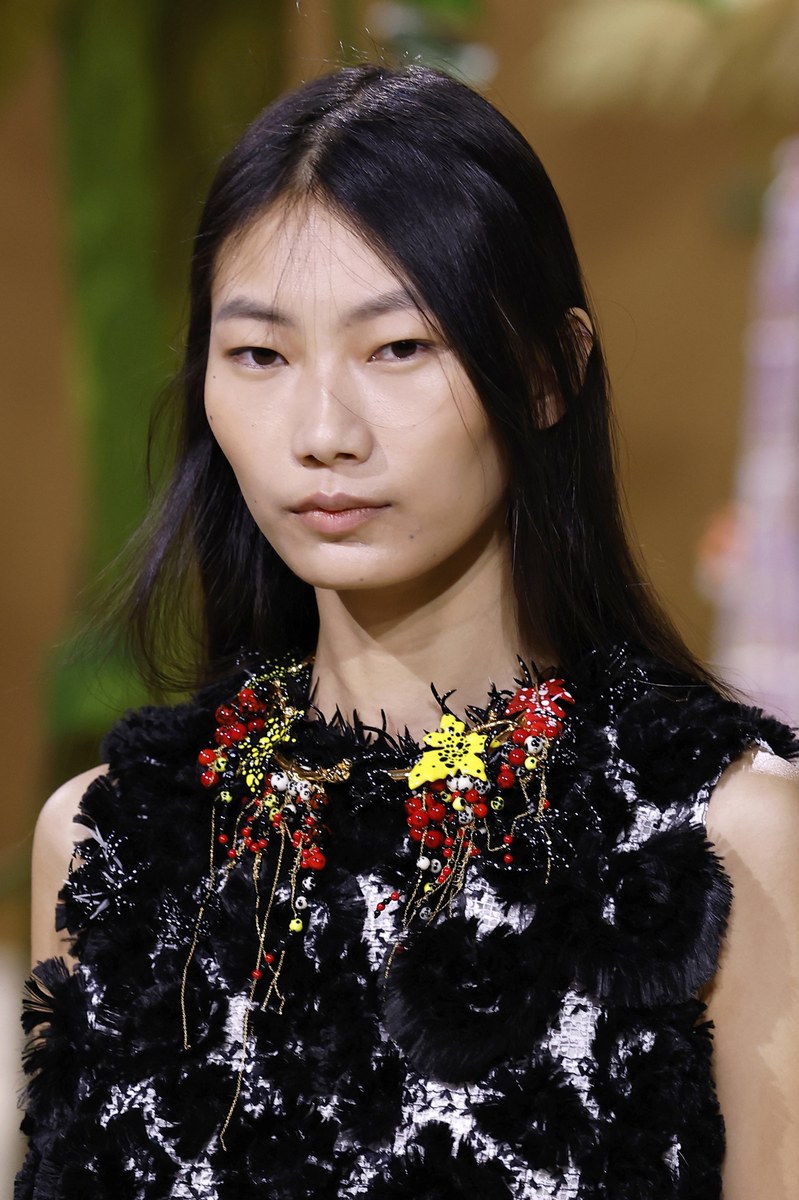
Chanel FW26 constructs a dual identity across its detail work, pairing rigorous tailored craft with overtly sensual, lingerie-inflected embellishment. Buyers and product managers should note this tension carefully, as it signals a commercial split between wardrobe-foundation pieces and high-margin statement units within a single collection.
Category Overview
All 12 details fall under Dress Detail, yet the range within that single category is wide enough to read as a full accessories and surface-treatment strategy. Between boucle tweed suiting with structured hardware closures, heavily beaded and feather-trimmed slip constructions, and a multicolor faux-fur panel that operates as its own visual statement, Chanel moves fluidly across registers. The styling direction is not unified by mood but by craft level. Every detail, regardless of register, carries a high degree of handwork or surface complexity that justifies couture-adjacent price positioning at the ready-to-wear level.
Material and Construction
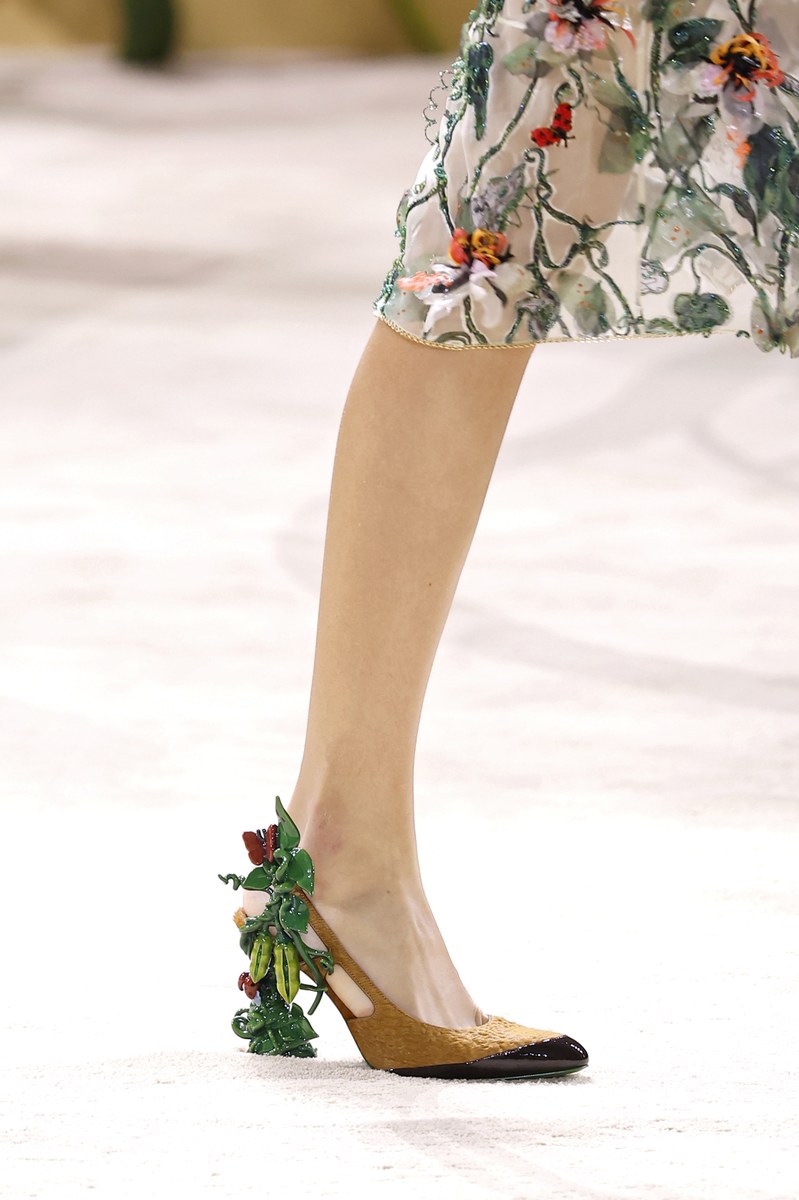
Boucle tweed appears in at least three details: Detail 3, Detail 8, and Detail 10. Each instance is cut differently and finished with contrasting trim or hardware that prevents the fabric from reading as a single seasonal story. Detail 10 pairs a salt-and-pepper tweed with a black braided cord edge and rounded red enamel buttons, a construction choice that adds visual weight without altering the underlying cloth. What appears to be a white crepe base in Detail 11 is entirely covered in hand-cut ribbon or ribbon-woven star-burst appliqués, graduating in density toward the hem. A close-crop of Detail 9 reveals multi-tonal faux or real fur layered in yellow, red, black and white, with a blurred texture suggesting intentional dyeing or piecing rather than a printed surface.

Color and Finish Direction
Two clear directions emerge in the dominant palette. Neutrals anchor the tailoring side, specifically the warm oatmeal of Detail 3, the charcoal grey denim of Detail 7, and the ivory-and-black of Detail 6. Saturated primaries arrive on the statement side: cardinal red across Details 5 and 7, cobalt and black in Detail 8, and the yellow-red-black fur of Detail 9. Mint and soft teal ground the embellished slip in Detail 1, while blush and salmon carry the feather-trimmed pieces in Details 2 and 12. Gold hardware, present in Details 1, 5, and 6, serves as the consistent metallic finish across registers.
Key Pieces and Details
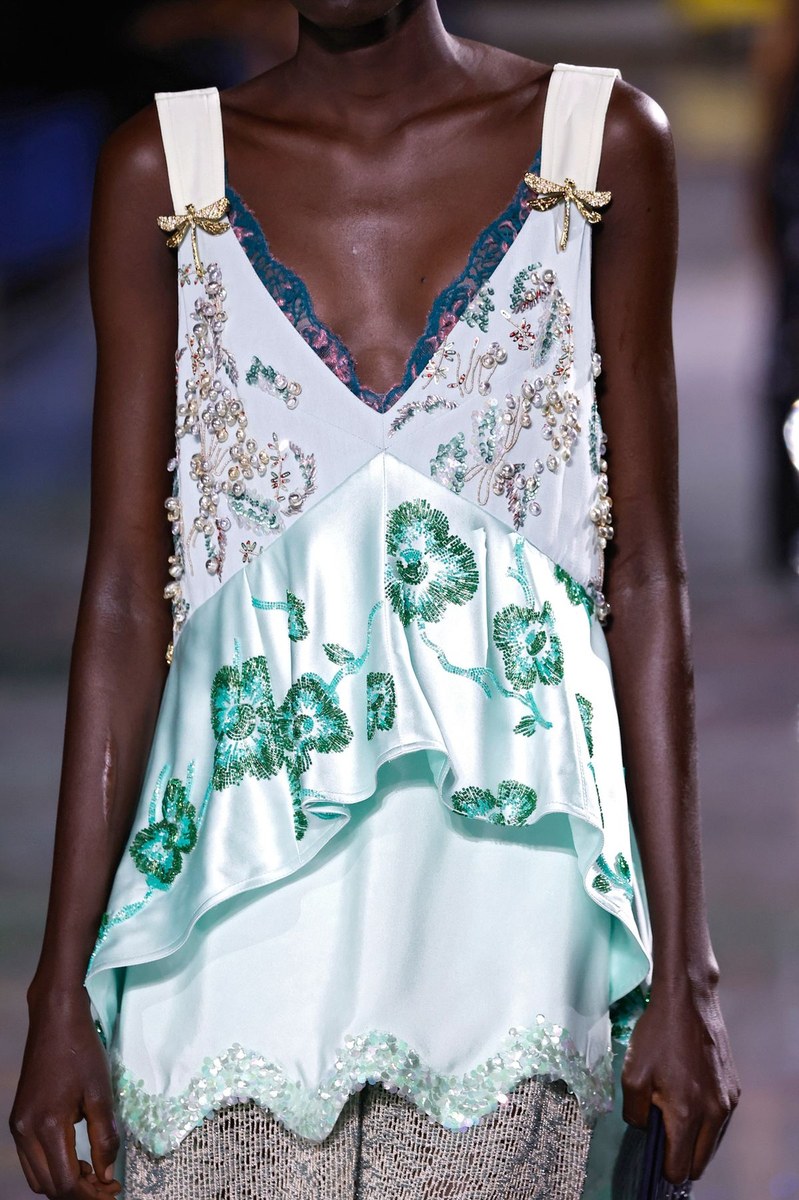
Detail 10 reads as the clearest commercial anchor: a fitted tweed jacket with breast pockets, black braided cord trim at every edge, and red dome buttons that function as an immediate product identifier. Detail 1 combines a layered mint satin slip, pearl-and-crystal beaded bodice, gold bow shoulder clips, and teal lace trim into a single garment that carries at least five distinct surface treatments, making it a high-cost production piece with strong editorial pull. Detail 5 presents a red duchess or heavy crepe coat with dense tonal fringe trim at the waist and sleeve hem, plus gold coin buttons that translate cleanly into a reorderable seasonal coat silhouette. Three oversized square red enamel buttons on a grey wrap blazer in Detail 7 serve as the sole embellishment, a minimal detail with strong hardware sourcing implications.

Detail by Detail Highlights
Detail 1 (Dress Detail) A mint satin slip bodice carries pearl and crystal bead clusters across the upper chest, with cream straps fastened by small gold bow clips at the shoulder and a teal lace trim at the neckline interior.

Detail 2 (Dress Detail) A blush and ochre layered dress grounds a large pink ostrich or marabou feather corsage at center front, surrounded by scattered beaded bouquet motifs on the skirt panels.

Detail 3 (Dress Detail) A warm oatmeal boucle blazer reveals a white quilted shirt cuff folded back at the sleeve opening, with a single small gold charm visible at the wrist and red embroidered script on the inner cuff.
Detail 5 (Dress Detail) A cardinal red fitted coat carries a dense fringe trim in matching red along the waist seam and sleeve cuffs, with four flat gold coin buttons set vertically down the front placket.

Detail 7 (Dress Detail) Three large square-format buttons in glossy deep red enamel fasten the side wrap of a charcoal grey denim or wool blazer, with visible topstitching following the curved seam above the button line.

Detail 9 (Dress Detail) A close-cropped fur panel layers yellow, black, red and white tones in what reads as hand-dyed or intarsia piecing, with the blurred texture confirming long pile and a deliberate flame or animal-spot pattern.

Detail 11 (Dress Detail) A white or pale lavender shift dress is entirely covered in ribbon star-burst appliqués, evenly distributed across the body and increasing in density and fringe length at the hemline.

Detail 12 (Dress Detail) A coral and blush silk slip sits under a red floral lace overlay, with a large pink marabou or ostrich feather burst at the right shoulder creating a three-dimensional focal point at the décolleté.

Operational Insights
Button sourcing: Details 5, 7, 8, and 10 all use statement buttons as the primary embellishment driver. Buyers should open conversations with enamel and resin button suppliers now, specifically in red, cobalt, and black, because these closures function as a recurring signature across the collection rather than a single-look detail.
Feather compliance: Details 2 and 12 rely heavily on what appears to be ostrich or marabou trim. Product managers must confirm species sourcing and CITES compliance early in development, and should also evaluate high-quality synthetic alternatives given increasing retailer restrictions on animal-derived trim.
Tweed as a platform fabric: Three distinct tweed applications appear across Details 3, 8, and 10, each with a different trim logic. Fabric directors should treat boucle tweed not as a single SKU but as a base cloth to be developed with varied edge treatments, including braided cord, enamel hardware, and contrast buttons.
Fur-alternative investment: Detail 9 reads as a strong case for investing in high-pile faux fur with multi-color dyeing capability. The yellow-red-black colorway is commercially bold but the technique itself, whether pieced or dyed, translates to a product line with strong outerwear margin potential.
Embellishment labor costs: Details 1 and 11 carry the highest surface complexity in the lineup. Buyers evaluating these garment types for wholesale should build in extended lead times of 14 to 20 weeks minimum and request cost breakdowns by embellishment technique, since beading, appliqué, and feather trim carry very different labor rate structures and may need to be developed with separate specialist ateliers.
More Details


✦ This report was generated with AI — combining human editorial vision with Claude by Anthropic. Because the future of fashion intelligence is already here.