Chanel FW26 Women Looks Report
Paris Fashion Week
Virginie Viard's final collection opens the door to a Chanel directed by Matthieu Blazy, and his FW26 debut reads as a clear statement: the house's core codes, tweed, knit, the boucle jacket suit, the pleated dress, remain intact but shift toward a more physical, layered and occasionally confrontational energy. For buyers and style directors, this matters because Chanel is not dismantling its commercial pillars but recontextualizing them, which creates both safe reorder opportunities and new editorial positioning.
Silhouette and Volume
The collection centers on the midi-length pencil skirt and knee-to-midi A-line, both paired with either a cropped or slightly oversized jacket to preserve the house's proportional signature. Looks 9, 43 and 57 push volume outward aggressively, with cocoon-shaped tweed coats and a multicolored faux-fur statement coat that serve as deliberate volume punctuation within an otherwise controlled lineup. Trousers surface in Looks 16, 19, 63, 77 and elsewhere, offering a consistent pantsuit alternative that leans toward wide-leg and straight cuts rather than tailored slim. Pleated skirts dropping to midi or maxi recur across Looks 5, 8, 10, 13, 34, 35, 47, 55 and 62, functioning as the collection's fluid counterweight to the structured jacket.
Color Palette
Black and ivory dominate the first third of the collection and return at the close, creating commercial bookends around a far more chromatic midsection. Burgundy and deep bordeaux thread through Looks 11, 44, 46 and 49 as a recurring accent that reads both autumnal and luxurious against ivory bouclé. Red arrives with force in Looks 8, 27, 36, 51, 59 and the red-and-black rose tweed of Look 12, making it the collection's most commercially legible accent color for the season. Acid yellow and black appear in Look 55, cobalt violet in Look 54, and iridescent silver-green in Looks 66 and 67, lifting the palette toward evening and pushing boundaries that buyers in growth markets will read as directional rather than core.

Materials and Textures
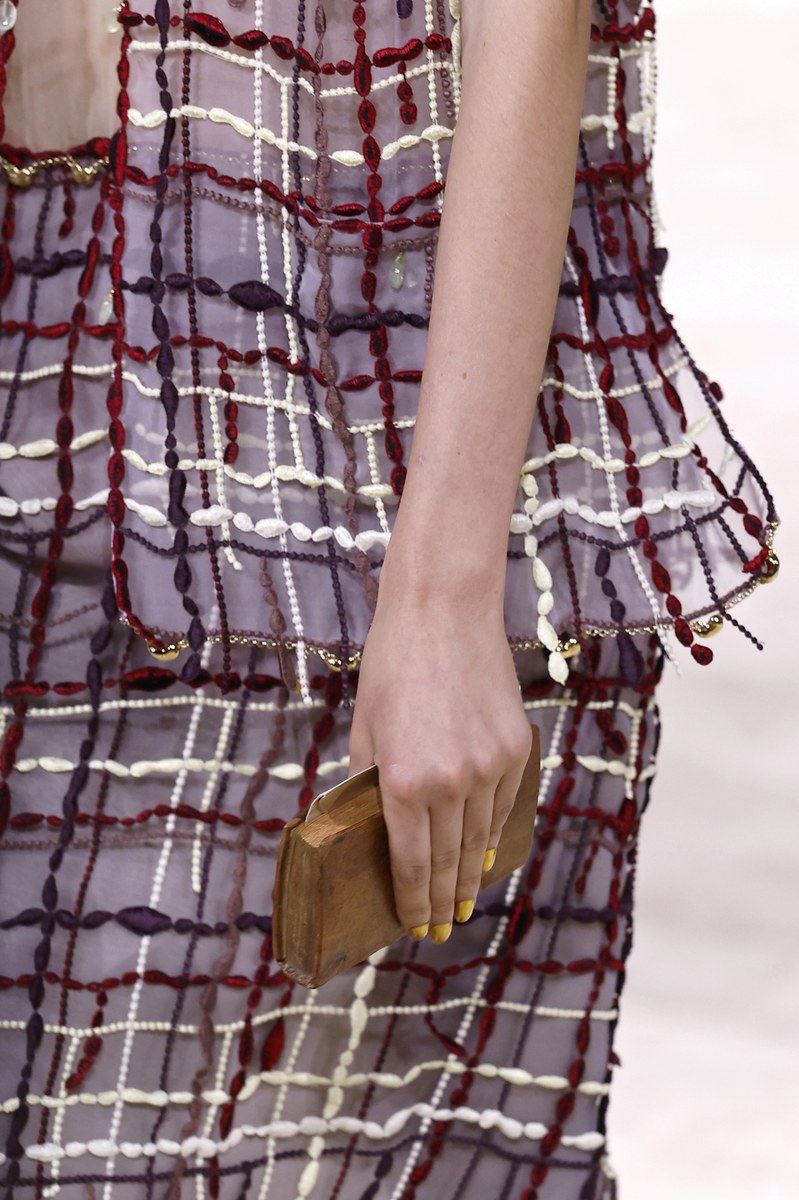
Tweed functions as the structural backbone of the collection, appearing in at least 25 looks across weights ranging from tight boucle in Looks 4 and 22 to loose, fringed open-weave constructions in Looks 69 and 76. Heavy gauge ribbed knit drives Looks 1, 2 and 37, delivering a more casual register that sits closer to sportswear than couture without abandoning the house's precision. Pleated chiffon and fluid crepe carry the dress looks, particularly Looks 5, 8, 47 and 55, where the fabric moves with a deliberate weight that photographs strongly and translates well to retail floor display. Sequin and metallic surfaces arrive in Looks 6, 24, 66, 67 and 74, adding a festive-adjacent tier that rounds out the assortment for holiday and event dressing.
Styling and Layering
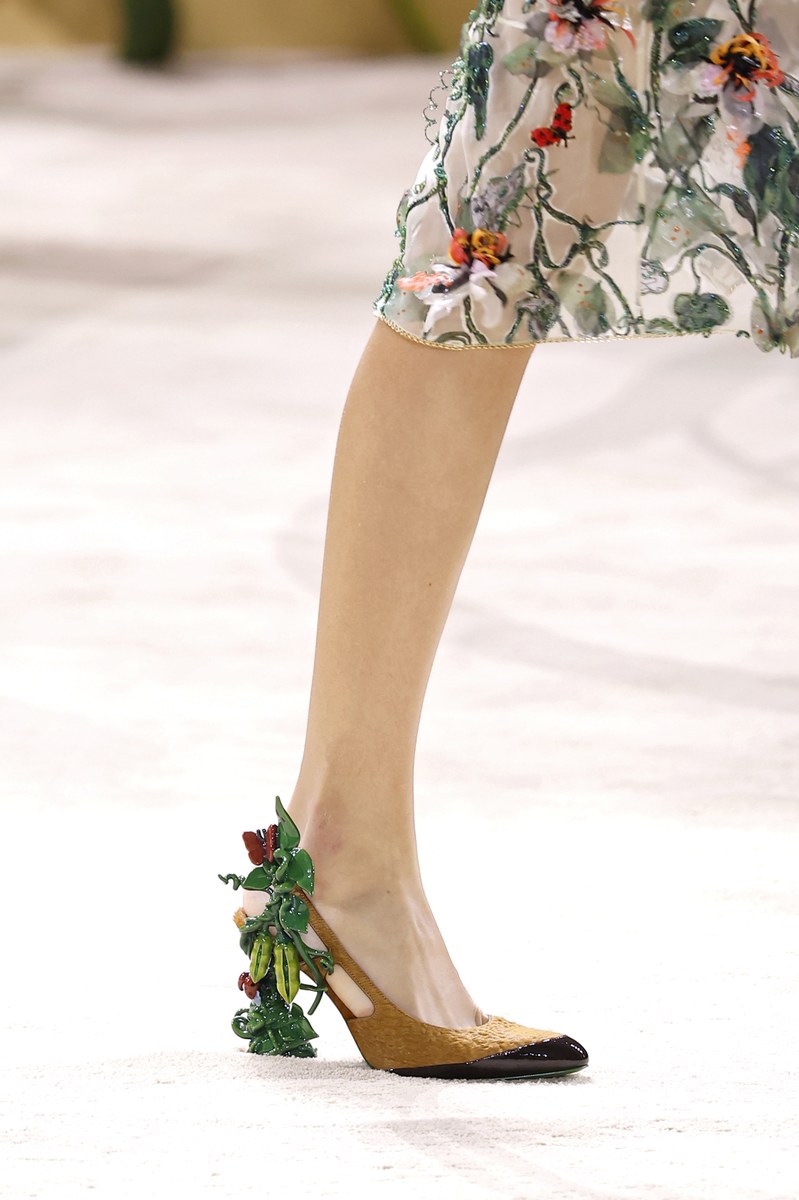
A consistent formula anchors the layering logic: a textured outer layer, either a jacket or coat, sits over a contrasting fabric beneath, a silk blouse, a knit zip-front cardigan, or a sheer printed dress. Look 49 makes this explicit, placing a checked bomber over a ribbed zip cardigan over a fluid black satin skirt, stacking three distinct textures in one outfit. Footwear runs almost entirely on the house's two-tone pointed pump with a white toe cap, which appears across more than 40 looks and functions as the visual signature of the season. Bags shift between the quilted flap in various sizes, a new structured tote visible in Looks 3 and 63, and a handful of miniature novelty formats that serve editorial purposes rather than commercial volume.

Look by Look Highlights
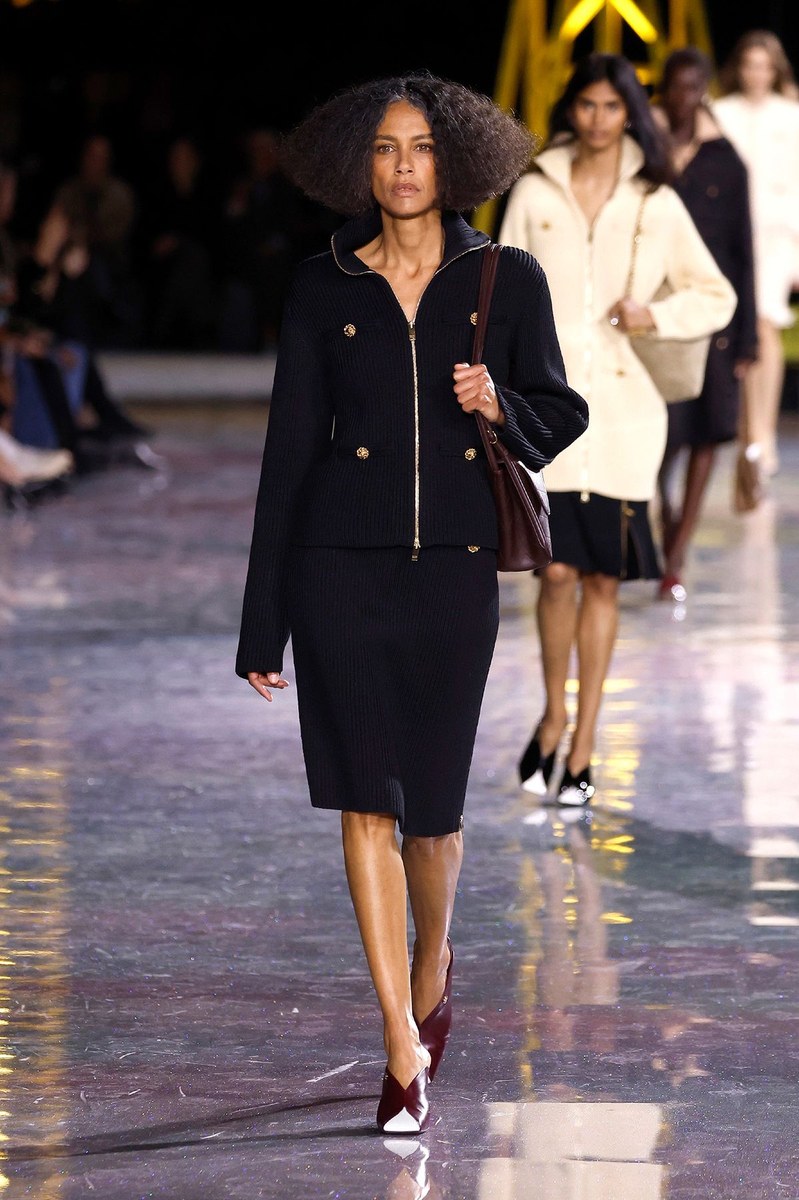
Look 1 Establishes the collection's commercial spine with a black ribbed knit zip jacket and matching pencil skirt, gold lion buttons and a burgundy leather bag, a reorder-ready SKU with strong sell-through potential across core markets.

Look 6 Delivers the highest-impact single look in the opening section, a bronze and copper sequin tweed jacket and skirt with gold chainlink trim over a gold silk blouse, positioned directly for holiday gifting and red-carpet dressing.

Look 12 Pairs a red rose-patterned tweed jacket and skirt with black chainlink trim against a camel silk blouse and a classic black quilted flap, a print-forward tweed unit that gives buyers a high-contrast alternative to plain boucle.
Look 27 Presents a red-and-white plaid tweed belted coat with heavy red fringe trim and a matching fringe bucket bag, a strong editorial piece that functions as a campaign anchor and can drive traffic to lower-priced adjacent items.

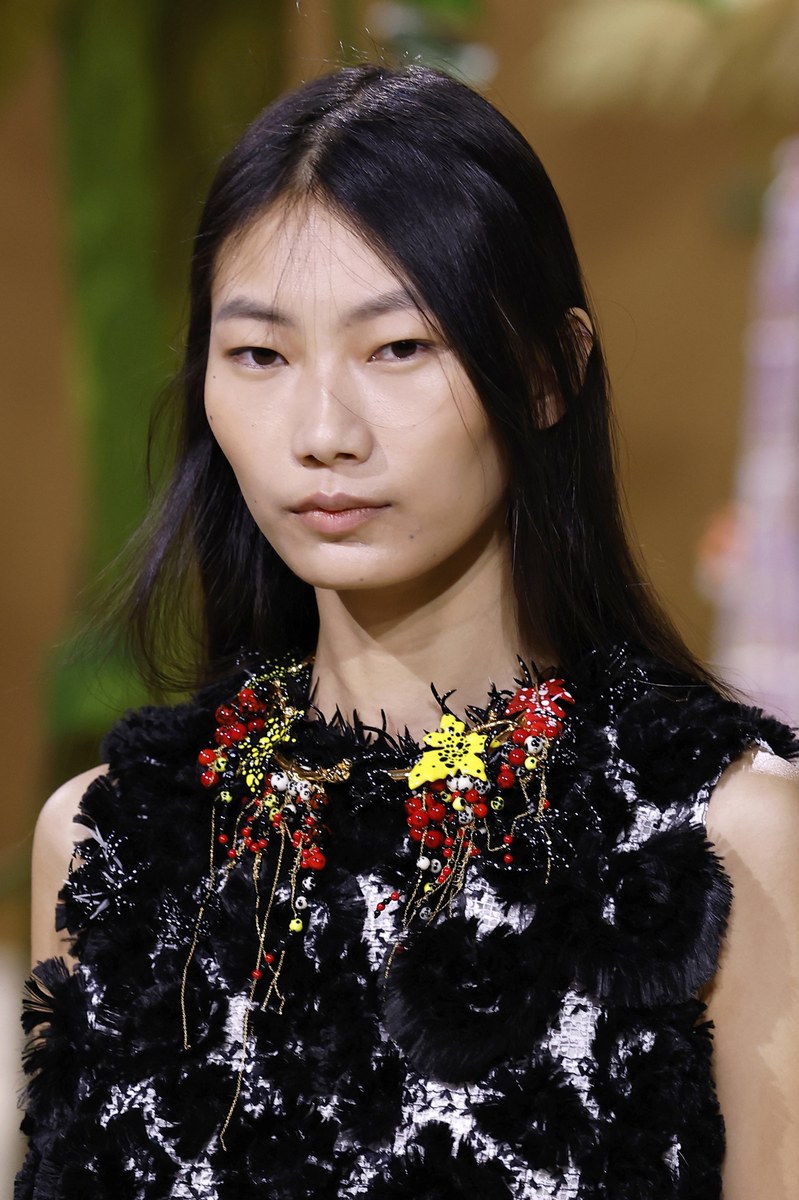
Look 41 Sends out a black-and-white 3D floral appliqué midi dress in an A-line silhouette, the flower clusters covering the full surface, making it the collection's most tactile and production-intensive piece and a direct candidate for trunk show exclusivity.

Look 55 Cuts a black-and-yellow zebra-wave pleated maxi halter dress in a fluid crinkled fabric that moves continuously on the runway, demonstrating that the collection's print language extends beyond tweed into a more youthful, resort-adjacent register.

Look 67 Layers an iridescent green sequin midi skirt with a metallic plaid tweed coat, a sheer embellished blouse and layered crystal necklaces, signaling a maximum-impact evening direction that justifies a separate capsule buy.

Look 78 Closes the collection with a long-sleeve black cowl-neck jersey midi dress in a clean draped silhouette, no embellishment, no layering, a deliberate quiet exit that underlines the breadth of the range from construction-heavy tweed to pared-back knit.

Operational Insights
Tweed SKU depth: The volume and variety of tweed constructions across at least 25 looks, from cropped boucle jackets to belted coats to full-length dusters, means buyers can build a substantial tweed-only capsule buy that covers multiple price points and use occasions without leaving the category.
Two-tone pump as hero accessory: The white-toe-cap pointed pump appears in over 40 looks and functions as the footwear anchor of the season. Shoe buyers and licensing partners should treat this as a high-volume reorder item rather than a fashion statement, as its versatility across both day and evening looks maximizes floor productivity.
Color strategy for regional markets: Black and ivory looks dominate the commercial core and suit conservative markets, while the cobalt, red and acid-yellow pieces in Looks 51 to 55 and beyond are better allocated to markets with higher appetite for color and editorial positioning, allowing regional style directors to tailor their buys without losing brand coherence.
Layering as a multi-unit sell: The consistent three-layer formula throughout the collection, outer jacket or coat, mid-layer blouse or knit, and skirt or trouser, creates a natural basis for outfit-complete selling strategies in-store and online, increasing average transaction value without requiring customers to seek out styling guidance.
Evening capsule viability: Looks 6, 17, 18, 20, 24, 67, 70 and 73 form a coherent evening sub-collection spanning sequin tweed, embellished lingerie-inspired dresses and metallic pleated skirts, sufficient in number and range to support a standalone trunk show or private client event in Q4 without cannibalizing the main floor assortment.
Complete Collection


Fashion Designer

Matthieu Blazy was born in Paris in 1984 to a French father who worked as an expert in pre-Columbian art and a Belgian mother who was a historian and researcher. He grew up between France and Belgium, a position between two cultures he never quite resolved, and was sent to boarding schools after proving a restless student, first to a Marist school in the Ardèche and then to a military academy in England. His childhood hero, as he has said, was Tom Sawyer. As a teenager he rummaged through his family's paper recycling bin for old issues of Harper's Bazaar, Vogue and The Face, teaching himself fashion from discarded magazines. Kate Moss's image was the first thing he ever printed from the family computer.
He almost became an archaeologist, spending time excavating sites in the south of France and visiting the Universidad de Salamanca. His mother eventually redirected him toward La Cambre in Brussels, a liberal arts school where design sat alongside music and art history rather than inside a dedicated fashion curriculum. His graduation collection was inspired by Claudie Haigneré, the first French woman to travel to space. Raf Simons was on the jury and hired him the same day. Blazy began at Simons in 2007, then spent four years at Maison Margiela overseeing the Artisanal collection — work so good that Suzy Menkes broke the house's anonymity policy to identify him publicly. He moved to Celine under Phoebe Philo, then rejoined Simons at Calvin Klein in New York until they were both fired in 2018. He was appointed creative director of Bottega Veneta in 2021, where trompe-l'oeil leather jeans that looked like denim, woven bags named after fish and fruits, and leather sock-slippers turned the house into one of fashion's most watched addresses.
In December 2024 he was named artistic director of Chanel, only the fourth person to hold the role in the house's history. His first haute couture collection debuted in January 2026 at the Grand Palais to wide critical acclaim. He still collects art obsessively, dresses in jeans and a t-shirt, and smokes constantly.
"With Raf, what I loved the most is that anything could be an inspiration. I never felt judged because everything was possible. And then you are happy to explore other fields."
"I said, 'Chanel is modern.' He asked me, 'Do you think Chanel is modern now?' I said, 'I think the pillars are still modern, but we can push it.'"
Sonnet 4.6Estesa
✦ This report was generated with AI — combining human editorial vision with Claude by Anthropic. Because the future of fashion intelligence is already here.