Charlie Costantinou FW26 Women Looks Report

Charlie Costantinou FW26 Women Looks Report
Charlie Costantinou FW26 Women Looks Report

London Fashion Week

Charlie Costantinou FW26 builds a wardrobe around the tension between utilitarian construction and softly ceremonial detail, using military-derived outerwear shells, braided cord hardware and heraldic graphic motifs to dress a body that is always in motion. For buyers navigating a market saturated with post-streetwear basics, this argues that functional silhouettes can carry emotional weight without sacrificing versatility or commercial legibility.

Silhouette and Volume

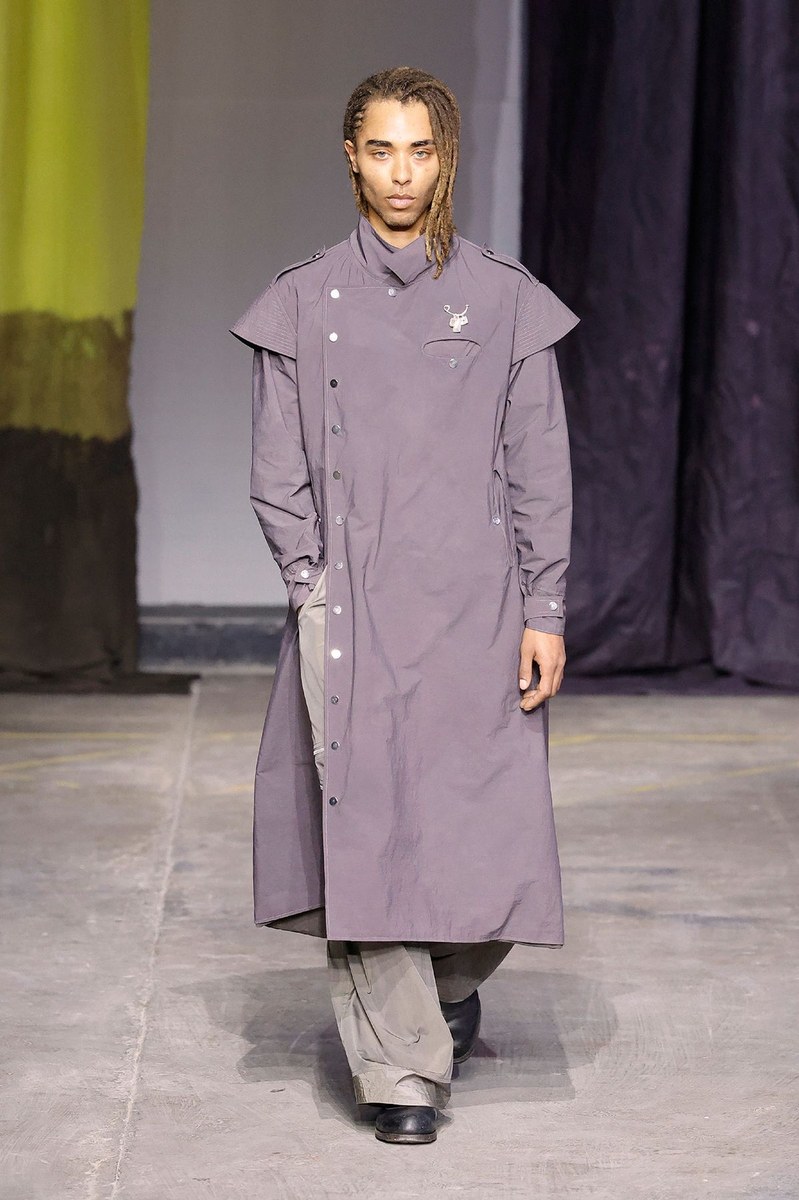
Width at the leg and controlled looseness through the torso define the silhouettes here. Trousers fall wide and long, pooling or grazing the floor across nearly every look, from the pleated grey trousers of Look 2 to the heavily zippered cargo pants of Look 14. Outerwear runs either cropped and structured, as in Look 3 and Look 17, or floor-length and enveloping, as in Look 1 and Look 11. Skirt lengths and hooded knit dresses appear in Looks 5, 7, 9, 13 and 19, softening the silhouette without abandoning the insistence on volume.
Look 2
Look 2

Color Palette

Slate grey dominates as the neutral ground, anchoring Looks 2, 3, 4, 6, 7 and 18. From there, Costantinou moves outward in deliberate steps: sage and dusty teal appear in Looks 10, 11 and 14, then bruised purple in Looks 1, 4 and 17, and finally a clear periwinkle blue in Looks 15 and 16. Metallic silver in Look 9 and near-black in Look 13 serve as punctuation marks. Muted but not austere, this palette photographs well in editorial contexts and translates cleanly to capsule retail environments.

Look 9
Look 9

Materials and Textures

Technical shell fabrics, lightweight but with a slight crinkle and sheen, carry the outerwear and trouser construction throughout, visible in the ripstop-adjacent coats of Looks 1 and 11 and the cargo pants of Look 14. Knit ribbing appears in Look 7 as a full floor-length fitted dress and resurfaces as cuff and hood trim on Look 4, introducing stretch and body-consciousness against the otherwise structured shapes. A laminated or coated woven appears in Look 9 for the wrap skirt, giving it a crumpled foil quality that reads as both sportswear and occasion dressing depending on context. Tweed arrives in Look 19 as a sleeveless field jacket worn over a sheer grey long-sleeve, and it is the only traditional suiting-adjacent fabric in the collection.

Look 14
Look 14

Styling and Layering

Layering is additive and visible. Inner garments are not hidden but allowed to show at hems, cuffs and necklines, as in Look 11 where a raw-edged lining falls below the zip-front coat, and Look 19 where a grey knit shirt extends past the tweed vest. Braided cord straps cross the body in Looks 6, 12 and 15, carrying sculptural bottle-shaped vessels that read as accessories but feel closer to talismans. Footwear divides cleanly between chunky lug-sole hikers and low squared-toe loafers, with no visible heel across the entire collection, reinforcing a grounded, ambulatory logic.

Look 11
Look 11

Look by Look Highlights

Look 1 The slate-purple long trench with storm collar, epaulette tabs and snap closures down the center front is a direct commercial proposition for buyers building outerwear programs around gender-neutral silhouettes.

Look 1
Look 1

Look 5 A white long-sleeve top printed with a grey heraldic crest and snowflake motif pattern, worn with pleated wide-leg grey skirt-trousers, is the collection's clearest entry-level buy for a trend-conscious contemporary customer.

Look 5
Look 5

Look 7 Floor-length ribbed grey knit hooded dress with fitted body and flared hem, worn with only a small ring brooch at the chest, is a high-wearability single-garment investment that works across multiple retail categories.

Look 7
Look 7

Look 9 The silver laminated wrap skirt layered over grey wide-leg trousers, paired with a silver-toned long-sleeve base and a black hijab, is one of the collection's strongest arguments for modular dressing that respects both coverage and material precision.

Look 12 A grey zip-front embroidered sweatshirt layered under a braided cord chest harness and worn with teal multi-pocket wide-leg cargo trousers represents the most complex commercial proposition in the collection, best suited to specialty retailers with a customer already fluent in technical dressing.

Look 12
Look 12

Look 13 Dark brown hooded snap-front cape worn over a soft blue-grey sleeveless midi dress with a chain belt detail is the collection's strongest womenswear moment, pairing two autonomous pieces that each have standalone retail life.

Look 13
Look 13

Look 17 The bright violet cropped military jacket with zip-front construction, layered over a matching violet midi skirt and grey trousers, with a teal braided strap bag, is the collection's boldest color statement and the most directional buy for fashion-forward department store women's floors.

Look 17
Look 17

Look 19 Sleeveless speckled tweed field jacket worn over a sheer grey long-sleeve, with layered brown nylon skirt and grey pleated wide-leg trousers, is the look most suited to a contemporary buyer who wants texture complexity without committing to full outerwear scale.

Look 19
Look 19

Operational Insights

Outerwear architecture: Buyers should prioritize the long snap-front trench silhouette (Look 1) and the floor-length quilted zip coat (Look 11) as hero SKUs. Both are cut with enough volume to work across a wide size range without grading complications.

Modular separates strategy: The trouser program, spanning cargo, pleated, pintuck and printed iterations, can be bought and merchandised independently of the tops and outerwear, giving product managers flexibility to build assortments at different price tiers.

Accessory opportunity: Braided cord crossbody straps with attached vessel objects appear in Looks 6, 9, 15 and 17 and function as the collection's signature accessory. Style directors should treat these as a limited-run accent buy rather than a volume piece.

Color sequencing for retail: The grey-to-teal-to-blue-to-purple color arc running through the collection suits a phased drop strategy well, with the neutral grey and sage pieces dropping first to build the base and the violet and purple pieces arriving as a mid-season color injection.

Graphic print extraction: The heraldic crest and botanical star motif used on Look 5 and Look 8 has strong potential as a licensed or repeatable graphic element across a broader product range, including knitwear, bags and accessories, for brands with in-house print licensing capability.

Complete Collection

Look 3
Look 3
Look 4
Look 4
Look 6
Look 6
Look 8
Look 8
Look 10
Look 10
Look 15
Look 15
Look 16
Look 16
Look 18
Look 18
Look 20
Look 20
Look 21
Look 21
Look 22
Look 22
Look 23
Look 23
Look 24
Look 24
Look 25
Look 25
Look 26
Look 26
Look 27
Look 27
Look 28
Look 28
Look 29
Look 29
Look 30
Look 30

About the Designer

Charlie Constantinou grew up in North London within a tight-knit Cypriot family, surrounded by the diverse cultural communities that define the area. His path to fashion began unexpectedly through music. He trained in piano from age 11 and planned to study film composition until a part-time job at a sneaker store at 16 shifted his trajectory entirely. The world of footwear led him into streetwear, and by his A-levels, he was discovering brands like Undercover, Issey Miyake, and Margiela. At 18, he made a portfolio of sketches and secured a place on a fashion degree through clearing, despite having no technical experience with garments.

His education at Central Saint Martins proved transformational. Despite arriving knowing so little that he had to ask how to thread a sewing machine on his first day, he caught up with more experienced classmates within two years through sheer determination. Graduating with an MA in fashion design in 2022 at age 24, he immediately won the International Talent Support Contest and became an LVMH Prize semifinalist in 2023. His work draws from an eclectic mix of ancient history, Cypriot heritage, Iceland's landscapes, manga, film scores, and cinema, all filtered through his obsession with functionality and adaptation.

At the core of Constantinou's aesthetic lies a philosophy of transformation and purpose. His adjustable garments, from zip trousers that can be worn five different ways to expandable quilted pieces, challenge fashion's culture of constant consumption. He works exclusively with deadstock fabrics, hand-dyeing pieces to create unique colorways that ensure no two garments are identical. His collections blend technical innovation with historical references, from medieval armor to military uniforms, always asking how historical elements can serve contemporary needs. Operating from his North London studio, he continues to build his brand while collaborating with companies like 66°North and creating custom pieces for artists like Central Cee.

"I got to a point where I stopped buying clothes and I started making everything myself, and then making things for friends. I made a portfolio of sketches when I was 18 and I got into a small university and I had to learn everything from scratch." Speaking about his approach to design philosophy, he adds, "Functionality in general comes from the idea that something can have more than just one use."

✦ This report was generated with AI — combining human editorial vision with Claude by Anthropic. Because the future of fashion intelligence is already here.