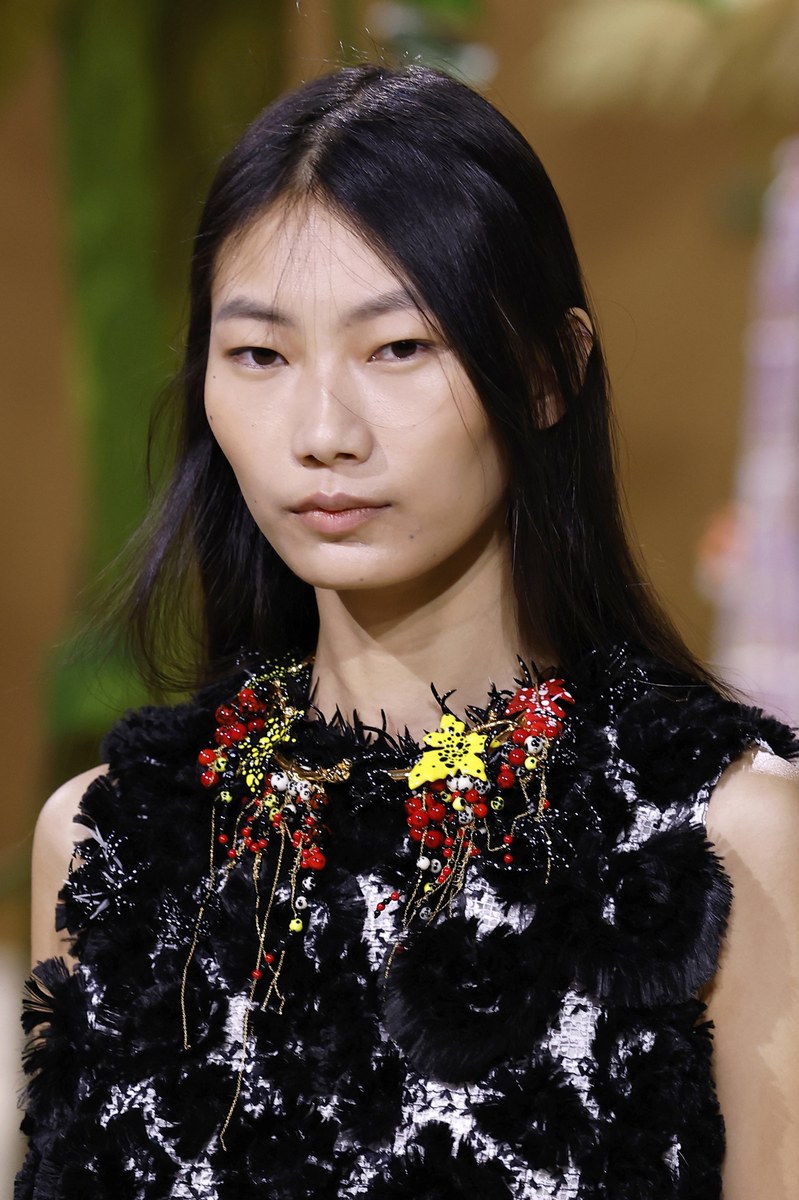
Chet Lo FW26 Women Looks Report

Chet Lo FW26 Women Looks Report
Chet Lo FW26 Women Looks Report

London Fashion Week

Chet Lo FW26 builds a visual language around the textures of sea creatures and spiked organic forms, translated through the designer's signature smocked and spined fabrications into garments that oscillate between sculptural armor and second skin. Buyers are actively seeking statement pieces with a strong cultural identity and a defined construction vocabulary that can anchor a retail assortment, and this collection arrives at precisely that moment.

Silhouette and Volume

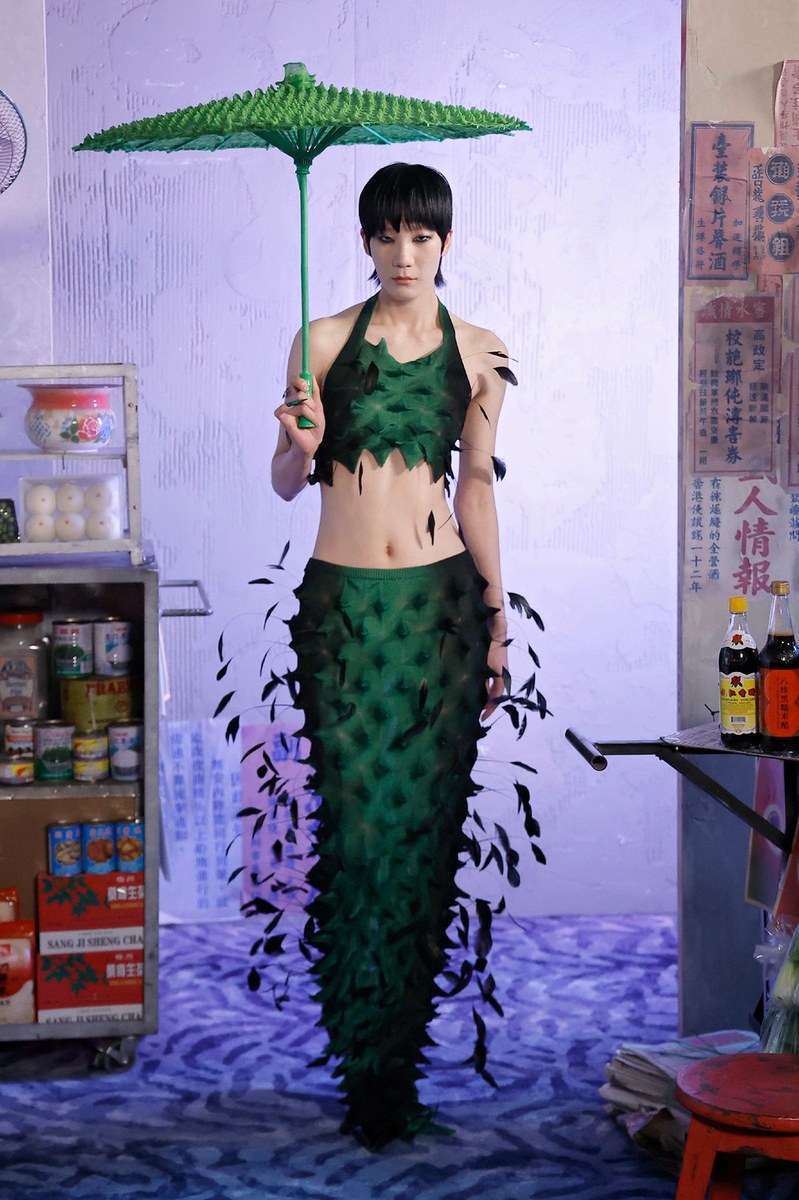
Two opposing forces shape the collection. Column-slim, floor-length dresses cling to the body with almost no ease, while voluminous layered torso pieces expand aggressively from the shoulders and chest as the lower body stays narrow. Look 9 pushes this contrast to its extreme: a spined red hooded top that consumes the upper body entirely, paired with flat black satin trousers underneath. Look 1 introduces the mermaid logic early through a strapless green column that widens at the hem via cascading feather and spike appliqué. Menswear silhouettes in Looks 2, 4 and 8 run wide-leg and oversized yet read as controlled, anchored by structured outerwear.
Look 9
Look 9

Color Palette

Two opposing color territories dominate, occasionally colliding. Black is the dominant ground across knit, satin, organza and mesh in Looks 2, 5, 6, 7, 8, 11 and 13. Against this sits a saturated vermilion red threading through Looks 3, 4, 9, 10 and 12, ranging from brick-orange at its lightest to near-burgundy at the base of the ombre jumpsuit in Look 10. Deep forest green in Look 1 breaks both directions, standing alone as the collection's single cool-spectrum moment and reading as the most immediately commercial outlier for buyers targeting novelty.

Look 10
Look 10

Materials and Textures

The signature spined smocking appears in at least eight looks. This heat-formed technique creates raised bubble or spike nodes across stretch fabric and is clearly the collection's proprietary material signature. Look 3 and Look 10 both showcase it in full garment coverage, demonstrating its range from a rigid, almost crustacean surface at the torso to a softer, compressed texture at the legs where the fabric relaxes. Sheer mesh and organza run through Looks 5, 12 and 13, giving the collection its transparency layer and contrasting the weight of the spined pieces. Black satin in wide-leg trouser form grounds Looks 2, 7 and 11, adding a fluid, light-reflective surface that keeps the heavier textures from reading as costume.

Look 3
Look 3

Styling and Layering

Accessories do structural work across the collection. Parasols in Looks 1, 5 and 10 are covered in the same spined or smocked material as the garments, making them coordinated objects rather than afterthoughts and functioning as a direct retail extension opportunity. Long black leather gloves recur in Looks 5, 7, 8 and 10, adding a sleek elongating element that balances the volumetric upper-body pieces. Footwear stays minimal throughout: pointed black pumps on the women and black dress boots on the men ensure the fabrication and silhouette carry the full visual load. Dramatic black quill spines appear in Looks 2, 3 and 7, while feather-and-spike fascinators crown Look 12, signaling a complete head-to-toe world that press and editorial will respond to, though they are unlikely to translate directly into commercial orders.

Look 12
Look 12

Look by Look Highlights

Look 1 The forest green spined halter and matching skirt with cascading black feather appliqué and coordinated parasol is the clearest full-look commercial package in the collection, with three separable SKUs in one image.

Look 1
Look 1

Look 3 The brick-red full-length spined column dress with feather quill headpiece is the strongest single-garment statement piece, with the texture density and color saturation to perform as a lead visual in editorial and buy-now retail.

Look 5 The black sheer smocked catsuit with alternating mesh and bubble panels, paired with long gloves and the spined parasol, reads as a precision lingerie-adjacent evening look that could convert for a luxury nightwear or occasion buyer.

Look 5
Look 5

Look 6 The charcoal satin-lapel blazer with spined shoulder epaulettes and matching cropped trousers is the most wearable tailoring moment in the collection, translating the texture vocabulary into a format that a contemporary luxury retailer can actually stock.

Look 6
Look 6

Look 10 The red-to-black ombre full-body smocked jumpsuit with matching spined parasol demonstrates the fabrication's range across a full silhouette and makes the strongest argument for the material as a knit-category investment for production teams.

Look 12 The orange-red sheer halterneck qipao-collared column dress is the most direct reference to Chinese dress heritage in the collection, and its sheer construction over a visible red bodysuit gives it a deliberate provocation that will drive press coverage and selective buyer interest.

Look 13 The black semi-sheer long-sleeved column dress with scattered black feather appliqué dispersed asymmetrically across the fabric sits at the accessible end of the collection's drama scale and represents the lowest-risk entry point for a multi-brand buyer testing the designer.

Look 13
Look 13

Look 9 The red spined hooded top with black feathers erupting from its surface is a runway spectacle piece rather than a commercial one, but it anchors the collection's creative premise and justifies the price architecture for everything around it.

Operational Insights

Proprietary texture as a brand moat: The spined and smocked fabrication defining this collection is Chet Lo's clearest commercial differentiator. Understand that this technique carries significant production complexity and likely requires the designer's dedicated manufacturing relationships. Lead times and MOQ conversations need to start early.

Parasol as a product category: The coordinated spined and smocked parasols in Looks 1, 5 and 10 are not styling props but fully realized accessories made in the same fabrication as the garments. Request them as standalone SKUs, as they carry strong editorial value and a price point that sits above accessories but below ready-to-wear.

Red and black as the buying core: Every commercial look in this collection resolves in either black or vermilion red. Prioritize these two color directions when building an assortment and treat the forest green of Look 1 as a limited-availability statement rather than a repeatable colorway.

Menswear crossover potential: Looks 2, 4, 8 and 11 all carry elements, spined outerwear, satin trousers, mesh crop tops, that are currently trafficking between menswear and womenswear retail. Style directors at gender-neutral or contemporary menswear accounts should flag these looks as priority conversation pieces.

Occasion and evening positioning: The sheer column dresses in Looks 5, 12 and 13 and the tailoring in Look 6 give the collection enough occasion-ready range to position Chet Lo outside pure concept retail. Request fabric composition and care label details on these specific looks before committing to orders, as sheer and smocked fabrications often carry dry-clean-only constraints that affect sell-through in certain markets.

Complete Collection

Look 2
Look 2
Look 4
Look 4
Look 7
Look 7
Look 8
Look 8
Look 11
Look 11
Look 14
Look 14

About the Designer

Growing up between New York City and a Hong Kong heritage, Chet Lo understood early the complexities of navigating Asian-American identity. His family's roots in Hong Kong meant learning to balance Eastern traditions with Western upbringing, though his path to fashion began not through childhood dreams but circumstance. After high school, he made the practical choice to study at Central Saint Martins in London, drawn as much by the school's prestige and relative affordability compared to New York institutions as by creative ambition. What started as pragmatism became passion when he discovered knitwear during his foundation course in 2015.

Before launching his eponymous label, Lo earned his credentials through internships at Proenza Schouler and Maison Margiela, where he worked under John Galliano. These experiences taught him the mechanics of collection development, but it was unemployment after graduation during the pandemic that forced his hand. Unable to find work, he launched his brand out of necessity to pay rent. His signature spiky knitwear emerged from a university technique he had mastered, combining mathematical precision with his most challenging yarn choices. The result caught attention quickly, leading to celebrity placements and his acceptance into Fashion East's incubator program.

Lo draws from Japanese comics, 1950s aesthetics, and Barbarella to create what he calls retro-futuristic designs. His technical approach treats knitwear as sculpture, using nylon yarns to create spike textures he has compared to durian fruit. Buddhist upbringing influences his collections, while his mother Mai-Wah Cheung, a computer science pioneer, serves as both muse and inspiration. His brand operates as an extension of his identity, with sustainability and community building what he describes as a family environment in his London studio.

"I love the craft of what I do," Lo reflects. When discussing his mission, he adds: "I didn't want to hide who I was, that wasn't my mission. My mission has always been to design things that I like, and just create a mood."

✦ This report was generated with AI — combining human editorial vision with Claude by Anthropic. Because the future of fashion intelligence is already here.