Coach FW26 Shoes
Coach FW26 Shoes Report
Coach FW26 plants its footwear identity firmly in deliberate destruction, presenting a low-profile canvas and leather sneaker silhouette treated to aggressive distressing, raw-edge detailing, and intentional wear simulation across every colorway. For buyers and product managers, this signals a direct commercial challenge to Golden Goose's stranglehold on the premium distressed sneaker category, and Coach is now competing with brand equity, price architecture, and runway credibility behind it.
Silhouettes and Construction
One silhouette carries nearly the entire collection: a low-to-mid cut lace-up sneaker with a flat, cupsole-style rubber sole measuring approximately 25 to 30mm underfoot and a slightly squared, rounded toe. A subset of styles, visible in Shoes 3, 4, 5, 15, and 16, cuts higher at the ankle, sitting just above the ankle bone in a low-top-to-mid hybrid height. Visible stitching at the toe box and lateral panels appears intentionally distressed post-construction across all styles, which seem to employ vulcanized or cup-sole bonding. Utilitarian is the dominant read here, referencing 1980s and 1990s skate and basketball training silhouettes stripped back to their most essential geometry.
Materials and Finishes
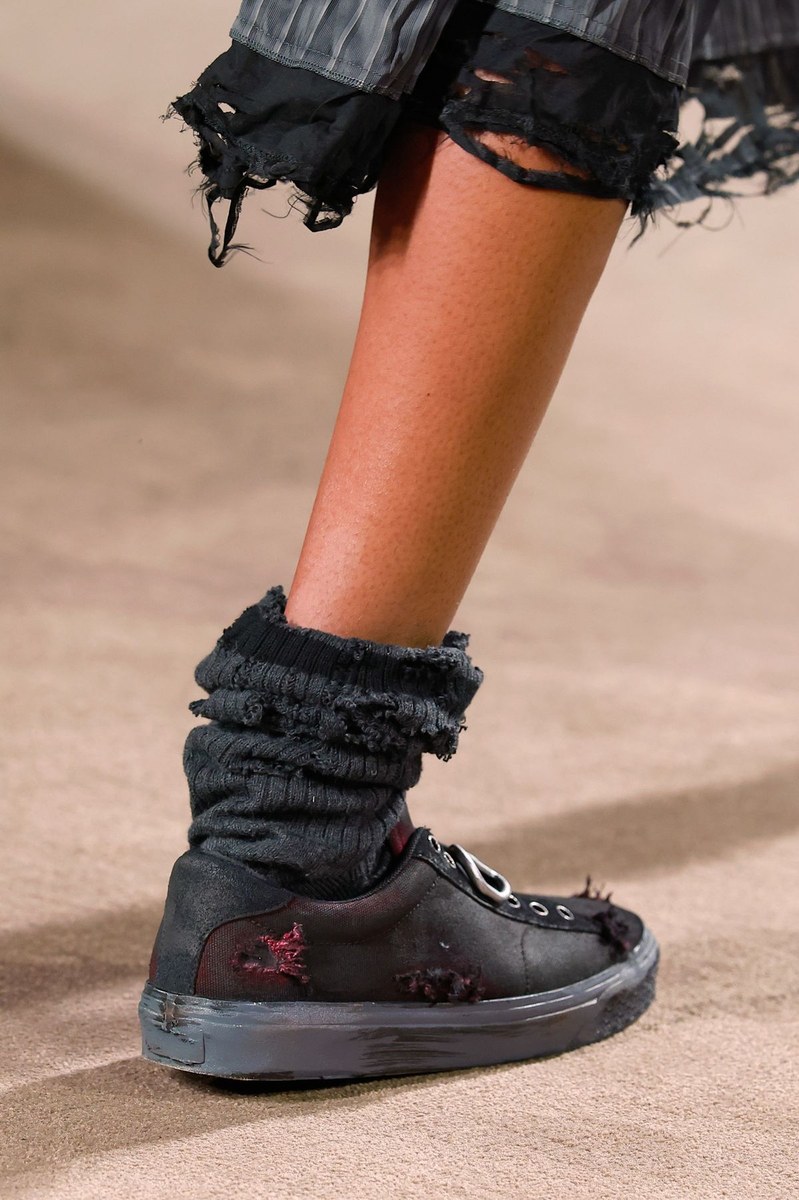
Coated canvas and smooth leather or leather-effect panels alternate as the primary upper material, with suede overlays appearing on the toe box and heel counter in several dark styles including Shoes 9, 10, and 11. Scuffs, paint-bleed effects, fraying at seams, and pulled threads at the toe and lateral wall are applied across the uppers as a finishing treatment rather than incidental wear. Hardware functions as both structural fastening and primary decorative anchor: a silver or antiqued brass D-ring closure sits at the vamp on almost every style, threaded through eyelets. Molded rubber outsoles in tonal colorways, either all-black or off-white, feature a flat profile and minimal tread texture visible from the side.
Color Direction
Nine of the seventeen looks run in black, ranging from true black with tonal black soles in Shoes 4, 14, and 15 to near-black with burgundy or dark green bleed-through distressing in Shoes 9, 10, and 11. Cobalt blue enters as a primary upper color in Shoes 8, 12, and 17, while red appears as a primary in Shoe 13 and as a panel accent in Shoe 12. Saturated magenta or hot pink upper in Shoe 7 stands apart, functioning as the collection's maximum-contrast commercial hook. Archive sportswear filtered through a goth and punk sensibility describes the palette, with the brighter colorways serving as the commercial entry point for a broader consumer.
Key Models and Details
Two distinct models span the collection. A low-cut slip-on style with D-ring hardware and minimal lacing appears most clearly in Shoes 7, 8, 12, 13, and 17, featuring a white rubber cupsole and a cleaner, less distressed surface treatment. Mid-cut lace-ups with deeper distressing, darker sole units, and more aggressive fraying at the upper edges define Shoes 3, 4, 5, 9, 10, 14, 15, and 16. Debossed or printed patch labels sit at the lateral ankle or tongue, visible on Shoes 5 and 6, keeping logo presence restrained and positioned toward heritage authentication rather than logomania. Between silver-tone in the darker styles and antiqued brass in the lighter and brighter colorways, D-ring hardware shows deliberate tonal calibration that signals two distinct consumer moods within the same model architecture.
Shoe by Shoe Highlights
Shoe 1 Low-cut black leather sneaker with burgundy distress bleeding through the toe box and lateral wall, no D-ring visible, making it the most pared-back entry in the assortment and the easiest wholesale open-to-buy decision.

Shoe 5 Mid-cut black canvas style with the Coach patch label clearly placed at the lateral ankle, a silver D-ring at the vamp, and a translucent or charcoal sole, representing the most brand-legible unit in the dark portion of the range.

Shoe 7 Hot pink satin or coated canvas low-top with animal print distress detailing, white rubber cupsole, antiqued brass D-ring, and frayed white and yellow layered socks styling, the single loudest SKU in the collection and the most likely candidate for editorial and influencer seeding.

Shoe 11 Dark forest green with teal bleed-through distressing on a black base upper, silver D-ring hardware, and a near-invisible sole, a colorway that reads as directional for fall green trend buying without straying into costume territory.

Shoe 12 Blue, red, and tan patchwork low-top with a white cupsole, antiqued D-ring, and multicolor paneling that references 1990s American sportswear color-blocking, making it a strong candidate for the collector and sneaker-culture adjacent buyer.

Shoe 13 All-red low-top with white stitching contrast, antiqued brass D-ring, and a white rubber sole that grounds the intensity of the red upper, a clean buy for buyers who need a statement color with crossover potential into the general sportswear floor.

Shoe 17 White and blue low-mid with a blue heel counter, white canvas body, gold D-ring, and heavy toe-box distressing, a colorway that reads as the most accessible and commercially safe interpretation of the collection's destructed aesthetic.

Shoe 16 Black canvas mid with gray-toned layered distressed socks and visible Coach patch on the lateral panel, with fraying along the vamp seam and a matte black sole, a production-intensive style that will likely carry a higher wholesale price point and anchor the top of the dark-palette range.

Operational Insights
D-ring hardware sourcing: Nearly every style features a D-ring closure in both silver and antiqued brass variants, making consistent hardware sourcing a production priority. Confirm minimum order quantities and lead times for both metal finishes before committing to the full range.
Distressing as a manufacturing cost driver: Multiple finishing passes including abrasion, paint application, and seam pulling characterize surface distressing across styles like Shoes 9, 10, and 16, each adding labor cost and quality control complexity. Request a detailed finishing specification sheet from product managers to assess per-unit cost variance between the lightly distressed and heavily distressed SKUs.
Colorway tiering for open-to-buy planning: Black core styles maximize floor penetration, blue and red styles address seasonal color buys, and hot pink and patchwork styles suit capsule or limited-floor placement. Structure initial orders around this tiering to reduce markdown risk.
Sock styling as a visual merchandising directive: Heavily layered, distressed, and cuffed socks pair with every look, positioning them as part of the product story Coach is telling. Treat socks as a coordinating SKU and plan co-placement on the floor or in digital editorial.
Sole unit consistency across models: Both the low-cut and mid-cut models appear to share the same cupsole construction and rubber compound, creating favorable tooling economics if Coach manufactures both on a shared last. Use this shared construction as leverage when negotiating volume pricing and tiered cost structures with the brand.
More Shoes
More Shoes
More Shoes


✦ This report was generated with AI — combining human editorial vision with Claude by Anthropic. Because the future of fashion intelligence is already here.