Comme des Garçons FW26 Women Looks Report
Paris Fashion Week
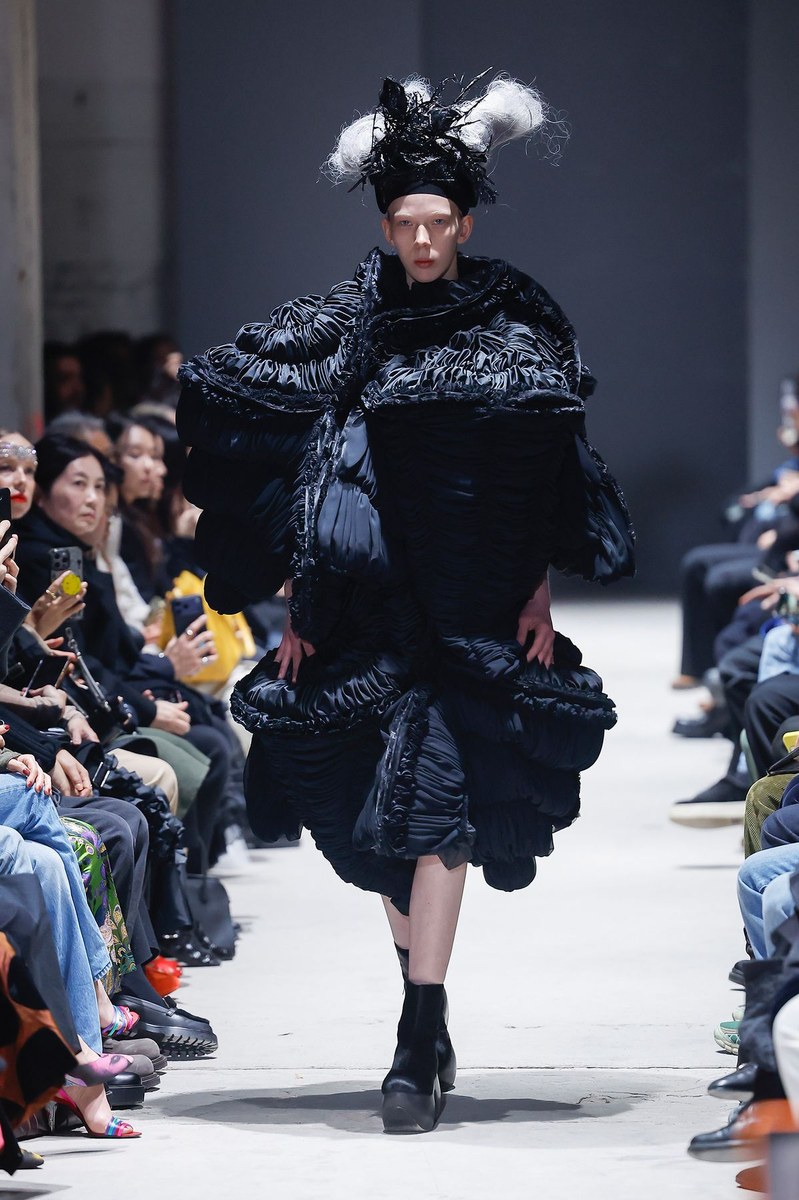
Rei Kawakubo builds a collection around the collision of organic mass and constructed armor, pushing volume so far beyond the body that the garment becomes its own architecture. For buyers and style directors navigating a market saturated with minimalism fatigue, this collection signals a hard turn toward sculptural maximalism with clear commercial anchors in fabrication and color.
Silhouette and Volume
Two distinct silhouette registers drive the collection. Extreme radial volume appears in Looks 1, 15, and 16, where quilted, inflated forms balloon outward from the shoulder and torso, extending the body's footprint to nearly double its natural width. Columnar compression shows up in Looks 2, 23, and 26, with the body wrapped tightly in layered textiles that read as vertical mass rather than horizontal spread. Both registers share one constant: the waist disappears entirely, and the body becomes a support structure rather than a focal point.
Color Palette
Black dominates the opening and closing sequences. A blue-black with cool, slightly matte undertones recurs across Looks 1 through 16 and again from Look 22 onward. Looks 17 through 21 break hard into saturated bubblegum pink, close to Pantone 812 C, with no mixing or gradation in sight. Red punctuation appears at the belt in Look 12 and the waist sash in Look 21. A single green satin belt in Look 13 works the same way: one vivid accent against an otherwise monochromatic body. Restraint like this makes those accent colors read as intentional system, not decoration.

Materials and Textures
Quilted nylon with a high-sheen surface dominates the black section, manipulated into ruching, smocking, and gathered rope-like coils that hold their three-dimensional shape independently of any internal boning. Look 4 and Look 24 introduce a heavyweight crinkle-jacquard with a crushed metallic lace overlay, giving those looks a denser, more architectural gravity than the lighter quilted pieces. Look 26 works with what reads as long-strand fringe or shredded organza layered over a base, creating soft, feather-like movement that contrasts the rigidity elsewhere. Pleated satin and gathered duchess-weight silk take over in Looks 17 through 21, both catching light differently at each stride and adding kinetic energy to silhouettes that might otherwise read as static.

Styling and Layering
Every look pairs with a low-heeled black ankle boot in a square-toe last, consistent across all 26 looks without exception, grounding the most extreme volumes in a deliberately unglamorous foundation. Head pieces carry as much design weight as the garments themselves. Wire-and-feather sculptural forms, densely felted wool masses, wide-brimmed hat structures draped in fraying textile, extend the vertical or horizontal silhouette of the garment beneath in every case. Layering logic in the middle looks, particularly Looks 9, 10, and 11, places a more fitted printed or structured underlayer beneath a looser, volumetric outer piece, giving those looks a legible duality that translates more directly to retail than the fully abstract silhouettes at either end of the show.
Look by Look Highlights
Look 1 Sets the template with quilted black nylon gathered into rope-like coils across the entire body surface, establishing ruched-rope construction as a primary technique a buyer should track for exclusivity conversations.

Look 6 Deploys gray-and-black padded panels shaped into scalloped, almost crustacean-like forms over a black velvet bodice and sheer skirt. Hard-soft material contrast reads strongest here, and the look stands as a strong candidate for editorial placement.

Look 8 Uses a sheer black organza tent silhouette over a dense padded inner structure to create a lantern shape that reads as wearable sculpture. Specialty retailers with an art-adjacent customer should take note.

Look 12 Breaks the all-black surface with a glossy red patent belt worn over a densely appliquéd black fabric coat. This is the single look most likely to photograph as a standalone product shot for campaign use.

Look 13 Wraps the body in deeply gathered black parachute-weight nylon cinched by a single emerald green satin belt. The most commercially accessible silhouette in the black section and the one most adaptable to a modified production version.

Look 17 Opens the pink sequence with a full-length column of pleated pink satin layered with ruffled borders at every horizontal seam. A direct signal that CdG is reclaiming pink as a structural rather than decorative color.

Look 19 Presents a tightly ruched blush-to-white ombre column dress that reads almost bridal against the louder pink volumes on either side of it. Relative restraint here gives it the strongest standalone commercial potential in the entire collection.

Look 25 Returns to black with a multi-tiered gathered nylon cape over a tulle underskirt, worn under a wide-brimmed shredded-textile hat. Functions as a closing argument for the collection's core thesis: that volume, texture, and headwear operate as a single unified design object.

Operational Insights
Fabrication lead times: Quilted and ruched nylon constructions in Looks 1, 2, 14, 15, and 16 require specialized pleating and smocking machinery not available at general CMT factories. Buyers commissioning interpretation pieces should build a minimum 18-week production window and confirm vendor capability before line adoption.
Color story sequencing: The hard split between black and pink, with no transitional neutrals, makes this collection difficult to buy as a cohesive floor set. Style directors should treat the black and pink groups as two separate capsules with distinct customer profiles and price positioning rather than a single seasonal narrative.
Headwear as a revenue category: Sculptural head pieces read as collectible objects, not styling props. Product managers with access to millinery production should evaluate limited-edition headwear drops tied to key looks as a high-margin adjacent category with strong editorial pull.
Accent color strategy: The red belt in Look 12 and the green belt in Look 13 perform outsized visual work against monochromatic garments. Buyers sourcing separates should note that a single saturated accessory against an all-black ground is a repeatable formula this customer responds to, and stock planning for belts and sashes should reflect that.
Volume calibration for retail: Looks 9, 10, 13, and 19 represent the closest the collection comes to wearable proportion. For buyers without a strictly avant-garde customer, these four looks are the entry point. They carry the collection's material and construction DNA without the extreme silhouette scale that limits sell-through outside major urban and specialty markets.
Complete Collection


✦ This report was generated with AI — combining human editorial vision with Claude by Anthropic. Because the future of fashion intelligence is already here.