Cult Gaia FW26 Details
Cult Gaia FW26 Details Report
Cult Gaia FW26 anchors itself in tactile construction and material plurality, moving between handcrafted bead-work, structural pleating, and architectural textile manipulation with deliberate range. Buyers and product managers should note the collection's commitment to artisanal fabrication methods that translate directly into high-margin statement pieces with strong visual retail presence.
Category Overview
Two categories anchor this collection: Dress Details and Headwear. Dress Details carry the heavier commercial weight, spanning woven textile, bead-assembled constructions, chain-linked panels, embroidered surfaces, and precision pleating, each communicating a distinct production story. Headwear appears in a tightly edited deep-crimson leather beret format across Details 10 and 11, plus a bridal tulle veil in Detail 12, signaling that the brand treats head styling as a punctuation mark rather than a primary category driver. Material storytelling emerges as the accessories strategy here, where each construction method justifies its own price architecture.
Material and Construction
Beaded construction dominates a significant portion of the collection. Details 2, 3, and 4 all deploy large oval and tubular resin or glass beads threaded into grid and radial formations, with red bugle beads acting as structural separators between rows. Detail 5 replaces organic materials entirely with rectangular metallic leather or lacquered textile panels connected by gold-tone jump rings, borrowing directly from chainmail logic. Pleated and pressed textile drives Details 1 and 9, where the fabric itself is manipulated into radiating or spiraling three-dimensional forms without applied embellishment.

Color and Finish Direction
Deep olive and warm grass green anchor Details 1 and 9, with the black spiral of Detail 9 providing the darkest point in the palette. Warm amber, honey, cream, and burgundy tones characterize the bead-work pieces, a palette that reads simultaneously as autumnal and archival. Acid chartreuse appears in Detail 8, introducing a sharp contemporary contrast against the earthier tones. Bridal white in Details 7 and 12 and the cobalt and sky-blue blocked panels of Detail 5 round the palette toward clarity and brightness, suggesting the collection intentionally spans a wide commercial color story rather than committing to a single seasonal tone.

Key Pieces and Details
Detail 3 stands out as the collection's most commercially ambitious piece, a full beaded breastplate constructed in a mandala-like radial formation using amber, burgundy, green, and blush resin beads, worn as a standalone top. Its construction implies significant hand labor hours and positions it squarely as a collector or special-occasion buy. Detail 9, with its black pleated spiral disc extending from one shoulder, is the strongest editorial piece and the most likely to drive wholesale conversation with luxury department store buyers. Detail 5's chainmail-logic dress in two-tone blue metallic panels with gold jump-ring hardware addresses a customer who wants tactile drama without organic or artisanal references.

Detail by Detail Highlights
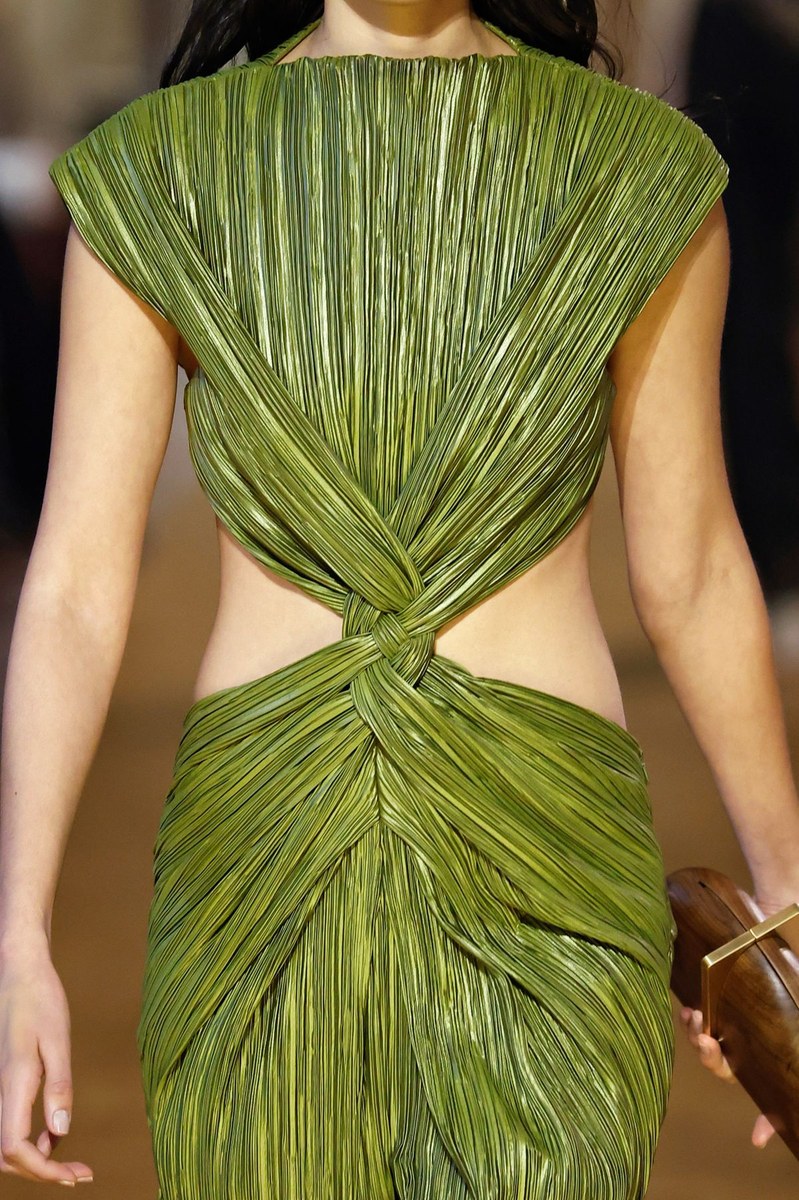
Detail 1 (Dress Detail) The olive-green back of this gown pulls all pleated fabric into a central knot at the lumbar, creating a cutout waist with a braided anchor point that functions as both structural closure and sculptural focal element.

Detail 2 (Dress Detail) A micro-mini skirt built entirely from horizontal rows of amber, burgundy, and pale blush beads terminates in a fringe of dangling bugle and oval beads that swing with movement, paired with a brown leather vest for deliberate tonal contrast.

Detail 3 (Dress Detail) Large oval resin beads arrange themselves in a concentric, mandala-like radial grid anchored at the sternum, with red bugle beads acting as dividing lines between each sector, worn with a matching bead-strand necklace.
Detail 5 (Dress Detail) Rectangular panels of cobalt and pale-blue metallic textile connect via small gold jump rings in a chainmail grid to form a tank-style mini dress, with the bottom row left as loose hanging tabs.
Detail 7 (Dress Detail) An ivory strapless bridal dress uses horizontal micro-pleating across the entire body, then releases into four large sculptural petal-like folds at the hip, paired with a sheer tulle veil that extends well below frame.

Detail 9 (Dress Detail) A black pleated textile gown grows a single large spiral disc from the left shoulder, the disc constructed from tightly packed vertical pleats arranged in concentric rings that reference a nautilus shell cross-section.
Detail 10 (Headwear) A structured deep-crimson leather beret sits close to the crown with a raised front panel and soft gathered back, worn with long dangling earrings strung with red, amber, and green oval beads.

Detail 12 (Headwear) A sheer ivory tulle veil drapes directly over the head without a comb or crown anchor, worn with large white fabric and pearl-cluster flower earrings at each ear, keeping the bridal styling deliberately minimal.
Operational Insights
Beadwork sourcing: Details 2, 3, and 4 rely on consistent access to large-format oval resin beads in amber, honey, and blush tones alongside uniform burgundy bugle beads. Buyers should confirm whether the brand works with a single bead supplier or a regional atelier, as supply chain variance will affect reorder consistency.
MOQ risk: Bead-assembled and chain-panel constructions in Details 3, 4, and 5 carry high per-unit labor costs and are likely produced in very limited quantities. Product managers should request confirmed unit availability before committing to editorial or window placements.
Color adjacency: The amber-burgundy-honey palette across Details 2, 3, 4, 10, and 11 creates a natural cross-category merchandising cluster. Styling these pieces together on floor or in digital lookbooks reduces the need for separate styling investment.
Headwear as accessory upsell: The crimson leather beret in Details 10 and 11 sits visually in the same color family as the bead-work garments, making it a low-friction add-on sale for buyers stocking the bead-work pieces as hero SKUs.
Structural pleating as a fabrication signal: Details 1, 7, and 9 all use pressed pleating as a primary construction language rather than an applied finish. Buyers should assess whether these pieces require specialized steaming or storage protocols, as improper handling will collapse the three-dimensional forms and compromise the garment value.
More Details


✦ This report was generated with AI — combining human editorial vision with Claude by Anthropic. Because the future of fashion intelligence is already here.