Daniela Gregis FW26 Bags
Daniela Gregis FW26 Bags Report
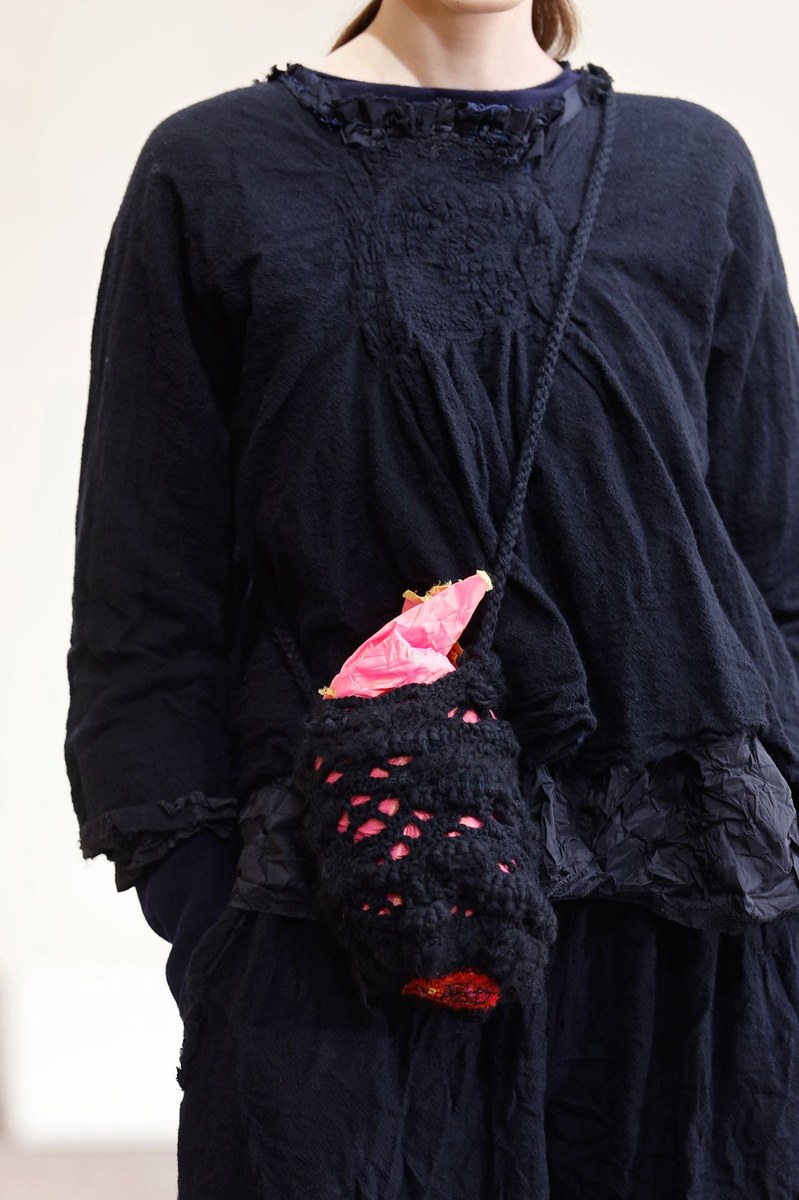
Handcraft emerges as the primary material language across Daniela Gregis FW26, with an accessories range built entirely around crochet, felted wool, crumpled textile and raw fabric construction. There's zero conventional leather or metal hardware. For buyers and product managers navigating a market saturated with logo-driven structured bags, this collection argues directly for artisanal volume, tactile variety and deliberate imperfection as viable commercial propositions.
Silhouettes and Shapes
A rounded, barrel-bottom tote with short top handles dominates the range, appearing in multiple colorways and scales across Bags 2, 3, 5, 10, 12 and 13. Medium-to-large in volume, these totes sit wide enough at the base to hold significant daily cargo, with the rounded lower section created structurally through crochet density rather than internal frames or boning. Bags 8, 9 and 11 represent a smaller format, all compact bucket or pouch shapes carried by hand and functioning as secondary or accent pieces within a layered carry system. A third category emerges in Bags 4, 6 and 7: small crossbody and shoulder pouches in textile and crumpled fabric, minimal in volume and worn close to the body.
Materials and Hardware
Hardware is entirely absent. No clasps, no rings, no chain straps, no metal feet. Every bag closes or carries through textile solutions: twisted cord shoulder straps in Bag 6, braided rope in Bag 1, short loop handles formed from the same crochet body in Bags 2, 3, 5, 8, 9, 10, 11, 12 and 13. Thick multi-yarn crochet combining wool, mohair and recycled fabric strips appears across the tote range, while Bags 4 and 6 use heavily crumpled silk or waxed cotton in a collapsed, sculptural finish. Bag 7 shifts to a structured herringbone wool suiting fabric shaped into a minimal hobo silhouette.
Color Direction
Near-black navy and charcoal dominate the small pouch formats and the crumpled textile pieces, with Bags 1, 4, 6, 8, 9 and 11 all reading as dark ink tones in varying fabric weights and surface treatments. Large totes split into two clear directions: the earth-and-muted stripe palette of Bags 2, 3 and 12, which layers taupe, dusty pink, red, white and olive across a dark ground and reads closest to a landscape painting, and the full rainbow stripe palette of Bags 10 and 13, which runs from deep purple through orange, green and pink in saturated, high-contrast bands. Bag 5 stands alone as an ivory and natural white piece, the only bag in the collection with no dark ground, signaling that the cream and undyed wool direction carries real seasonal weight. Accent colors throughout are hot pink, neon orange cord and small injections of cobalt blue embroidery, all used sparingly enough to read as artisan details rather than color-blocking decisions.
Key Models and Details
The rounded multi-yarn crochet tote represents the season's signature model, visible in six variations across Bags 2, 3, 5, 10, 12 and 13, and the most commercially transferable silhouette. Each version shares the same domed base construction and short loop handle, with differentiation coming entirely from yarn selection, color combination and the inclusion of scrap fabric strips woven through the crochet ground. Bag 13 and Bag 10 feature small stuffed animal ear forms in grey felted wool attached to the bag rim, a detail that reads as a statement on collectibility and limited-edition positioning rather than standard production. Drawstring closures in twisted ribbon or braided rope appear on Bags 4 and 6, the only closure mechanism in the collection, reinforcing that the design language prioritizes textile over hardware throughout.
Bag by Bag Highlights
Bag 2 The dark multi-stripe crochet tote in navy, dusty pink, red and taupe with a grey bouclé base reads as the most immediately wearable version of the signature shape and the strongest candidate for a lead production SKU.

Bag 3 Bold purple, red and orange horizontal bands cross a charcoal ground, carrying the highest contrast of the earth-palette group. It positions itself as an accent piece for buyers looking to anchor a tonal wardrobe with one expressive carry.

Bag 5 The all-ivory felted and crochet tote in natural undyed wool is the only light-ground piece in the lineup. Its neutral base makes it the most cross-market friendly option for retailers outside the brand's core customer base.

Bag 6 Crumpled navy waxed textile forms the pouch here, paired with a twisted orange and white nylon cord shoulder strap. This is the most minimal and most accessibly priced-looking piece in the range, with strong potential as a gateway or entry-level unit.

Bag 7 A grey herringbone wool hobo with a clean open top and structured front pocket carries a more tailored construction logic than anything else in the collection, making it the clearest crossover option for contemporary suiting or workwear adjacent floor sets.

Bag 10 The large rainbow stripe crochet tote with stuffed rabbit ear forms in grey felted wool attached to the rim is the most viral-ready piece in the collection, built for editorial placement and social amplification rather than volume production.

Bag 9 A small black bucket in heavy crochet with a scrap fabric embellishment band at the base and short loop handle functions as a secondary carry. Its compact cylinder format translates well into a capsule or set with the larger tote formats.

Bag 12 The oversized version of the dark multi-stripe crochet tote, scaled up to near-market bag proportions, tests the upper limit of the silhouette and would suit a retailer focused on statement outerwear or voluminous layered dressing.

Operational Insights
Minimum order complexity: Variation across these bags comes from yarn color and strip combinations, not from structural changes, meaning a single crochet base pattern can generate the full range. This significantly reduces tooling and pattern costs for production partners.
Lead times: Handcraft-dependent construction in crochet and felted wool requires longer production windows than machine-finished bags. Buyers should build in a minimum of 16 to 20 weeks and confirm artisan studio capacity before committing to seasonal volumes.
Scalability ceiling: Stuffed animal ear details on Bags 10 and 13 involve a separate hand-fabricated component in grey felted wool, adding labor time per unit and limiting scalability. These models suit limited capsule runs of under 200 units per colorway.
Retail floor pairing: A three-tier size architecture spanning large tote, compact bucket and small crossbody pouch gives retail floor teams a natural tiered display and gift or add-on sell opportunity, particularly strong for independents building a curated accessories wall.
Consumer positioning: The complete absence of metal hardware and conventional leather positions every bag in this collection outside the resale-value conversation entirely and inside the craft object conversation. Buyers should align shelf placement and clienteling language with ceramics, textiles and wearable art categories rather than traditional accessories departments.
Complete Collection
More Bags
More Bags


✦ This report was generated with AI — combining human editorial vision with Claude by Anthropic. Because the future of fashion intelligence is already here.