Daniela Gregis FW26 Details

Daniela Gregis FW26 Details
Daniela Gregis FW26 Details Report

Daniela Gregis FW26 builds its accessories language around tactile contrast, layered volume, and deliberately handmade construction across headwear, gloves, eyewear, and garment details. For buyers and product managers navigating a market saturated with polished minimalism, there's a strong commercial appetite here for craft-forward, high-texture product with obvious artisanal provenance.

Category Overview

Four categories anchor the accessories strategy: sculptural headwear, mismatched wool mittens, small-oval sunglasses, and heavily worked garment details that function as accessories in their own right. Headwear is the most architecturally ambitious piece, built from crinkled technical fabric and draped knit. It drives the collection's visual identity more than any single garment. Gloves enter as color-blocking tools rather than functional afterthoughts, worn mismatched and layered. Against the volume-heavy clothing, eyewear plays with studied restraint. This calculated contrast is worth flagging for product directors as a cross-category strategy.
Material and Construction

Details 16, 18, and 20 rely on a crinkled, paper-thin coated or treated fabric, structured into tall, turbaned or conical forms that hold their shape without visible internal armature. Either stiffened interfacing or a thermally treated shell material creates this effect. A ribbed knit beanie in navy pairs with a strip of the same crinkled fabric as a headband in Detail 17, proving the two material families are intentionally linked. Boiled or felted wool mittens in Details 13, 14, and 15 have a dense, compressed surface, soft at the hand but visually matte and flat. Heavily crumpled silk or silk-blend in Details 3, 4, and 8 reads as permanently pleated, layered over and against mohair, nylon, and raw-edged wool.

Detail 17
Detail 17

Color and Finish Direction

Navy, charcoal, off-white, and warm taupe form the foundational palette, appearing across multiple categories and anchoring the collection in a wearable, commercially safe neutral range. Accent colors are deliberately loud: coral red in Details 8 and 18, hot pink in Details 9 and 14, and a vivid cobalt rope in Detail 15. The crinkled fabric used for headwear lands in ecru, pale blush, and khaki-brown, all matte and devoid of sheen. Only the nylon panels of Detail 1 and the navy taffeta-like outer layer of Detail 10 provide glossy finishes, offering measured surface contrast against an otherwise entirely matte palette.

Detail 15
Detail 15

Key Pieces and Details

The mismatched mitten pairing strategy in Details 14 and 15 is the most immediately actionable commercial concept here. Selling mittens as deliberate non-matching pairs, in colorways like charcoal and red or white and grey, opens a set-building opportunity that increases average unit value per transaction. Sculptural crinkled-fabric headwear in Details 16, 18, and 20 is the most photographed category for good reason: the forms read strongly from a distance on a sales floor or editorial page. The color-block looped fringe jacket in Detail 9, split across taupe, black, hot pink, red, and off-white panels, translates directly into a top-seller profile for statement outerwear in specialty retail.

Detail 9
Detail 9

Detail by Detail Highlights

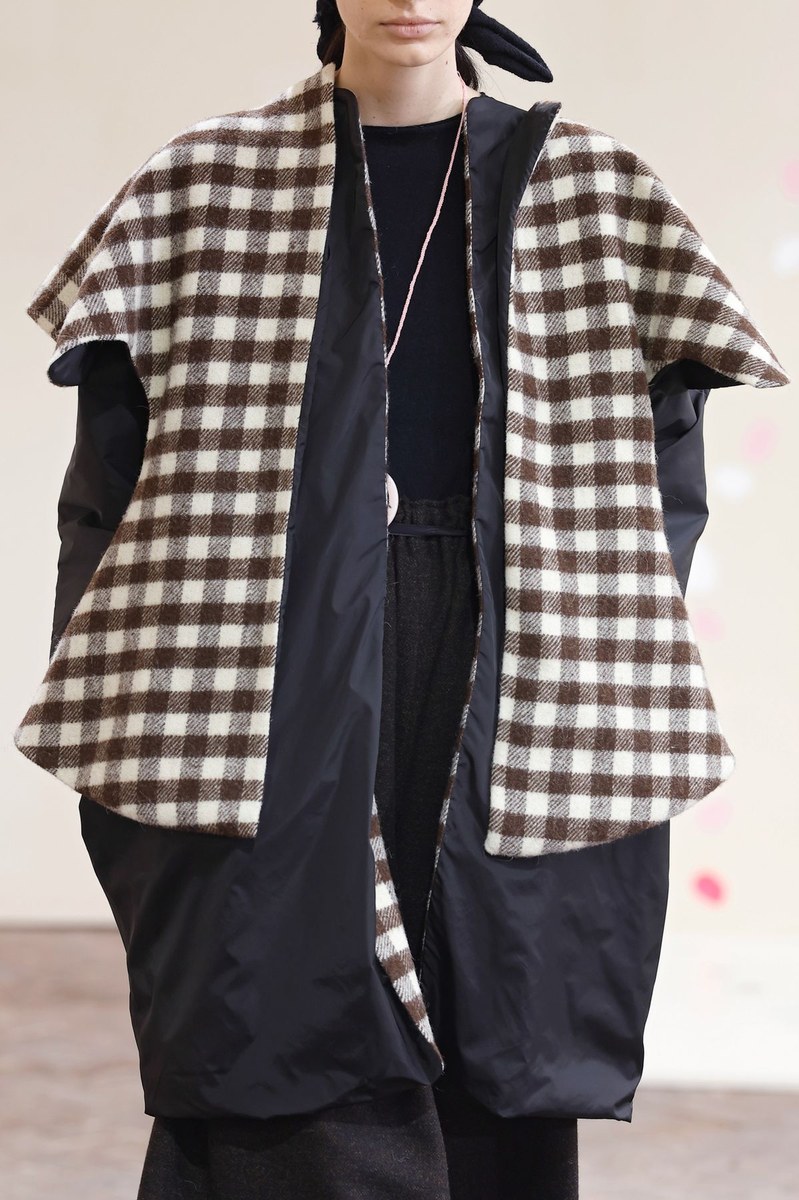
Detail 1 (Dress Detail) pairs a brown and cream large-scale gingham wool outer layer with a matte black nylon underlayer. The contrast between the two fabric weights and surfaces is the entire design statement.

Detail 1
Detail 1

Detail 3 (Dress Detail) places a roughly square appliqué patch of red, magenta, and black printed fabric directly onto a crumpled navy silk ground, stitched with visible raw edges that read as intentional rather than unfinished.

Detail 3
Detail 3

Detail 6 (Dress Detail) inserts a vertical panel of dark, painterly abstract-printed fabric into a plain navy coat, with white, orange, and red calligraphic marks that reference action painting and add significant perceived value to an otherwise simple silhouette.

Detail 6
Detail 6

Detail 9 (Dress Detail) constructs a boxy jacket entirely from looped yarn panels in blocked sections of taupe, black, hot pink, red, and off-white. Each section is sewn together with visible seams and no attempt to blend the transitions.

Detail 15 (Glove) threads a thick braided rope in cobalt blue and white through the coat's button closures as a decorative lanyard, with a grey felted mitten on one hand and a white felted mitten on the other, making mismatched pairing a stated design position.

Detail 16 (Headwear) sculpts a tall, turbaned crown from khaki-brown crinkled coated fabric, rising several inches above the skull with a deliberately asymmetrical peak and a smooth exterior that contrasts the looped-yarn collar beneath it.

Detail 16
Detail 16

Detail 18 (Headwear) builds an oversized conical crown in crinkled off-white fabric above a bright coral red ribbed cuff band. The hard geometric hat form against the soft knit band communicates the collection's core tension between structure and softness.

Detail 18
Detail 18

Detail 12 (Eyewear) frames the face with a small, tightly oval acetate sunglass in tortoiseshell with mauve lenses, worn under a voluminous navy knit beanie. Deliberately mismatched scale between hat and frame is the styling decision buyers should study for floor merchandising.

Detail 12
Detail 12

Operational Insights

Mismatched sets: Buyers should consider purchasing gloves in single-unit SKUs rather than matched pairs, enabling stores to build their own color-mix sets and merchandising stories at the point of sale. This model increases basket size and supports visual display.

Crinkle fabric sourcing: The crinkled coated or treated fabric used across headwear and skirt panels in Details 4, 16, 18, and 20 is a signature material worth identifying at the fabric fair level. Sourcing or commissioning a proprietary crinkle treatment in this weight category could anchor a private-label accessories line for autumn delivery.

Oval small-frame eyewear: Details 11 and 12 confirm that Gregis is committing to the small oval silhouette in both white and tortoiseshell acetate. Optical and sunglass buyers should read this as a directional signal to weight reorders toward oval frames under 50mm lens width for FW26 delivery windows.

Appliqué and patch detail: Multi-color thread-laced fabric scraps in Details 3 and 10 are applied to a dark ground using an unfused construction method with strong appeal to the handcraft and slow-fashion retail segment. Product managers evaluating trim suppliers should note the raw-edge, unfused application technique as a lower-production-cost alternative to embroidery.

Color accent strategy: Coral red, hot pink, and cobalt blue function as accent colors across every category, from headwear bands to glove colorways to rope accessories. Accessories directors can use this three-color accent system as a cross-category buying framework, ensuring color continuity from gloves through eyewear cord details without requiring full collection commitment.

More Details

Detail 2
Detail 2
Detail 4
Detail 4
Detail 5
Detail 5
Detail 7
Detail 7
Detail 8
Detail 8
Detail 10
Detail 10
Detail 11
Detail 11
Detail 13
Detail 13
Detail 14
Detail 14
Detail 19
Detail 19
Detail 20
Detail 20
Detail 21
Detail 21
Detail 22
Detail 22
Detail 23
Detail 23
Detail 24
Detail 24
Detail 25
Detail 25
Detail 26
Detail 26
Detail 27
Detail 27
Detail 28
Detail 28
Detail 29
Detail 29
Detail 30
Detail 30
Detail 31
Detail 31
Detail 32
Detail 32
Detail 33
Detail 33
Detail 34
Detail 34
Detail 35
Detail 35
Detail 36
Detail 36
Detail 37
Detail 37
Detail 38
Detail 38
Detail 39
Detail 39
Detail 40
Detail 40
Detail 41
Detail 41
Detail 42
Detail 42
Detail 43
Detail 43
Detail 44
Detail 44
Detail 45
Detail 45

✦ This report was generated with AI — combining human editorial vision with Claude by Anthropic. Because the future of fashion intelligence is already here.