Daniela Gregis FW26 Shoes
Daniela Gregis FW26 Shoes Report
Daniela Gregis FW26 builds its entire footwear vocabulary around tactile materiality, deliberate flatness or low-block elevation, and a consistent pairing of chunky wool socks with open-backed or low-cut shoe constructions. For buyers and product managers, this collection signals a commercial shift away from pointed-toe and stiletto silhouettes toward grounded, craft-inflected footwear with strong cross-category sock coordination potential.
Silhouettes and Construction
Two distinct silhouette families anchor the collection. The first is a low-profile flat or near-flat group, represented by Shoes 3 and 4, sitting at approximately 5mm to 10mm off the ground with rounded or square blunt toe shapes. Shoes 2 and 5 form the second family, a platform clog group built on a solid block platform of roughly 6cm to 7cm with a matching block heel of approximately 4cm, creating a stacked total height with no waist on the sole. Rounding out the lineup are Shoes 1 and 6, chukka-style ankle boots that occupy middle ground with a crepe or rubber-look stacked sole of approximately 2cm to 3cm and two-eyelet lace closures.
Materials and Finishes
Distressed or waxed suede in dark charcoal brown defines Shoes 1 and 6, matte in surface with no visible stitching ornamentation beyond the standard construction seam. Shoes 2 and 5 use smooth, matte black leather on the upper vamp paired with a molded black rubber or dense resin platform sole, no visible welt stitching, and a clean unbranded finish. Black crushed velvet or a velvet-effect textile appears on Shoe 4, which features a single button or snap closure at the instep sitting on a thin leather-look flat sole. Dense curly shearling or bouclé-textured material in black constitutes Shoe 3, constructed as a slip-on mule form with no heel counter.
Color Direction
Black dominates the collection. Every pair except Shoes 1 and 6 reads in a single unbroken black, from upper to sole, creating a monolithic foot silhouette that feels intentionally grounded rather than restrained. Shoes 1 and 6 introduce the only material contrast, a dark slate or espresso-toned suede with a slightly warmer brown undertone on the crepe sole. Charcoal grey, near-black, and a muted tobacco stripe at the cuff appear across the wool socks visible in all six looks, functioning as quiet accent color and a potential private-label or gifting add-on.
Key Models and Details
The platform clog (Shoes 2 and 5) emerges as the collection's most commercially legible statement model, stripped of hardware, buckle, logo, and strap. Proportion and material quality alone communicate value here. Buyers will recognize the chukka boot (Shoes 1 and 6) as an accessible entry point, with its classic two-eyelet lace system, round toe, and construction profile echoing existing Clarks Desert Boot references. Shoe 4 stands apart as the most directional model, its velvet or velvet-effect finish and single-button mary-jane strap breaking from the otherwise strap-free vocabulary elsewhere in the lineup.
Shoe by Shoe Highlights
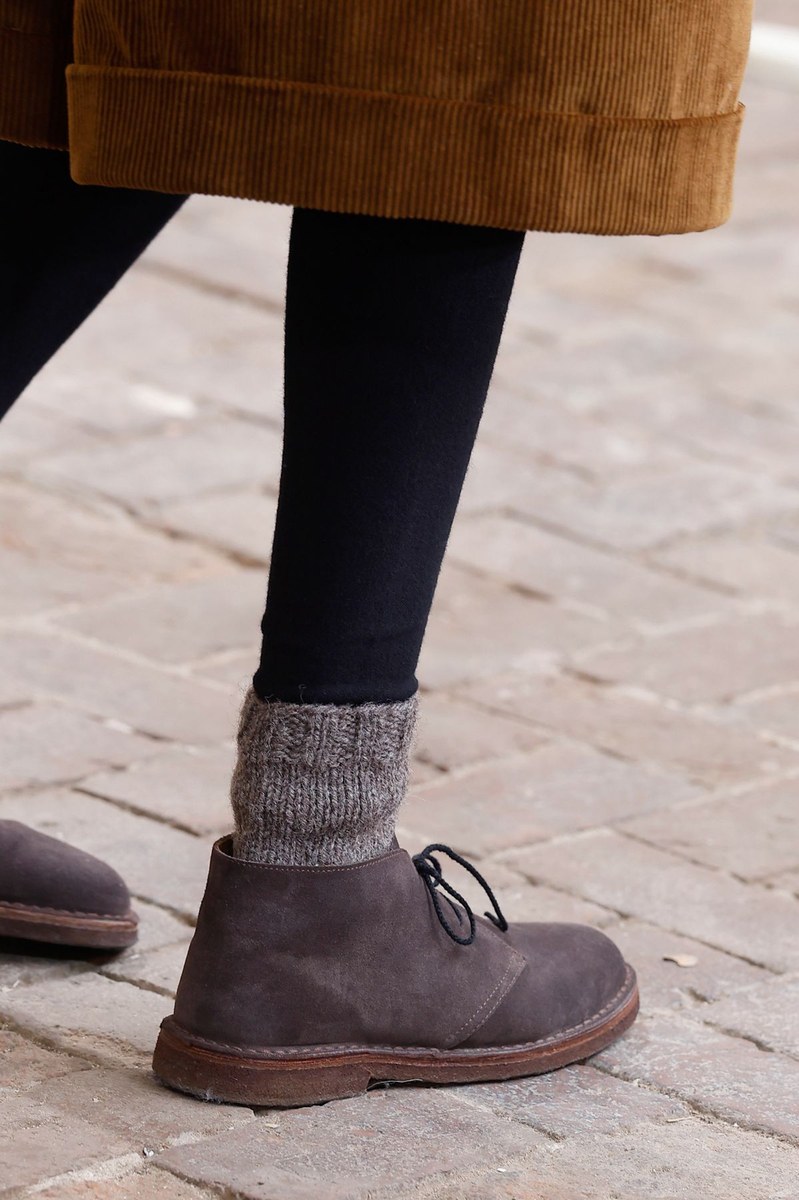
Shoe 1 A waxed or distressed suede chukka in dark charcoal with a crepe-look stacked sole and two-eyelet lacing, worn over a chunky grey wool sock. Here, the sock becomes central to the product story.

Shoe 2 A black leather platform clog with a solid block heel and open back, sitting at approximately 6cm to 7cm total platform height. The clean unbroken silhouette removes all hardware risk from the production spec.

Shoe 3 Dense curly black shearling or bouclé-textured material defines this slip-on flat mule, with zero visible structure or counter. It functions more as a tactile textile object than a traditional shoe.

Shoe 4 A flat black velvet or velvet-effect mary-jane with a single button or snap closure at the instep and a thin sole. This stands as the most season-forward silhouette in the lineup and a strong candidate for limited-run production.

Shoe 5 The same platform clog form as Shoe 2, here worn under a long frayed-hem skirt. This demonstrates how the silhouette reads equally well under both wide-leg trousers and voluminous skirts, broadening its styling range for buyers.

Shoe 6 A chukka boot in slightly deeper slate-brown suede paired with a dark plaid hem, confirming the model works across multiple garment contexts. The suede colorway carries enough versatility to avoid markdown risk.

Operational Insights
Sock Coordination: All six looks pair socks as a visual and functional component, creating a direct opportunity for buyers to build bundled sock-and-shoe programs or coordinate with hosiery suppliers on a Daniela Gregis-adjacent palette of charcoal, near-black, and tobacco stripe.
Platform Clog MOQ Strategy: Shoes 2 and 5 share the same last and platform construction, meaning a single tooling investment covers two looks. Product managers should flag this as a cost-efficient hero model with strong margin potential.
Material Finish Risk: The distressed suede on Shoes 1 and 6 requires consistent finish control across production runs, as the matte waxed surface will read differently under various lighting conditions in retail and e-commerce photography.
Velvet Entry Point: Shoe 4 in velvet-effect textile sits outside the leather and suede majority of the collection, and its production cost is likely lower per unit, making it a viable entry-price or diffusion option if the full collection runs above accessible retail thresholds.
Shearling Timing: Early raw material sourcing commitment becomes essential for Shoe 3 given global shearling supply constraints. Buyers intending to carry this model for FW26 delivery should initiate supplier conversations no later than Q1 of the preceding year to protect lead times.
✦ This report was generated with AI — combining human editorial vision with Claude by Anthropic. Because the future of fashion intelligence is already here.