Daniela Gregis FW26 Women Looks Report
Milan Fashion Week
Daniela Gregis FW26 builds a wardrobe around deliberate imperfection, layering crinkled, handcrafted and raw-edged textiles into looks that read as assembled rather than designed. For buyers navigating a market fatigued by polish, there's a coherent commercial argument here for artisanal slow-fashion at a moment when that positioning carries genuine pricing power.
Silhouette and Volume
Almost everything in the collection works in oversized and voluminous shapes, with dropped shoulders, wide-leg trousers and cocoon-like dresses dominating the lineup. Midi and below are the only hemlines you'll see, and proportions are deliberately off-balance, pairing cropped upper layers against floor-grazing bottoms as in Look 10 and Look 13. Nothing is fitted. Layering builds volume more than cut alone ever could.
Color Palette
Charcoal, ink black, graphite and warm taupe form the dominant palette, appearing across at least twelve of the twenty looks. Look 12 holds entirely within grey-brown, while Look 20 breaks the collection open with head-to-toe chalk white. Signal red appears in mittens, gloves and bag details across Looks 4, 5, 11 and 18, functioning as punctuation rather than accent. The mood reads monastic and muted, with warmth arriving through material rather than color.

Materials and Textures
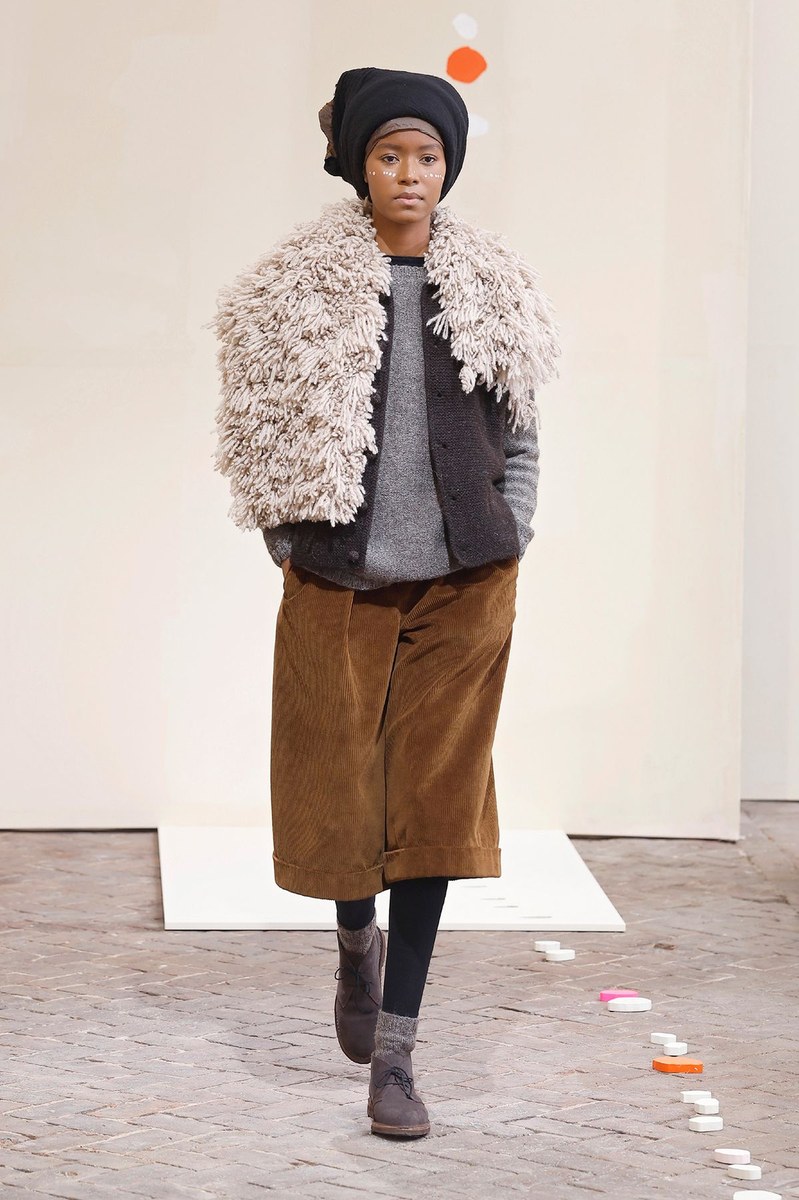
Crinkled and permanently crushed fabrics appear in multiple weights, from the heavy sculptural pleating of the white dress in Look 20 to the lighter crushed silk-like trousers in Look 13. Shaggy loop-pile textiles, visible in the vests of Look 1 and Look 11 and the coat of Look 7, add a raw, almost undressed quality that reads as handmade. Warm caramel corduroy appears in Look 1, boucle-effect wool in Looks 2 and 5, and quilted check in Look 6, giving the collection genuine material range within a unified tactile language. Lace trim, burnished taffeta and velvet panels provide quieter moments of surface contrast throughout.

Styling and Layering
Every look is built in multiple layers, typically three or more, with lengths deliberately staggered so that hems and cuffs of inner garments peek below outer ones. Black, dark brown and white head wraps and turbans appear across virtually every look, functioning as a consistent house signature that anchors the collection's identity. Footwear runs to flat or low-platform lace-up ankle boots and flat slip-ons, almost always in black or dark grey, keeping the base of every look grounded. Handmade knitted or crocheted bags in dark and natural tones appear in Looks 2, 3, 4, 6, 7, 11 and 16, and they are structural to the aesthetic rather than secondary additions.
Look by Look Highlights
Look 1 pairs a shaggy loop-pile vest over a grey marl cardigan and caramel corduroy midi skirt, making it the most immediately wearable entry point for buyers targeting an accessible artisanal customer.

Look 4 uses a pale pink crinkled anorak-style top against a brown and white oversized gingham skirt with red knit gloves, making it the collection's strongest color-blocking proposition for a buyer looking for a differentiated hero piece.

Look 6 layers a quilted small-check coat in dark brown over a houndstooth midi skirt with a colorwork knit tote, combining three distinct woven surface patterns in a way that demonstrates the collection's pattern-mixing logic without losing coherence.

Look 13 sets gold crinkled metallic shorts against a black velvet overcoat and dark corduroy culottes, producing the collection's most commercially striking contrast and a strong candidate for editorial pull or window placement.

Look 19 presents a near-tent-shaped layered silk organza dress in black with a multicolor embroidered patch at hip level, the most directional silhouette in the collection and the piece most likely to drive press attention.

Look 20 closes the show in an all-white heavily crushed sculptural dress over wide white trousers with a matching white crinkled turban, functioning as a clear collection statement piece and a high-margin special-order candidate.
Look 16 mixes a loose pale plaid oversized shirt over a grey waffle-knit midi skirt with a cream crocheted bucket bag and layered black leg warmers, assembling the most pieces of any look and demonstrating the collection's full layering depth for a style director building editorial content.

Look 17 grounds a long black crinkled linen coat over wide dark trousers with a two-panel knit detail in sky blue and burnt orange visible at center front, adding the only true colorblock moment in an otherwise all-dark look and signaling where the brand allows graphic surprise.

Operational Insights
MOQ and craftsmanship positioning: The volume of handmade and artisanal construction across bags, knitwear and embroidered patches suggests low production runs. Buyers should negotiate early and plan for extended lead times, particularly on the loop-pile and crinkled fabrications.
Head wrap as SKU: Turbans and head wraps appear in every look and in multiple materials including cotton, taffeta and quilted fabric. This is a low-cost, high-margin accessory with strong brand recognition that merits treatment as a standalone category rather than a styling prop.
Bag program: Handmade crocheted and knitted bags appear in at least seven looks across the collection in varying scales. Product managers should assess whether these can be produced at retail-viable volume and price points, as they carry significant visual equity.
Color strategy for buying: Black, charcoal and taupe account for the majority of the collection and will carry the commercial core. Buyers should limit red accent pieces, which appear only in accessories, to small-quantity buys intended to animate display and editorial rather than drive volume.
Layering as a retail narrative: The consistent layering logic, with staggered hems, mixed textures and visible inner garments, is difficult to communicate on a single hanger. Style directors and visual merchandising teams should plan for mannequin groupings and full look presentation rather than separates-only floor sets.
Complete Collection


About the Designer
The daughter of a doctor in 1959 Bergamo, Daniela Gregis discovered her path to fashion through an unexpected route. Her early life was shaped by the healing arts, first through her family's medical background, then through her own training as a herbalist. This grounding in natural remedies and plant-based knowledge would later inform her deep connection to organic materials and sustainable practices. An aunt who crocheted became her first teacher in textile crafts, guiding young Daniela through the creation of her first shawl made from orange synthetic yarn.
Her entry into fashion came in 1987 when she launched her first label, Ok'am, before collaborating with Naj Oleari on various projects throughout the early years. By the 1990s, she had shifted her focus entirely to textile research, exploring the possibilities of handcraft techniques within contemporary design. This period of experimentation led to the founding of her eponymous brand in 1997, establishing her studio in the serene hills of Bergamo where she continues to work today.
Gregis draws inspiration from the rhythms of rural Italian life, the changing seasons, and what she describes as the balance of the natural world. Her aesthetic philosophy centers on poetry, humility, and harmony, rejecting the excesses of contemporary fashion in favor of what she calls "a deeply human minimalism." She incorporates Japanese influences alongside traditional Italian craftsmanship, creating pieces that navigate between rustic and modern sensibilities. Her work often features hand-painted fabrics, intricate embroidery, and innovative use of leftover materials, ensuring that not even a centimeter of fabric goes to waste.
"My deepest desire was to recover the lost arts as crochet or embroidery. I dreamed of reviving them in a modern way, mixing ancient tradition to contemporary shapes and patterns." She has also stated, "The person comes before the dress," reflecting her philosophy that clothing should serve the individual rather than dominate them.
✦ This report was generated with AI — combining human editorial vision with Claude by Anthropic. Because the future of fashion intelligence is already here.