Dior FW26 Women Looks Report

Dior FW26 Women Looks Report
Dior FW26 Women's Looks Report

Paris Fashion Week

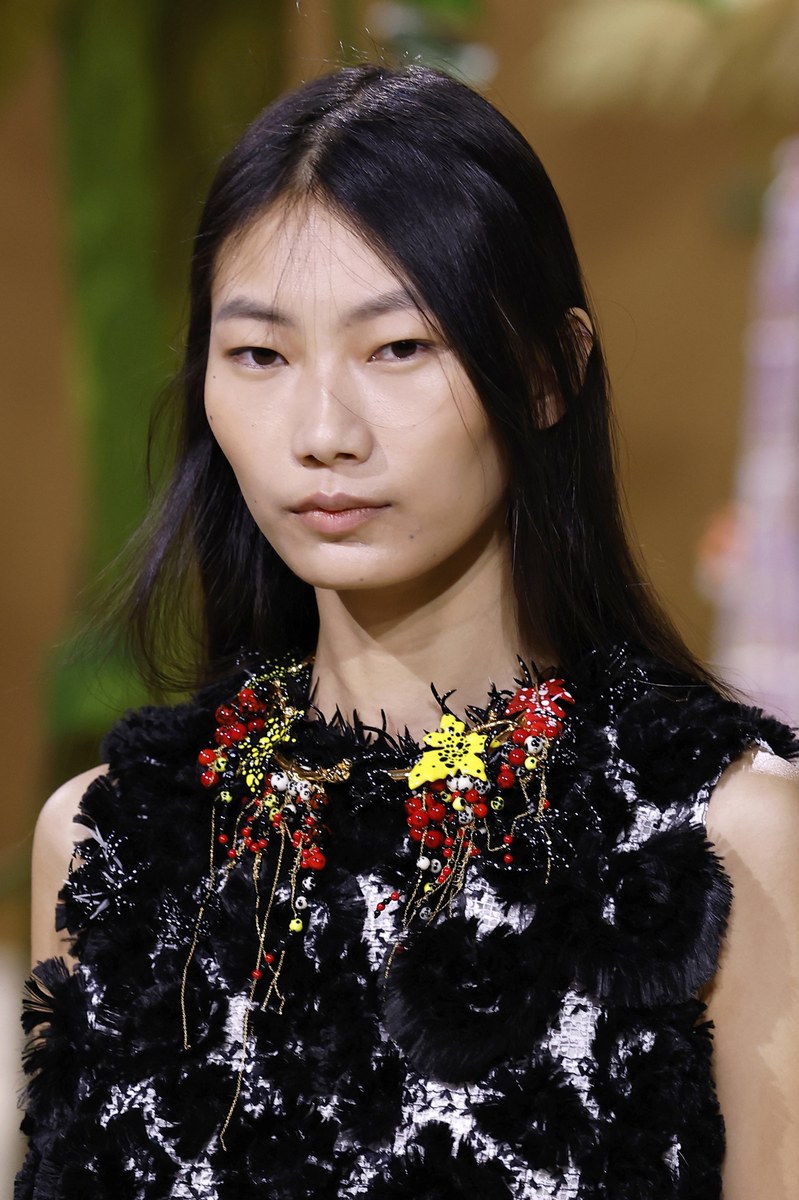
Maria Grazia Chiuri builds this collection around a sustained tension between structured tailoring and deliberately disheveled romanticism, cycling through wool coats, brocade jackets, tiered lace skirts, and deconstructed knitwear within a single runway sequence. For buyers, this breadth signals a deliberate commercial strategy: the house is speaking to multiple wardrobe occasions simultaneously, from daywear suiting to occasion dressing, without forcing the customer to choose a single aesthetic register.

Silhouette and Volume

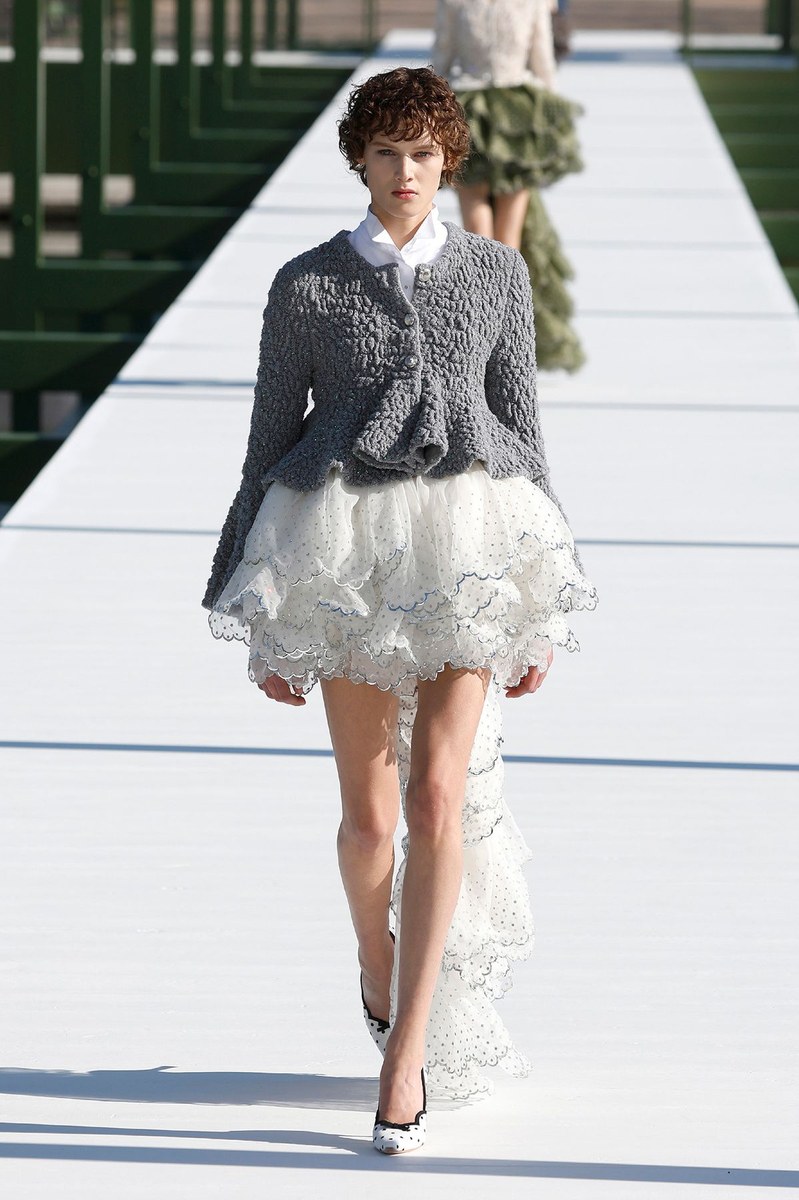
The peplum jacket is the collection's load-bearing silhouette, appearing in tweed, wool bouclé, lace, and brocade across Looks 6, 7, 18, 32, 39, 54, 60, 61 and 62, always cinched at the waist and flared at the hip. A secondary silhouette, the belted wrap coat cut to midi or maxi length, carries equal weight in Looks 8, 10, 15, 19, 46, 51, 65, and 66. The tiered, scallop-edged skirt built from polka-dot organza or lace in hi-lo construction runs through Looks 1, 2, 3, 23, 29, 50, and 58. What makes this piece directional is the theatrical volume at the hem. Short silhouettes are aggressive and leggy when they appear, never modest.
Color Palette

Black and white anchor the collection absolutely, appearing as a monochrome pairing in Looks 9, 23, 24, 30, 40, 56, and 59, and as a recurring shorthand for house codes. Ivory, cream, and chalk white function separately from pure white, lending a softer, more textural read to Looks 6, 12, 41, 58, and 65. Olive green deployed in Looks 2, 13, and 26 sits beside a warm caramel and tobacco brown palette in Looks 8, 10, and 64, creating an earthy, autumnal undercurrent. Bursts of lemon yellow in Looks 26 and 52, dusty rose in Looks 45 and 59, and cobalt blue on footwear in Looks 41 and 45 prevent the collection from reading as somber.

Materials and Textures

Heavily textured bouclé and looped wool appear in the collection's most commercially viable jackets, Looks 1, 6, 52, 53, 58, and 59, carrying a tactile surface quality that reads clearly on a hanger and photographs well. Scallop-edged polka-dot organza used for the tiered skirts in Looks 1, 2, 3, and 23 is lightweight and semi-sheer, creating volume without significant weight. Brocade in a swirling marbled print present in Looks 3, 5, 33, 49, and 50 gives the tailored jackets a strong pattern identity. Ostrich feather trim appears as a structural device rather than mere decoration in Looks 14, 25, 39, and 57, always placed at a hem, cuff, or waist seam where it carries movement.

Styling and Layering

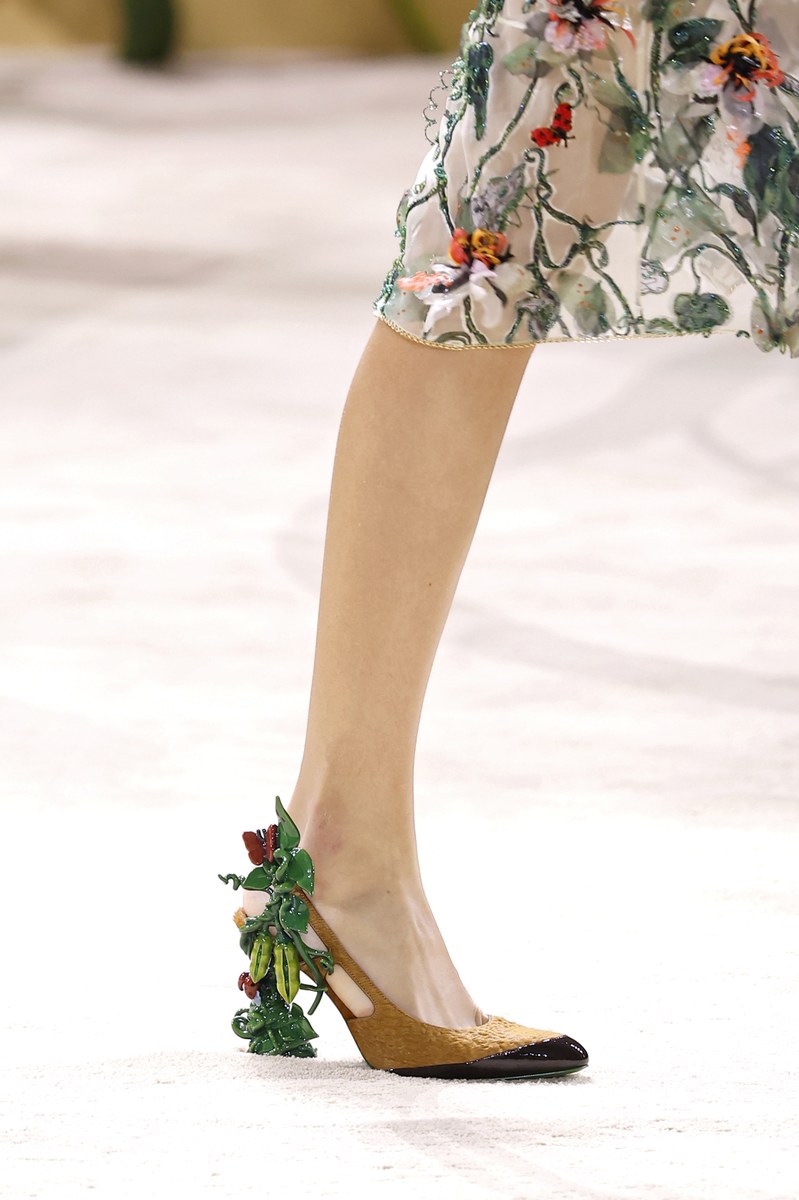
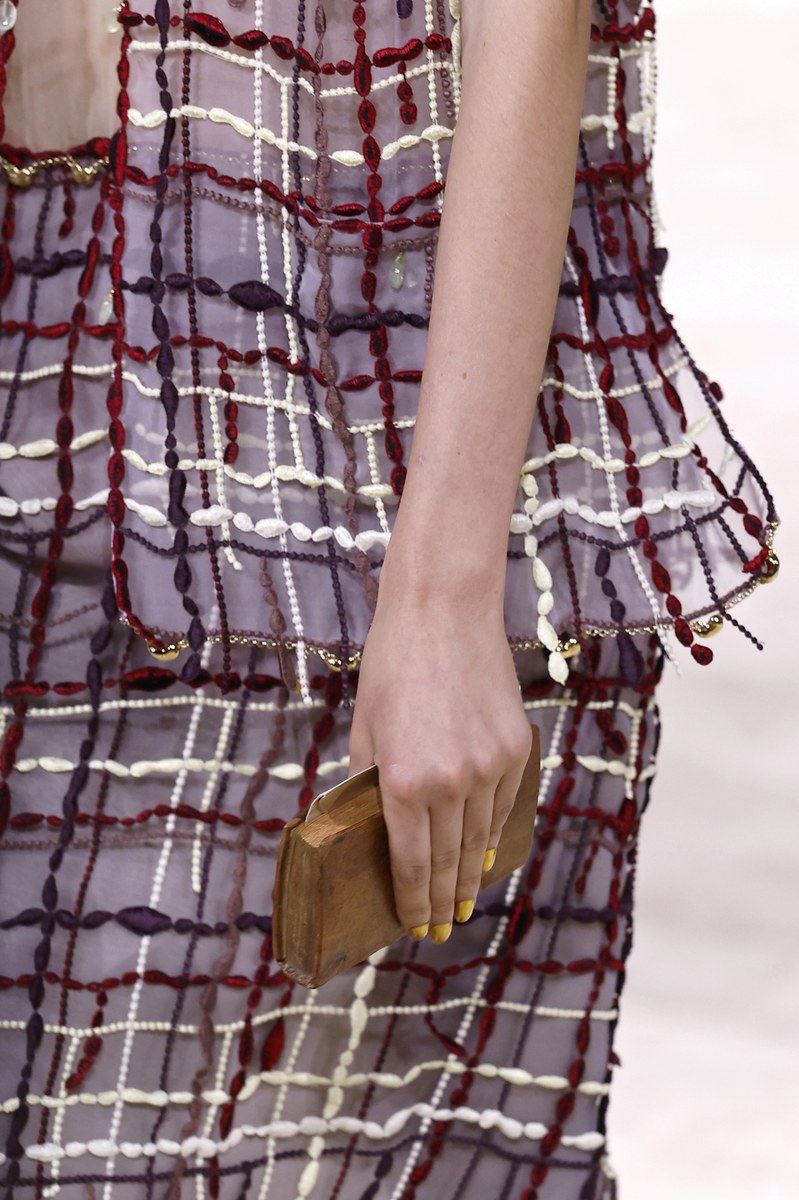
The collection's core layering logic pairs a structured, waist-defining jacket with either embellished wide-leg trousers or a tiered skirt, rarely leaving the top half without significant silhouette work at the waist. Footwear splits into two clear categories: the polka-dot pointed-toe kitten heel, a recurring house signature visible across at least a dozen looks, and jewel-heeled strappy sandals in gold, cobalt, or green that elevate the evening-adjacent pieces. Denim appears as a deliberate leveler, grounding brocade and feather-trimmed pieces in Looks 5, 13, 47, 57, 60, 61, and 62, signaling that the house is actively pursuing a younger customer who wears luxury separates rather than full looks. Bags range from quilted micro pouches and fuzzy chain bags to structured bucket bags and the Dior Book Tote, with monogram and logo hardware kept restrained.

Look by Look Highlights

Look 7 The grey-and-cream color-blocked peplum jacket over a flared mini skirt, both in dense wool with gold military buttons, is a near-complete retail ready proposition requiring minimal styling direction for the floor.

Look 7
Look 7

Look 13 An olive structured jacket with shearling collar and dramatically ruffled asymmetric hem over heavily embellished crystal-and-pearl blue denim jeans produces the collection's strongest luxury casual argument.

Look 13
Look 13

Look 23 The black-and-white tiered scallop-edged organza gown, with an off-shoulder ruffle top in white and a black polka-dot skirt trailing to the floor, is the standout occasion piece for editorial and red carpet pull.

Look 23
Look 23

Look 25 A sleeveless bias-cut gown in marbled pastel print brocade with a full cream ostrich feather hem sweep delivers maximum visual impact at minimum structural complexity, making it an accessible event piece for specialty retailers.

Look 25
Look 25

Look 32 The all-black version of the military peplum look, with double-tiered fluted sleeves and a flared mink-trimmed mini skirt, is the most resolved and immediately wearable evening jacket in the collection.

Look 32
Look 32

Look 52 The yellow bouclé peplum cardigan paired with a blue-and-coral botanical print draped maxi skirt with long feather fringe is the collection's most color-forward separates combination, speaking directly to buyers building resort or transitional floor sets.

Look 52
Look 52

Look 56 The ivory lace column dress with three-dimensional black sequined floral appliqués and a voluminous black organza peplum skirt is architecturally complex and embellishment-heavy enough to function as a headline dress for luxury e-commerce.

Look 56
Look 56

Look 65 The double-breasted grey melton wool coat with exaggerated sleeve volume and large silver buttons is the cleanest, most commercially transferable outerwear piece in the collection, requiring no editorial styling to read as desirable.

Look 65
Look 65

Operational Insights

Volume strategy: The peplum silhouette in both jacket and dress form is the collection's most repeatable and scalable shape. Prioritize this cut across at least three fabrications for maximum floor coverage.

Denim integration: Embellished and plain denim trousers appear paired with couture-level outerwear and brocade in at least seven looks. Product managers should evaluate a denim capsule positioned as a luxury casual entry point into the Dior wardrobe.

Fabrication complexity: Several hero looks combine two or three distinct fabric weights and construction types in a single garment. Flag these for production lead time and cost conversations early, particularly the tiered organza skirts and the feather-trimmed coats.

Color entry points: Ivory, cream, and chalk white dominate the wearable-luxury tier of the collection. These are the safest opening orders for new accounts or conservative markets, while yellow, cobalt, and olive serve as color accent buys for fashion-forward doors.

Footwear as collection connector: The polka-dot kitten heel and the jewel-heeled sandal appear across day, evening, and casual looks without contradiction. Both styles function as strong accessories buys that bridge the collection's tonal range and can be merchandised across multiple price tiers.

Complete Collection

Look 1
Look 1
Look 2
Look 2
Look 3
Look 3
Look 4
Look 4
Look 5
Look 5
Look 6
Look 6
Look 8
Look 8
Look 9
Look 9
Look 10
Look 10
Look 11
Look 11
Look 12
Look 12
Look 14
Look 14
Look 15
Look 15
Look 16
Look 16
Look 17
Look 17
Look 18
Look 18
Look 19
Look 19
Look 20
Look 20
Look 21
Look 21
Look 22
Look 22
Look 24
Look 24
Look 26
Look 26
Look 27
Look 27
Look 28
Look 28
Look 29
Look 29
Look 30
Look 30
Look 31
Look 31
Look 33
Look 33
Look 34
Look 34
Look 35
Look 35
Look 36
Look 36
Look 37
Look 37
Look 38
Look 38
Look 39
Look 39
Look 40
Look 40
Look 41
Look 41
Look 42
Look 42
Look 43
Look 43
Look 44
Look 44
Look 45
Look 45
Look 46
Look 46
Look 47
Look 47
Look 48
Look 48
Look 49
Look 49
Look 50
Look 50
Look 51
Look 51
Look 53
Look 53
Look 54
Look 54
Look 55
Look 55
Look 57
Look 57
Look 58
Look 58
Look 59
Look 59
Look 60
Look 60
Look 61
Look 61
Look 62
Look 62
Look 63
Look 63
Look 64
Look 64
Look 66
Look 66

Fashion Designer

Jonathan Anderson was born in 1984 in Magherafelt, a small town in County Derry, Northern Ireland, during the Troubles. His father Willie was a professional rugby player for the Irish national team, his mother Heather taught English and French, and his maternal grandfather ran one of Ireland's major linen companies and spent his days doing old-school screen printing. Anderson grew up between that tight, provincial world and the family's villa in Ibiza, a contrast he has returned to repeatedly as central to how he thinks: "Life is about contrast. You need good and evil for things to exist. It's that zone where you find ambiguity." He was diagnosed with severe dyslexia in primary school, became obsessed with fashion magazines and Jean Paul Gaultier, and spent his teenage years more interested in theatre than sport.

He moved to Washington D.C. at eighteen to study acting, then spent time in Dublin before arriving in London, where Central Saint Martins turned him away and the London College of Fashion took him in. He graduated in menswear in 2005, launched his own label JW Anderson in 2008 with a collection that drew brutal reviews, and pushed through anyway. LVMH took a stake in JW Anderson in 2013 and simultaneously appointed him creative director of Loewe, a Spanish house most people outside fashion had barely heard of. What followed over eleven years was a systematic transformation: the Puzzle bag, the Anthea Hamilton collaborations, the Miyazaki collections, costumes for Luca Guadagnino's films, a leather pigeon clutch that went viral, and a version of Rihanna's Super Bowl reveal outfit. He turned an obscure leather goods house into one of the most discussed brands in fashion.

In 2025 he was named creative director of Dior, the first person since Christian Dior himself to oversee women's, men's and haute couture simultaneously. His debut collection for Dior menswear showed in June 2025, womenswear followed in October. He still runs JW Anderson alongside his Dior duties.

"Authenticity is invaluable; originality is non-existent. Steal, adapt, borrow. It doesn't matter where one takes things from. It's where one takes them to."

"I grew up in Northern Ireland during the Troubles — car bombs, a town getting blown up. It toughened me up. I don't take anything for granted because I know that life is like a fuse."

✦ This report was generated with AI — combining human editorial vision with Claude by Anthropic. Because the future of fashion intelligence is already here.