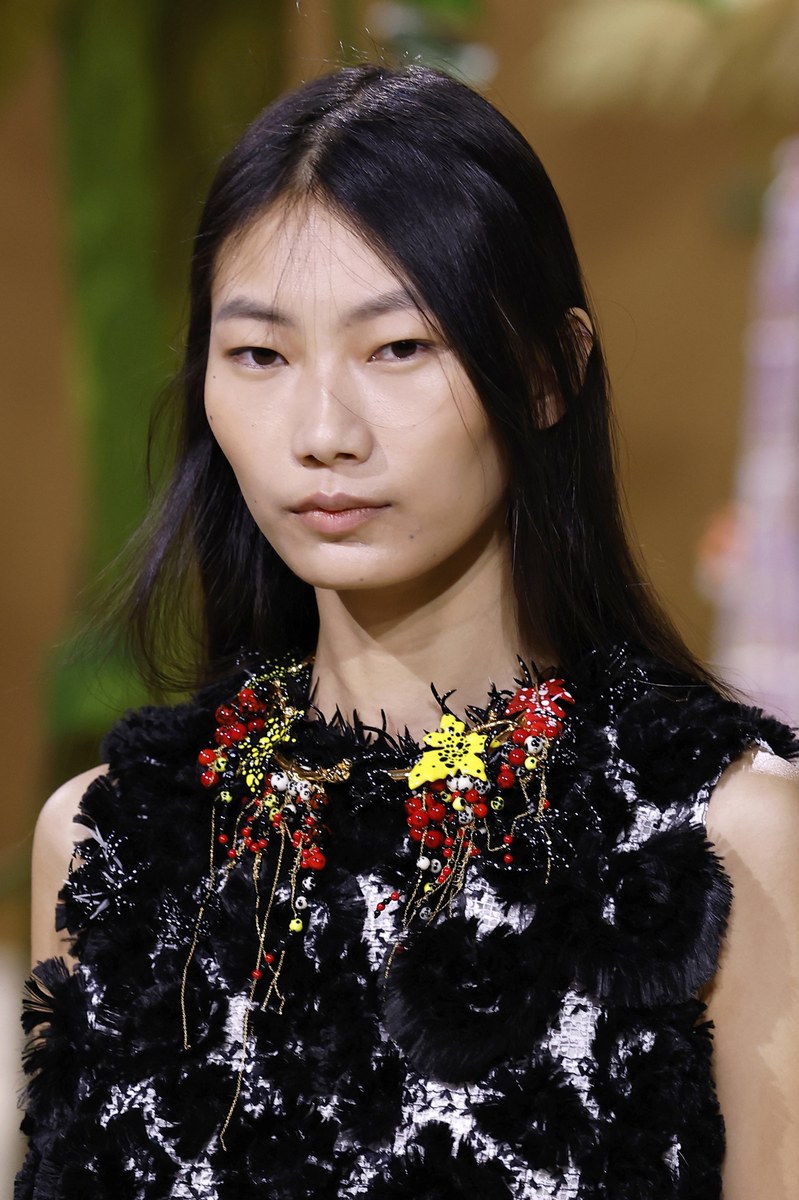
Dolce & Gabbana FW26 Women Looks Report
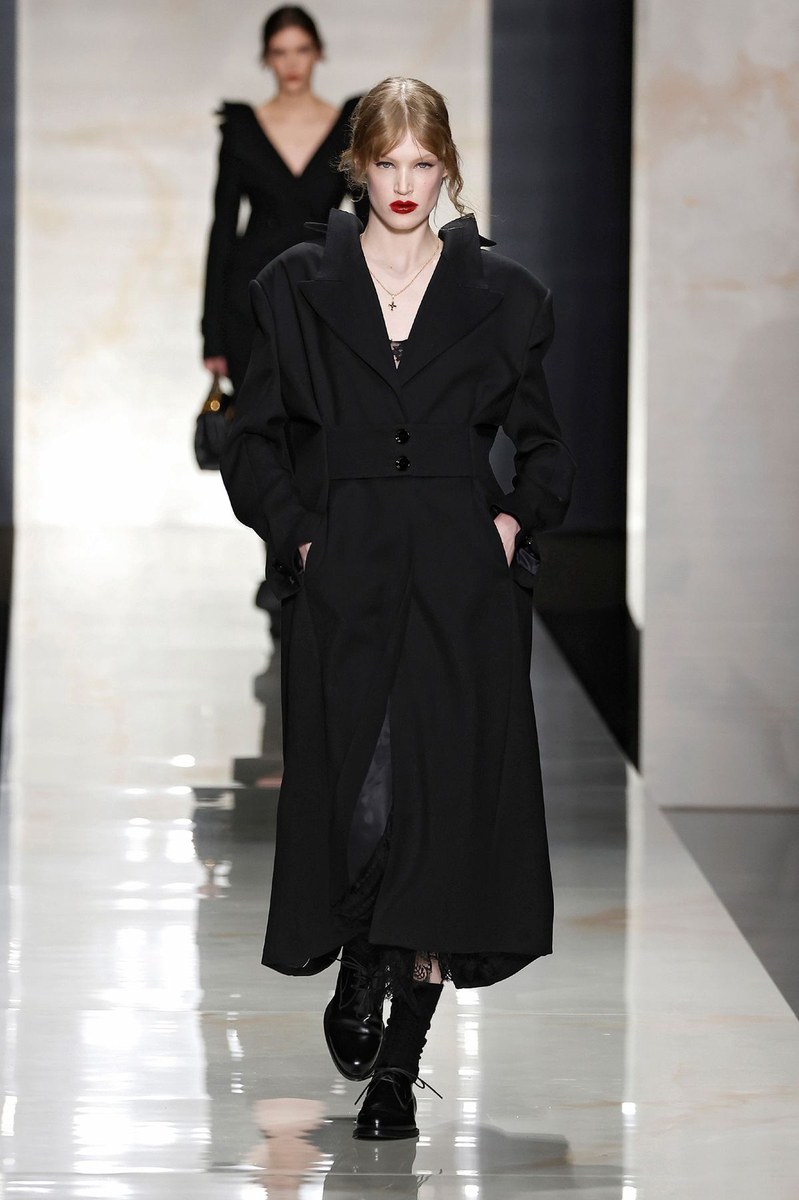
Dolce & Gabbana FW26 Women's Looks Report
Milan Fashion Week
Dolce & Gabbana FW26 constructs a total-black wardrobe built around the tension between severe tailoring and intimate lingerie dressing, moving from structured outerwear through sheer lace to oversized suiting within a single, disciplined color story. For buyers, this signals a strong consumer appetite for all-black dressing that carries emotional range rather than minimalist restraint, a distinction with real implications for how retailers build their FW26 floors.
Silhouette and Volume
Two opposing poles define the silhouette here. Outerwear volumes run large and architectural, with exaggerated shoulder construction and elongated hemlines falling to the mid-calf or ankle (Looks 1, 2, 5, 7). Body-conscious looks pull tight through the torso, relying on corsetry seaming and stretch fabrications to define the waist without structured boning (Looks 3, 6). Look 19 breaks both directions entirely with an oversize double-breasted trouser suit cut in a menswear grain, broadening the silhouette vocabulary toward a more commercial wearable range.
Color Palette
Black dominates every look. No accent color, no contrast lining, no tonal shift until the red patent leather bag and matching lace-up shoes appear in Look 18, and the brown crocodile-embossed bag arrives in Look 12. These two moments function as punctuation rather than palette expansion, which tells buyers that accessories carry the entire color opportunity for the season. Red lips appear on every model, reinforcing black as the deliberate and unwavering ground tone.

Materials and Textures
At least six distinct black surfaces move through the collection, and the range is the point. Heavy wool coating (Looks 2, 7), matte cotton twill (Look 1), crisp poplin suiting (Look 19), and bouclé tweed (Look 10) anchor the outerwear and tailoring tier. Sheer Chantilly lace in multiple weights runs through Looks 8, 9, 14, 15, and 16, layered directly over bare skin or lingerie pieces, with enough transparency to read as eveningwear without constructed underlining. Adding textural contrast, the fringed bouclé shawl in Look 17 sits in its own product category between knitwear and outerwear.

Styling and Layering
Layering serves as the central operational logic. Lace bralettes and slip-style lingerie pieces appear beneath open tailored jackets and trench coats throughout, making the underwear-as-outerwear strategy a functional buying decision rather than a runway conceit. Footwear splits between chunky black lace-up Oxford-style boots (Looks 1, 7, 10, 13) and square-toe black kitten heels with sheer socks (Looks 6, 8, 9), creating two distinct foot stories that serve different retail channels. Over-the-knee ribbed knit boots (Looks 4, 12) read as the most commercially aggressive footwear moment and will require close coordination with legwear sourcing. Bags range from structured top-handle silhouettes to soft pouch forms with chain hardware, and the fur-trimmed circular bag in Look 7 ties directly to the fur collar of its coat.

Look by Look Highlights
Look 2 delivers the most retail-ready coat in the collection, a double-breasted structured wool coat with dramatic folded lapels and a flared hem that can be merchandised as a standalone hero outerwear piece.

Look 4 combines a black knit long-sleeve bodysuit with high-cut leather shorts and over-the-knee ribbed knit boots, a head-to-toe monochrome formula that translates directly into a coordinated product bundle for fast-follower retailers.

Look 7 anchors the luxury outerwear tier with a long black wool coat trimmed in black fur at the collar and cuffs, paired with a matching fur bucket bag, making it the most giftable and press-ready look in the lineup.
Look 8 uses a sleeveless Chantilly lace slip dress with ruffled tiers and full transparency as the clearest eveningwear proposition, requiring no restyling to function as a high-margin occasion piece.

Look 11 pairs a sharp double-breasted black blazer with sheer chiffon straight-leg trousers, a hybrid between tailoring and lingerie dressing that gives buyers a transitional piece capable of sitting in both daywear and eveningwear categories.

Look 16 stands apart structurally, a fringed crochet cape coat with macramé-style cutwork covering a matching crochet skirt, making it the most artisanal and limited-production item with strong editorial pull.

Look 19 closes the ready-to-wear narrative with an oversized pinstripe double-breasted suit worn with a white shirt and black tie, the most gender-neutral and broadly wearable look in the collection, and a direct signal toward the continuing power-dressing market.
Operational Insights
Outerwear depth: Five distinct coat and jacket silhouettes appear across different fabrications, from cotton twill to fur-trimmed wool to crochet. Buyers should plan outerwear as the primary category investment, with at least three silhouette options per door.
Lace sourcing lead times: Sheer lace appears in six looks across multiple weights and constructions. Product managers need to open conversations with Chantilly and re-embroidered lace suppliers immediately, as this category carries long lead times and limited mill capacity for true quality tiers.
Accessories as color vehicles: With the full apparel collection locked in black, bags and shoes carry all color differentiation. Red patent and brown croc-embossed bags in Looks 18 and 12 are the only non-black moments and will likely become the most photographed and requested pieces from press and wholesale buyers.
Legwear as a category driver: Over-the-knee ribbed knit boots (Looks 4 and 12), sheer socks with heels (Looks 6 and 9), and opaque knee socks (Looks 13 and 17) confirm that legwear is a key styling engine. Style directors building FW26 floor sets should treat hosiery and boot-length legwear as display anchors rather than afterthoughts.
Lingerie crossover production planning: Recurring bralette-under-tailoring formulas across Looks 3, 10, 11, and 13 create a real commercial opportunity for coordinated sets where the lace inner piece is sold as a unit with its outer layer. Production teams should evaluate whether these can be developed and priced as curated two-piece sets rather than separates.
Complete Collection


About the Designer
Domenico Dolce Co-founder and Creative Director, Dolce & Gabbana
Domenico Dolce was born in 1958 in Polizzi Generosa, a hillside town in the Sicilian interior that most people have never heard of, which is part of the point. His father was a tailor; his mother sold fabric and clothing from the family shop. He grew up handling cloth before he could articulate why it mattered, working in the family's small production atelier as a teenager, learning garment construction not as theory but as physical practice. When he moved to Milan and enrolled at Istituto Marangoni, he dropped out after four months, convinced he already knew enough. He wanted to work for Armani. Instead, he found a job at the studio of Giorgio Correggiari, a mid-tier Milanese designer whose primary contribution to fashion history may well be that he hired both Dolce and Gabbana in 1980.
The encounter that followed was not immediately harmonious. The two men shared an office and Dolce initially built a wall of books between their desks, worried the new arrival might steal his ideas. What emerged instead was a partnership, a romance, and eventually a house. They launched Dolce & Gabbana in 1985, their first show staged with friends as models, no budget, and no PR, in a small apartment. Dolce's role in the partnership has always been the structural one: he designs the prototypes, oversees construction quality, controls the tailoring. Sicily is not merely an inspiration for him but a material source, the place that provides the actual grammar of the brand: the black slip dress, the boned corsets, the lace and devotional crosses, the earthy opulence of Baroque churches, all rooted in a specific and unromantic understanding of where he came from.
"We built our fashion around three fundamental concepts: Sicily, tailoring, and tradition. Our dream is to create a style that is timeless and to design clothes with such a strong personality that, at first glance, anyone can immediately say without a shadow of a doubt: this is Dolce & Gabbana."
"Each of our collections is like a movie. We write the script, and this Sicilian woman who has traveled around the world plays the lead role."
Stefano Gabbana Co-founder and Creative Director, Dolce & Gabbana
Stefano Gabbana was born in Milan in 1962, the son of a man who worked in a printing factory and a mother who took in laundry. The city he grew up in had nothing to do with fashion in his household, and fashion had nothing to do with him until he was about fifteen, when he became obsessed with Fiorucci: the colour, the irreverence, the pop-culture noise of it. He collected Fiorucci shopping bags when he could not afford the clothes. He studied graphic design, then went to the Istituto Superiore per le Industrie Artistiche in Rome with a vague idea about advertising. He tried it briefly after graduation, found it empty, and turned toward something he did not yet have the technical vocabulary to pursue. When Correggiari hired him to work on sportswear, it was Dolce who taught him to sketch and to cut. He has said that what Correggiari primarily taught them both was what not to do.
Where Dolce brought the tailoring and the Sicilian mythology, Gabbana brought the image: the overall aesthetic vision of the finished collection, the sense of how each piece would look on a body in movement, the instinct for spectacle. His references are cinematic and explicitly Italian, Luchino Visconti and Lina Wertmüller as much as Anna Magnani and Sophia Loren, the particular kind of excessive femininity that Southern Italian culture both worshipped and feared. He is the louder of the two publicly, the one more likely to speak first and apologize later, and his social media activity over the years has created problems the brand is still negotiating. He stepped down as chairman in December 2025, though he remains in his creative role. The two still greet the audience together at the end of every show.
"We live with movies — our inspiration all the time is movies, and we make our collection like a movie."
"If you want to speak to your audience you need to talk about your experiences, your point of view, your life. Not just make twenty-five cool outfits. If you're honest as a designer, you talk about your life."
✦ This report was generated with AI — combining human editorial vision with Claude by Anthropic. Because the future of fashion intelligence is already here.