Dries Van Noten FW26 Shoes
Dries Van Noten FW26 Shoes Report
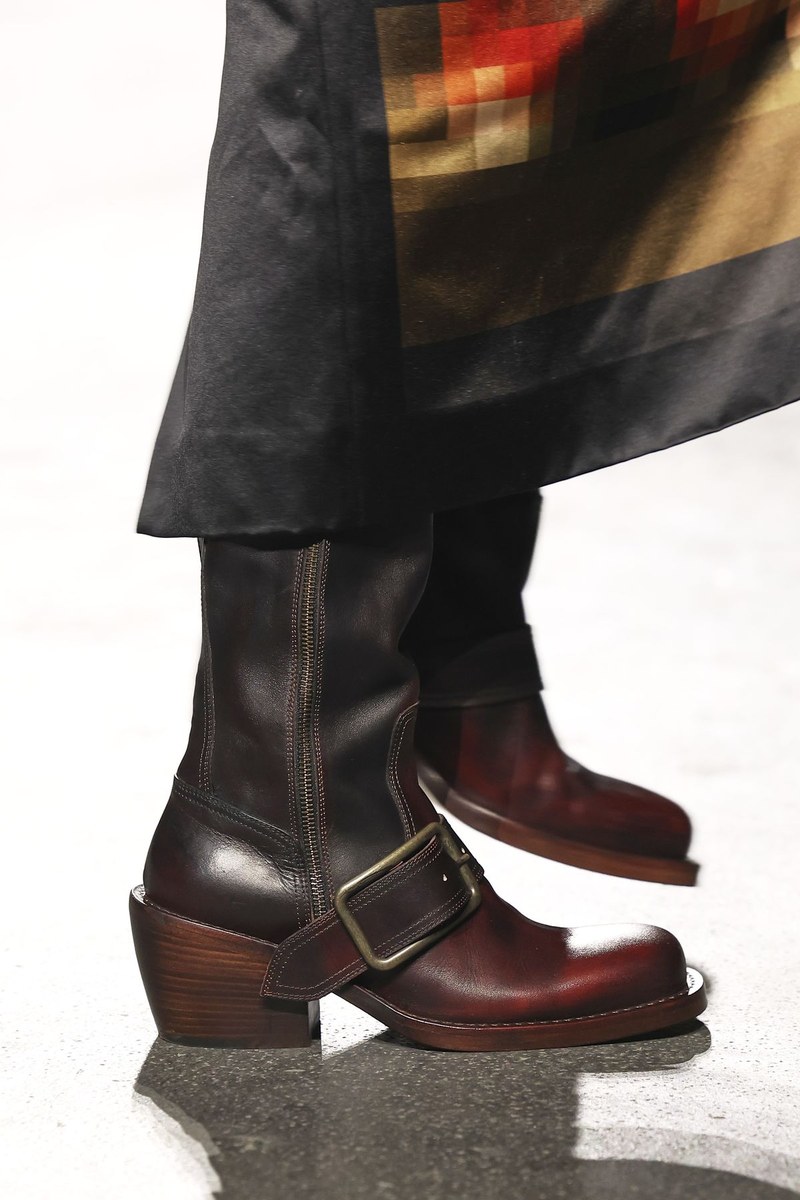
The footwear program hinges on two distinct archetypes: a rugged, buckle-harness engineer boot built on a stacked wooden heel, and a razor-thin stiletto pump worn with voluminous patterned socks. Buyers and product managers should read this as a deliberate bifurcation strategy. It serves both the workwear-adjacent market and the more directional fashion tier simultaneously.
Silhouettes and Construction
A mid-calf to knee-height pull-on or zip-back boot with a square or subtly rounded toe cap dominates the range. The stacked wooden block heel measures approximately 6 to 7 centimeters. A second silhouette, equally clear, is a pointed-toe stiletto pump with a slim metal heel pin of roughly 10 to 11 centimeters, constructed with a Mary Jane-style ankle strap and a buckle closure. Both sit on flat, lug-adjacent rubber outsoles with visible white or contrast welt stitching at the toe box. Several boots incorporate a front zip running the full shaft length, a detail that signals production complexity but adds significant commercial appeal.
Materials and Finishes
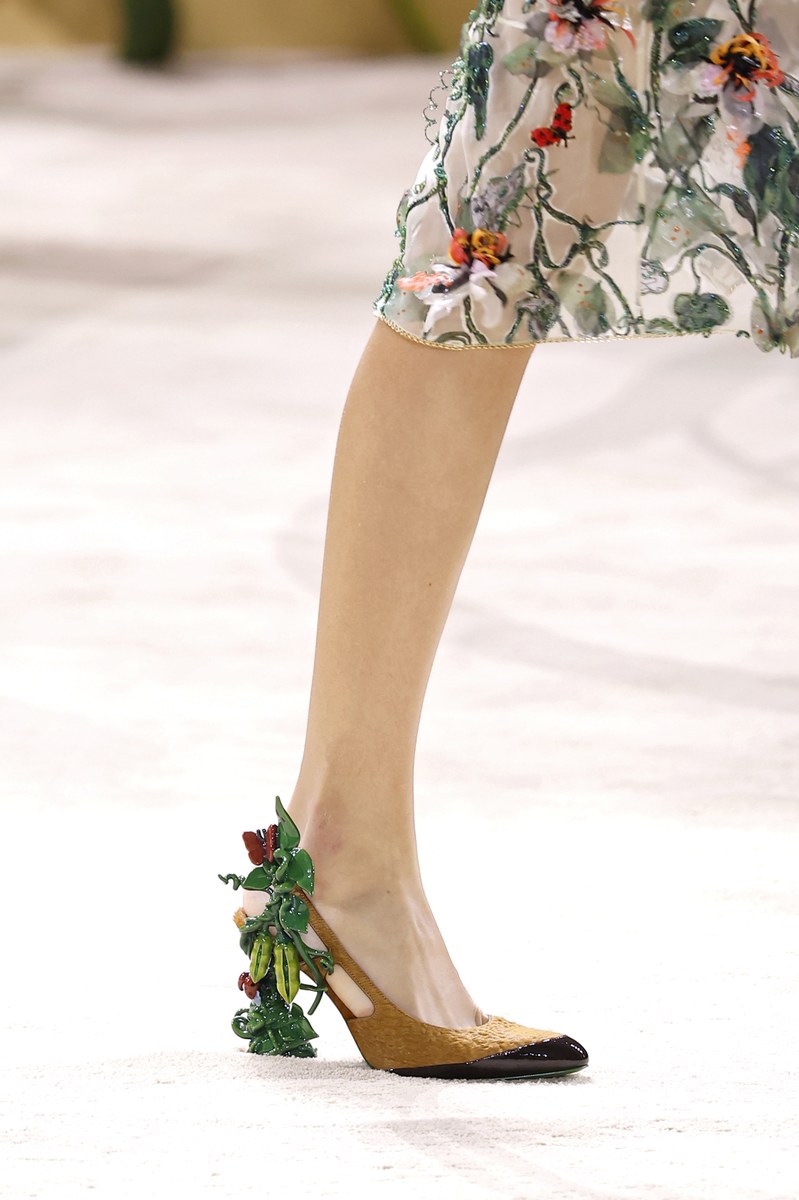
Full-grain smooth leather with a high-shine burnished finish on the lower quarter and toe characterizes the engineer and pull-on boots, graduating to a matte or slightly distressed surface toward the shaft. Shoes 9, 10, 11, 14 and 20 introduce a patchwork construction combining python-embossed leather panels with woven floral tapestry fabric, creating a mixed-media upper that demands careful material sourcing and panel alignment in production. Antique brass hardware with a rectangular frame sits on a leather keeper strap that wraps the lower shaft across the buckle boots. Dark leather with a subtle two-tone burnish at the toe characterizes the stiletto pumps in Shoes 3, 7, 16 and 18.
Color Direction
Deep oxblood and dark brown dominate the leather boots, with the oxblood concentrating at the toe and heel counter through a hand-finished burnish technique. Black leather appears in Shoes 4, 6 and 12, providing a cleaner commercial option within the same silhouette family. Sage green, dusty rose, camel and black floral motifs combine with the neutral snake-emboss ground across the tapestry and python patchwork boots, which read as their own color story. Near-black with a deep burgundy burnish undertone characterizes the stilettos, kept deliberately subdued so the patterned sock becomes the focal point.
Key Models and Details
The harness engineer boot appears across Shoes 1, 4, 6, 8, 12 and 17 and serves as the core commercial model, differentiated by shaft height and leather tone rather than structural changes. A single wide buckle strap placed at the ankle, antique brass hardware, a stacked wood-effect block heel, a metal toe tap at the square toe, and a back zip for entry comprise its key elements. Shoes 2, 5, 13, 15 and 19 show the pull-on cowboy-influenced boot, which omits the buckle entirely and relies on topstitching along the vamp seam as the primary visual detail. Without visible branding, the stiletto pump reads as a clean, brandless platform, making it highly licensable or adaptable for private label production.
Shoe by Shoe Highlights
Shoe 1 The ankle-height harness boot in oxblood burnished leather with a single antique brass rectangular buckle and a 6-centimeter stacked heel sets the foundational commercial model for the collection.

Shoe 5 A knee-height pull-on in mid-brown distressed leather with a wedge-adjacent block heel and no hardware presents the most accessible silhouette for mainstream department store buyers.

Shoe 7 The stiletto pump in floral tapestry with a green paisley knit sock draped over the vamp and a gold metal pin heel emerges as the collection's most editorial image, built for press placement rather than volume production.

Shoe 9 Combining rose-printed tapestry panels with python-emboss leather sections on a wide wood block heel, this ankle boot stands as the strongest candidate for limited-edition or capsule production given its material complexity.

Shoe 12 The full-length black leather zip boot with the large rectangular buckle strap and contrast oxblood burnish at the lower shaft reads as the most season-neutral option and the safest reorder bet within the harness family.

Shoe 16 A black leather pointed-toe stiletto with a slim metal pin heel, Mary Jane strap, and grey paisley knit sock confirms that the sock-as-accessory layering is a deliberate styling directive rather than a one-off runway device.

Shoe 19 The mid-calf pull-on in heavily mottled dark chestnut leather with pronounced topstitching and a rubber platform outsole represents the most wearable update on the cowboy boot silhouette and the strongest crossover piece for the contemporary women's market.

Shoe 4 A knee-high black leather zip boot with back zip, antique brass buckle strap and a stacked wood heel carries a yellow paint mark at the sole edge visible in the photo, suggesting a production marking that may translate to a colorblock sole detail in final samples.

Operational Insights
Material sourcing: The tapestry and python-emboss patchwork boots require two distinct upper material streams with precise panel engineering. Lead times on woven tapestry fabric and embossed exotic-look leather should be confirmed separately, as mismatches will delay production schedules.
Heel component: A single shared last insert across the engineer and pull-on boot families will reduce unit costs significantly at scale, since the stacked wood-effect block heel appears consistent in height and profile throughout.
Silhouette tiering: Three commercial levels emerge naturally from the range: the clean pull-on boot for volume, the harness engineer boot for mid-tier fashion accounts, and the tapestry patchwork boot and stiletto for specialty and luxury retail. Assortment ratios should be planned accordingly rather than treating the range as uniform.
Sock styling: Paisley and floral knit socks pair repeatedly with the stiletto pump across Shoes 3, 7, 16 and 18, signaling a bundled accessory opportunity. Co-branded or coordinating sock SKUs alongside the shoe warrant evaluation for wholesale or direct-to-consumer bundling.
Toe hardware: A metal toe tap visible on multiple engineer boots, including Shoes 1, 8 and 17, adds weight and cost while communicating durability and a workwear reference. Fashion-forward accounts should retain it, while more commercial channels should assess whether it is structurally necessary or purely aesthetic.
More Shoes
More Shoes
More Shoes


✦ This report was generated with AI — combining human editorial vision with Claude by Anthropic. Because the future of fashion intelligence is already here.