Dries van Noten FW26 Women Looks Report

Dries van Noten FW26 Women Looks Report
Did you know? Dries van Noten was the only designer among the famous "Antwerp Six" who chose not to show his debut collection at London Fashion Week in 1986, instead presenting directly to press and buyers, establishing an independent approach to brand building that he maintains today without a traditional advertising budget.

Dries van Noten FW26 Women Looks Report

Paris Fashion Week

Dries van Noten's final collection as creative director builds a layered visual archive, pulling school uniform codes, Old Master painting references rendered in pixelated print, folk-knit textures, Liberty-style florals and raw denim into a single extended wardrobe argument. For buyers, this is a collection that asks how much complexity a customer will tolerate at full price, and answers with conviction that the answer is: a great deal.

Silhouette and Volume

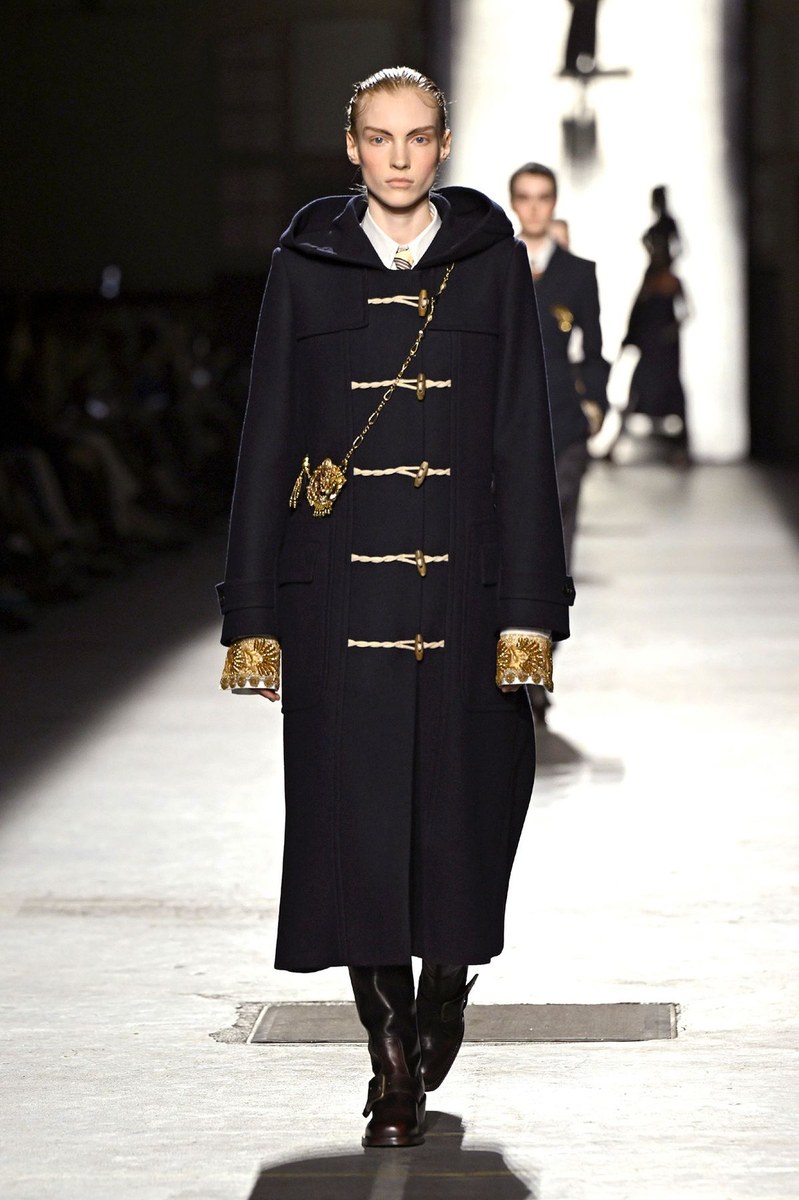
Length dominates throughout, with midi and maxi skirts, full-length coats and dropped-crotch trousers forming the structural backbone across nearly every look. Volume sits high at the shoulder in the tailored pieces, particularly the blazers in Looks 2, 6 and 44, where structured lapels and wrap construction create a broad, almost architectural upper body against a narrower or fluid lower half. Outerwear alternates between the extreme cocoon of Looks 27, 29 and 39, where the garment swallows the body entirely, and the more controlled A-line discipline of the duffle coats in Looks 1, 40 and the satin frock coat in Look 4. The approach is deliberately oscillating between containment and release, and that range gives buyers multiple entry points across customer body preferences.
Look 4
Look 4

Color Palette

A strict navy and black grammar opens the collection, punctuated by gold embroidery, before expanding through chartreuse and olive tartan in Looks 10, 11 and 12, and reaching its warmest register with the burnt sienna, rust and orange floral prints of Looks 45, 46 and 47. Acid yellow-green appears as both a woven ground and a lining flash, most legibly in Look 18 where neon yellow gloves cut against a dark floral jacket. Black functions as a reset tone across Looks 4, 44, 47, 50 and 61, each time anchored by gold passementerie, embroidery or trim that keeps it from reading as minimal. Muted, almost camouflage-like khaki, terracotta, rose and forest green move through the pixelated prints in Looks 14, 15, 26, 51 and 57, sitting tonally between the sharp tartan chapter and the high-contrast floral chapter.

Look 18
Look 18

Materials and Textures

A deliberately wide material range moves through the collection, from heavy boiled wool in the duffle coats and blazers, to liquid satin in Looks 4 and 59, to stiff brocade in Look 17, to quilted and padded outerwear in Looks 11, 29 and 39. Denim arrives mid-collection and runs through Looks 31, 32, 36, 51, 53, 55 and 58, where it reads not as casual interruption but as a deliberate grounding fabric against elaborate embroidery and pixel-printed tops. Dense, multi-yarn jacquard constructions in Looks 19, 21, 28 and 37 read as woven from a distance, built for warmth and visual weight rather than drape. Silk-ground florals, appearing in Looks 20, 22, 23, 25, 27 and 60, carry a burnished, slightly antiqued surface quality that separates them from brighter commercial floral references.

Look 17
Look 17

Styling and Layering

Systematic layering across categories places knit cardigans over white shirts with ties, wraps blazers over draped inner garments and slides quilted coats over skirts in contrasting prints, so that virtually no look reads as a single garment. A white poplin shirt with embroidered gold cuffs recurs as a unifying base through Looks 3, 7, 28, 30, 31 and 35, functioning as a connective anchor across otherwise disparate outerwear and bottom weights. Footwear is consistent and commercially deliberate: tall dark brown leather riding boots run through the vast majority of looks, occasionally replaced by ankle boots with paisley-print socks, maintaining a resolved, wearable base that does not compete with the complexity above the knee. Structured leather backpacks and top-handle styles appear sparingly, keeping accessory complexity low and leaving room for buyers to build their own accessory strategies against these pieces.

Look by Look Highlights

Look 1 The navy duffle coat with ivory toggle closures and gold bullion-embroidered cuffs and belt bag sets the collection's central idea immediately: institutional outerwear remade with decorative density that reads as heirloom rather than costume.

Look 1
Look 1

Look 6 The cobalt blue blazer with white piping and a matching striped inner vest layered over black side-stripe trousers lands as one of the most commercially clean looks, separating easily into individual units for buying.

Look 6
Look 6

Look 17 A full-length hooded duffle coat in green and gold botanical brocade, with toggle closures and matching printed trousers and boots, reads as the most maximalist single-piece statement and its clearest candidate for editorial placement.

Look 26 The double-breasted trench coat in a full-body pixelated print, carried in a cool grey, dusty rose and olive palette, paired with a heavy floral tapestry bag, directly addresses buyers looking for a print outerwear piece with broad appeal across age demographics.

Look 26
Look 26

Look 38 A cropped black blazer with nude leather trim and a gold lion brooch over a long tiered skirt built from horizontal bands of brocade, ikat, lace and embroidery constructs one of the most technically complex bottoms, with strong potential as a made-to-order or capsule exclusive.

Look 38
Look 38

Look 45 The belted orange floral satin trench, with black ground and large-scale rose print, carries immediate seasonal energy and sits apart from the darker register, making it the most accessible entry point for color-driven buyers.

Look 45
Look 45

Look 58 A double-breasted denim trench coat with gold embroidered cuffs and a wide woven obi-style belt with fringe tassels marries utility fabric construction with couture embellishment, a pairing that will photograph well and position strongly in premium denim adjacency.

Look 58
Look 58

Look 61 The closing black wool coat with horizontal gold passementerie bands, fringe trim and paisley printed hem border over straight denim jeans ends on a note of controlled grandeur, and its coat-over-denim logic translates directly into a high-sell-through commercial formula.

Look 61
Look 61

Operational Insights

  • Print exclusivity: The pixelated Old Master motif prints across Looks 2, 4, 14, 15, 26, 51, 54, 57 and 59 carry strong intellectual property value. Style directors should confirm exclusivity windows and whether prints will be available across categories or limited to specific silhouettes.
  • Modular unit strategy: The white poplin shirt with gold-embroidered cuffs and the striped tie function as a system base across at least eight looks. Buyers should consider buying these separates in depth as they activate multiple outfit builds with existing customer wardrobe pieces.
  • Denim integration: At least eight distinct looks feature denim, always elevated by embroidery, embellishment or luxury outerwear pairing. Product managers at premium department stores should flag this as a narrative tool for floor merchandising, placing denim units alongside brocade and embellished coats rather than in a separate denim zone.
  • Footwear alignment: The consistent tall brown riding boot across the runway provides a direct co-merchandising signal. Footwear buyers should source or commission a brown tall boot at accessible and premium price points to complete the look logic on floor.
  • Coat depth and timing: At least twelve distinct coat silhouettes move through the collection including brocade duffles, satin frock coats, pixelated trenches, floral satin coats, denim trenches and heavily embroidered wool overcoats. Given this breadth, style directors should tighten assortment to no more than four coat styles per door to avoid category dilution and protect margin on the highest-embellishment units.

Complete Collection

Look 2
Look 2
Look 3
Look 3
Look 5
Look 5
Look 7
Look 7
Look 8
Look 8
Look 9
Look 9
Look 10
Look 10
Look 11
Look 11
Look 12
Look 12
Look 13
Look 13
Look 14
Look 14
Look 15
Look 15
Look 16
Look 16
Look 19
Look 19
Look 20
Look 20
Look 21
Look 21
Look 22
Look 22
Look 23
Look 23
Look 24
Look 24
Look 25
Look 25
Look 27
Look 27
Look 28
Look 28
Look 29
Look 29
Look 30
Look 30
Look 31
Look 31
Look 32
Look 32
Look 33
Look 33
Look 34
Look 34
Look 35
Look 35
Look 36
Look 36
Look 37
Look 37
Look 39
Look 39
Look 40
Look 40
Look 41
Look 41
Look 42
Look 42
Look 43
Look 43
Look 44
Look 44
Look 46
Look 46
Look 47
Look 47
Look 48
Look 48
Look 49
Look 49
Look 50
Look 50
Look 51
Look 51
Look 52
Look 52
Look 53
Look 53
Look 54
Look 54
Look 55
Look 55
Look 56
Look 56
Look 57
Look 57
Look 59
Look 59
Look 60
Look 60

Fashion Designer

Julian Klausner was born in Antwerp and grew up in Brussels, in a household shaped by design on both sides: his father worked in architecture, his mother restored Art Deco furniture. The family home was close to La Cambre, the visual arts school, and as a teenager Klausner started attending its graduate shows, drawn in by a friend of his older sister. By his mid-teens he was consuming Margiela and Helmut Lang and, eventually, stumbling into the Dries Van Noten store in Antwerp. He has described that visit as the moment something clicked.

He completed his BA and MA at La Cambre in 2016, part of a generation from that school that would go on to hold some of fashion's most watched positions. After interning at Thom Browne and Kenzo, he joined Maison Margiela as a junior designer, working under John Galliano during what he calls "fashion heaven," an apprenticeship in storytelling and absolute creative commitment. In 2018 he heard through a friend that Dries Van Noten was looking for a womenswear designer. The studio was small, the team stable, the atmosphere like nothing he had encountered. He said yes within seconds.

Over six years he quietly became indispensable: head of womenswear, casting director, image director, studio organizer, and the person Van Noten called when he needed someone to push an idea further. Klausner has said he thinks he encouraged Van Noten to embrace bolder expressions. He oversaw the celebrated Christian Lacroix collaboration and shaped collections whose DNA he now carries forward as their sole author. His first womenswear runway collection as creative director was shown at the Opéra Garnier in Paris in March 2025, built around the power of costume and childhood dressing-up boxes. His theatre and dance references run deep. He does not have public social media. He cooks, sees friends, has long conversations.

"What I learnt from John is really the storytelling, the absolute dedication and commitment to an idea."

"The last thing I want to do is imitate Dries. I want to push it forward and do something new out of it."

✦ This report was generated with AI — combining human editorial vision with Claude by Anthropic. Because the future of fashion intelligence is already here.