Edeline Lee FW26 Details

Edeline Lee FW26 Details
Edeline Lee FW26 Details Report

Edeline Lee FW26 commits fully to structural detailing as the primary decorative language, replacing ornament with construction itself, whether through rope lattice, ribbon strapping, wide sash bows, or sculptural hardware. For buyers and product managers, this signals a market appetite for garments where the detail is the product story, reducing reliance on separate accessories investment.

Category Overview

All 15 details fall within the Dress Detail category, which means the collection positions garment construction as its own accessory tier. Belting, knotting, strapping, pleating, and open lattice work carry the visual weight that jewelry or bags might otherwise handle. Material discipline is strict: every detail reads as an extension of the garment fabric rather than an applied embellishment, with the single exception of the white circular ring buckles in Details 5 and 14 and the H-bar buckle in Detail 11. The approach is directional but commercially scalable, rewarding strong in-house construction capability over trend-led accessory sourcing.
Detail 11
Detail 11

Material and Construction

The collection spans textured crepe, smooth matte jersey, ribbed knit, woven rope cord, silk-weight satin, and structured poplin. Knitwear in Details 3 and 4 deploys raised rib channels as structural seaming, creating dimensional surface relief without added material. Rope and strap construction in Details 2, 9, 12, and 13 use the garment's own fabric cut into long strips or round cords, then assembled into cage and fringe formations. Detail 8 introduces the only applied embellishment: a column of white crystal or bead fringing cascading from a pleated sleeve split, which reads as precise and restrained against the navy ground.

Detail 8
Detail 8

Color and Finish Direction

Three color groups organize the collection: off-white and ivory in Details 1 through 4, navy and deep indigo in Details 5 through 10, and burnt terracotta orange in Details 11 through 15. Within each group, the palette stays mono, broken only by white hardware accents on buttons and buckles in the navy and orange ranges. Off-white pieces carry a warm, slightly yellowed tone rather than a cold white, reading closer to cream and positioning the collection toward a sophisticated, non-bridal palette for the white market. Terracotta orange in Details 11 through 15 is saturated and warm, closer to clay than coral, which aligns with the broader market shift toward earthy mid-tones for autumn delivery.

Key Pieces and Details

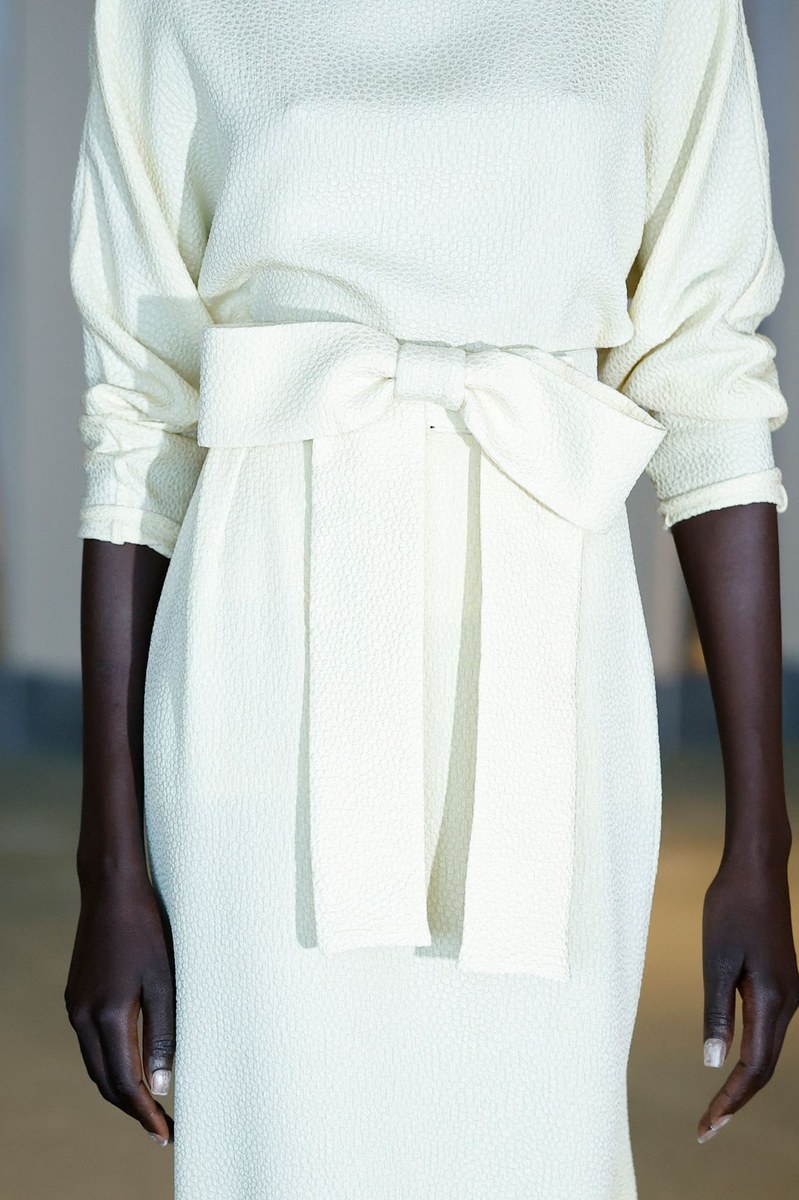
The wide self-fabric sash bow in Details 1 and 7 is the most commercially transferable detail across the range. It reads as a standalone waist accessory that buyers could pitch as an add-on belt product using remnant fabric from core dress production. The cage rope skirt in Detail 9 and the lattice sleeve in Detail 2 represent the collection's structural high point, requiring advanced cut-and-assembly skills but producing a visual payoff with strong editorial and wholesale pull. Circular ring buckles appearing in Details 5 and 14 function as the only recurring hardware motif and offer the clearest licensed or diffused product opportunity. Both are finished in gloss white resin or lacquered metal.

Detail 9
Detail 9

Detail by Detail Highlights

Detail 1 (Dress Detail) A wide self-fabric sash in textured ivory crepe ties into a flat, structured bow at the front waist, with two long vertical tails dropping past the hip.

Detail 1
Detail 1

Detail 2 (Dress Detail) The right sleeve dissolves into a three-dimensional cage built from the same ivory fabric cut into flat strips and assembled in a grid formation that creates a lantern silhouette from shoulder to wrist.

Detail 2
Detail 2

Detail 3 (Dress Detail) A cropped ivory knit cape closes at the neck with a single covered button, its front edges framed by eight parallel raised rib channels that arc from shoulder to center, mimicking structural boning.

Detail 3
Detail 3

Detail 7 (Dress Detail) The navy version of the self-fabric sash bow uses a dotted pebble-texture crepe, and the bow reads fuller and more dimensional than its ivory counterpart in Detail 1 due to the heavier fabric weight.

Detail 7
Detail 7

Detail 8 (Dress Detail) A column of dense white crystal fringe, approximately 20 centimeters long, is anchored at the inner seam of a pleated navy sleeve split, creating a single vertical accent that catches light against the matte ground.

Detail 9 (Dress Detail) The navy rope cage skirt uses round tubular cord in the garment's own indigo color, looped from a fitted waistband into wide vertical drops that splay outward at the hem to form a full cage volume.

Detail 11 (Dress Detail) An H-bar buckle in gloss white metal or resin sits centered on a wide terracotta self-belt, its geometric negative space providing a clean graphic contrast against the saturated orange ground.

Detail 12 (Dress Detail) Long terracotta fabric strips, cut from the skirt body itself, fall from the waistband in irregular vertical lines and terminate in looped rings at the hem, creating a fringe-meets-hoop-skirt construction.

Detail 12
Detail 12

Operational Insights

Hardware sourcing: The white ring buckle appearing in Details 5 and 14 and the H-bar buckle in Detail 11 are the only hardware components across all 15 details. Buyers should identify a single hardware supplier capable of producing both profiles in lacquered resin and polished metal to consolidate MOQs.

Fabric efficiency: Round cord in Detail 9, strip fringe in Detail 12, and the cage sleeve in Detail 2 all use the parent garment fabric cut into continuous strips, which enables low-waste production if pattern cutting is sequenced correctly from the outset.

Construction grading: Cage and lattice structures in Details 2, 9, and 12 are not grade-friendly at standard RTW tolerances. Product managers should flag these as fixed-size production items or invest in grading studies before confirming size ranges beyond a core three.

Color blocking opportunity: Strict mono-color discipline within each of the three palette groups means capsule packaging by color story is straightforward. Buyers can build a white capsule, a navy capsule, and a terracotta capsule with internal coherence and no cross-color coordination risk at retail.

Belt as standalone SKU: Details 1, 7, and 15 all feature waist-defining elements that function independently of the garment body. Brands with existing dress programs should evaluate the wide self-fabric sash as a separate belt SKU produced in the core season fabrics, which extends the garment offer without additional design development cost.

More Details

Detail 4
Detail 4
Detail 5
Detail 5
Detail 6
Detail 6
Detail 10
Detail 10
Detail 13
Detail 13
Detail 14
Detail 14
Detail 15
Detail 15

✦ This report was generated with AI — combining human editorial vision with Claude by Anthropic. Because the future of fashion intelligence is already here.