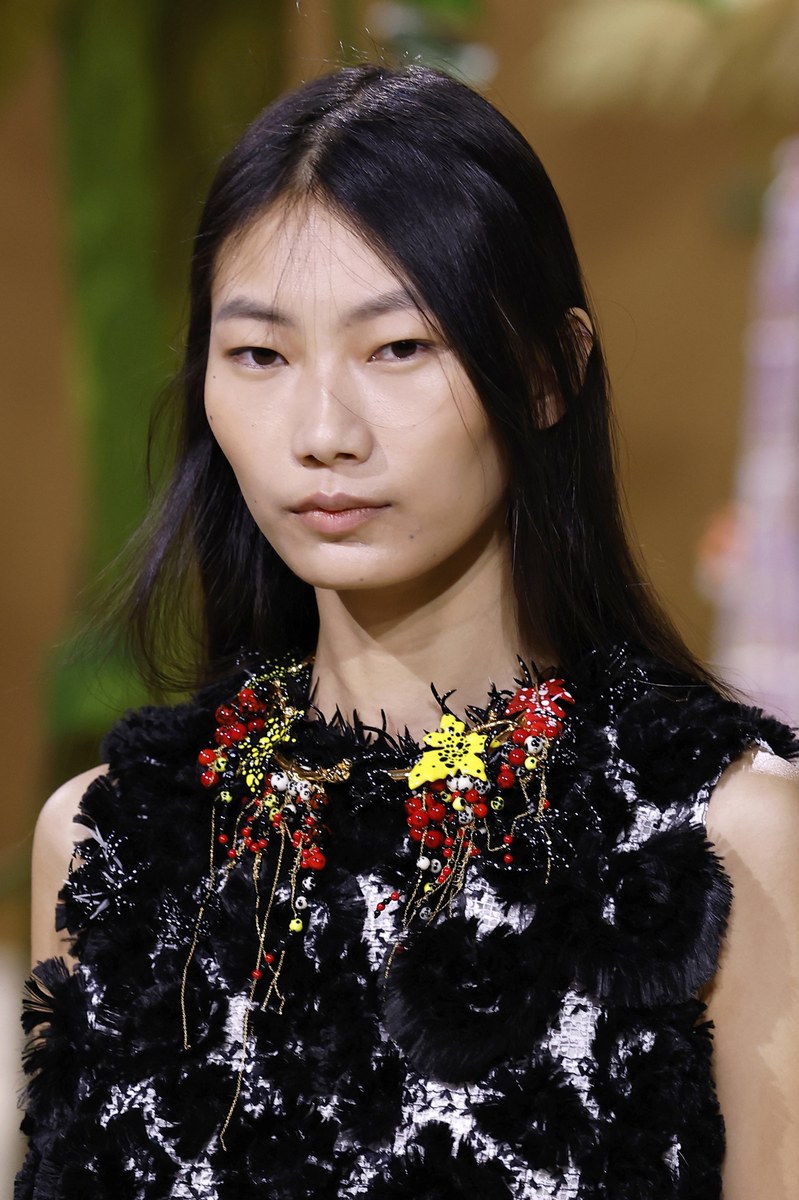
Elie Saab FW26 Women Looks Report
Paris Fashion Week
Elie Saab FW26 operates across two distinct registers: architectural daywear built on croc-embossed patent and structured wool, and grand evening construction anchored in lace, taffeta, and watercolor-print silk. For buyers, this dual approach widens the commercial window significantly, placing the house in both the luxury occasionwear and the premium ready-to-wear conversation simultaneously.
Silhouette and Volume
Two parallel silhouette tracks run through the collection without ever quite meeting, and that tension feels intentional. Daytime favors a sharp, abbreviated torso with cropped jackets over slim cropped trousers (Looks 2, 5, 22), keeping volume entirely above the hip. Evening pivots hard into sculptural skirt mass, from the gathered taffeta ballgowns of Looks 20 and 60 to the draped, asymmetric column of Look 57. Bodycon columns appear in lace and embroidery throughout the evening section (Looks 38, 40, 51, 56), forming a clean counter-argument to all that displaced volume.
Color Palette
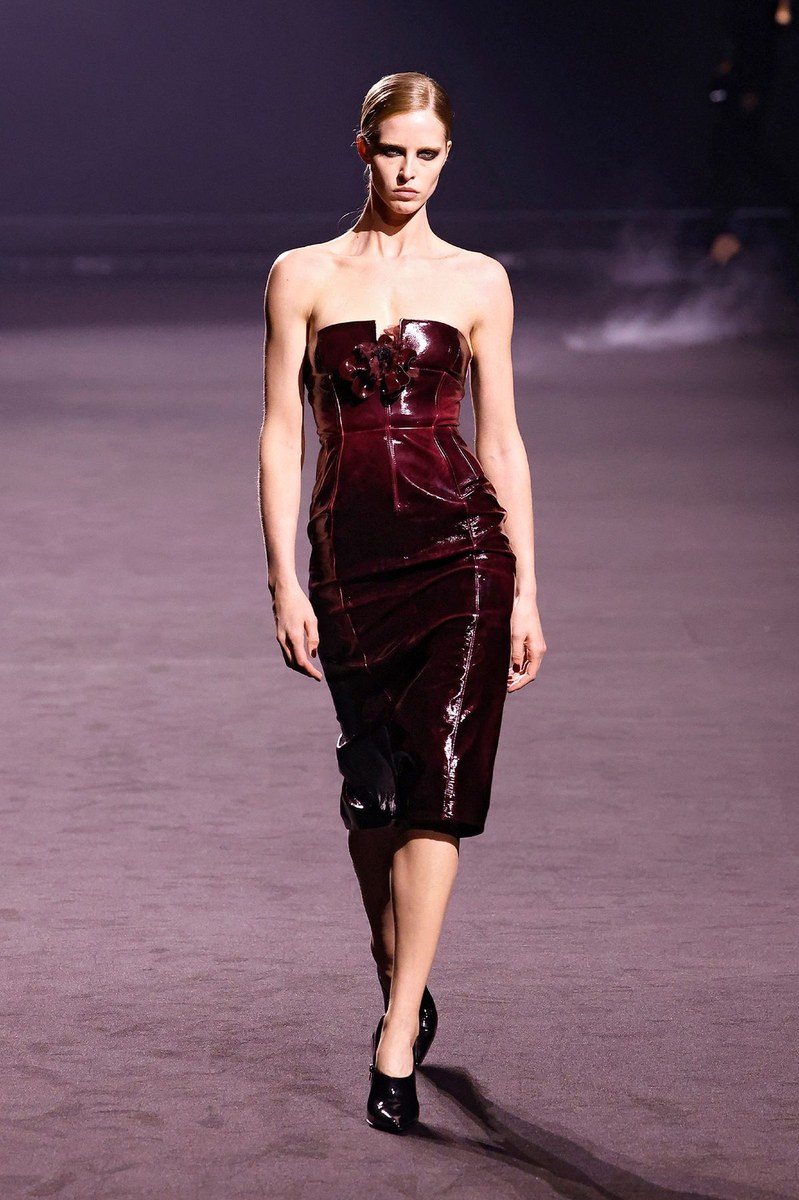
Deep burgundy and oxblood anchor the first third, appearing in patent (Look 1), croc-embossed suiting (Look 27), and velvet (Look 41). Black dominates the mid-collection, running from matte wool to lacquered croc to sheer lace with no tonal break between categories. Nude and blush enter deliberately in the evening section, most prominently in the crystal-encrusted columns of Looks 47 and 56 and the ivory lace peplum of Look 12. A painterly watercolor floral print in dusty pink, grey-violet, and muted red closes the collection across taffeta and organza (Looks 60 through 63), functioning as the single sustained chromatic statement.

Materials and Textures
Patent croc-embossed leather or its fabrication equivalent runs through at least twelve looks, shifting in colorway from black to chocolate brown to oxblood, always with a high-gloss, rigid surface that holds structure without boning (Looks 3, 4, 8, 27, 33, 55). Taffeta carries the volume plays, with enough crisp body to sustain the gathered skirt masses in Looks 14, 20, 29, and 54 without collapsing at the hem. At least eight evening looks feature lace, ranging from flat Chantilly-weight panels (Look 7) to heavily dimensional guipure with sequin overlay (Looks 9, 38, 51). Crushed velvet appears on the oversized jackets of Looks 11 and 25, adding deliberate weight contrast against the fluid chiffon and organza of the gown closers.

Styling and Layering
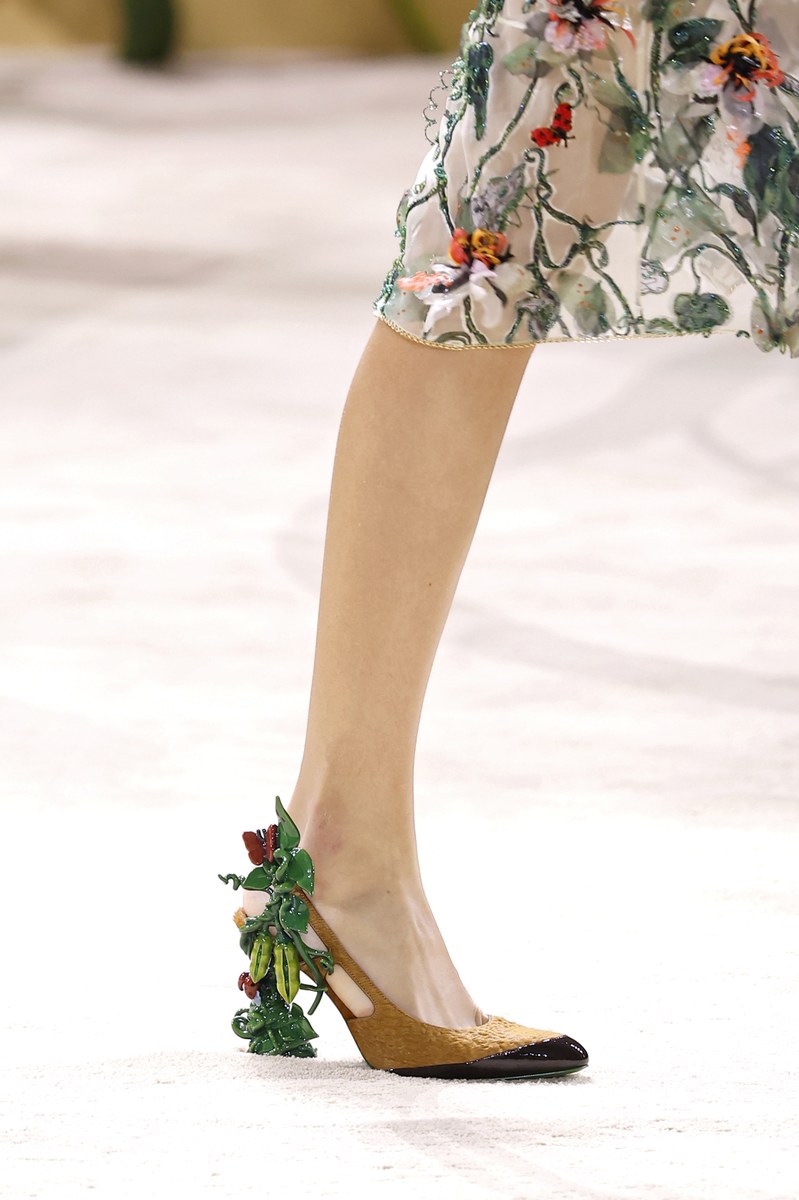
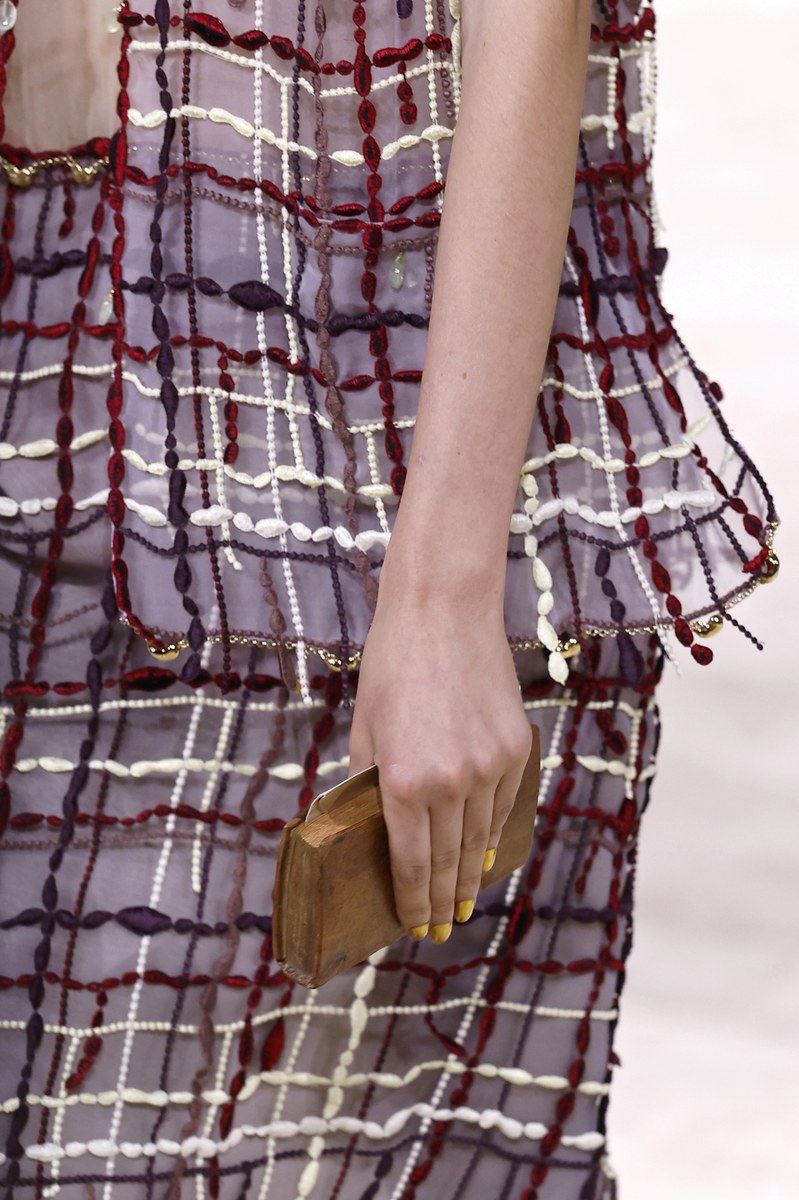
Mid-forearm leather gloves link the two registers, appearing consistently across both daywear and evening looks (Looks 12, 18, 35, 51, 52). Patent pointed-toe pumps in black or oxblood dominate the first half, while metallic silver pumps and croc-embossed heels carry the evening section. Bags remain compact, structured clutches in patent croc, never shoulder bags, which keeps the daywear proportion clean. A floral corsage rendered in patent leather or velvet recurs at the shoulder or chest across Looks 1, 2, 5, 9, and 52, serving as the house's recurring ornamental signature rather than an afterthought.
Look by Look Highlights
Look 1 The burgundy patent strapless sheath with a tonal patent corsage reads as the clearest single-item commercial proposition in the collection, priced and silhouetted for red-carpet rental and luxury retail equally.
Look 8 A full-length black croc-embossed trench coat with a defined waist seam and front slit emerges as a strong outerwear hero, with structured construction that makes it viable as a standalone category driver.

Look 16 Black-and-white croc-print appears in a strapless column gown, introducing the only true graphic contrast moment. Priority for press samples due to its distinct editorial impact.

Look 29 Halter-neck lace bodice over a black satin gathered ballgown skirt combines two dominant material languages in one look, with construction complexity that positions it squarely as a made-to-order or trunk-show piece.

Look 38 High-neck, long-sleeve black floral lace column with dense sequin embroidery represents the most technically demanding piece in the evening section and showcases the house's embroidery ateliers at full capacity.

Look 47 Crystal-encrusted nude slip column with structured boning channels 1990s bias-cut vocabulary through a maximalist lens. Its embellishment density makes it a clear awards-season placement candidate.

Look 60 Deep V-neck floral watercolor ballgown in blush and pink taffeta closes the narrative arc and functions as the lead image piece, with volume and print that will read at distance in both editorial and red-carpet contexts.

Look 63 Halter-neck floral ballgown in grey-violet and pink crinkled taffeta with a ruffled neckline stands as the strongest commercially differentiated piece in the closing group, since the structured bodice and full skirt proportion suit both gala and bridal-adjacent markets.

Operational Insights
Patent croc fabrication dominates across 12 or more looks, signaling strong potential for a licensed or capsule goods extension in small leather goods, belts, and shoes using the same embossed finish to build category coherence.
Watercolor floral print appears only in the final six looks but stands as the most distinct proprietary print in the collection, making it a priority candidate for fabric exclusivity negotiation if buyers want to protect differentiation in the evening market.
Embroidery complexity tiering across the lace gowns (Looks 9, 38, 47, 51, 56) suggests a natural good-better-best pricing architecture within the evening segment. Buyers should map lead times against each tier before committing to delivery windows.
Leather gloves appear consistently enough across both day and evening looks to warrant consideration as a standalone accessory buy, particularly in the patent black finish, which aligns with the footwear and bag palette throughout the collection.
Taffeta volume construction in the ballgown closers (Looks 20, 29, 54, 60, 61, 63) carries significant fabric yardage requirements and internal structure. Product managers should flag extended production lead times and higher per-unit cost when planning floor allocation or trunk-show inventory.
Complete Collection


Fashion Designer

Elie Saab was born in 1964 in Damour, a coastal town in Lebanon, the eldest of five children. At nine he was already cutting patterns from newspaper and fashioning dresses out of whatever fabric he could find in his mother's closet, using his sisters as his models. His parents, like many, hoped he would become a doctor or an engineer. At eighteen, he opened his first atelier in Beirut. The year was 1982, and Lebanon was in the middle of a civil war. His first show, held at Casino du Liban, made the next day's newspapers alongside photographs of the conflict, a contrast that stayed with him.
He had no formal training beyond a brief spell at a design school in Paris before returning home. Everything else he taught himself, learning by doing: local women began buying from him, word spread to high society, and his client base grew steadily outward from Beirut. He has often said that architecture was his second love, and that Beirut's buildings, their clean lines, their pale limestone, their layered detail, informed his sense of structure. The body, for him, comes before the pencil. He drapes on the form before sketching. The waist is the center of everything.
The international breakthrough came in 1997 when he became the first non-Italian designer invited to show at Rome's Alta Moda Fashion Week. He moved cautiously, testing the European market before entering Paris. In 2002, Halle Berry wore one of his gowns to the Academy Awards, the moment that made his name globally known overnight. In 2003 he was admitted to the Chambre Syndicale de la Haute Couture as a membre correspondant, the first Arab designer to hold that distinction. His main atelier remains in Beirut. In 2013, in partnership with the London College of Fashion, he launched a bachelor's degree in fashion design at the Lebanese American University, training the next generation of Lebanese designers at home.
"Lebanon has been systematically associated with war and conflict. Thanks to couture, today I am the positive face of Lebanon."
"It's the body that dictates, not the pencil."
✦ This report was generated with AI — combining human editorial vision with Claude by Anthropic. Because the future of fashion intelligence is already here.