Emilia Wickstead FW26 Women Looks Report
London Fashion Week
Emilia Wickstead FW26 builds a wardrobe around the tension between tailored restraint and deliberate disruption, mixing Prince of Wales checks, bouclé, leather and satin across silhouettes that range from sharply structured to architecturally draped. For buyers navigating a market that wants occasion dressing with daywear utility, here's a collection that delivers both in a single transaction.
Silhouette and Volume
Two clear poles anchor the silhouettes: a fitted, military-influenced jacket-and-skirt proportion (Looks 5, 18) and a dramatically volumized A-line or full-circle skirt shape (Looks 9, 14, 19). Wide, pleated trousers sit low and pool slightly at the ankle (Looks 2, 13), while dresses move between body-skimming midi tubes and sculptural, floor-grazing forms. Look 12 stands apart with a wrapped, origami-folded cocoon silhouette in a single fabric that eliminates all construction lines.
Color Palette
Charcoal, warm ecru, and black dominate, with brown and dark chocolate recurring as grounding tones across Looks 1, 8, 11, 12 and 18. A full-volume scarlet suit in Look 18 and an acid-yellow green in Look 17 act as isolated chromatic punctuation against the otherwise muted field. Look 14 breaks entirely with a golden-ochre silk print carrying pale blue floral blooms, while Look 15 delivers undiluted gold sequin and fringe for a close-the-show evening moment.

Materials and Textures
Check and plaid wools dominate the first half, ranging from a tightly woven grey Prince of Wales (Looks 3, 6, 16) to a warmer, looser brown houndstooth (Look 8). Bouclé appears in heavy, frayed-edge iterations across Looks 4, 7 and 10, with a high surface texture that reads well at distance on a shop floor. Black leather arrives in two moods: matte and structured for the jacket-and-skirt combination in Look 5, and softer, draping for the coat weight of Look 1. Looks 11 and 12 introduce a smooth, dense scuba-weight chocolate fabric that holds sculptural form without stiffening.

Styling and Layering
Layering is the primary editorial device. A shirt, jacket and skirt are treated as three distinct but co-dependent garments rather than a two-piece coordinate, visible in Looks 5, 13 and 18, where each layer has its own hem, collar and fastening logic. Chambray denim appears as an underlayer in Looks 6, 7 and 13, its blue pushing through bouclé and check as a deliberately casual counterweight. Footwear stays low and utilitarian throughout, with black Oxford brogues, lace-up ankle boots and monk-strap block-heeled shoes carrying nearly every look. Cable-knit cardigans tied at the waist or carried loose in Looks 11, 14 and 17 add a portable softness to otherwise hard-edged outfits.
Look by Look Highlights
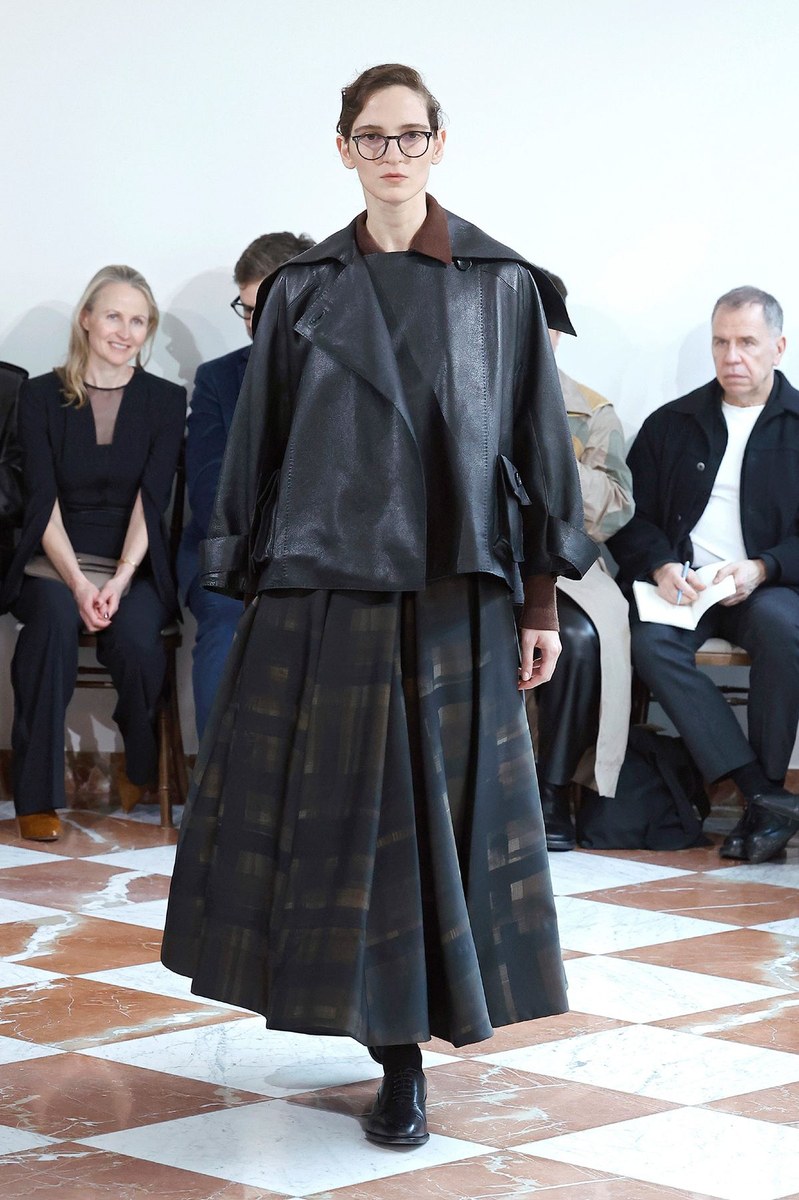
Look 1 A matte black leather oversized biker jacket worn open over a dark plaid full-length skirt with deep box pleats establishes the collection's key push-pull between hard material and fluid volume.

Look 6 A double-breasted Prince of Wales check longline coat with sharp, extended shoulders and deliberately deconstructed hem panels creates a strong wholesale story for buyers sourcing statement outerwear.

Look 9 A single-fabric taupe plaid coat dress with exaggerated gathered shoulders and a full, unlined A-line skirt reads as a direct ready-to-wear investment piece with minimal SKU complexity.

Look 13 A brown-and-cream Prince of Wales check power suit with a fragmented, multi-panel jacket construction layered over a chambray shirt and a mustard yellow knit creates the collection's strongest menswear-inflected commercial proposition.

Look 14 The golden-ochre floral print shirtdress with a full godet skirt and a camel cable-knit cardigan tied at the front is the most immediately giftable, editorially versatile piece for spring transition selling.

Look 15 A strapless gold sequin-and-fringe column dress worn with flat black sock boots is a deliberate contradiction in formality that gives event-wear buyers a modern alternative to full-length gowns.

Look 18 A scarlet double-breasted military jacket paired with a burgundy-panelled waistband and a scarlet pleated midi skirt delivers a tight tonal red dressing story that translates directly to capsule gifting edits.
Look 19 A strapless black-and-white floral appliqué ballgown with a sculptural three-dimensional rose at the waist closes with a made-to-order or trunk-show anchor with strong editorial placement potential.

Operational Insights
Check fabric depth: At least four distinct check and plaid weights appear here, from fine Prince of Wales suiting cloth to heavier overcoat bouclé. Buyers should confirm fabric minimums and lead times for each weight separately to avoid range compression at production.
Leather category risk: Looks 1 and 5 use leather as primary outerwear and skirt fabric. Given current leather supply volatility and price sensitivity in the mid-luxury segment, buyers should assess unit cost against their customer's price ceiling before committing to depth.
Denim as underlayer: Chambray shirts function as visible base layers under bouclé and tailoring (Looks 6, 7, 13), opening a commercial opportunity to sell the shirt as a standalone SKU with strong cross-sell logic to the tailored pieces.
Cable-knit accessory proposition: Carried cardigans in blue, green and camel (Looks 11, 14, 17) function as bag-adjacent accessories rather than garments in the styling. Product managers should evaluate whether these translate as a standalone knitwear accessory category with dedicated display and pricing.
Occasion-to-day conversion: At least six looks (Looks 5, 9, 11, 17, 18 and the suit in Look 13) move between daywear and occasion wearing without restyling. Style directors building curated floor sets should use this convertibility as the primary customer communication strategy rather than separating the collection into day and event segments.
Complete Collection


About the Designer
Growing up between cultures shaped Emilia Wickstead's approach to fashion in ways she could never have anticipated. Born in Auckland to a fashion designer mother who ran a boutique in Parnell, Wickstead's early exposure to the industry came through sitting in on client fittings while still in her school uniform. The dramatic shift at age 14, when her mother relocated the family to Milan, proved transformative. The contrast was stark and instructive. "Milan was all about women dressing for men and it was all about being feminine," she recalls, "as opposed to Auckland where the girls would wear board shorts over bikinis."
This cultural awakening continued through her studies at Central Saint Martins, where she graduated with honors in fashion design and marketing in 2007. Her post-graduation years were spent accumulating experience at some of fashion's most respected houses, including Giorgio Armani, Narciso Rodriguez, and Proenza Schouler, alongside editorial work at American Vogue. These positions taught her the mechanics of luxury fashion, but it was her return to London in 2008 that allowed her creative voice to emerge. With £5,000 from her boyfriend and a living room transformed into a showroom, she began creating made-to-measure pieces for friends and family, a model that would become the foundation of her business philosophy.
Wickstead's aesthetic draws from what she describes as a careful balance between tradition and surprise. Her collections consistently reference old Hollywood glamour and couture history, filtered through a contemporary lens that makes them relevant for today's women. She cites old films and vintage imagery as primary sources of inspiration, often discovering prints at vintage fairs that she then reimagines for her collections. Her approach to design centers on what she calls "effortless style," creating pieces that feel both polished and wearable, with unexpected details that elevate the familiar.
As both founder and Creative Director of Emilia Wickstead, she has built a global luxury brand that dresses everyone from the Princess of Wales to Michelle Obama, while maintaining the intimate, made-to-measure service that launched her career. The brand now encompasses ready-to-wear, homeware, and bridal collections, all carried by prestigious retailers worldwide while maintaining its flagship presence on London's Sloane Street.
"I always design with presence in mind, it's really about the experience of fine dressing and how a woman feels the moment she walks into a room," Wickstead explains. "As for design, I gravitate to traditional styles but mix it with an element of surprise. Whether it's a big sash bow in the back or an unexpected fabric, it all needs to work together."
✦ This report was generated with AI — combining human editorial vision with Claude by Anthropic. Because the future of fashion intelligence is already here.