Emporio Armani FW26 Shoes

Emporio Armani FW26 Shoes
Emporio Armani FW26 Shoes Report

Emporio Armani FW26 plants its footwear firmly in restrained, wearable luxury, anchoring the collection across three distinct shoe archetypes: ruched stiletto pumps, tassel loafers in both polished leather and patent, and pointed-toe flats in velvet. Buyers and product managers should pay close attention because this range targets a broad commercial sweet spot, pairing directional construction details with accessible silhouettes that translate well across multiple retail price tiers.

Silhouettes and Construction

Between heeled and flat silhouettes, the collection splits cleanly with no mid-heel or block-heel options in sight. Shoe 1 carries a slender stiletto at approximately 80 to 90mm with a pointed toe and a sculpted, slightly tapered heel post in black metal. Round-toe tassel loafers appear in Shoes 2 and 4, built on a low, substantial lug-adjacent sole, while Shoes 3 and 5 adopt a wingtip-adjacent lace-up silhouette on a flat, streamlined sole. Pointed-toe ballet flats emerge in Shoes 6 and 7, featuring a barely-there sole profile and a deep, low-cut vamp that sits close to the toes.
Materials and Finishes

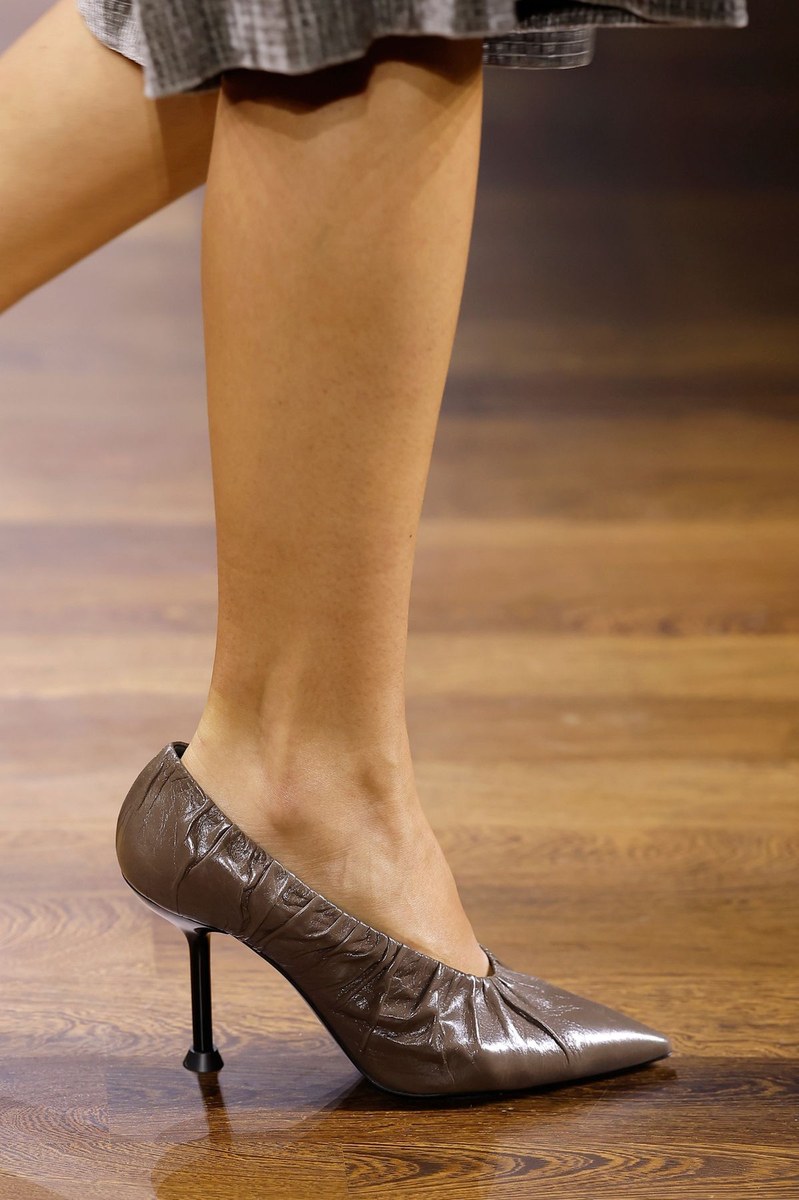
A soft, ruched nappa leather or nappa-like coated leather in a metallic pewter-taupe finish defines Shoe 1, with visible gather stitching across the vamp creating deliberate surface texture. High-shine polished calf leather in dark burgundy appears on Shoe 2, while Shoes 3, 4, and 5 use a high-gloss patent leather in black, with Shoe 4 reading slightly softer in its patent grain than its counterparts. Short-pile velvet cuts Shoes 6 and 7, matte black for one and deep cobalt-violet for the other, both appearing to sit on a very thin rubber or leather flat sole with no visible welt construction.

Color Direction

Almost entirely dark and tonal, the FW26 footwear palette has black and near-black dominating across five of the seven styles. Shoe 1 breaks that pattern with its pewter metallic, which reads as a warm neutral rather than a statement accent. Burgundy makes a single warm appearance in Shoe 2, set against an otherwise cool-to-neutral range. Only Shoe 7 delivers a chromatic statement, its cobalt-violet velvet positioned as a direct color-match to its paired wide-leg trouser and signaling a head-to-toe tonal dressing strategy that buyers in the ready-to-wear adjacency space should consider.

Key Models and Details

Three interpretations of the tassel loafer span Shoes 2, 4, and implicitly inform the spirit of Shoes 3 and 5 through their shared round and apron-toe construction language, making it the anchor model. A classic rolled leather tassel with a round bead detail on a chunky rubber sole defines Shoe 2, while Shoe 4 mirrors that tassel treatment in patent leather on a flatter, lighter sole unit. Lace-up oxfords in Shoes 3 and 5 share a wingtip seam line and a patent upper, differentiated primarily by the trouser styling above them rather than by structural variation between the two.

Shoe by Shoe Highlights

Shoe 1 The ruched nappa stiletto in pewter metallic is the most production-intensive style in the range, with gather construction across the entire vamp requiring precise pattern engineering and consistent leather softness across a full size run.

Shoe 1
Shoe 1

Shoe 2 The dark burgundy tassel loafer on a chunky rubber sole is the most commercially transferable style, sitting at the intersection of heritage menswear dressing and the current gender-fluid loafer trend driving strong sell-through across wholesale accounts.

Shoe 2
Shoe 2

Shoe 3 The black patent lace-up oxford with apron-toe seaming is styled with wide pinstripe trousers, positioning it as a formal-casual crossover that works for buyers sourcing footwear for tailoring-adjacent capsule collections.

Shoe 3
Shoe 3

Shoe 4 The black patent tassel loafer worn with scrunched navy socks reads as the most youth-facing style in the range, a detail that buyers targeting a younger contemporary customer should log for styling and campaign direction.

Shoe 4
Shoe 4

Shoe 5 The second patent lace-up oxford, styled beneath wide navy wool trousers, confirms this silhouette as a collection staple rather than a one-off, which warrants planning it as a core carry-over SKU rather than a seasonal one-shot.

Shoe 5
Shoe 5

Shoe 6 The black velvet pointed-toe flat worn with opaque black tights creates a near-invisible shoe effect, which aligns with the quiet-luxury minimal aesthetic and supports a strong argument for placing this style as a wardrobe basic in premium flat programs.

Shoe 6
Shoe 6

Shoe 7 The cobalt-violet velvet flat matched precisely to its trouser fabric signals that Armani intends at least some styles to function as look-specific accessories rather than standalone SKUs, a consideration for buyers building coordinated sets or total-look buys.

Shoe 7
Shoe 7

Operational Insights

Loafer depth: Three loafer expressions span Shoes 2, 4, and the lace-up variations in Shoes 3 and 5, signaling that the brand sees the loafer and its close relatives as a commercial pillar for FW26. Buyers should plan depth across at least two price points within this silhouette family.

Patent leather volume: Four styles feature patent, which points to strong seasonal demand for high-shine leathers. Product managers should pressure-test patent supplier capacity early, as this material category tends to compress lead times when multiple labels chase it simultaneously.

Velvet flat opportunity: Shoes 6 and 7 confirm velvet flats as a viable category entry for the season. Construction appears straightforward and the silhouette is proven, making this a lower-risk option for buyers who need a trend-right flat without committing to a complex new last.

Color-match strategy: Shoe 7 is built to coordinate with a specific runway look rather than function as a standalone. Style directors and visual merchandising leads should plan for total-look presentation if carrying this style, as it will underperform sold separately without the color context.

Ruched upper complexity: Shoe 1 requires a leather or coated leather soft enough to gather without cracking, and the ruching pattern must remain consistent across sizes. Sourcing teams should request graded sample sets early and build extra quality control checkpoints into the production timeline for this style specifically.

✦ This report was generated with AI — combining human editorial vision with Claude by Anthropic. Because the future of fashion intelligence is already here.