Emporio Armani FW26 Women Looks Report
Milan Fashion Week
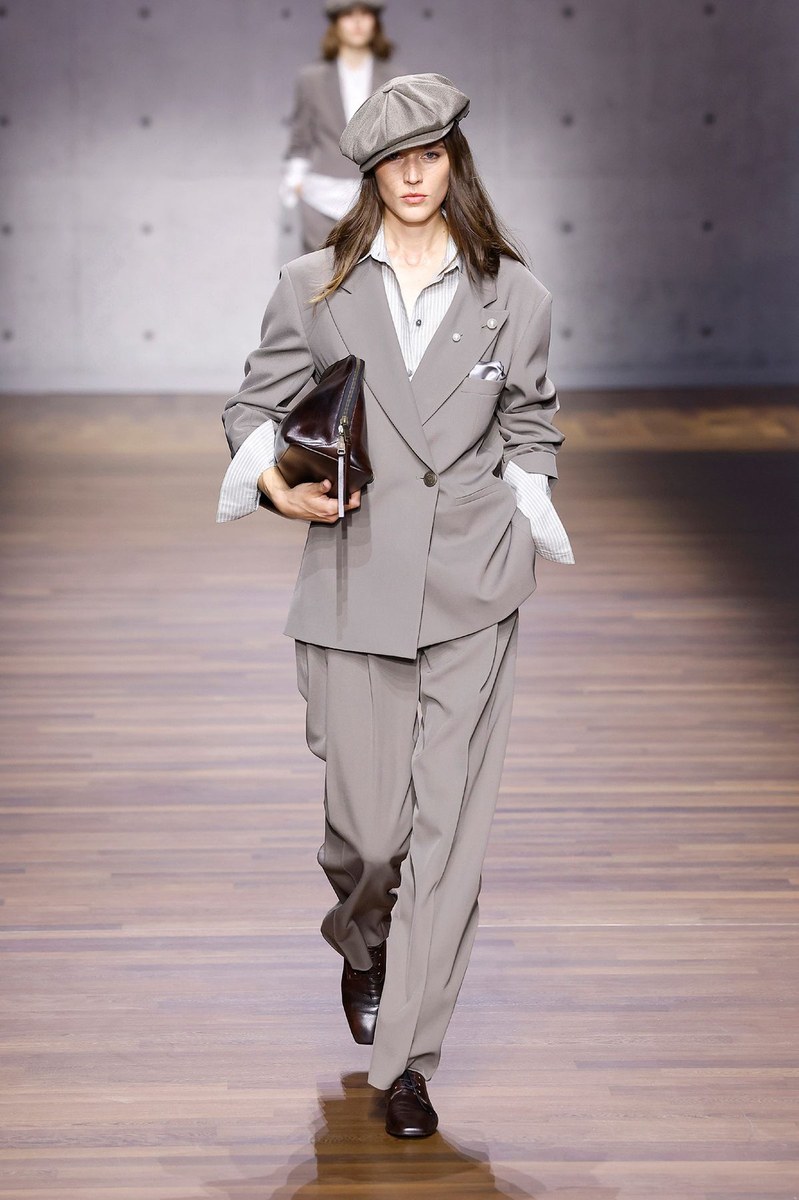
Emporio Armani FW26 builds a gender-fluid wardrobe around the vocabulary of interwar tailoring, pulling newsboy caps, wide-leg trousers, double-breasted blazers and layered suiting directly from the 1920s and 1930s and delivering them in a muted, almost monochromatic grey spectrum. For buyers, this lands at exactly the moment when the market is consolidating around androgynous, investment-grade separates that read as both formal and directional without requiring trend-specific styling.
Silhouette and Volume
A generous, unstructured wide leg dominates, paired with either an oversized blazer or a cropped layered jacket. Both create a low shoulder and a broad, relaxed column through the body. Look 1 and Look 2 establish this immediately, with roomy double-breasted tailoring worn loose over striped dress shirts, the jacket hem falling at the hip rather than the waist. Look 14 extends the logic into a full-length jumpsuit cut on the same wide tailored line, tightening only slightly through a subtle self-belt. Shorter hemlines arrive in Looks 12 and 13, where blazer-and-miniskirt combinations with over-the-knee socks create a compressed, schoolboy proportion that contrasts sharply with the floor-grazing lengths elsewhere.
Color Palette
Grey moves from warm dove and putty in Looks 1, 2 and 4 through to cool mid-grey herringbone in Looks 3, 5 and 6, landing finally in near-charcoal and black in Looks 9, 10 and 19. Olive cargo green enters in Look 8, the only significant departure from the achromatic core. Navy appears in Look 14 as a deep almost-black anchor. Across the board, the palette creates a composed, corporate-adjacent mood that reads as serious without being stiff, positioning it cleanly for professional wardrobes that want edge.

Materials and Textures
Smooth, medium-weight suiting wool carries the majority of the tailored looks, with a matte, press-resistant surface that suggests a fabric construction built for real wear. Look 15 breaks this monotony entirely with a liquid silver lamé fabric that catches light as it moves, used for a belted wrap dress and coat ensemble and serving as the collection's lone evening pivot. Look 18 places crystal or bead embroidery across the shoulder and sleeve of a grey belted coat, adding weight and opulence to an otherwise minimal silhouette. Dark brown distressed leather in Look 8 carries visible grain, giving it a worn-in quality that keeps it from reading as costume.

Styling and Layering
Tailored pieces stack consistently throughout, placing waistcoats under blazers under coats in Looks 3, 10 and 16, allowing buyers to read each layer as a separable unit with its own sales potential. Striped dress shirts are left deliberately untucked and loose in Looks 1 and 2, the oversized cuffs folding back over blazer sleeves to create relaxed formality. Grey fabric or leather newsboy caps appear across Looks 1, 2, 3, 5, 6, 11, 12 and 16, functioning almost as a collection-wide brand signature rather than a background accessory. Dark burgundy leather oxford shoes anchor the tailored looks with consistent warmth, while Look 8 pivots to grey chunky sneakers, the only athletic footwear in the lineup.
Look by Look Highlights
Look 1 Warm dove-grey double-breasted oversized suit with a cotton pinstripe shirt worn loose underneath and a dark brown patent leather clutch makes the case for the full head-to-toe grey sell-in.
Look 3 A three-piece light grey herringbone suit with a double-breasted waistcoat, striped tie and newsboy cap is the clearest commercial anchor for the men's crossover buy, with each component sellable as a separate.

Look 4 The sleeveless belted trench in pale putty with a fur-effect stole draped off one shoulder is a strong coat statement that translates directly into a buyer-friendly outerwear SKU without requiring the full look.

Look 8 Distressed dark brown leather biker jacket over a chocolate cotton top with cuffed olive cargo trousers and grey sneakers is the most youth-facing look in the collection and the clearest signal toward a younger Emporio customer.
Look 12 The grey pinstripe double-breasted blazer worn over a matching waistcoat and pleated miniskirt with over-the-knee socks and a leather newsboy cap is the sharpest women's tailoring moment and the most immediately editorial.

Look 15 The silver lamé belted wrap ensemble, worn with nude pointed flats, is the single evening proposition and carries enough surface drama to function as a hero piece in a capsule delivery.
Look 18 A belted mid-grey wool coat with crystal embroidery concentrated across the left shoulder and sleeve is a high-margin embellishment story with clear gifting and event dressing commercial logic.

Look 19 A white poplin shirt with a sweeping silver beaded embroidery motif across the chest, paired with flat-front black wide trousers, distills the collection down to two garments and lands as the strongest minimal-luxury statement in the lineup.

Operational Insights
Capsule architecture: Built for modular selling, this collection allows waistcoats, blazers, trousers and shirts to work as separates. Buyers should structure their orders around mix-and-match sets rather than head-to-toe look packages.
Color consolidation: Stocking across the full grey spectrum, from putty through dove to charcoal, allows for tonal dressing across multiple SKUs without introducing colour risk. Buyers can build depth in grey rather than breadth across colours.
Embellishment as margin driver: The beaded coat in Look 18 and the embroidered shirt in Look 19 are positioned as elevated entry points into eveningwear. Style directors should flag these for gifting edits, holiday floor sets and trunk show programming.
Newsboy cap as a repeating accessory unit: The cap appears in over eight looks and functions as a signature item with strong recognisability. Accessories buyers should treat it as a frontline collectible, not a background styling prop.
Gender-neutral merchandising opportunity: Silhouettes, fabrics and styling codes are deliberately shared across male and female looks, particularly in Looks 3, 5, 6 and 14. Retailers with gender-neutral floor concepts or editorial buying mandates should treat this as a direct sourcing opportunity rather than a styling reference.
Complete Collection


About the Designer
Silvana Armani Women's Creative Director, Giorgio Armani
Silvana Armani did not arrive at the top of her uncle's house by inheritance alone. She started at the switchboard, which she mentions herself with a dry emphasis: no nepotism here. Before that, she had worked as a model for Walter Albini, Krizia and Cadette, a runway career cut short by what she describes as crippling nerves, a habit of destroying her nails before each show. What remained after the modeling was an intimate understanding of how clothes behave on a body, and it was this, more than any formal design training, that shaped her eye when she moved into the Emporio Armani women's design studio in 1980.
She spent forty-five years working alongside Giorgio, absorbing his method without imitating it. He was, she has said, a perfectionist who always believed you could give more, and who was usually right. Her approach to the design process is collaborative rather than solitary: she provides the inspiration and direction, works with a team she trusts, and focuses on the moment when fabric meets the model as the essential truth of the whole endeavor. After Giorgio's death in September 2025, she stepped into the role of women's creative director, debuting her first solo collection, "New Horizons," at Milan Fashion Week in March 2026. She wore navy slacks and sneakers to the preview. The collection ran to 57 looks.
"Continuity is fundamental, and it's my objective."
"One of the most important things he taught me is to always go forward, to materially carry out the work in a concrete way and offer clothes that are wearable."
Leo Dell'Orco Head of Menswear Creative, Giorgio Armani Group
The story of how Leo Dell'Orco entered Giorgio Armani's orbit has the quality of a fable that Milan occasionally produces: two dogs belonging to their respective owners began playing on a street, and that was it. Dell'Orco was 24, working in advertising and exploring industrial design, and within two years he had joined the company that Armani had just founded with Sergio Galeotti in 1975. He was not a trained fashion designer. He was, by all accounts, a man of precise aesthetic instinct and exceptional discretion, and in the world Armani was building, those qualities mattered as much as any technical skill.
After Galeotti's death in 1985, Dell'Orco became what Armani later described simply as the closest person to him, filling a role that was never formally named but was always understood: part creative collaborator, part confidant, part life partner. He rose to lead the Men's Style Office, overseeing menswear across all the house's lines, Giorgio Armani, Emporio Armani and Armani Exchange. He has no social media presence, grants no interviews, and is almost never photographed without Armani beside him. When Armani missed the menswear show in Milan in June 2025 for the first time in fifty years, Dell'Orco took the bow alone. Three months later, after Giorgio's death in September, he stepped forward as the primary creative guardian of the men's collections, alongside his role in the Giorgio Armani Foundation.
"After Sergio's death, he has been the closest person to me. He gave me an incredible psychological support, practical as well as workwise. First Sergio, then Leo." (Giorgio Armani on Dell'Orco, CNN, 2022)
✦ This report was generated with AI — combining human editorial vision with Claude by Anthropic. Because the future of fashion intelligence is already here.