Ermanno Scervino FW26 Women Looks Report

Ermanno Scervino FW26 Women Looks Report
Ermanno Scervino FW26 Women Looks Report

Milan Fashion Week

Ermanno Scervino FW26 pulls lingerie construction into outerwear territory, pairing structured military double-breasted jackets with slip dresses, lace bodices and organza skirts to build a wardrobe that reads both disciplined and overtly sensual. For buyers, this tension between tailoring and intimate dressing addresses a growing consumer appetite for pieces that move from day appointments into evening without a full outfit change.

Silhouette and Volume

Two dominant shapes alternate throughout: a fitted, high-waisted military silhouette held tight through the torso and a full, mid-calf circular skirt that floats away from the body. Look 3 illustrates this most clearly, placing a cropped double-breasted wool jacket directly over a voluminous ivory organza skirt. Wide-leg trousers appear in Looks 8 and 18, adding a third, elongated vertical line. Miniskirts anchor the shortest hemline, most forcefully in Look 2, where a cropped textured jacket and micro pleated skirt compress the silhouette into a compact, high-energy proportion.
Look 3
Look 3

Color Palette

Ivory, cream and warm ecru work against a deep matte black across nearly the entire collection. Camel makes a single but confident entry in Look 19, and a blush peach slip in Look 9 provides the one genuine pastel note. Gold surfaces intermittently through metallic brocade in Look 19 and the recurring antique gold buttons on military jackets, preventing the black-and-white axis from becoming severe. Cool restraint defines the mood, punctuated by deliberate moments of warmth.

Look 19
Look 19

Materials and Textures

Persian lamb or a convincing curled-pile fabric recurs across Looks 2, 10 and 14, adding a dense, sculptural surface weight that contrasts directly with the fluid satin slips worn beneath or alongside. Ivory cable-knit coats in Looks 7 and 9 carry significant volume and a hand-knit visual texture, sitting over silk charmeuse that reflects light back through the open knit. Patent and matte leather appear in Looks 15 and 16, while a lace fabric with raised floral motifs reads through multiple looks as a house signature material. Black silk organza and ivory organza manage volume without adding weight, keeping the full skirts in Looks 1 and 3 airy rather than stiff.

Styling and Layering

A consistent internal logic governs layering: a garment associated with intimate dressing, a slip, a lace camisole, a knit cardigan worn open, sits visibly inside or beneath a more structured outerwear piece. Five looks feature the net-veil fascinator pinned at the crown, functioning as a recurring house accent that ties disparate looks into a recognizable visual family. Looks 6, 8, 12, 14 and 15 all carry this element. Footwear divides between crystal-embellished open-toe mules and knee-high or thigh-high black boots, the former softening looks, the latter sharpening them. Long black leather gloves in Looks 12 and 14 extend the intimates-as-outerwear logic into accessories.

Look by Look Highlights

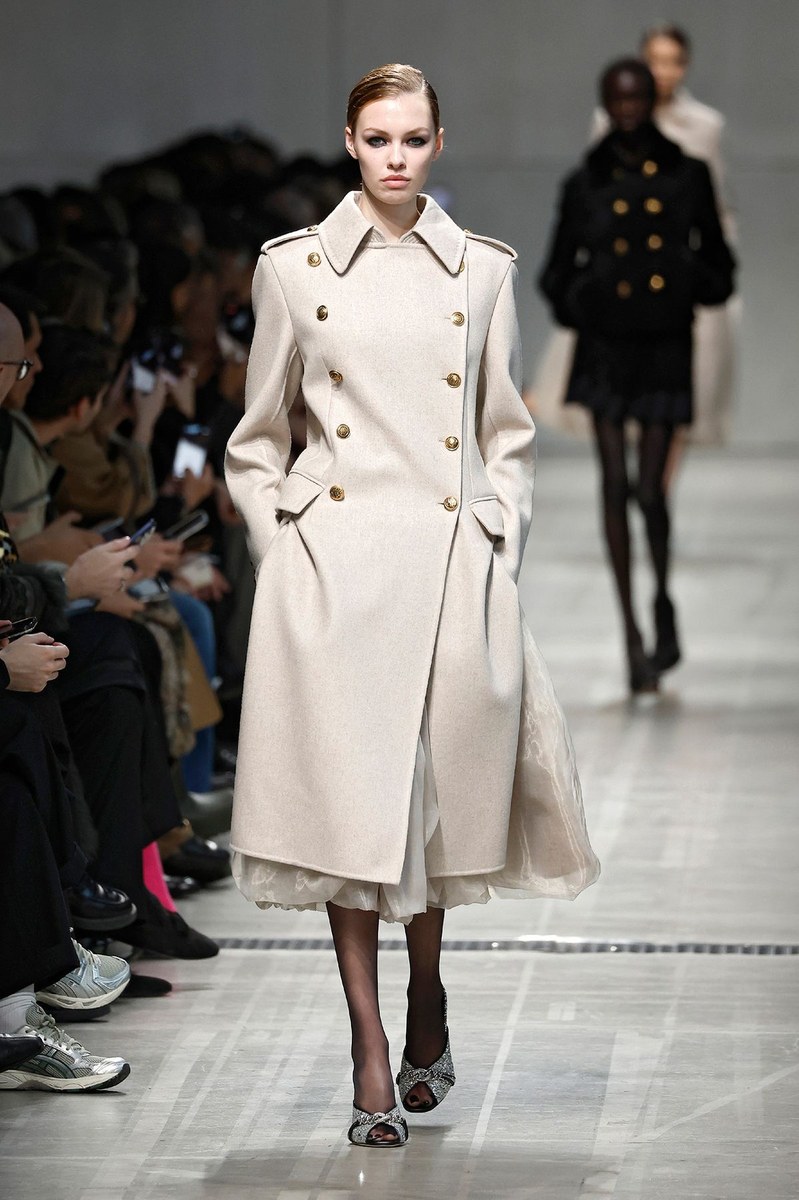
Look 1 The ivory wool double-breasted trench coat cut to mid-calf length over a sheer organza hem layer establishes the collection's core commercial piece, a coat with immediate ready-to-wear sell-through potential across multiple retail channels.

Look 1
Look 1

Look 3 Pairing a cropped cream wool jacket with a full ivory silk organza skirt creates the collection's clearest wardrobe-builder, as the pieces separate into strong individual SKUs for buyers planning mix-and-match assortments.

Look 6 A black double-breasted blazer in compact wool sits above a midi skirt in the curled-pile fabric and disappears into knee-high patent boots, producing one of the most editorially direct silhouettes in the lineup.

Look 6
Look 6

Look 11 An off-the-shoulder cream cashmere cardigan tied at the front over a cream satin skirt with silver lace appliqué at the hem translates the collection's intimates reference into a wearable, gift-driven proposition with strong gifting season potential.

Look 11
Look 11

Look 15 Fitted black patent leather double-breasted jacket layered over a black lace full skirt with a face veil compresses the collection's dual codes of military structure and feminine transparency into a single, highly photographable look with strong press pull.

Look 15
Look 15

Look 16 A white satin blouse with an oversized black satin bow at the neck worn over a black leather pencil skirt with lace hem and thigh-high boots is a precisely targeted evening-to-event piece that requires minimal styling effort from the end customer.

Look 16
Look 16

Look 17 Black lace V-neck fit-and-flare dress with tonal star embroidery and a wide black leather belt stands apart from the rest of the collection as a standalone dress with broad sizing and market appeal, accessible without the layering logic of surrounding looks.

Look 17
Look 17

Look 19 A slouched off-shoulder camel wool sweater over a floor-length gold metallic lace skirt closes the womenswear portion with the collection's strongest contrast in weight, texture and register, making it a priority look for editorial placements and window direction.

Operational Insights

Double-breasted hardware: Antique gold double-breasted buttons run across at least eight looks in wool, leather, textured pile and knit fabrications. Buyers should consolidate button sourcing early, as consistent hardware across a range simplifies production and strengthens visual brand coherence at retail.

Slip dress as foundation SKU: Cream and black slip dresses with lace trim appear as standalone pieces and as layering bases throughout. Producing these as a separate, lower price-point entry item captures customers who want the collection's mood without committing to outerwear price tags.

Veil accessory as margin driver: Small net fascinator veils recur across five looks and require minimal material input at production. Stocking them as an accessory SKU at retail allows style directors to extend the collection's editorial story into an impulse price point.

Fabric pairing logic for VM: One heavy or structured material consistently pairs with one fluid or transparent one within a single look. Visual merchandisers should display mannequins using this same pairing logic, avoiding styling two heavy or two fluid pieces together, to maintain the collection's intended tension on the floor.

Boots versus mules segmentation: Looks styled with black thigh-high or knee-high boots split cleanly from those styled with embellished flat mules. Buyers placing footwear orders should treat these as two distinct customer archetypes within the same purchase, one dressing for authority and one for occasion, and allocate depth accordingly.

Complete Collection

Look 2
Look 2
Look 4
Look 4
Look 5
Look 5
Look 7
Look 7
Look 8
Look 8
Look 9
Look 9
Look 10
Look 10
Look 12
Look 12
Look 13
Look 13
Look 14
Look 14
Look 18
Look 18
Look 20
Look 20
Look 21
Look 21
Look 22
Look 22
Look 23
Look 23
Look 24
Look 24
Look 25
Look 25
Look 26
Look 26
Look 27
Look 27
Look 28
Look 28
Look 29
Look 29
Look 30
Look 30
Look 31
Look 31
Look 32
Look 32
Look 33
Look 33
Look 34
Look 34
Look 35
Look 35
Look 36
Look 36
Look 37
Look 37
Look 38
Look 38
Look 39
Look 39
Look 40
Look 40
Look 41
Look 41
Look 42
Look 42
Look 43
Look 43
Look 44
Look 44
Look 45
Look 45
Look 46
Look 46
Look 47
Look 47
Look 48
Look 48
Look 49
Look 49
Look 50
Look 50
Look 51
Look 51
Look 52
Look 52
Look 53
Look 53
Look 54
Look 54
Look 55
Look 55
Look 56
Look 56
Look 57
Look 57
Look 58
Look 58
Look 59
Look 59
Look 60
Look 60
Look 61
Ermanno Daelli

About the Designer

Ermanno Daelli was born in Milan and raised in Florence, a city whose relationship with tailoring, textile trade, and Renaissance proportion left a permanent imprint on how he sees clothes. Before entering fashion he studied architecture, and the discipline stuck: he has spent the following decades applying structural logic to the female body, thinking in terms of what he calls "body architecture," the idea that a garment is first and foremost a constructed form that engages with volume and silhouette before it is anything else. That background gave him something most designers never acquire in a school of fashion, an understanding of space and mass that made his work legible in three dimensions from the very beginning.

After his architecture years, Daelli traveled extensively, including a formative period in New York where he encountered Andy Warhol's Factory, a collision with the American cult of image and personality that sharpened his instinct for spectacle without diluting his Italian sense of craft. He worked his way into the fashion industry largely self-taught, eventually working for a Florentine company that used his name to open stores. When creative differences made that arrangement untenable, he walked away, relinquishing the use of his own name in the process. The clean break brought him to Toni Scervino, a sharp commercial mind with complementary ambitions, and together in 2000 they founded the house in Florence that spliced his first name with his partner's surname.

The brand debuted internationally in Cortina, then Paris and New York, before settling into Milan Fashion Week, where it has held a steady position ever since. Daelli's references tend to be cinematic and personal rather than archival: Ava Gardner, the Italian Riviera, the physical confidence of women who dress for themselves rather than for a room. He has dressed the national Italian football team, worked with Monica Bellucci and Nicole Kidman, and built a house built on the synthesis of masculine tailoring with overtly feminine construction. His atelier sits in Bagno a Ripoli, in the hills outside Florence, where the couture workrooms, knitwear labs, and tailoring departments share the same building, keeping the entire creative process contained and under his control.

"I love the female body and I try to dress it in a way that respects its shape, giving it form and structure without ever constraining it."

"Florence gave me a sense of beauty that I carry in everything I do. It is impossible to live in that city and not develop a particular relationship with craftsmanship and proportion."

✦ This report was generated with AI — combining human editorial vision with Claude by Anthropic. Because the future of fashion intelligence is already here.