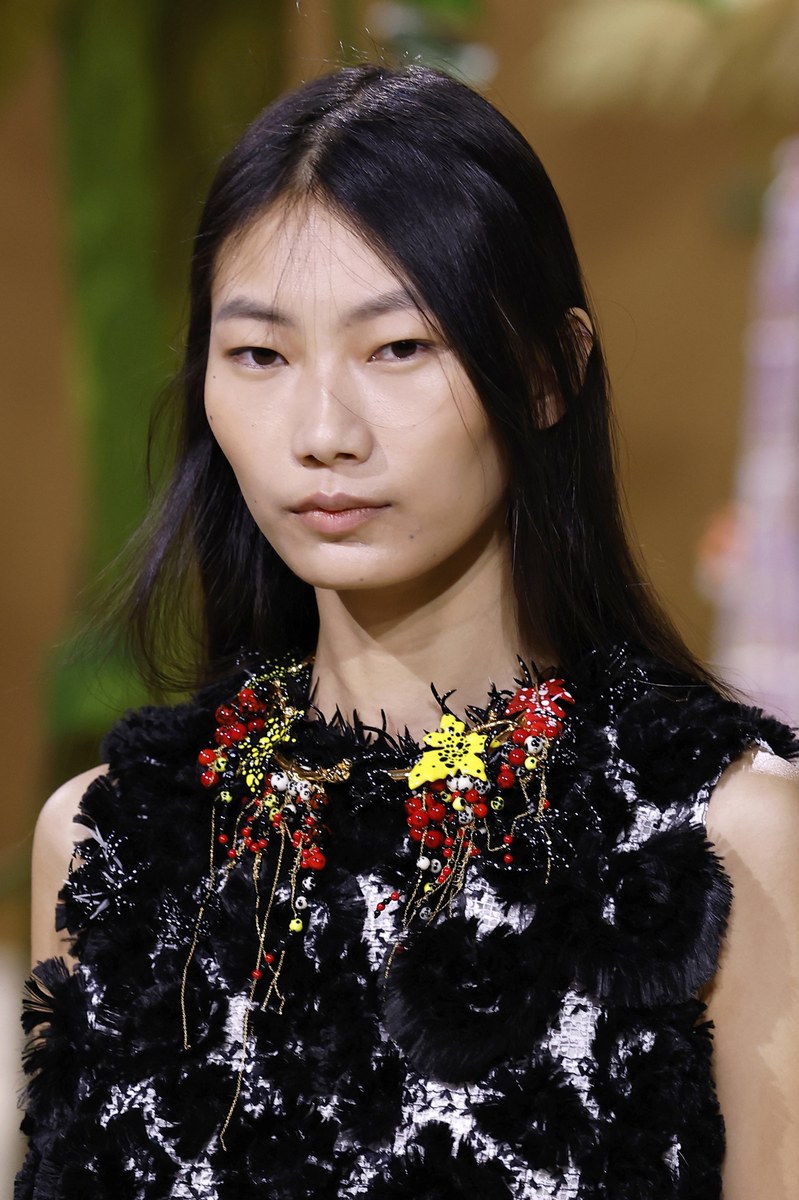
Etro FW26 Women Looks Report
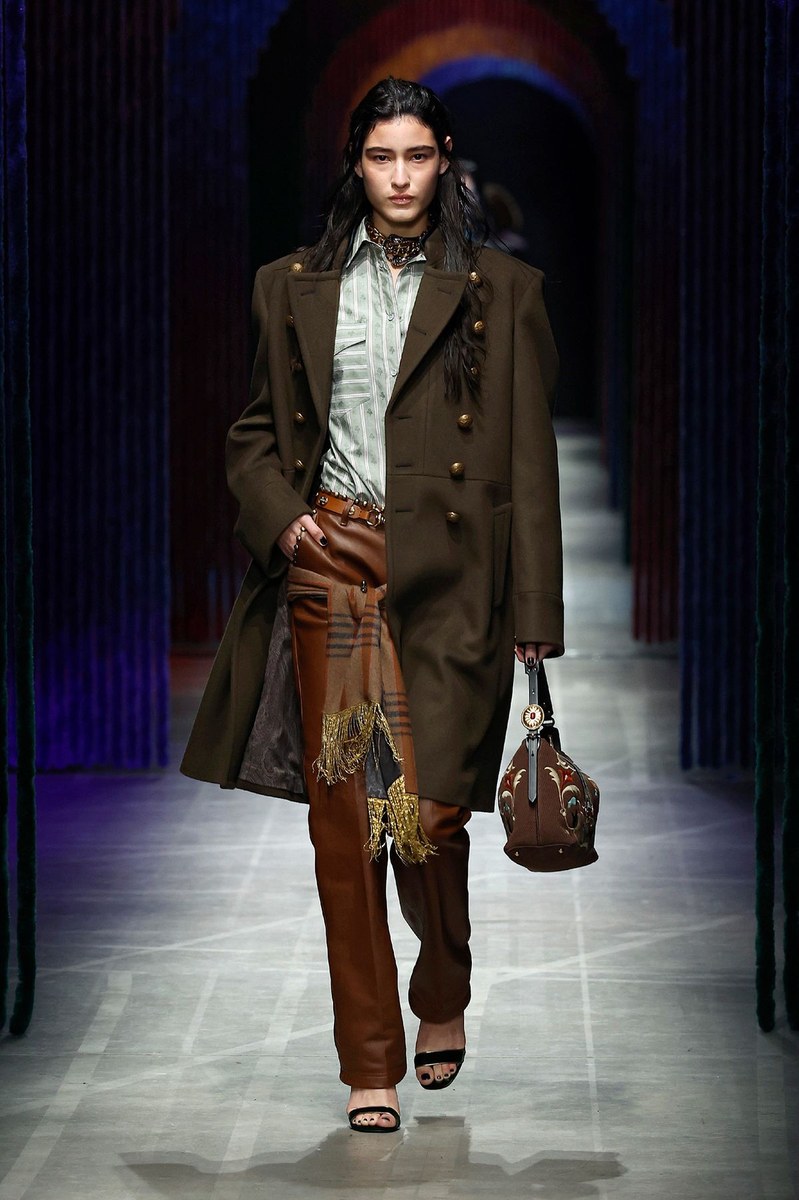
Milan Fashion Week
Etro FW26 builds its identity around a collision of nomadic romanticism and structured tailoring, pulling paisley, plaid, leather, and military suiting into a single wardrobe that feels layered by life rather than by formula. For buyers operating in a market that is oversaturated with quiet luxury, maximalism becomes something earned and personal here, not performative.
Silhouette and Volume
Two clear poles structure the collection. Oversized double-breasted coats with strong military shoulders anchor the structured end, seen in Looks 1, 3, and 16, while bias-cut and caftan silhouettes in Looks 8 and 19 pull in the opposite direction toward fluid, body-grazing volume. Wide, long trousers favor a high-rise pleat in Look 18 and a straight leather leg in Look 2. The wrap skirt with a front split, repeated in Looks 9 and 11, adds a mid-length option that sits between the two extremes and will likely be a strong commercial performer.
Color Palette
Deep olive, tobacco brown, oxblood, and ink navy dominate throughout, with forest green emerging as a recurring accent across Looks 13, 14, and 6. Most arresting is the navy and burnt amber paisley jacquard in Look 17, which reads jewel-toned without tipping into evening territory. Denim blue appears in Looks 3 and 5 as the single concession to casualness, grounding louder pieces and broadening accessible price-point entry. Look 19 breaks the earth-tone discipline entirely with a sequined and feathered kaftan in multicolor jewel tones, acting as a deliberate punctuation mark.

Materials and Textures
Leather serves as a structural pillar, appearing in slim chocolate trousers in Look 2, a multi-panel brown biker jacket with contrasting tan insets in Look 15, and a studded oxblood jacket in Look 5. Wool suiting fabrics carry visible weight, with a houndstooth and a chalk-stripe both reading substantial on the body rather than tailored-light, which signals cold-weather durability over transitional dressing. Sheer paisley chiffon, layered in Look 6 and used as full-length panels in Look 8, contrasts the heaviness elsewhere and adds a translucent, slightly antique drape quality. Embellished sweaters in Looks 9 and 11 use thick-gauge rib with appliqued cord and tassel detailing that reads handcraft-adjacent and justifies a premium price point.

Styling and Layering
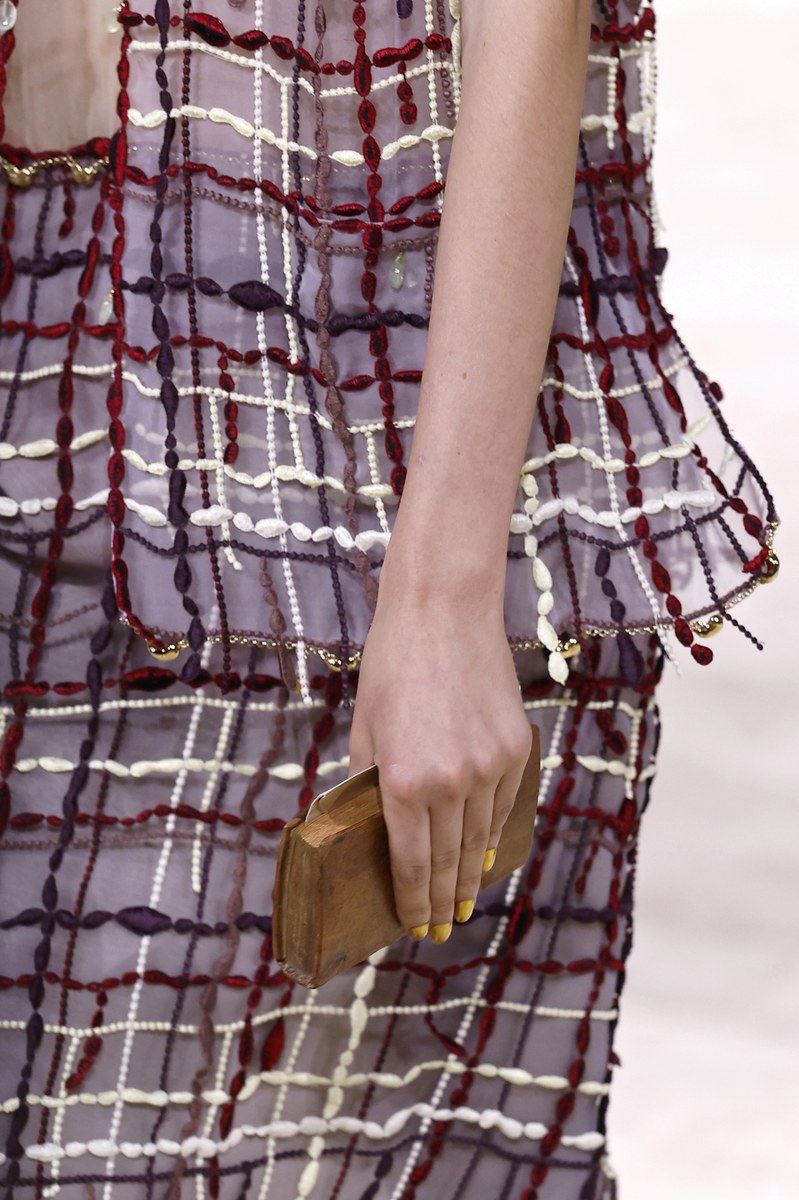
Most consistent is the fringed plaid scarf tied at the hip, which appears in Looks 2, 4, 10, and 12 as a belt substitute and a color connector across otherwise mismatched pieces. Footwear splits between open-toe mule sandals with a low block heel and heavy leather loafers or boots, creating an intentional tension between dressed-up and worn-in. Structured half-moon and bucket bags with ornate metal hardware reference equestrian and Western craft traditions. The corset-as-outerwear device, visible in Looks 14 and 18, acts as a waist anchor over flowing or oversized underlayers and adds a convertible styling layer that store teams can communicate clearly to customers.
Look by Look Highlights
Look 1 pairs a floor-length olive military coat with gold buttons over western-fringed brown leather trousers, making it the collection's most immediately wearable hero outerwear piece for a contemporary or luxury department store buy.

Look 2 runs a full head-to-toe dark chocolate leather suit with stud trim and a plaid hip scarf, a strong editorial look that also works as separates since each piece reads clearly on its own.
Look 6 layers two transparent paisley chiffon pieces in forest green and rust over a silk slip, accessorized with hunter green leather gloves and chunky loafers, making a case for the layered dress category as a commercial proposition rather than a styling trick.

Look 9 grounds a burgundy intarsia sweater with heraldic applique and shoulder tassels against a navy-and-burgundy plaid wrap skirt and cognac knee-high boots, producing the strongest full-look story for a knitwear-led buying decision.

Look 15 represents the most cohesive leather outerwear piece in the collection, a paneled brown biker with tan and rust insets and fringe trim worn over a printed bias-cut maxi dress. It reads as a statement investment piece with strong sell-through potential in cold-weather markets.

Look 17 puts the paisley jacquard to its best structural use in a double-breasted coat with a navy and amber repeat pattern, worn over a washed silk shirt and dark corduroy trousers. Etro's signature print works hardest when it covers the entire outer shell.
Look 19 closes the runway with a fully embellished kaftan covered in sequins, beadwork, and feather trim in indigo, copper, and ruby, which functions as an eveningwear anchor and a press moment rather than a volume driver.

Operational Insights
Key repeat unit: The double-breasted military coat in either olive wool or navy wool appears across Looks 1, 3, 7, 13, and 16 with minimal variation, signaling that Etro intends this silhouette as a franchise piece buyers can confidently build floor space around.
Separates strategy: The wrap skirt in plaid or houndstooth wool, seen in Looks 9 and 11, functions as a standalone commercial item that connects easily to the knitwear, tailoring, and leather categories without requiring full-look commitment from the customer.
Print hierarchy: Paisley operates at three scales and across three substrates, chiffon, jacquard, and printed jersey, which gives buyers flexibility to select print entry points at different price tiers without visual redundancy on the floor.
Leather depth: Five distinct leather garments appear across the collection, from the studded jacket to the biker to the tailored trouser, confirming that leather is a core category investment rather than an accent, and sourcing teams should plan accordingly for lead times.
Eveningwear volume: Look 19 is the single overt eveningwear piece, with Look 8 and Look 14 functioning as secondary evening options. Heavy day-to-evening dressing means buyers targeting occasion or resort markets will need to supplement accordingly.
Complete Collection


About the Designer
Marco De Vincenzo grew up in Messina, on the northeastern tip of Sicily, in a city where the ancient Greek and Roman past is embedded in the architecture and the landscape. He has spoken about the island as a source of intellectual curiosity as much as visual language, a place that shaped how he asks questions rather than simply what he sees. In the 1980s and 1990s, before the internet collapsed distances, Messina was genuinely far from fashion. De Vincenzo learned what he could from television and the occasional magazine, and at 18 moved to Rome to study at the Istituto Europeo di Design, carrying that outsider's hunger with him.
At 21, shortly after graduating, he joined Fendi's creative offices. He worked alongside Silvia Venturini Fendi on accessories, eventually becoming Head Designer of Leather Goods, a role he held for more than two decades while simultaneously building a parallel life as a designer in his own right. His eponymous label launched in 2009, the same year Franca Sozzani selected him as the winner of Vogue Italia's Who Is On Next competition. By 2014, LVMH had taken a stake in the brand, recognizing in him a talent with a specific point of view: an obsession with cloth and construction that consistently preceded any concern for trend. The label went on hold in 2020, but the thinking never stopped.
In June 2022, private equity firm L Catterton, which had acquired a controlling stake in Etro the year prior, appointed De Vincenzo as Creative Director of the entire house, overseeing women's, men's, home, and the newly launched children's collections. The fit looked unlikely on paper: Etro had been synonymous with saturated paisley and the wandering bohemian spirit the Etro family had cultivated across generations, while De Vincenzo was known for restraint and precision. But his approach was rooted in the house's actual origin, a textile factory founded in 1968, not the lifestyle mythology that had grown around it. Fabrics remained his starting point for every collection, with Sicily's layered classical heritage surfacing regularly in his set design and thematic choices, from temple columns to Greek theatre masks.
"I am so proud of my origins, and my takeaways from Sicily are the quest for knowledge, the curiosity."
"Fabrics are always my starting point when I work on a new collection. Then comes shapes, but shapes are determined by the fabrics we decided to present, and not the other way around."
✦ This report was generated with AI — combining human editorial vision with Claude by Anthropic. Because the future of fashion intelligence is already here.