Fashion East - Jacek Gleba FW26 Women Looks Report

Fashion East - Jacek Gleba FW26 Women Looks Report
Fashion East, Jacek Gleba FW26 Women Looks Report

London Fashion Week

Jacek Gleba builds a collection around the collision of athletic base layers and deconstructed tailoring, routing sportswear codes through a ballet and dancewear vocabulary that reads as both archival and forward-facing. For buyers navigating the current appetite for gender-fluid, body-conscious dressing with conceptual weight, there's a legible commercial throughline beneath the experimental surface.

Silhouette and Volume

Lean, columnar legs anchor every silhouette, consistently held by compression-style leggings or bike shorts with sculptural cut-away panels in Looks 1, 6, 11, and 12. Volume hits deliberately and suddenly against that tight base, either draped fabric panels hanging from zip-open seams at the hip (Look 3, Look 7) or oversized outerwear collapsing over the body in Look 9. Look 8 breaks entirely from the athletic register, delivering a floor-length khaki coat layered over a frayed floral duster that reads as the clearest outlier and most immediately wearable statement piece in the lineup. The tension between compressed and released volume drives the collection's central structural argument.
Look 3
Look 3

Color Palette

Dusty rose, grey marl, and burgundy function as the core triad, appearing across at least seven looks and grounding the collection in a muted, body-adjacent warmth. Teal makes a clear secondary push in Looks 6, 9, and 11, providing a cooler foil that prevents the palette from reading as purely blush-and-neutral. Near-black pinstripe against pale pink and grey appears only in Look 7, the single moment of dark-on-light contrast that references menswear suiting. Soft but not sweet, this mood sits closer to a physiotherapy clinic color chart than traditional spring softness.

Look 7
Look 7

Materials and Textures

At least three fabric registers cycle through the lineup: jersey compression fabric used for the legging and bodysuit bases, lightweight fluid satin or viscose for the draped cami tops in Looks 1, 4, and 6, and structured twill or canvas for the vest and coat silhouettes in Looks 3, 7, and 8. Cold-shoulder chiffon in Looks 2, 5, 10, and 12 reads as connecting tissue across genders and silhouettes, its raw-edge ribbon ties adding surface detail without weight. Look 8 introduces a frayed floral cotton, unlaundered in finish, that contrasts deliberately against the technical fabrications surrounding it. Fabric weights shift fast within single looks, requiring careful sourcing and construction notes for any production adaptation.

Look 8
Look 8

Styling and Layering

Layering logic is additive and almost archaeological, with bodies built from a compression inner, a draped mid-layer, and then either a structured vest or a loose outerwear piece placed on top. Every single model wears flat ballet-style shoes with ankle wrap straps, functioning as a unifying device that ties the sportswear and dancewear references into one coherent styling directive. Only one accessory appears, the teal drawstring bag carried in Looks 2 and 11, its sculptural, deflated quality reading more as prop than commercial accessory. White knee socks with a single black stripe appear in Looks 1, 2, 5, and 11, a micro-detail that adds schoolwear or gymnasium tone to the overall assembly.

Look by Look Highlights

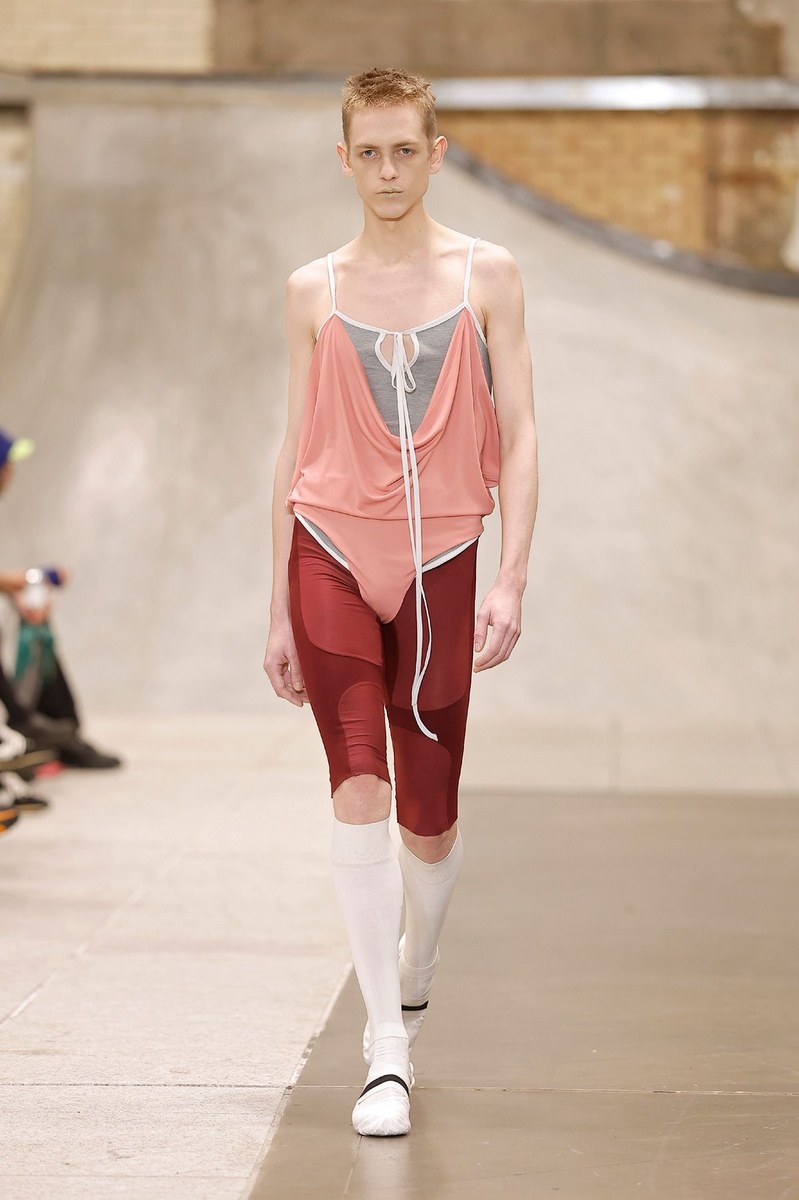
Look 1 The dusty rose draped cami over a grey jersey bodysuit with burgundy compression capris establishes the core three-color system and the layered athletic base formula that the entire collection reiterates.

Look 1
Look 1

Look 3 A double-breasted grey vest with oversized button hardware worn over a pink cap-sleeve top, with unzipped burgundy panels falling from the hip, is the most directly translatable piece for buyers targeting tailoring with sportswear crossover.

Look 6 Teal satin cami over grey and white color-blocked leggings with cut-away fabric panels at the knee demonstrates the collection's most resolved use of the deconstructed compression pant, making it a strong candidate for limited production testing.

Look 6
Look 6

Look 8 The khaki canvas midi coat layered over a frayed floral duster is the one look a style director could pull immediately for editorial or wholesale without restyling, carrying the highest standalone commercial value in the lineup.

Look 9 A teal puffer-like wrap knotted high at the neck over a mint jersey top and grey marl joggers with pink-trimmed seams delivers the most wearable and size-inclusive silhouette, with strong potential for outerwear buyers working in the casual luxury space.

Look 9
Look 9

Look 10 Sheer black chiffon floral cold-shoulder blouse over teal structured shorts with grey compression leggings beneath layers three distinct fabric registers in one look, which will be challenging to produce at scale but signals a clear direction for print-led separates.

Look 10
Look 10

Look 11 The shredded white and light blue fringe bomber over a slate blue bodysuit and navy compression shorts, carried by the teal bag, is the most youth-market facing look and the strongest signal of where the collection could intersect with streetwear retail.

Look 11
Look 11

Look 13 A cream ribbed zip polo with burnout-style texture panel and cropped light wash denim with tall brown leather boots reads as an entirely separate design register, possibly signaling a secondary line direction or a deliberate palette cleanser that buyers should flag as a standalone story.

Look 13
Look 13

Operational Insights

Fabrication complexity: Multiple looks combine jersey, woven, and sheer fabrics within one garment or layered set, which increases cut-and-sew lead times and requires suppliers with multi-fabric patternmaking capability.

Footwear dependency: The wrapped ballet flat is integral to the collection's visual identity, and buyers intending to carry key looks should plan for footwear co-buys or source close equivalents, as the styling reads incomplete without it.

Gender positioning: The collection moves fluidly across male and female models wearing near-identical garments, which opens direct-to-consumer gender-neutral SKU strategies but requires clear size grading decisions before any production brief is written.

Entry price architecture: Compression leggings and draped cami tops in Looks 1, 4, and 6 represent the most repeatable and lowest-complexity pieces, making them logical candidates for an entry-price capsule within any wholesale assortment built around this collection.

Outerwear priority: Look 8 stands alone as the collection's coat moment and carries the widest commercial reach across traditional womenswear buyers. Style directors should treat it as a hero piece rather than a supporting layer, and negotiate for it to be produced in at least two colorways.

Complete Collection

Look 2
Look 2
Look 4
Look 4
Look 5
Look 5
Look 12
Look 12

About the Designer

Jacek Gleba was born to a Polish father and a Spanish mother and grew up in Barcelona, a city whose specific quality — open, sun-lit, warm, physical — has run through his work as a constant undercurrent ever since. He had wanted to work in fashion since childhood but considered himself not good enough to pursue it formally, which is how he ended up spending his early adult years studying communications and PR at a Barcelona university instead. The styling came first, as a softer entry point, and then a sewing school attended alongside a group of local mothers, which turned out to be where the real education began. He has since said that he's grateful for the detour, because coming to design with more life behind him produced work more interesting than anything he might have made at eighteen. Eventually he applied to Central Saint Martins in London for the MA in Fashion, and it was there, in the concentrated pressure of that program, that everything he had been circling around found its form.

His graduate collection, titled "Diary," drew on the written journals of Vaslav Nijinsky — the Polish-Russian dancer of the Ballets Russes who performed in Paris in the 1910s, kept an obsessive private record of his inner life, and collapsed into madness not long after. The connection to Nijinsky is partly biographical: Gleba, also half-Polish but shaped by another culture, recognized the particular displacement of a person belonging fully to neither world. More than the biography, though, what interested him was Nijinsky's 1912 choreography for L'Après-midi d'un faune, in which the central figure, too shy to speak to the nymphs he desires, picks up a dropped scarf and dances with it alone, ending the performance in a moment of private ecstasy. For Gleba, the scarf is the organizing image: desire expressed obliquely, through the residue of contact rather than contact itself. The collection proposed light, gestural menswear — layered tank tops, kitten-heeled ballet shoes, jersey that clings and drapes by turn — designed not for nightlife but for the street, the museum, the everyday. It closed the MA show at Central Saint Martins in February 2025 and went directly into Fashion East.

His debut with Fashion East, at the SS26 show at the Old Truman Brewery in September 2025, continued the Nijinsky research into his first public-facing collection, introducing the same vocabulary of deliberate unfinish — open seams, unresolved edges — to a wider audience. For AW26, shown at Manor Place in Elephant and Castle, he turned to Oscar Wilde's Salomé and the ballet adaptations it inspired, pushing further into color: swoops of pink, burgundy, military green, and teal across draped bodysuits, leggings, and capris, with slashed cutouts along the hips and shoulders. Gleba is currently presenting his second season with Fashion East. His label takes his surname alone.

"I always say that my fashion is about the game of flirting; not so much the actual intercourse, it's about everything that comes between."

"I feel like queerness is something you act out, not something you wear. Looking queer a lot of the time is more about how you move than how you dress. With my fashion practice, I try to capture this and turn it into clothing."

✦ This report was generated with AI — combining human editorial vision with Claude by Anthropic. Because the future of fashion intelligence is already here.