Fashion East - Louis Mayhew FW26 Women Looks Report
Fashion East, Louis Mayhew FW26 Women Looks Report
London Fashion Week
Louis Mayhew builds a wardrobe from accumulation, stacking found-feeling garments, mismatched textures and repurposed hardware into looks that read as personal archives rather than polished outfits. For buyers and style directors working in the contemporary and advanced contemporary space, this signals a consumer appetite for anti-finish dressing that goes well beyond the patchwork trend already saturating the mid-market.
Silhouette and Volume
Two contrasting shapes dominate here: a tapered, dropped-crotch trouser that narrows to the ankle, seen in dark leather and sheer mesh in Looks 1, 5 and 11, and a cropped, exposed-midriff torso achieved through layering rather than cut, visible in Looks 9 and 12. Shorts appear in both relaxed cargo-adjacent proportions (Look 4) and a body-skimming micro length (Looks 8 and 10), grounding the collection in a dual-register volume logic that can read sporty or severe depending on how the upper body is loaded. Volume concentrates at the chest and shoulders through accumulated layers, leaving the lower leg consistently slim or bare. This top-heaviness is deliberate. It's not an accident of styling.
Color Palette
A compressed range of dark earth tones dominates: tobacco brown, near-black charcoal, khaki olive and a warm taupe that appears across leather, knit and nylon in multiple looks. Specific punctuation colors arrive as counterpoint: a flat red baseball cap in Look 5, a chalky white zip-up in Look 3, a yellow crinkled material erupting from the waist in Look 8, and a dusty rose bandana tucked into the waistband of Look 1. Muted, post-industrial and worn-in describes the mood, but those single-note color disruptions prevent the palette from reading as simply dark or minimalist. A white glove, recurring across at least seven looks, functions as a recurring pale accent that ties the palette together without lightening it.

Materials and Textures
Leather carries significant weight here, both matte chocolate-brown and a thinner, almost liquid dark brown, appearing as trousers in Looks 1, 5, 6 and 11, and as a structured corset-style top layer in Look 5. Knit surfaces range from a fine ribbed navy sweater with rope-and-toggle fastenings in Look 2 to a heavily textured plaid wool in Looks 1, 9 and 12, the latter cropped to a jacket length with a raw-edged sleeve. Sheer mesh and crinkled nylon appear in the shorts and trouser legs of Looks 5 and 7, introducing a lightweight, almost disposable surface quality that sits in deliberate friction against the leather. Fur adds tactile density without bulk at the hem, worn in both a voluminous black vest in Look 6 and as smaller trim pieces at the wrist or shoulder in Looks 2, 10 and 11.
Styling and Layering
Every look is assembled from at least three visible layers, and the logic is additive and slightly chaotic: a sheer base, a structured mid-layer and then a jacket or vest laid on top without full closure. Footwear moves between opposites: kitten-heel pumps in nude and blush (Looks 1, 6 and 8), knee-high equestrian boots in black leather (Looks 2 and 11), chunky tan leather riding boots (Look 3), and flat lace-up oxfords or loafers (Looks 9 and 12). Long and loose rather than fitted, the white driving glove functions more as a fabric layer than a formal accessory. Multiple reference points converge in the hat story: a shearling bucket in Look 1, a Robin Hood-style feathered cap in Look 4, a tricorn silhouette in Look 9, a tweed deerstalker in Looks 6 and 8. Eclectic by design, this headwear strategy is highly merchandisable as separates.

Look by Look Highlights
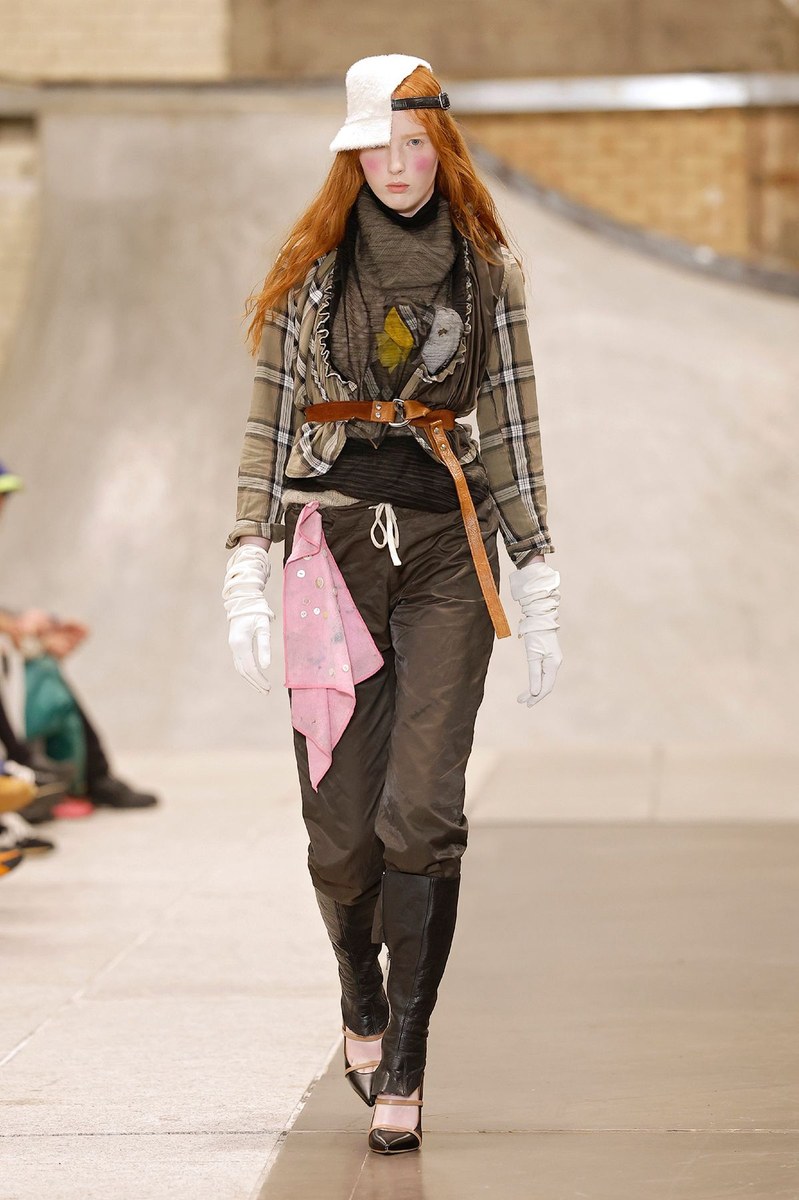
Look 1 A plaid wool layer over a graphic knit turtleneck, dark leather trousers, a brown leather belt worn high and loose, a pink bandana tucked at the hip and a white shearling bucket hat sets the collection's thesis immediately, demonstrating how many distinct product categories can coexist in one saleable outfit.

Look 2 The dark ribbed knit sweater with oversized rope-and-toggle fastenings is the most immediately commercial piece in the collection, a directional knitwear proposition with a clear production hook and strong wholesale potential for advanced contemporary accounts.

Look 3 A white crinkled zip-up with a sculpted, almost architectural torso and hardware pin closures over a grey jersey mini skirt covered in D-ring hardware, worn with tall tan leather boots, reads as the collection's most accessible entry point for younger contemporary buyers.
Look 5 Translucent dark mesh trousers worn over grey ribbed underlayer with cuffed ankle hems, topped with a leather corset panel and a fine-gauge striped cardigan, plus a red baseball cap with a large buckle, offers a strong layering formula for editorial-facing retailers.
Look 6 A black fur vest, navy ribbed knit, olive leather trousers, deep purple leg warmers and a tweed deerstalker with a white sweatband create the most maximalist look in the collection and will appeal to buyers at cult independent retailers looking for a high-impact, full-look purchase.

Look 9 A short-sleeved plaid shirt over a structured cross-strap top in mixed metallic and beige fabric, belted in tan leather with white ribbed trousers and a crocheted blue mesh panel draped across the lower torso, delivers the collection's most editorial construction detail and will photograph strongly for press and campaign use.

Look 11 A grey long-sleeve fitted jacket with ruffled white shirt front, dark leather dropped-crotch trousers and a stacked knit-and-straw bucket hat is the most coherent single outfit in the collection, with a clear equestrian-archivist reference that translates directly into a buyable, wearable proposition.

Look 12 A light grey plaid cropped jacket over a blue sheer knotted top, low-slung distressed denim midi skirt and tall fringe-hemmed knit socks with black loafers assembles four separate trend categories, denim, sheer, plaid outerwear, statement socks, into one look that functions as a buying roadmap for accessories and apparel simultaneously.

Operational Insights
Knitwear with hardware: Look 2 demonstrates that toggle and rope fastenings on a conventional ribbed sweater create a high-differentiation product with relatively low production complexity. Buyers sourcing statement knitwear for FW26 should prioritize this construction detail over print or colorblock novelty.
The white glove as category opportunity: Long white driving gloves appear in at least seven looks and function as a recurring styling anchor. Accessories buyers should treat this as a standalone category signal, not a runway affectation. A price-accessible version in stretch leather or coated fabric has clear floor potential at contemporary and mid-market retailers.
Hat diversity as a modular strategy: Six distinct hat silhouettes appear across twelve looks, from shearling bucket to feathered cap to tricorn to deerstalker. Style directors should read this as a directive to build out hat assortments with genuine silhouette variety rather than consolidating around a single shape.
Layering logic for product bundling: A three-to-four layer formula, sheer or fitted base, structured mid-layer, outerwear, belted or tied at the waist, gives visual merchandising teams a direct brief for mannequin and editorial display. Product managers should consider building curated layering bundles around this hierarchy for FW26 floor sets.
Leather trouser proposition: Dropped-crotch, tapered leather trousers in dark brown appear in at least four looks and anchor the collection's most elevated moments. Given the sustained consumer appetite for leather bottoms across contemporary and premium segments, this silhouette update, away from the straight-leg or wide-leg that currently saturates the market, deserves priority in early production conversations.
Complete Collection


About the Designer
Louis Mayhew is from Watford, and the way he arrived at fashion was not the usual route. For more than half his adult life, he worked in manual labour, specifically painting and decorating, a trade that put him on building sites, in other people's homes, and in close contact with the kind of physical problem-solving that professional designers rarely encounter. He noticed, over the years, the modifications that tradespeople make to their own clothing — the sleeves cut off, the hacks improvised for function, the fabric worn and repurposed rather than discarded — and recognized in these alterations a design logic that felt more honest to him than what he was seeing in fashion. His sourcing life ran alongside the day job: mudlarking on the Thames, treasure hunting and fossil digging, pulling materials from building sites, and paying a minimal annual membership to the Watford Recycling Arts Project, a local initiative that allowed him to take as much donated fabric as he needed. All of it, accumulated over years, became the raw material for a practice formed before he had a formal fashion education at all.
He applied to London College of Fashion's MA in Fashion Design Technology (Womenswear) and worked as a painter and decorator throughout the degree. His graduate collection in 2023, titled "Shortcuts," codified what he had been doing intuitively: defining the term as hacks or modifications made to clothing to enhance function, longevity, comfort, or aesthetics, and then building a zero-waste pattern-cutting technique derived from photogrammetry. The clothes looked like they had been lived in and worked over from the outside in, not designed from a concept board. He had applied to Fashion East before graduating and been turned down, which he has since identified as the right outcome at the right time. When the acceptance came, for Spring/Summer 2026, he was ready in a way that earlier versions of himself were not.
His debut collection under Fashion East, shown at the Old Truman Brewery in east London in September 2025 as part of the incubator's twenty-fifth anniversary program, was titled "Hard Graft" and was made almost entirely from found and donated materials. Wired headphones were fashioned into a necklace. Plastic bags were incorporated into tops. Metal clips cinched the back of sweaters. Faux fur scraps became a rough-edged wrap. Tie-dyed paper-like fabric became an asymmetric skirt. Jeans were assembled from different denim colors. For his second Fashion East collection, AW26, titled "Come On Over," he pushed further into womenswear and took inspiration from the idea of a treasure hunt — DIY-style bindles carried by the models, hats, a Blue Eyed Soul song from 1980. He remains based in London and is currently presenting his second season with Fashion East.
"My practice is deeply rooted in found and unorthodox objects. Materials from building sites, or stuff I've found mudlarking on the Thames. I try to find treasure and fossils. I have to work on a bit of a shoestring budget, but I think that's where the wonder comes from — trying to create high fashion, chic garments for a very minimal price."
"I've worked in manual labour for over half my life. Living your life helps you develop as a designer. These life experiences, without them, we wouldn't be able to make what we make today."
✦ This report was generated with AI — combining human editorial vision with Claude by Anthropic. Because the future of fashion intelligence is already here.