Fendi FW26 Details
Fendi FW26 Details Report
Fendi FW26 positions accessories and garment details as a unified system, moving between utilitarian hardware and luxurious surface embellishment without treating either as secondary. Buyers sourcing across categories should note how logo integration, fur application, and eyewear silhouette all pull toward the same oversize, high-contrast visual language.
Category Overview
Dress Details dominate the submission numerically, spanning fur bags, embellished coats, sheer lace construction, technical outerwear, and logo-graphic pieces. What this signals is that Fendi is treating the garment itself as an accessory object. Two Eyewear entries (Details 7 and 8) frame the collection's attitude precisely, with statement proportions and metal-dominant frames rather than quiet, understated shapes. Material diversity runs deliberately through the range, from mink and shearling to chiffon, lace, and technical nylon, all in the same collection moment. For product managers, that breadth signals a wide price-architecture story building within a single seasonal identity.
Material and Construction
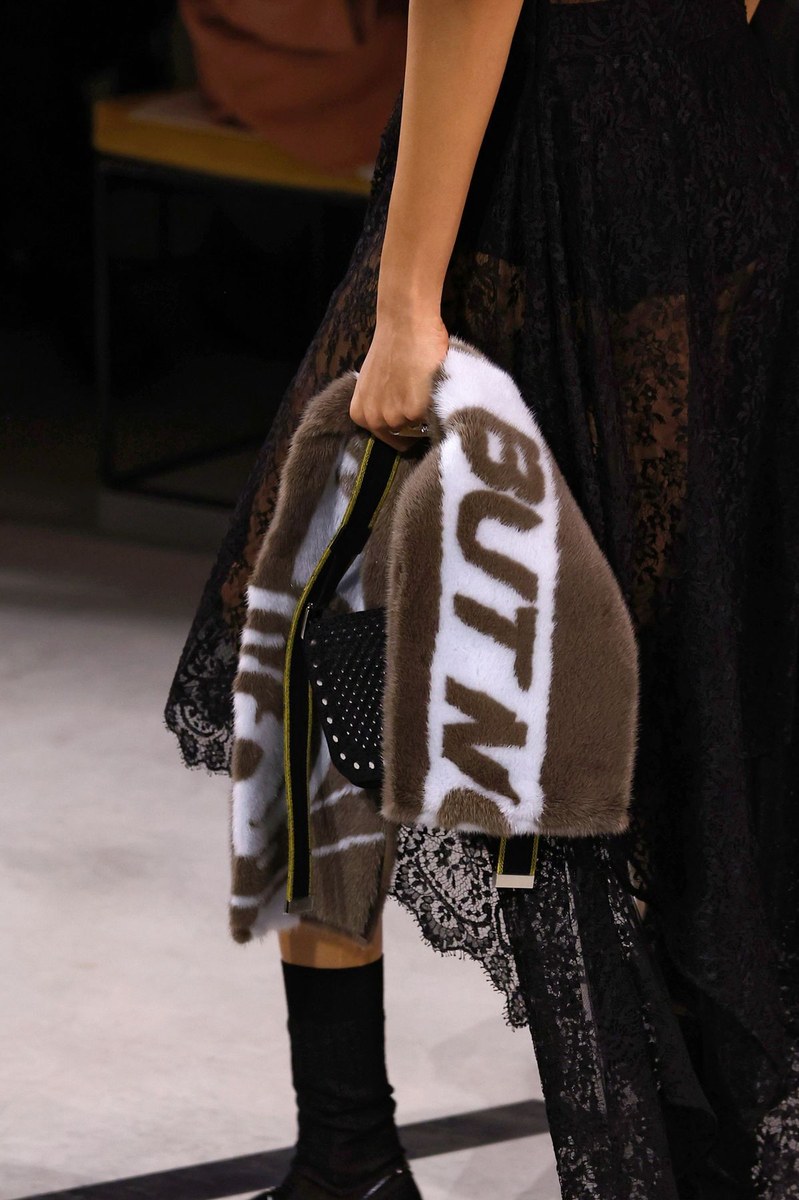
Detail 1 presents a structured triangular clutch cut from mink fur, with white and taupe color-blocking and a neon yellow zip closure that places utility hardware against luxury pelts. A black wool-faced coat in Detail 3 sits covered in scattered triangular jet embellishments, each piece appearing individually hand-applied given the irregular spacing and three-dimensional lift. Detail 5 layers curly shearling, flat rabbit, and patchwork fur panels in a camouflage-inspired composition with a conventional nylon zipper running the center front. Pure technical nylon defines Detail 6, with multiple silver metal zips and a woven Fendi logo grosgrain pull tab in yellow-on-grey. The strap construction echoes luggage hardware more than traditional fashion outerwear.

Color and Finish Direction
Near-black and deep navy anchor nearly every category, appearing across the lace dress (Detail 4), the embellished coat (Detail 3), the blazer layering (Detail 2), and both eyewear frames. Olive and taupe form the season's secondary palette, present in the fur clutch (Detail 1), the patchwork shearling jacket (Detail 5), and the technical anorak (Detail 6). Neon yellow appears as a precise accent, threading through the zip closure in Detail 1 and the branded pull tab in Detail 6. This creates a recurring electrical contrast that ties disparate pieces into one coherent system. Gold metal frames in Detail 7 and silver in Detail 8 mirror the warm-to-cool split visible across the garment category.

Key Pieces and Details
Detail 1 is the collection's most commercially loaded piece. The mink clutch combines logo graphics, colour-blocked fur, and a visible neon zip into a single object that communicates both craftsmanship and streetwear legibility. Detail 3 reads as the quiet standout for product managers, since the density and regularity of the embellishment would require significant SKU investment in trims sourcing but would anchor a coat buy at a high retail price point. Eyewear buyers will find two distinct frame architectures in Details 7 and 8: the gold aviator and the wide-shield silhouette. Retailers get a warm-metal and a sport-forward option within the same season.
Detail by Detail Highlights
Detail 1 (Dress Detail) The triangular mink clutch pairs white and taupe fur panels with partial brown tonal lettering and a neon yellow visible zip. Logo hardware becomes the structural closure rather than a decorative afterthought.
Detail 2 (Dress Detail) An oversize midnight-navy single-button blazer layers over a zigzag-jacquard shirt dress, with a long silver-chain pendant necklace carrying an open circular motif as the sole jewelry gesture.

Detail 3 (Dress Detail) A black long-line coat carries scattered three-dimensional triangular jet embellishments across both body and sleeve, with a welt pocket in unembellished fabric providing a deliberate tonal contrast.

Detail 4 (Dress Detail) A black chiffon and lace gown uses radiating lace panels from the waist to form a sunburst construction, with sheer sleeves and vertical lace columns creating architectural geometry through placement rather than volume.
Detail 5 (Dress Detail) A patchwork fur jacket combines curly green shearling collar and sleeves with flat-lying camouflage rabbit panels in olive, black, and white, worn over a white graphic jersey with a narrow nylon buckle belt.

Detail 6 (Dress Detail) An olive nylon anorak carries a diagonal chest zip, a sleeve zip with a woven Fendi logo pull in yellow and grey, and a lower flap pocket, with all hardware in silver-toned metal maintaining a consistent military-utility register.

Detail 7 (Eyewear) Oversize gold-frame aviator sunglasses carry dark lenses, a double-bridge bar, and a lightly textured upper rim, worn alongside a small silver two-finger cuff earring and a black velvet choker with a drop pearl pendant.

Detail 8 (Eyewear) A wide rectangular shield frame in silver with black lens fill and a white perimeter trim line creates a visor-like silhouette, positioned flat across the face rather than following the curve of standard wraparound sport frames.

Operational Insights
Fur sourcing timeline: Detail 1 and Detail 5 both require early-stage commitments with fur specialists. The mink clutch and multi-fur patchwork jacket demand advance planning. Buyers placing pre-orders should confirm mink and shearling allocations before broader market week buying windows close.
Trim complexity pricing: The triangular embellishment density on Detail 3 directly affects unit cost and production lead time. Product managers should build a minimum 20 percent trim cost buffer into initial margin calculations and request embellishment density specifications from the Fendi production team before committing volume.
Logo hardware as a category signal: The neon yellow Fendi grosgrain zip pull in Detail 6 and the lettered fur in Detail 1 both treat branded hardware as a visible design component, not a hang tag. Buyers curating logo-adjacent product should treat these pieces as hero units for window and editorial placement rather than core-volume basics.
Eyewear frame split: Details 7 and 8 represent a clear warm-and-cool, heritage-and-sport bifurcation within the eyewear range. Retailers with both a classic luxury customer and a younger sport-influenced customer can credibly carry both styles without cannibalisation, and should plan separate placement within the case rather than clustering them together.
Palette coherence across categories: The neon yellow accent appears in both the bag category and technical outerwear, allowing multi-category buyers to build coordinated floor sets or editorial groupings without requiring special-order colorways. Accessories directors should brief visual merchandising teams on this cross-category thread before delivery month.
✦ This report was generated with AI — combining human editorial vision with Claude by Anthropic. Because the future of fashion intelligence is already here.