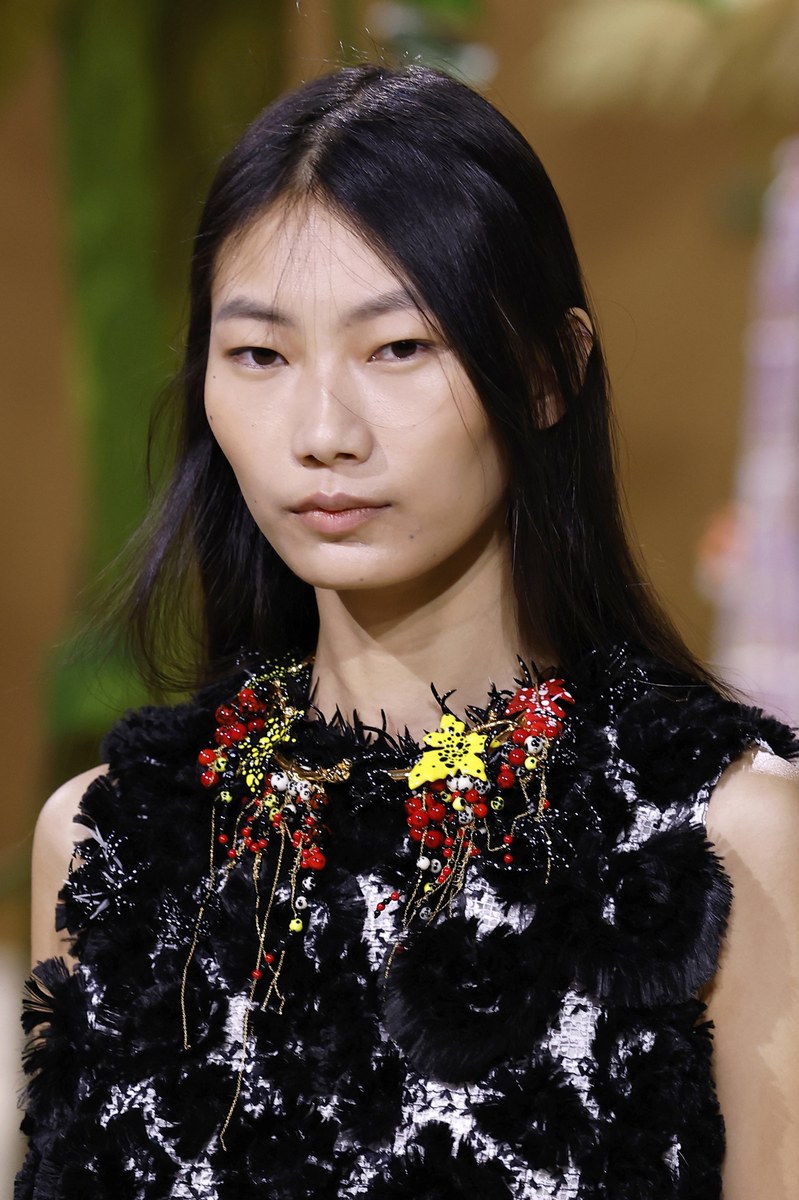
Fendi FW26 Women Looks Report

Fendi FW26 Women Looks Report
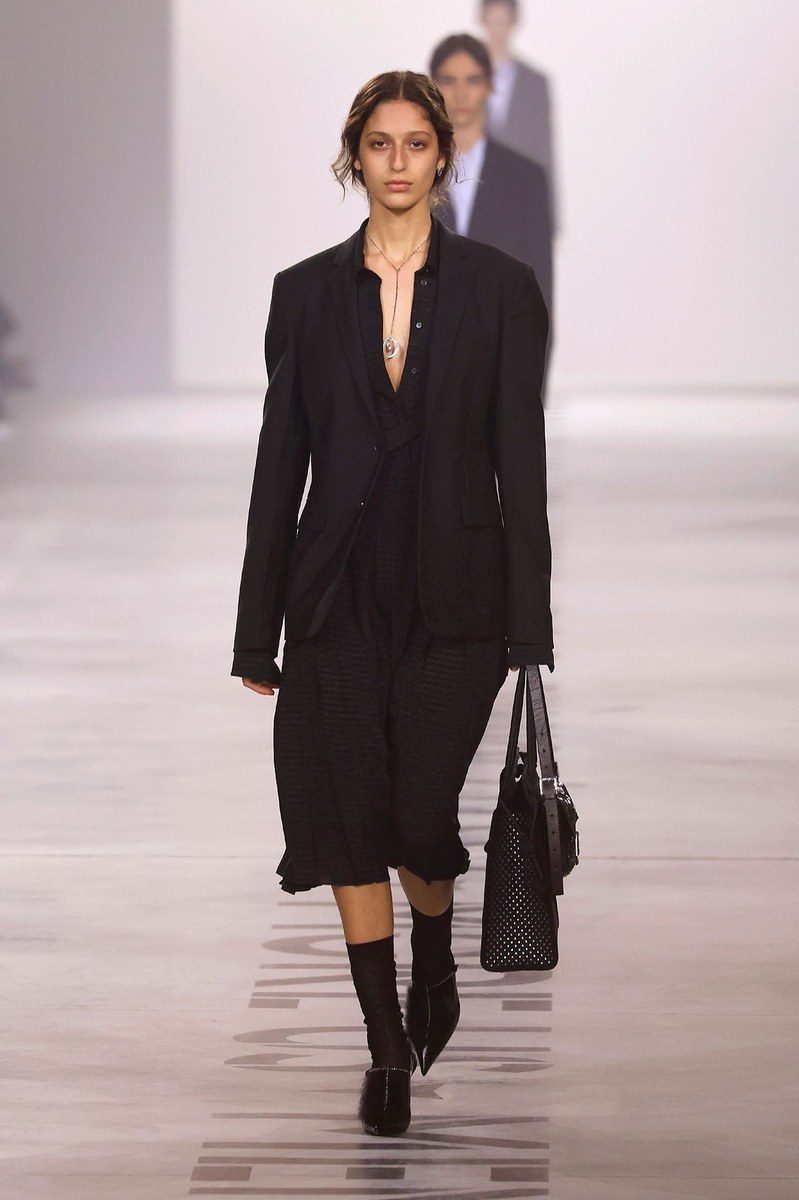
Fendi FW26 Women Looks Report

Milan Fashion Week

Fendi FW26 builds a wardrobe around the productive tension between masculine tailoring and feminine lingerie codes, running both threads through a single, near-monochromatic black palette. For buyers, this signals a market appetite for versatile investment pieces that move between professional and evening contexts without requiring a costume change.

Silhouette and Volume

Two distinct silhouette poles structure the collection. Tailored looks, including Looks 2, 7, and 9, carry oversized double-breasted blazers over wide-leg or midi-length bottoms, projecting a deliberately borrowed-from-the-boys authority. Slip dresses and lace constructions in Looks 5, 17, and 19 pull tight to the body instead, creating a push-pull rhythm across the runway that keeps the eye engaged without ever losing coherence. Long fluid lengths dominate throughout. Hemlines consistently hit the mid-calf or floor, reinforcing a sense of sustained, unhurried elegance.
Color Palette

Black is the absolute foundation, appearing across every look with only rare exceptions. Look 4 breaks the sequence with a stark white tuxedo shirt against a black lace skirt, while Looks 18 and 13 introduce camel and khaki outerwear as the sole warm neutrals. Neon yellow surfaces in sock details and bag fabrications across Looks 3, 8, and 10, functioning as a deliberate provocation within the otherwise severe palette. Nocturnal and authoritative, the mood relies on these yellow moments as punctuation rather than color story.

Look 4
Look 4

Materials and Textures

At least six distinct surface treatments move through the collection, all in the same black register, which prevents the palette from ever reading as flat. Matte wool suiting grounds the tailored looks. Silk satin in Looks 17 and 19 pulls light across the body with a liquid, low-sheen drape. Black lace recurs in Looks 4, 5, 12, and 16, ranging from dense floral patterns to open, sheer constructions that expose skin or layered foundations beneath. Faux or treated fur appears as trim in Looks 6, 11, 12, and 18, adding tactile weight at shoulders, collars, and vest surfaces without reading as costume.

Styling and Layering

White collarless or bib-front shirts placed beneath dark outer layers create the collection's signature move, visible in Looks 2, 3, 7, 8, and 10, and deliver a flash of pale contrast at the neckline that reads as both formal and subversive. Sheer knit ankle socks with pointed patent or metallic-tipped heeled boots repeat across nearly every women's look, locking in a single footwear signature that is distinctive enough to drive accessory sales. Bags function as deliberate focal points, ranging from the perforated black structured tote in Look 1 to the fur-patchwork and logo-print options in Look 18, each one heavy enough in proportion to read as a secondary garment. A white bar collar worn as a detached choker-like piece in Looks 4, 5, 6, 7, and 10 is a recurring styling tool that deserves its own production conversation.

Look 1
Look 1

Look by Look Highlights

Look 4 pairs a voluminous white tuxedo-bib shirt with a black lace midi skirt, making it the collection's most immediately commercial separates proposition for buyers seeking day-to-evening flexibility.

Look 5 places a black floral lace off-shoulder gown with a detached white bar collar, delivering evening drama that buyers can position as a high-margin hero SKU for formal retail.

Look 5
Look 5

Look 7 layers a double-breasted black wool blazer over a waistcoat and wide-leg trouser in a full three-piece reading, the strongest argument in the collection for a complete tailored suit story.

Look 7
Look 7

Look 11 wraps a black shaggy faux fur coat over a V-neck knit and wide-leg trousers, with studded platform boots and a structural leather tote, making it the most directional men's crossover piece for unisex buying strategies.

Look 11
Look 11

Look 13 introduces a black-on-black textured croc-embossed belted trench coat with aviator sunglasses and knit sock boots, producing the collection's most wearable outerwear silhouette for volume-driven coat buying.

Look 13
Look 13

Look 18 stands as the outerwear high point for print and material mixing, combining a camel trench with a black fur collar, a quilted black inner layer, a lace hem, and a logo Fendi tote, stacking four distinct textures in one look that quantifies the house's layering logic for visual merchandising teams.

Look 18
Look 18

Look 19 closes the main women's sequence with a deep navy-black satin floor-length dress with velvet collar panels and bishop sleeves, the lone departure from pure black that style directors should note as an evening investment piece with strong red-carpet adjacency.

Look 19
Look 19

Look 17 runs a black silk slip dress trimmed in floral lace at the V-neckline and hem over opaque socks with feather-trimmed heels, translating the lingerie-as-outerwear thesis into its most direct and production-ready form.

Look 17
Look 17

Operational Insights

Footwear dependency: Knit ankle socks with pointed patent heel boots function as a collection-wide signature. Buyers who carry Fendi footwear should treat this as a priority reorder style, and style directors building editorial presentations should include it in every look.

Separates potential: A detached white bar collar appears across at least five looks as a standalone styling device. Product managers should evaluate whether this accessory warrants its own SKU, as it drives perceived outfit multiplicity without requiring additional RTW investment from the customer.

Outerwear depth: At least five distinct outerwear propositions surface throughout the collection, including the fur-trimmed camel trench in Look 18, the textured croc trench in Look 13, the speckled long coat in Look 15, the black faux fur coat in Look 11, and the tailored wool overcoat in Look 16. Buyers should plan coat depth accordingly and not collapse these into a single outerwear category.

Lace as a core fabrication: Black lace appears in at least four separate looks across different garment categories, from skirts to gowns to bodysuits worn under coats. This repetition signals lace as a persistent material investment for the house, not a seasonal accent, which affects both fabric sourcing decisions and how buyers position the category on the floor.

Yellow accent strategy: Neon yellow appears exclusively in accessories and socks, never in garments. Restraint is intentional here. Buyers should stock yellow accessory options as low-risk entry points for customers who want connection to the collection's energy without committing to the all-black wardrobe, making yellow the most accessible upsell opportunity in the lineup.

Complete Collection

Look 2
Look 2
Look 3
Look 3
Look 6
Look 6
Look 8
Look 8
Look 9
Look 9
Look 10
Look 10
Look 12
Look 12
Look 14
Look 14
Look 15
Look 15
Look 16
Look 16
Look 20
Look 20
Look 21
Look 21
Look 22
Look 22
Look 23
Look 23
Look 24
Look 24
Look 25
Look 25
Look 26
Look 26
Look 27
Look 27
Look 28
Look 28
Look 29
Look 29
Look 30
Look 30
Look 31
Look 31
Look 32
Look 32
Look 33
Look 33
Look 34
Look 34
Look 35
Look 35
Look 36
Look 36
Look 37
Look 37
Look 38
Look 38
Look 39
Look 39
Look 40
Look 40
Look 41
Look 41
Look 42
Look 42
Look 43
Look 43
Look 44
Look 44
Look 45
Look 45
Look 46
Look 46
Look 47
Look 47
Look 48
Look 48
Look 49
Look 49
Look 50
Look 50
Look 51
Look 51
Look 52
Look 52
Look 53
Look 53
Look 54
Look 54
Look 55
Look 55
Look 56
Look 56
Look 57
Look 57
Look 58
Look 58
Look 59
Look 59
Look 60
Look 60
Look 61
Look 61
Look 62
Look 62
Look 63
Look 63
Look 64
Look 64
Look 65
Look 65
Look 66
Look 66
Look 67
Look 67
Look 68
Look 68
Look 69
Look 69
Look 70
Look 70
Look 71
Look 71
Look 72
Look 72
Look 73
Look 73
Look 74
Look 74
Look 75
Look 75
Look 76
Look 76
Look 77
Look 77
Look 78
Look 78
Look 79
Look 79
Look 80
Look 80
Look 81
Maria Grazia Chiuri

About the Designer

Maria Grazia Chiuri was born in Rome in 1964, the daughter of a military father and a seamstress mother. The combination shaped her in ways that still show in her work: an almost structural sense of discipline alongside a deep, unromantic respect for craft learned at close range. She grew up watching her mother work with her hands, and that proximity to making things rather than simply designing them became a permanent part of how she thinks. She studied at the Istituto Europeo di Design in Rome, and in 1989, at 25, walked into Fendi's accessories department and started building what would become one of the most consequential careers in contemporary fashion.

At Fendi she met Pierpaolo Piccioli, and the two eventually left together in 1999 for Valentino, where they spent nearly two decades working as co-creative directors, first in accessories and then across the full collection after Valentino Garavani retired in 2008. Their Valentino was operatic and feminine, steeped in couture tradition but alive to something more current. When Chiuri departed in 2016 to take the top job at Dior, she became the first woman ever to hold that position in the house's then seventy-year history, a fact that said as much about the industry as it did about her.

Her nine years at Dior were defined by a deliberate effort to make the clothes carry meaning beyond their cut. She printed "We Should All Be Feminists" across T-shirts worn on the runway, collaborated with artists, craftswomen, and writers from across the world, and consistently pushed against the idea of fashion as a purely aesthetic exercise. Some found the messaging heavy-handed; the commercial results were hard to argue with. She left in 2025 with a final show held in Rome, the city she had always circled back to.

In October 2025, Fendi announced her appointment as Chief Creative Officer, a return to the house where she began her career more than thirty years earlier, now reporting to CEO Ramon Ros. She will present her first collection in Milan in February 2026.

"Fendi has always been a forge of talents and a starting point for many creatives, thanks to the extraordinary ability of these five women to nurture generations of vision and skill."

"The role of a creative director is no longer to simply design beautiful clothes, but to curate a culture and hold a mirror to the world we live in."

✦ This report was generated with AI — combining human editorial vision with Claude by Anthropic. Because the future of fashion intelligence is already here.