Ferragamo FW26 Women Looks Report
Milan Fashion Week
Ferragamo FW26 stakes its identity on a single architectural gesture: the oversized double-breasted coat, reinterpreted across wool, leather and technical fabric, worn over fluid silk separates that trail and pool beneath its hem. For buyers operating in a market hungry for investment outerwear with clear brand codes, there's a repeatable, scalable hero silhouette backed by strong color logic and material contrast.
Silhouette and Volume
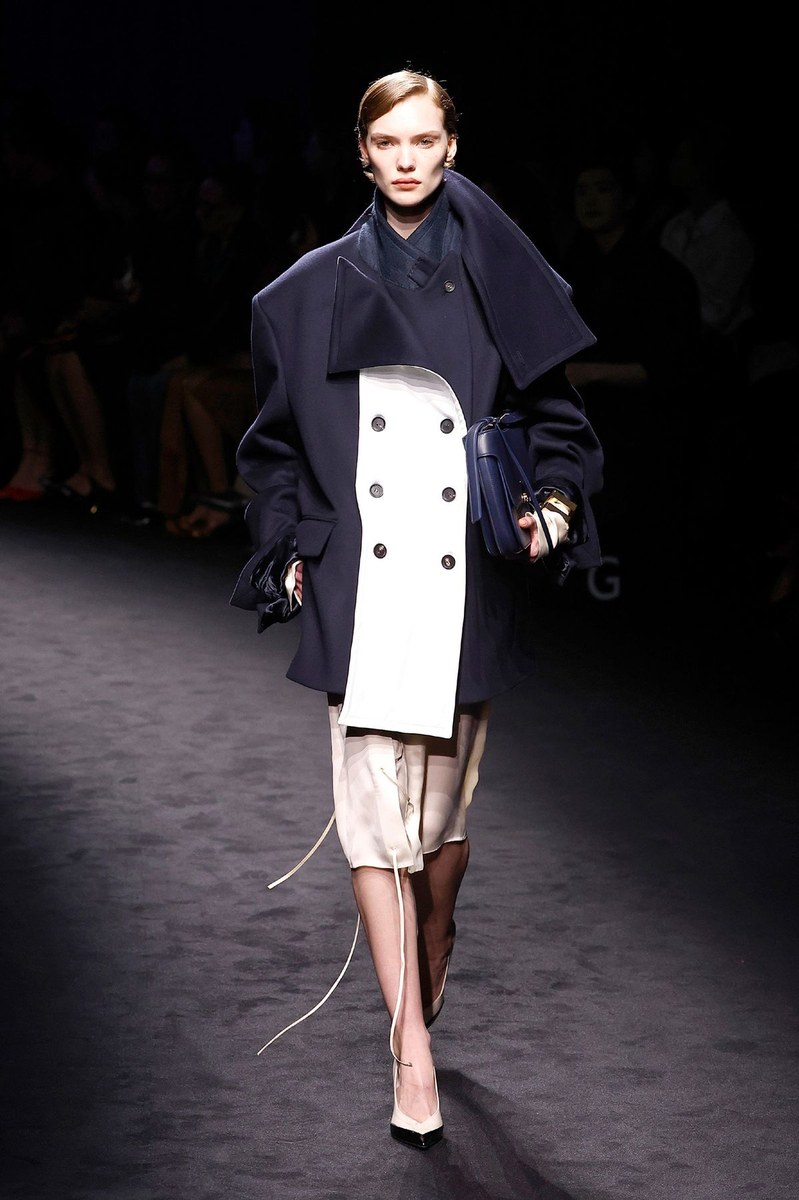
Two clear bodies drive the collection. First comes a monumental, broad-shouldered coat with an exaggerated cape-like collar, cut to fall at or below the knee, seen in Looks 1, 4, 6, 11, 13, 15 and 16. Then there's a fluid, dropped-shoulder tunic or dress with lace-up front closures, worn with wide-leg trousers or standalone, visible in Looks 2, 5, 9, 12 and 14. Where these two bodies meet, as in Look 1 with its cream slip skirt escaping beneath a navy coat, the proportion becomes everything.
Color Palette
Midnight navy and charcoal grey carry the weight of the collection. They appear repeatedly across outerwear, suiting and footwear, creating a palette that reads as authoritative without being funereal. Cream and ivory break the heaviness in Looks 5, 7, 12 and 15, functioning as contrast linings, blouses and full-look treatments. Amethyst purple is the single bold departure, deployed with conviction in Looks 8, 9 and 11, adding a commercial accent color that translates directly to a capsule story.
Materials and Textures
Heavy boiled wool dominates the coat program, with a matte, dense surface that holds structure without boning or internal scaffolding. Look 16 pivots to glossy navy leather for the same double-breasted coat shape, adding a surface tension that reads differently under light. Silk and satin treatments in Looks 2, 9, 12 and 14 are fluid and heavy-weighted, draping with a liquid quality rather than a crisp one. Look 19 introduces the most textural moment in the collection, pairing a sheer charcoal georgette top with a bronze accordion-pleated skirt that gathers and flares at the hem.

Styling and Layering
Contrast rather than tone-on-tone drives the layering strategy throughout. A white shirt collar or silk scarf bleeds out from beneath a dark coat, as in Looks 6 and 15, signaling that the pieces beneath are intended to be seen and sold as part of the story. Gloves, cut short and in leather, appear across Looks 1, 4, 8, 11 and 13, reinforcing the tailored register without adding bulk. Pointed-toe kitten and mid-height pumps appear on nearly every look, grounding the oversized volumes without competing with them, and the bag program runs lean: structured top-handle frames in navy, black and off-white, proportioned to be tucked under an arm rather than carried by a strap.
Look by Look Highlights
Look 1 pairs a voluminous navy double-breasted wool coat with a white front panel and cream silk midi skirt, making it the clearest commercial entry point in the collection for buyers who need a coat with built-in styling narrative.
Look 6 shows the same oversized double-breasted coat in navy with a white dress shirt and tie visible at the neck, confirming that this silhouette crosses gender dressing codes and broadens the potential customer base.

Look 9 is the collection's boldest single statement: a full amethyst purple silk off-shoulder dress with lace-up front and side construction that pulls the fabric across the body, worth prioritizing for evening and resort buyers.

Look 16 translates the hero coat into glossy navy leather with a matching leather button-front skirt underneath, creating a high-impact leather set that production teams should evaluate for its price positioning and run potential.
Look 17 delivers the sharpest suiting moment, a structured navy blazer with wide lapels and cropped hem worn over a matching button-front pencil skirt, with a midriff gap that keeps the silhouette modern without compromising the tailored vocabulary.

Look 18 stands apart as the strongest standalone dress in the lineup, a grey wool sleeveless sheath covered in double-breasted button detailing and a diagonal front seam, accessible enough in construction to carry broad retail distribution.

Look 19 is the evening anchor, a two-material column dress combining sheer black georgette and a bronze pleated velvet lower half with ruffle hem, best suited for specialty or luxury department store floor placement.

Look 12 presents the lace-up tunic and skirt formula in head-to-toe ivory silk with an asymmetric shoulder, a softer, more wearable interpretation of the collection's structural language that gives buyers a white dress option with genuine design differentiation.

Operational Insights
Hero SKU identification: The oversized double-breasted wool coat is the collection's anchor product and appears across at least seven looks in navy, charcoal and black, making it the primary SKU for reorder planning and depth of buy decisions.
Colorway leverage: Navy, black and ivory cover the core coat program, and buyers should confirm whether the amethyst purple from Looks 8, 9 and 11 is available as a full coat option, because it represents the strongest impulse color in the range for a fashion-forward capsule.
Material tiering: The collection runs across boiled wool, leather and silk at three distinct price tiers, giving retailers the ability to build a three-door strategy: entry at wool, mid at leather, top at made-to-measure silk, without diluting the visual coherence of the floor presentation.
Accessories integration: Structured top-handle bags and short leather gloves are styled as functional complements to the coats rather than statement pieces, which suggests strong attachment rates at point of sale and argues for buying them as part of a coordinated outfit package rather than as standalone accessories.
Gender fluidity consideration: Looks 3, 6, 7 and 10 present menswear-coded silhouettes on male models using the same fabrics, collar constructions and color palette as the womenswear, and style directors should evaluate whether their floor can present this as a shared wardrobe proposition, particularly given how consistently the suiting and knitwear pieces crossover.
Complete Collection


About the Designer
Maximilian Davis grew up in Manchester, the son of a Trinidadian mother and a Jamaican father, both deeply embedded in the world of image-making: his father studied fashion design, and his mother and sister worked as models. The Caribbean ran through the household not as nostalgia but as a living culture, full of music, color, and a particular understanding of the body in motion. Davis absorbed all of it before he understood what fashion was, and that foundation has never left his work.
He studied at the London College of Fashion and went on to show with Fashion East, Lulu Kennedy's platform for London's sharpest emerging voices. His own label, Maximilian, launched in 2020 and drew immediate attention for its precise, sensual tailoring rooted in his Caribbean heritage, pieces that were sharply constructed but moved with an ease more commonly associated with sportswear than with luxury. The LVMH Prize took notice, shortlisting him as a semifinalist in 2022. He withdrew from the competition quietly, and within days Ferragamo announced his appointment as Creative Director.
He took the role at 26, one of the youngest designers ever to lead a historic Italian house, and wasted no time making his intentions clear. He stripped back the branding, zeroed in on the house's archive and its particular shade of red, and began rebuilding Ferragamo around a wardrobe rather than a statement: clothes and accessories that people would reach for daily and hold onto for years. His references swing between the freedom of the 1920s and the cinematic warmth of late-1970s campaigns, periods that interest him less for their aesthetics than for what they say about how people wanted to be seen.
"When I start a collection for Ferragamo, I always look into the archive. The campaigns from the late seventies showed the family of the brand. It was family and community, a softer, more romantic side to the way they were showing the collections."
"I think people want to look at something and see themselves in it. They want it to be relatable."
✦ This report was generated with AI — combining human editorial vision with Claude by Anthropic. Because the future of fashion intelligence is already here.