Fforme FW26 Details
Fforme FW26 Details Report
Fforme FW26 commits to a rigorous vocabulary of volume, weight and texture across its dress details and headwear, positioning outerwear construction and fur-trimmed ushanka-style hats as the twin commercial anchors of the season. For buyers and product managers, this collection arrives at a moment when customers are actively trading up to considered, investment-weight pieces that read as quiet authority rather than trend noise.
Category Overview
Two categories dominate the detail shots: dress details spanning outerwear, tailoring and knitwear, and a tightly focused headwear program built entirely around one hat silhouette in two colorways. Boiled wool coats, oversized wool-blend topcoats, liquid satin blazers, chunky rib knits, a caramel shearling coat, and a white textured cotton coat with fringe make up the dress detail category, which is the broader and more commercially layered of the two. For headwear, strategy means repetition. One fur trapper-style hat with long side flaps appears across black and blue-grey colorways to signal a hero-SKU approach. Together, the two categories frame a collection that builds its commercial argument through material weight and silhouette volume rather than ornamentation.
Material and Construction
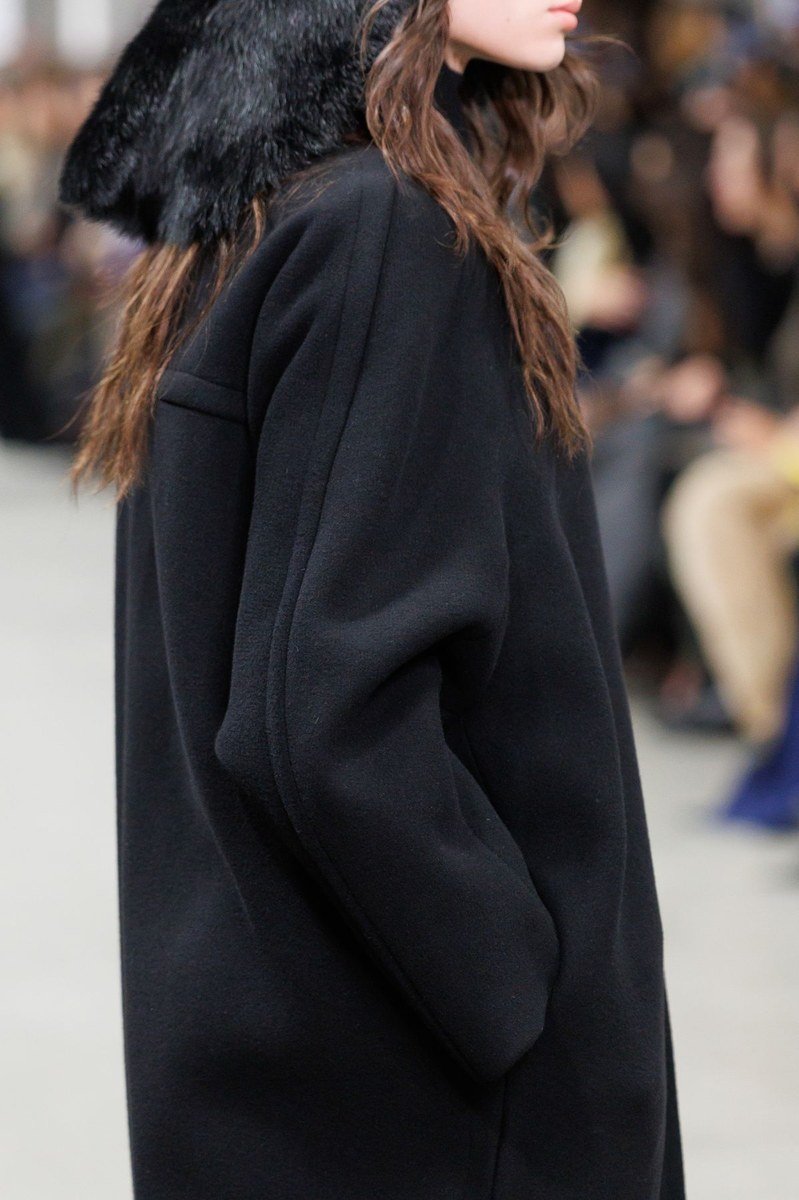
Sculptural ease defines the dress details, with set-in sleeves shaped into pronounced forward-rolling volume on the wool coats in Details 1, 2 and 15, and the balloon-shaped sleeve mass in Detail 14. Clean peak lapels with minimal internal structure characterize the tailored pieces, Details 9, 10 and 11, producing a soft-shoulder drape that reads as deflated tailoring rather than power suiting. Details 3 appears to use a crushed or washed satin with deliberately distressed surface dimpling. Long, directionally brushed caramel pile with visible seaming running vertically along the sleeve marks Detail 4, the shearling piece. A tonal stripe-textured woven fabric with raw fringe trim at the sleeve hem and along the front opening appears in Details 13 and 14, a detail that could signal production complexity for factories unfamiliar with controlled raw edges.

Color and Finish Direction
Charcoal grey and black are the foundational tones, appearing in Details 1, 2, 7, 8, 9, 10, 11, 15, 16, 17, 18, 19 and 20, and between them they account for the majority of the commercial weight in the collection. Warm blush and camel form the secondary palette, visible in the dusty rose rib knits of Details 5 and 6, the crushed champagne satin of Detail 3, and the tawny shearling of Detail 4. Ecru and warm white close out the palette in Details 12, 13 and 14, carrying a raw, unprocessed quality rather than a bridal or clinical brightness. A season built for versatile cross-category buy strategies emerges here, where grey and black anchors absorb the fur hat and outerwear investment, and warm neutrals give buyers a lighter, spring-adjacent entry point.

Key Pieces and Details
The oversized sculptural wool coats, represented in both black and grey across Details 1, 2 and 15, are the clearest commercial priority, with their volumetric sleeve construction and minimal surface detailing making them strong candidates for a broad range of wholesale accounts. Consistent across Details 16 through 20, the fur trapper hat is a direct reorder proposition given its single silhouette and two-colorway discipline. At the highest end of the cost spectrum sits the caramel shearling coat in Detail 4, with its full-length format and dense pile likely carrying the highest unit price, making placement decisions critical for buyers managing margin. Strong knitwear buys arrive in Details 6 and 8, the oversized rib-knit pieces with their dramatically bunched sleeve volume and sleeveless body construction, playing to the current demand for directional but wearable separates.

Detail by Detail Highlights
Detail 1 (Dress Detail) The black boiled wool coat presents a deeply curved, forward-projected sleeve head with no visible seaming at the shoulder, creating a monolithic one-piece sleeve illusion that reads as both technical and minimal.

Detail 2 (Dress Detail) A mid-weight flannel-like fabric shows more surface texture and drape than Detail 1, softening the architectural effect slightly while maintaining the same sculptural sleeve construction.

Detail 4 (Dress Detail) Dense, directionally combed pile in a warm amber-brown tone characterizes the long caramel shearling coat, with visible vertical seaming along the sleeve length and a clean, unfringed hem.
Detail 6 (Dress Detail) The blush ribbed-knit vest with detached sleevewear creates a deliberately oversized sleeve mass that bunches at the wrist, presenting the knit construction as the visual and textural centerpiece rather than a supporting layer.

Detail 11 (Dress Detail) A matte wool body pairs with satin-faced peak lapels and jet-black button closures on the black double-breasted blazer, creating a tonal contrast between surfaces that reads as formal precision.

Detail 13 (Dress Detail) Raw fringe at the sleeve hem and an ivory silk or organza layering piece held at the wrist distinguish the white tonal-stripe coat, presenting one of the more construction-intensive pieces in the lineup, with controlled fraying requiring careful finishing specification.

Detail 16 (Headwear) The black fur trapper hat with deep crown, short front fringe and long ear-covering side flaps appears in what reads as dyed rabbit or fox fur, with a dense, multi-directional pile that holds its shape under runway movement.

Detail 19 (Headwear) Longer, more voluminous side flaps characterize the blue-grey version of the trapper hat compared to the black version, with a silver-tipped fur texture that gives the colorway a cooler, more editorial tone.

Operational Insights
Sleeve construction complexity, the sculptural forward-rolled sleeve on the wool coats in Details 1, 2 and 15 requires precise pad-stitching or internal boning to maintain its shape across multiple wears, and buyers should confirm with production partners that pattern grading preserves the volume geometry across size runs.
Hero-SKU headwear strategy, the trapper hat appears in five of the twenty detail shots across two colorways only, signaling that Fforme intends this as a replenishment-ready accessory rather than a novelty, making it a low-risk depth buy for accessories buyers seeking a defined investment piece.
Raw fringe finishing, the intentional raw-edge fringe on Details 5, 13 and 14 requires wash and wear testing before production sign-off, as uncontrolled fraying post-consumer care could generate returns and brand risk for wholesale partners.
Neutral palette versatility, the black, grey and warm blush palette across all twenty details maps cleanly onto existing wardrobe frameworks for core contemporary customers, reducing sell-through risk for buyers in markets where directional color adoption is slow.
Knit construction as outerwear, the oversized ribbed-knit pieces in Details 6 and 8 function visually as outerwear rather than layering pieces, which creates a merchandising and pricing opportunity for product managers to position them at outerwear price points rather than standard knitwear, provided weight and gauge specifications support the premium.
More Details


✦ This report was generated with AI — combining human editorial vision with Claude by Anthropic. Because the future of fashion intelligence is already here.