FILA FW26 Shoes

FILA FW26 Shoes

FILA FW26 Shoes Report

FILA FW26 pivots the brand's athletic heritage toward a low-profile, sport-utility aesthetic built on flat or near-flat soles, velcro closures, and a deliberately retro racing silhouette that runs across the majority of the range. For buyers and product managers, this signals a clear commercial opportunity at the intersection of the archive-revival trend and the ongoing consumer appetite for low-sneaker profiles as an alternative to the chunky dad shoe.

Silhouettes and Construction

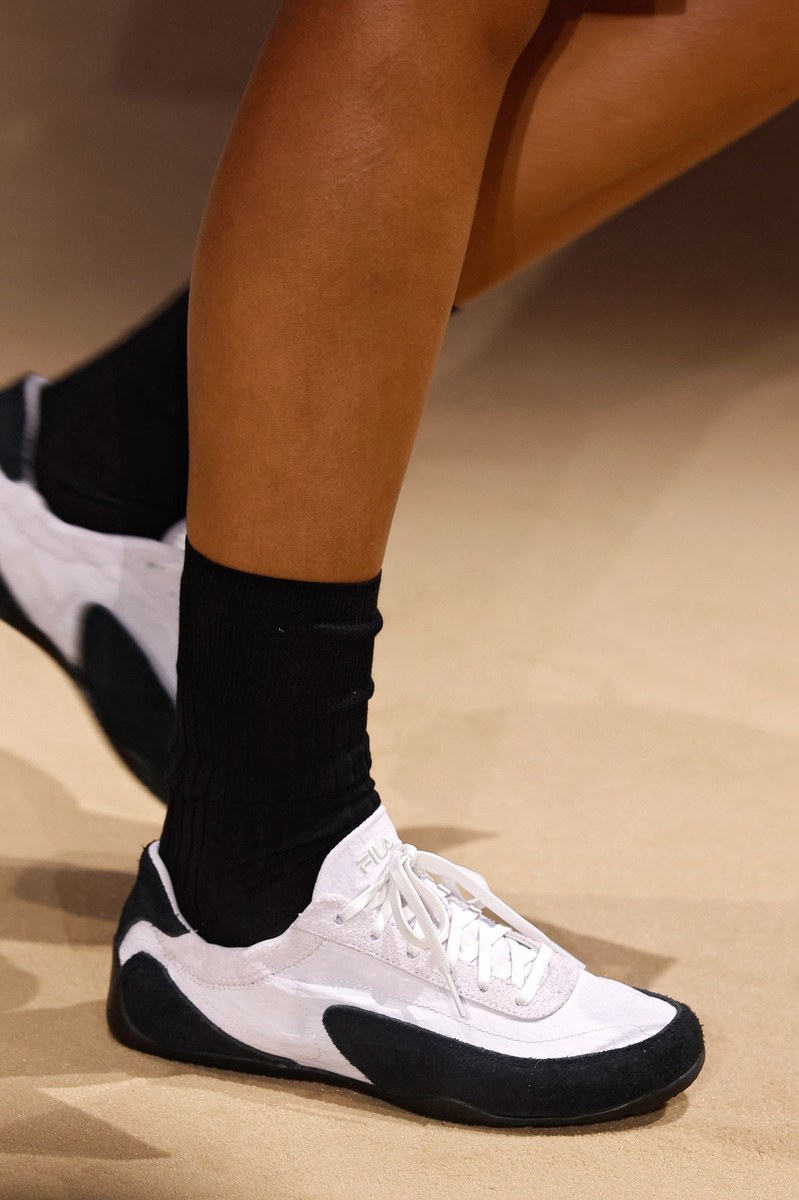
A flat or minimal-stack racing sneaker with a rounded toe dominates here, sitting at roughly 15 to 20mm of sole height across most styles. Shoes 2, 6, 9, 10, and 13 share a structured velcro-strap closure system that crosses the midfoot, pointing to a deliberate construction platform built for recoloring and rematerialing across the line. Shoe 3 breaks from this entirely with a pull-on leather boot cut just below the knee, a flat sole, and a slouched shaft that reads more as a functional art object than a commercial staple. Shoe 14 introduces a slip-on mule form with a pronounced black wedge outsole, the only significant platform in the collection.
Materials and Finishes

Smooth leather and tumbled suede carry the majority of the upper work, with mesh inserts appearing on Shoes 2, 6, 9, 10, and 13 as ventilation panels behind the velcro straps. High-gloss leather panels paired with matte suede in Shoe 5 create a mixed-finish construction that reads as the most premium build in the athletic group. Shoe 7 stands apart with a heavily textured, almost shearling-like suede upper that appears intentionally distressed or pre-worn at production level. Throughout the collection, flat rubber outsoles are thin and cupped at the perimeter, referencing indoor court or driving shoe construction rather than running.

Color Direction

Black and white dominates, appearing across Shoes 1, 2, 6, and 10 as a hard graphic contrast rather than a tonal pairing. Burgundy and blush in Shoe 5 emerge as the season's most commercially accessible accent color, targeting a slightly softer, fashion-leaning consumer without abandoning the sport frame. Burnt orange collars against a white and sand base in Shoe 11 deliver the strongest color pop in the range. Navy appears twice, in Shoes 8 and 12, as a quieter directional tone that suits tailored or workwear adjacent styling.

Key Models and Details

The velcro racing sneaker, seen in Shoes 2, 6, 9, 10, and 13, is the structural hero of the collection, with a cross-strap that integrates a thin elastic or woven webbing element and sits flush against a mesh underlayer. FILA branding appears as an embossed or embroidered wordmark on the heel tab in Shoes 1 and 5, and as a small rectangular badge on the lateral quarter in Shoe 5. Shoes 1 and 8 carry a lace-up closure on the same low racing base. Shoe 8 is executed entirely in a dense navy loop-pile or toweling-like textile that suggests a limited or capsule-production approach. Shoe 4 introduces a quilted white leather sneaker with a rounded, almost padded toe box, the sole construction and quilting pattern suggesting a soccer shoe or indoor flat reference.

Shoe by Shoe Highlights

Shoe 1 White suede and leather lace-up with hard black rubber heel and toe caps, the FILA logo embossed at the collar, positioned as the clearest entry point for wholesale accounts seeking a black-and-white sport classic.

Shoe 1
Shoe 1

Shoe 2 White and black velcro racing sneaker with mesh upper panels and red micro-stripe detailing along the lateral wall, the closest thing in the range to a direct archive reissue and the strongest candidate for a hero SKU.

Shoe 2
Shoe 2

Shoe 3 Black leather pull-on boot with a sculpted flat sole and a relaxed, gravity-slumped shaft, a high-risk, high-reward editorial piece that suits specialty and concept store buyers over mass accounts.

Shoe 3
Shoe 3

Shoe 5 Burgundy and blush mixed-finish sneaker with a gloss leather shell, matte suede toe, tonal laces, and a FILA badge on the lateral heel, the most feminized and fashion-forward build in the collection.

Shoe 5
Shoe 5

Shoe 7 Sand and off-white lace-up sneaker with a heavily textured suede upper that appears intentionally aged, paired with wide red trousers on the runway, signaling a styling direction toward tonal earth-tone dressing.

Shoe 7
Shoe 7

Shoe 8 All-navy lace-up sneaker constructed from a dense loop-pile or toweling textile with white laces and a flat black cupped sole, a material-driven style that justifies a higher production cost through tactile differentiation.

Shoe 8
Shoe 8

Shoe 11 White and sand suede sneaker with a burnt orange collar trim and white laces, the orange appearing raw and slightly frayed at the edge, which reads as a deliberate artisanal finish rather than a production fault.

Shoe 11
Shoe 11

Shoe 14 White slip-on mule with a clean, minimal upper and a thick black wedge outsole forming a distinctive concave arc at the toe, the most structurally original last in the collection and a potential talking piece for press and editorial placement.

Shoe 14
Shoe 14

Operational Insights

Velcro Platform: Five distinct makeups appear across the velcro racing sneaker, Shoes 2, 6, 9, 10, and 13, confirming a modular last strategy. Buyers should plan for colorway extensions and material swaps from a single tooling investment, reducing development cost per SKU.

Textile Differentiation: The toweling or loop-pile upper in Shoe 8 and the shearling-adjacent suede in Shoe 7 suggest FILA is testing non-standard upper materials on proven silhouettes. Product managers should evaluate minimum order quantities and lead times for these fabrics early, as specialty textile sourcing typically extends development timelines by four to six weeks.

Sole Architecture: The thin, cupped flat rubber outsole running through most of the collection carries an indoor court or driving shoe reference that aligns with the current retail appetite for low-profile athletic soles. This construction is generally lower cost per pair than a traditional EVA midsole stack, which improves margin at mid-tier retail price points.

Color Segmentation: The palette splits cleanly into three commercial tiers: black and white for volume, navy for tailored and premium positioning, and burgundy or orange for fashion and editorial adjacency. Buyers should map these tiers to their channel strategy rather than buying across all colorways uniformly.

Boot Anomaly: Shoe 3 sits entirely outside the athletic framework of the collection in terms of materials, construction, and silhouette. Footwear directors should treat it as a brand-positioning statement for press rather than a production priority, and assess it separately from the sneaker buys in terms of minimum quantities and stocking depth.

More Shoes

More Shoes

More Shoes

Shoe 4
Shoe 4
Shoe 6
Shoe 6
Shoe 9
Shoe 9
Shoe 10
Shoe 10
Shoe 12
Shoe 12
Shoe 13
Shoe 13

✦ This report was generated with AI — combining human editorial vision with Claude by Anthropic. Because the future of fashion intelligence is already here.