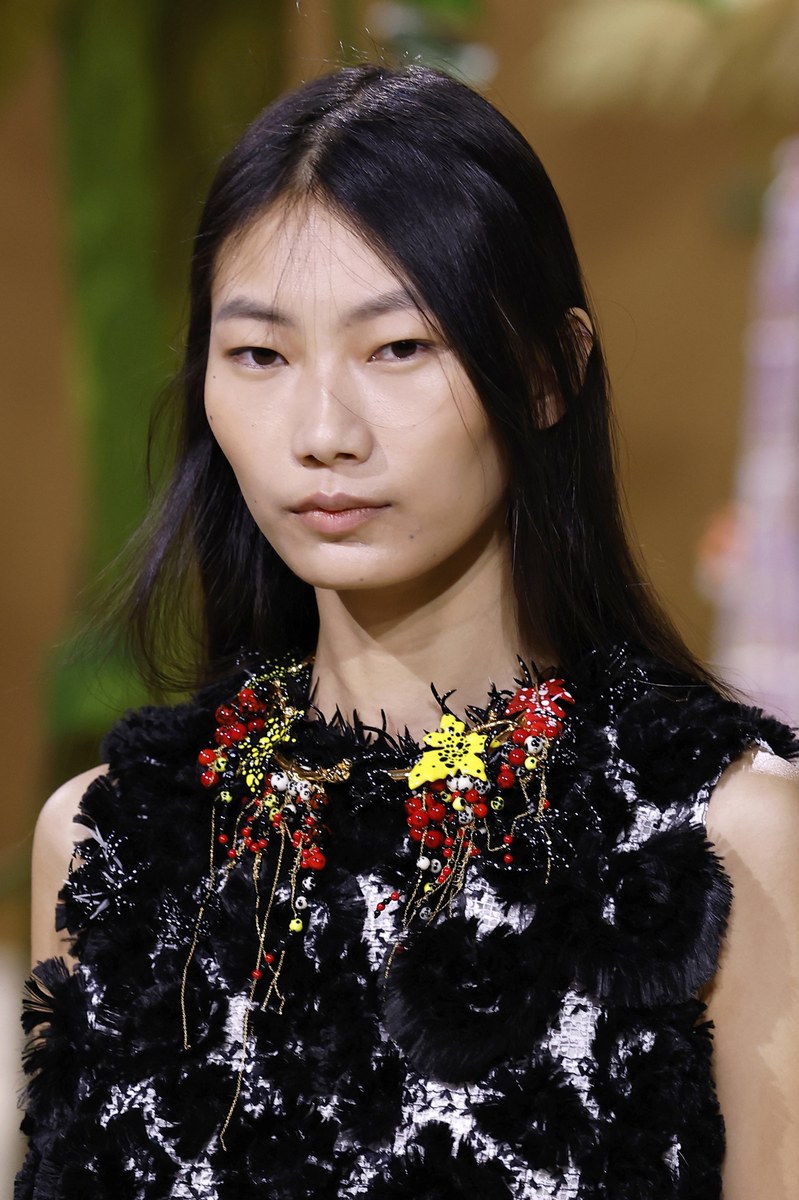
Florania FW26 Women Looks Report
Milan Fashion Week
Florania FW26 builds a world where textile destruction and formal tailoring coexist as equally weighted design languages, threading distressed knitwear, shredded mesh and lace through both eveningwear and daywear silhouettes. For buyers navigating a market where the appetite for craft-driven, anti-polish aesthetics continues to displace conventional luxury finish, this collection arrives with strong commercial anchors alongside its more editorial statements.
Silhouette and Volume
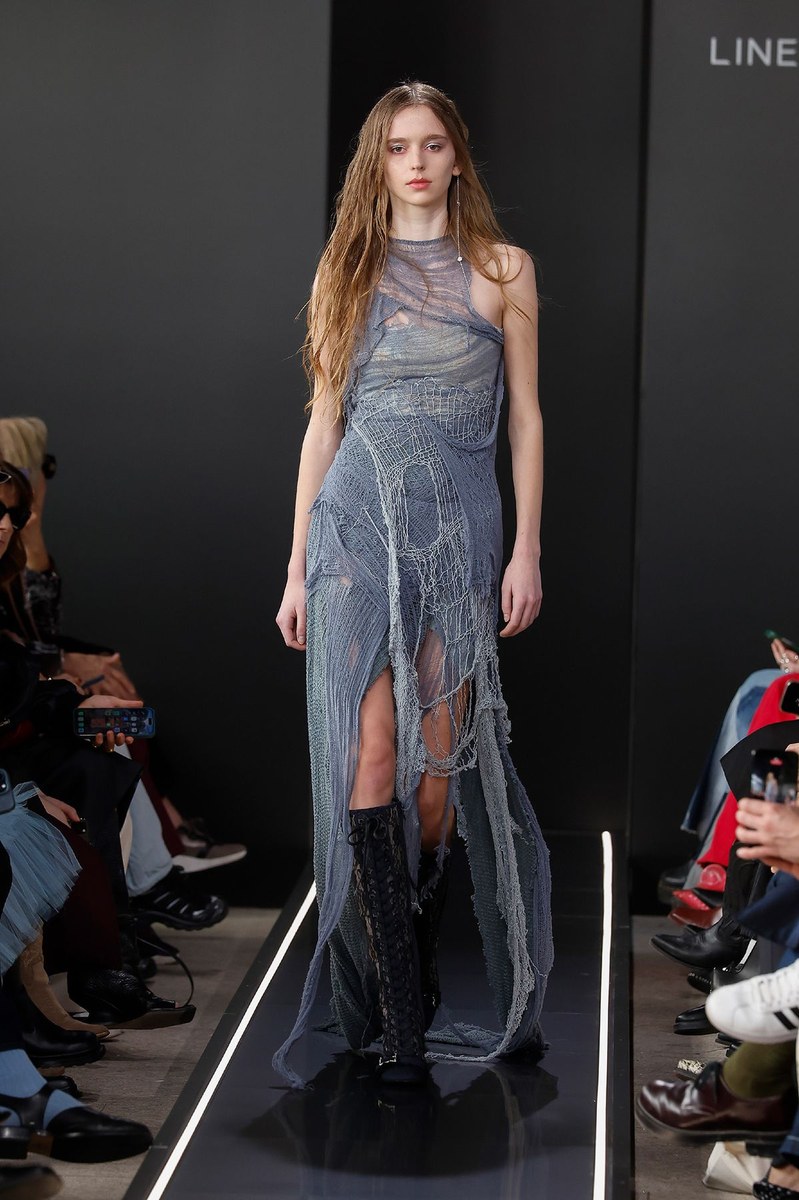
Two clear poles dominate here: long, floor-grazing columns and very short, high-hemmed dresses, with almost nothing in between. Look 1 pulls a sheer, distressed mesh gown to the floor. Look 10 cuts a shredded lace minidress at the upper thigh. That contrast repeats deliberately across womenswear. Outerwear reads oversized and coat-length in Look 6 and Look 8, where wide, dropped shoulders and relaxed chests give masculine structure to otherwise deconstructed builds. Asymmetric hemlines appear in Look 11 and Look 2, adding a drape-forward, movement-conscious element that reads well in motion.
Color Palette
Ash grey, bone white and raw ecru open the palette in a tight range, anchored by Looks 1 through 4 as an almost archaeological study in degraded neutral. Black enters hard in Looks 7, 10, 14, 19, used at full saturation against skin or sheer ground to create a graphic, high-contrast effect. Strongest commercial moment arrives as chartreuse acid yellow across Look 17 and Look 18, a strong satin slip dress and a silk-satin shirt respectively, giving buyers a single-color story with clear cross-category potential. Look 13 introduces a dark ground botanical floral print in dusty pink, teal and olive, the only multi-color print in the lineup and a likely strong performer for the dress category.

Materials and Textures
Distressed knit, shredded mesh and degraded lace carry the collection's conceptual weight. Looks 1, 3 and 4 show fabric appearing to be mid-dissolution, with torn edges, open holes and loose warp threads left entirely unfinished. Silk satin appears in Look 16 and Look 17 with substantial weight and a high-sheen drape that reads evening-appropriate without embellishment. Look 5 pairs a textured, mohair-blend cardigan with hand-painted or digitally printed trousers, introducing surface-treated denim as a menswear-adjacent category play. Lace vocabulary spans at least three distinct weights here, from the dense broderie-adjacent panels in Look 9 to the sheer, almost disintegrating application in Look 7.

Styling and Layering
Ribbed knit knee-high socks appear across Looks 9, 10, 17 and 19, functioning as a recurring layering device that bridges the gap between bare leg and boot while adding a deliberate sportswear reference to otherwise formal garments. Lace-up ankle boots in both black patent and a cracked or distressed finish ground the more ethereal looks in Looks 1 and 3. Look 11 pairs its asymmetric jersey dress with tall, structured black leather knee boots for a sharper commercial read. Oversized tuxedo cutting appears in Look 7 and a sculpted single-button construction in Look 15, both worn open over sheer or printed underlayers. Jewelry stays minimal, with pendant necklaces and architectural earrings appearing in isolated looks, keeping focus firmly on fabric and construction.

Look by Look Highlights
Look 1 A floor-length grey mesh gown with webbed lace appliqué across the torso and a high front slit anchors the distressed mesh narrative for production context and serves as the collection's strongest editorial opener.
Look 3 A strapless ivory gown with multi-layer shredded hemlines and separate long mesh gloves gives buyers a separates option with high visual impact at lower unit cost than a single complex garment.

Look 7 An oversized black tuxedo blazer worn over a shredded black lace maxi skirt and lace bodysuit stands as the single look most ready to travel directly from runway to a premium multi-brand retailer's buying order.

Look 9 A short white lace minidress with hardware grommets at the shoulders, long fitted sleeves and a fringe hem sits at the intersection of the lace trend and the bridal-adjacent white moment, carrying real potential for occasion-wear buyers.

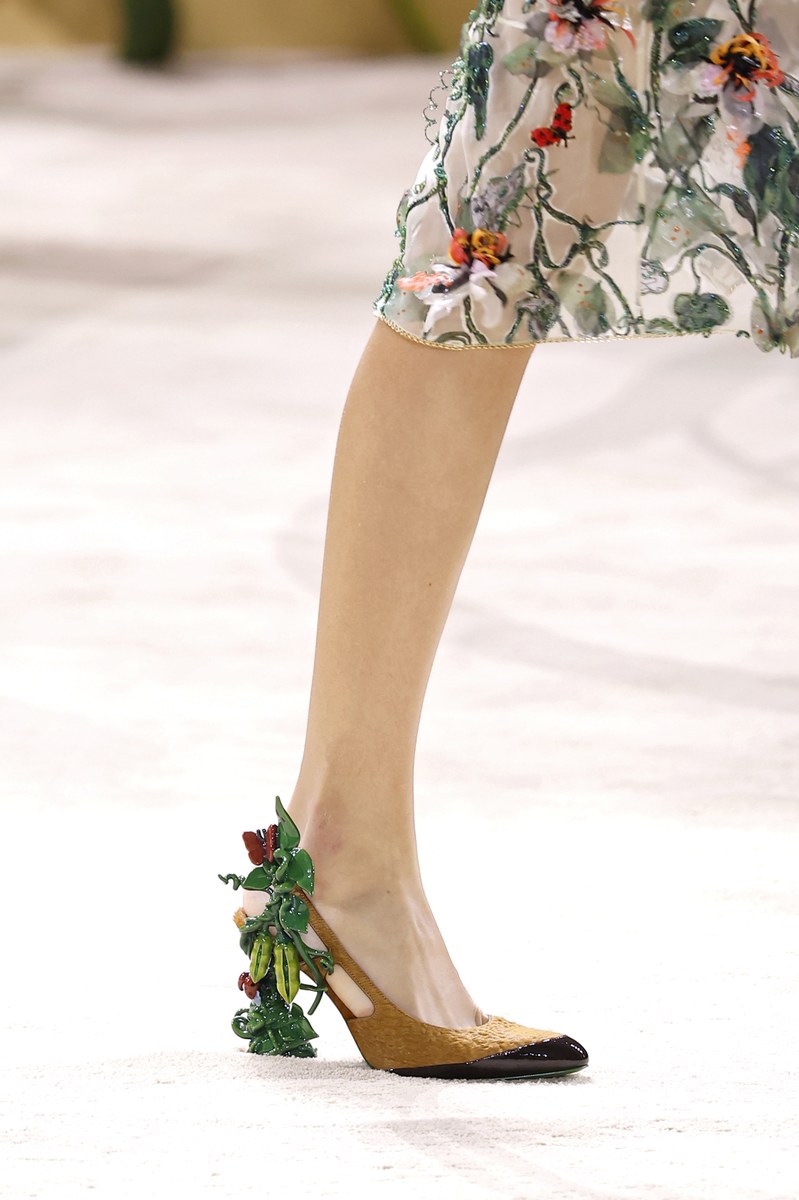
Look 13 A dark ground botanical print in a cape-shoulder silhouette layered over a tiered full-length skirt represents the collection's clearest nod to a commercially proven print-and-volume formula, with color balance differentiated enough to avoid trend saturation.

Look 16 Blush satin printed with a dense line-drawing pattern in steel blue functions as a standalone eveningwear piece with no construction complexity, making it a low-risk, high-return addition to any contemporary evening floor.
Look 17 Chartreuse acid-yellow satin with a deep front slit, fringe-effect seaming across the bodice and grey ribbed knee socks creates one of the collection's most photographable and product-specific moments. Color reads as both a standalone hero and a palette direction for the season.
Look 19 A black column dress with a deep front split, sheer banded bodice and dramatic ruffled lace capelet introduces volume at the shoulder without adding coat weight. Silver brooch detail gives product managers a clear opportunity for branded accessory tie-in.

Operational Insights
Distressed textile sourcing: Multiple looks depend on intentionally degraded knit and mesh, which requires supplier partnerships with controlled finishing capabilities. Confirm minimum order quantities and lead times for pre-distressed fabric early, as this process is not standardized across mills.
Capsule color strategy: Chartreuse satin in Looks 17 and 18 and dark botanical floral in Look 13 function as hero colorways that can anchor a tightly edited buy without requiring the full destructed-textile narrative, making them accessible entry points for retailers with a broader customer base.
Separates extraction: Look 3 gloves, Look 9 mini silhouette, Look 15 blazer and Look 18 oversized satin shirt each read as strong standalone separates. Style directors should consider pulling these as a separates story independent of the full look builds.
Size range and fit architecture: Look 4 demonstrates the collection proportioned on a plus-size body in the same textile language as the rest of the lineup, signaling genuine fit development across the range. Request full size spec sheets to confirm grading consistency before committing.

Knee-high sock accessory program: Ribbed socks appear across at least four looks in both black and grey, styled with heeled mules and boots. This low-cost, high-margin accessory category appears to be built deliberately into the brand's strategy, and style directors at multi-brand retailers should evaluate co-buying the sock program alongside the main collection to protect the full styling concept on the floor.
Complete Collection


About the Designer
Flora Rabitti was born in 1992 in Mantua, a Renaissance city in the Po Valley where she grew up inside the rigors of a Liceo Classico education and found her way out of it through a pair of scissors. At school, she was already sewing her own clothes and taking apart existing ones, a habit of deconstruction and reassembly that had less to do with fashion theory than with a teenager asserting herself against a prescribed world. Mantua's deep history in craft and painting — it was the city of the Gonzaga court, of Giulio Romano's Palazzo Te, of an entire culture built on the transformation of material into meaning — saturated her without her necessarily being aware of it. It surfaces now in everything she makes.
She studied fashion design at IED Moda in Milan, then pushed further: Central Saint Martins in London, the Institut Français de la Couture in Paris, private tailoring ateliers. In 2014, still before graduation, she was already working in the style office of Miu Miu within the Prada group, then at Alberta Ferretti, absorbing the mechanics of high-volume, high-precision production. The turn came in 2019, when she joined the Milanese collective Vitelli, a much more experimental outfit where the work was horizontal and the process openly artisanal. In between, she developed a parallel practice as an illustrator, and the two tracks never fully separated: at Florania, every collection begins as a drawn world, a set of characters built through comics and artwork before a single garment is conceived.
The brand was founded in 2021 following a research trip to Japan, where the precision of craft culture and the philosophical weight placed on materials reshaped how she thought about making things. She describes Florania's identity as solarpunk: punk for its refusal of industry conventions, solar for its genuine belief that technology and human ingenuity, applied carefully, can build something better. All production splits between Milan and Mantua, where part of the work happens at Drittofilo, a social tailoring workshop supported by Caritas that employs women in precarious situations. The aesthetic draws on surrealist painters — Leonora Carrington, Remedios Varo — on anime and manga, on the alchemical symbolism she absorbed growing up inside Renaissance frescoes. Florania was named Vogue Italia's number one brand to watch at Milan Fashion Week, won the CNMI Fashion Trust's MAX&Co. Design for Change Award in 2023, and was selected for the Kering Material Innovation Lab's Sustainable Style program in 2024. Rabitti is its founder and creative director.
"Florania was born after a trip to Japan, where I gathered respect for raw materials, nature and craftsmanship. I believe in the soul of the things around us, in a fragile world that must be protected."
"I hope my work can leave behind a language — a way of creating desire without imposing rules or making people feel inadequate in their own skin."
✦ This report was generated with AI — combining human editorial vision with Claude by Anthropic. Because the future of fashion intelligence is already here.