Gabriela Hearst FW26 Details
Gabriela Hearst FW26 Details Report
Gabriela Hearst FW26 reads as a study in restraint made tactile, where every belt, textile choice, and surface treatment carries deliberate weight rather than decoration for its own sake. For buyers and product managers navigating a market fatigued by excess, this collection offers a clear commercial argument for considered craftsmanship and tonal discipline.
Category Overview
Two categories anchor the accessories and detail strategy here: belts and dress details. Between fluid chain constructions and structured leather, the belt offering signals that the house is addressing two distinct customer archetypes within a single collection. Dress details range from dense guipure lace and voluminous fur stoles to lingerie-referencing embroidered panels and sculptural lace cape sleeves, communicating that surface and silhouette are equally weighted in Hearst's design language. Material integrity takes priority over embellishment volume.
Material and Construction
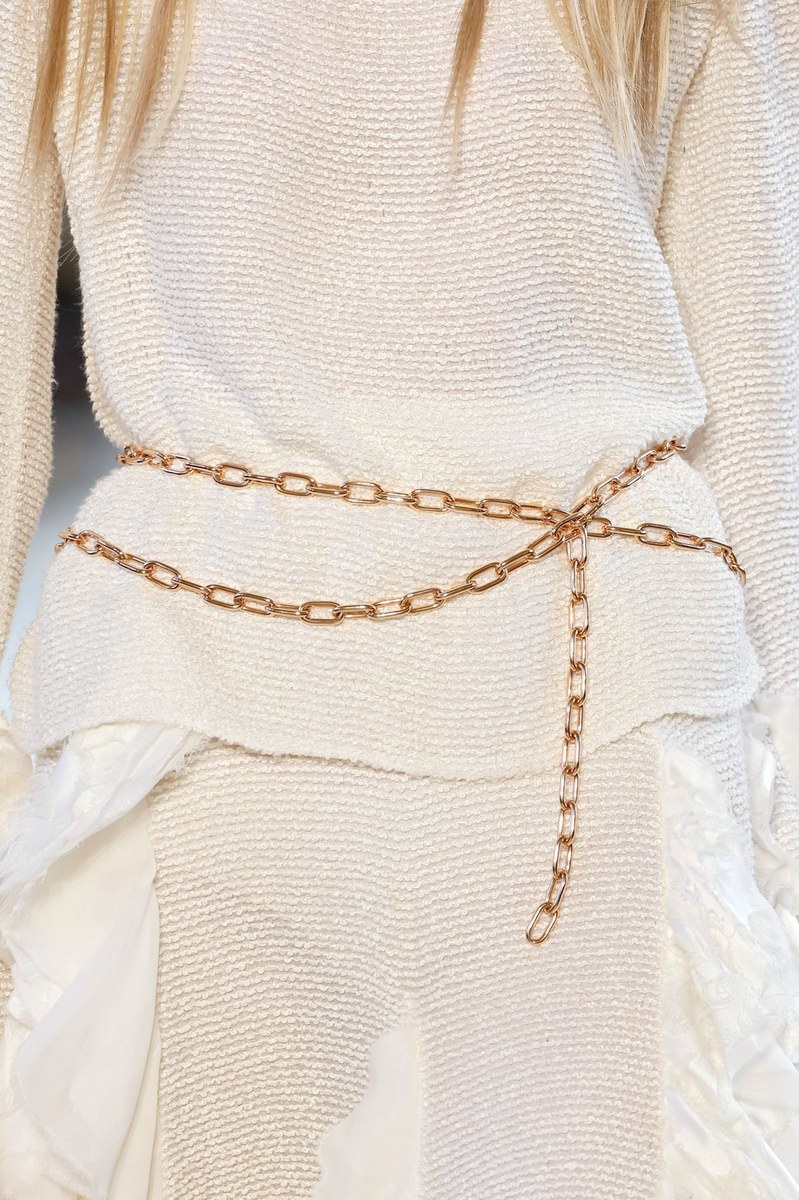
Detail 1 presents a rose gold paperclip chain belt, wrapped and knotted at the waist rather than clasped, which keeps the hardware minimal and the construction adaptable. Detail 2 is a wide black leather belt, approximately 4 to 5 centimeters across, with a silver rectangular single-prong buckle and a dramatically elongated trailing tail that extends well past the hip. Mink or mink-like faux fur in cream and red anchor the dress details, alongside dense floral guipure lace in near-black brown and embroidered tulle panels layered over black satin with floral appliqué motifs sewn in ivory thread.

Color and Finish Direction
Two distinct temperature zones divide the palette. Warm neutrals dominate, specifically cream, camel, ivory, and ecru, visible across Details 1, 4, and 6. A cool, saturated dark register anchors Details 2, 3, and 5 through near-black chocolate brown, true black leather, and a high-intensity fire red that operates as the sole chromatic accent across the entire group. Silver hardware on Detail 2 and the rose gold chain in Detail 1 reinforce that the collection is running two finish tracks simultaneously, not converging on a single metal tone.

Key Pieces and Details
Detail 1's knotted chain belt is commercially significant because it requires no hardware investment beyond the chain itself and reads as both jewelry and accessory, which broadens its retail positioning. Detail 2's oversized leather belt with its trailing tail drives a strong silhouette statement on its own and will photograph powerfully in editorial contexts, making it a high-visibility wholesale piece. Red fur stole in Detail 5 is the loudest single item in the group and functions as a color punctuation unit that converts an otherwise tonal outfit into a fully resolved look. Detail 3's guipure cape sleeve construction suggests a layering piece or dress investment that justifies a higher price-per-unit conversation with retail partners.
Detail by Detail Highlights
Detail 1 (Belt) A rose gold paperclip chain belt is wrapped twice around the waist and tied into a loose knot at center front, with a single tail dropping vertically, creating a jewelry-belt hybrid that avoids any traditional closure mechanism.
Detail 2 (Belt) A structured black smooth leather belt, wide and flat with a polished silver rectangular buckle, features an exaggerated tail left unbuckled and hanging past the hip, giving a single accessory both utility and sculptural presence.
Detail 3 (Dress Detail) Deep chocolate brown guipure lace forms a fitted bodice with a tiered cape sleeve that layers two scallop-edged lace panels at the shoulder, producing volume through cut rather than gathering or padding.

Detail 4 (Dress Detail) A cream mink or mink-adjacent fur stole is cut in wide horizontal panels and draped in a full crossbody wrap over a camel corduroy blazer, with the fur's plush pile and tonal seaming doing all the visual work against the structured suiting beneath.

Detail 5 (Dress Detail) A fire red crushed fur or sheared fur stole in wide lapel format is worn open over a dark chocolate brown dress, secured loosely at the waist by a brown leather belt with a brass-finish square buckle, with a gold paperclip chain hanging from the belt loop as a secondary detail that directly echoes Detail 1.

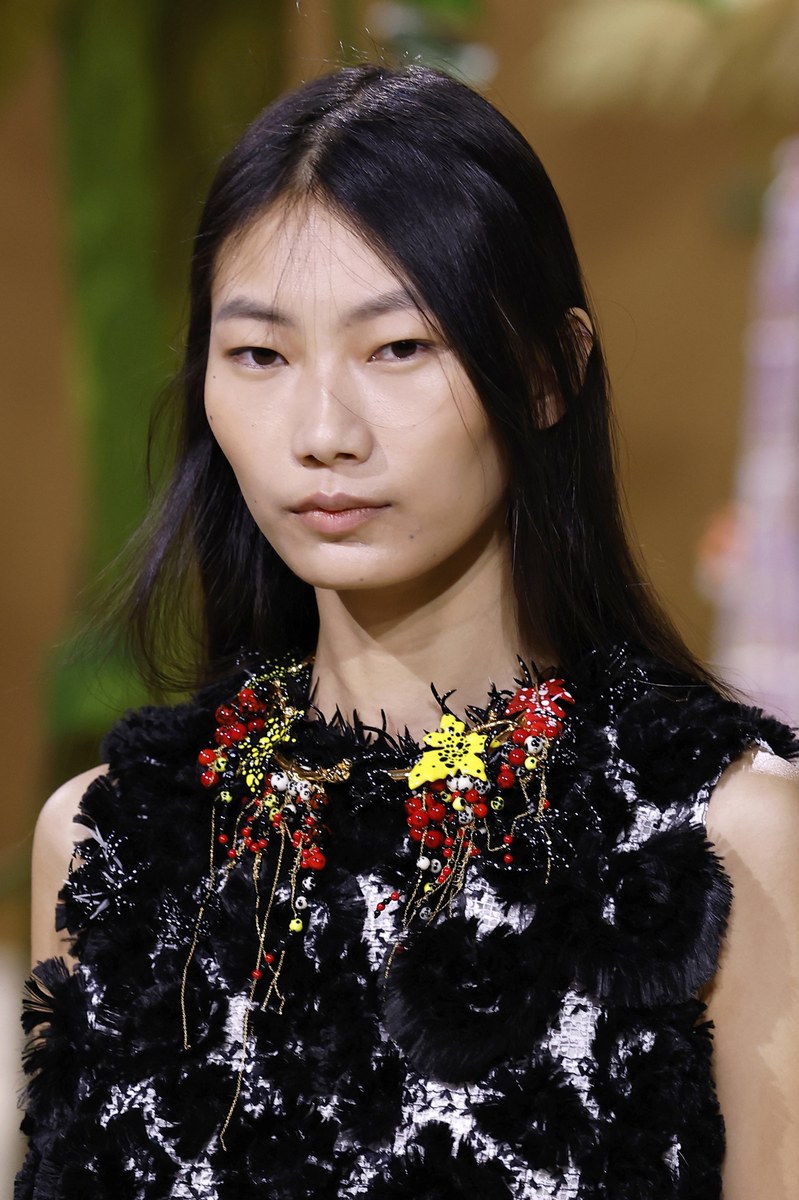
Detail 6 (Dress Detail) A black satin slip dress carries an embroidered tulle bib panel at the neckline, with ivory floral appliqué motifs transitioning from nude mesh at the top to black satin below, finished with a thin black leather cord tie closure at the back of the neck.

Operational Insights
Chain belt sourcing: The paperclip link format in Detail 1 is a repeatable, low-tooling construction that works in both rose gold and silver finishes, making it viable for multi-SKU production runs without significant investment.
Leather belt proportions: Wide-body, long-tail silhouettes like Detail 2 require more hide per unit than a standard belt, so buyers should account for a 20 to 30 percent material cost increase relative to a conventional 3-centimeter belt when building margin structures.
Fur unit strategy: Details 4 and 5 position fur stoles as statement toppers rather than outerwear, which allows product managers to slot them into accessories budgets rather than coat budgets, potentially freeing higher retail price points within a smaller category.
Lace investment: High per-meter cost on the guipure used in Detail 3 is offset by the cape sleeve construction, which uses a limited yardage, meaning the visual return on material investment is strong and the piece can be positioned at an accessible luxury price tier without margin compression.
Tonal pairing logic: Warm neutrals consistently pair with a single saturated accent across the collection, specifically red in Detail 5 and ivory embroidery in Detail 6 against black grounds, giving buyers a clear capsule-building formula to communicate to retail floors and visual merchandising teams.
✦ This report was generated with AI — combining human editorial vision with Claude by Anthropic. Because the future of fashion intelligence is already here.