GCDS FW26 Women Looks Report
Milan Fashion Week
GCDS FW26 plants itself at the intersection of early-2000s Italian streetwear nostalgia and lingerie-as-outerwear dressing, pulling both registers into a single, commercially legible wardrobe. The timing is precise. As the Y2K cycle matures past novelty into actual buying territory, this collection gives wholesale partners a fully developed product mix rather than a mood board.
Silhouette and Volume
Two poles anchor the collection, and GCDS moves between them without hesitation. Micro-length dominates the womenswear core, from the ruffled baby-doll silhouette of Look 1 to the barely-there denim shorts of Look 4, while the corset-and-peplum construction in Looks 6, 17 and 18 pulls the waist aggressively and flares at the hip. Oversized outerwear in Looks 15 and 16 counters those compressed shapes with dropped shoulders and engulfing volume, creating clear layering opportunities for the retail floor. Midi-length appears only in transitional pieces like Looks 8 and 12, positioned as the grown-up entry point into an otherwise maximally youthful proportion system.
Color Palette
Hot magenta, neon chartreuse and bubblegum pink recur across both womenswear and menswear, establishing a deliberately synthetic, candy-bright chromatic identity. From Look 1 through Looks 11, 14 and 17, the magenta-to-pink gradient builds a coherent monochromatic family that photographs well at point-of-sale. Chartreuse breaks in sharply through Look 18, the lace-trim skirt in Look 8 and the thigh-high boots of Look 16, functioning as an acidic accent that keeps the palette from reading as purely nostalgic. Black serves as a structural anchor in Looks 7, 8, 10 and 19, grounding the neon frequency with weight and contrast.
Materials and Textures
Stretch mesh and semi-sheer chiffon carry the most recurring work here. A lightweight power mesh holds boning channels cleanly in the corset dresses of Looks 17 and 18 while remaining fully transparent, which has strong production implications for pricing tiers. Lace appears in three distinct weights: a heavy black fringe trim on the skirt hem of Look 8, a flat pink lace panel framing the bodice of Look 11, and a sheer allover application across the full length of Look 19. Look 11's animal print reads as digitally printed satin rather than flock, giving it a sleeker, less costume-heavy finish than the leopard treatments typical of this market segment. Snake-effect faux leather in Looks 10 and 20 adds a tactile, high-gloss surface that contrasts directly with the soft mesh silhouettes elsewhere in the collection.

Styling and Layering
GCDS builds its styling logic around deliberate mismatching of register: a moto-racing leather jacket over a lace midi skirt in Look 12, a floral corset bodice over wide-leg track pants in Look 6, a black lace long-sleeve top worn open over a printed novelty skirt in Look 8. Each combination places one aspirational, craft-forward piece against a sportswear or casual reference, which is a practical formula for multiple price-point retail strategy. Footwear does significant tonal work throughout. Pink vinyl thigh-high boots in Look 15, neon green in Look 16 and white in Looks 3 and 9 carry color upward when the garment itself is neutral or subdued. Bags range from a plush pink cat novelty bag in Look 4 to a structured neon green tote in Look 11, signaling that accessories are treated as full-margin, statement-first product rather than afterthought.

Look by Look Highlights
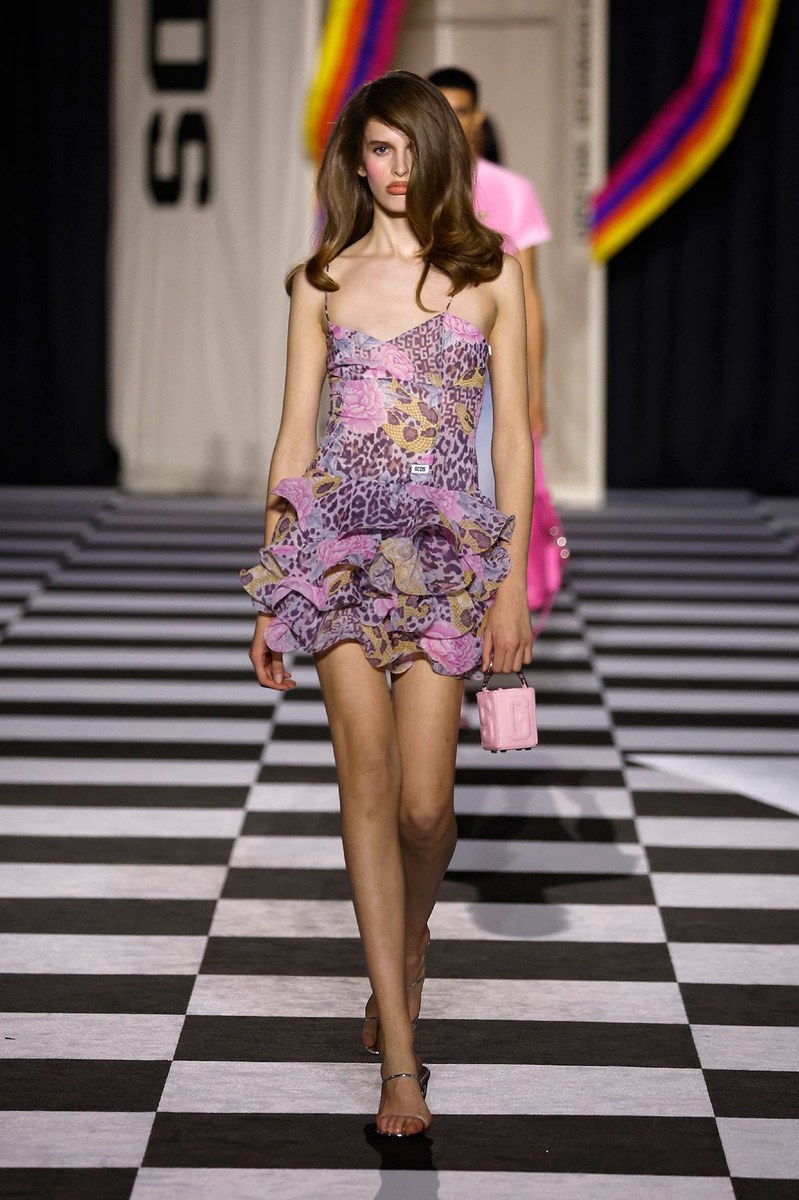
Look 1 Combines a purple and gold leopard-floral mixed print with tiered ruffle construction in a baby-doll silhouette, making it the single most complete expression of the collection's Y2K revival thesis and a strong candidate for hero-piece placement.
Look 6 Pairs a dusty rose brocade floral corset with wide-leg blue jersey track pants trimmed in white, a combination that tests the viability of corset-as-top dressing in a casual-adjacent context rather than an event context.

Look 8 Uses a sheer black lace long-sleeve bodysuit against a white novelty print skirt with black lace hem trim and carries a neon chartreuse box bag and matching pumps, making it the most accessory-forward look and the one with the clearest wholesale breakdown into separates.
Look 11 Presents a leopard satin slip dress with a hot pink lace bralette overlay, which reads as a finished commercial product requiring minimal adaptation for a lingerie-influenced ready-to-wear floor.

Look 12 Layers a black, white and yellow racing-stripe leather moto jacket over a lavender and gold lace-print midi skirt, directly addressing the luxury-sport crossover buyer who is currently the most active customer in the contemporary market.
Look 15 Commits to a single-piece statement through an oversize yellow satin track jacket that reads as a dress when worn alone, paired with bubblegum pink patent thigh-high boots, a two-SKU outfit that functions as a full look.

Look 17 Delivers the most technically resolved garment in the collection: a fuchsia power-mesh corset dress with structured peplum and visible boning, precise enough in construction to carry a premium price point without additional embellishment.

Look 19 Sends a sheer black polka-dot mesh column gown with a deep plunge and high front slit over lace-up black combat boots, a combination that will polarize buyers but represents the collection's clearest editorial asset for campaign and press use.

Operational Insights
Separates strategy: The majority of womenswear looks break cleanly into two or three individual SKUs, which gives buyers the flexibility to open the collection with lower price-point entry pieces such as the graphic tees or slip skirts before committing to full-look investment.
Print library: At least four distinct proprietary prints anchor the collection: leopard-floral mix, apple novelty, snake faux-leather, and floral brocade. Each is usable across multiple silhouettes, making print licensing or in-house translation a viable move for product managers working in adjacent categories.
Boot investment: Thigh-high boots appear in five colorways across the women's looks, pink, neon green, white, black, and purple for menswear, indicating GCDS is treating footwear as a core revenue category rather than a styling prop. Buyers should assess whether footwear rights are part of available wholesale agreements.
Corset construction cost: The boned mesh corset silhouette repeated in Looks 6, 17 and 18 requires a factory partner with lingerie-grade boning and finishing capabilities, which will affect margin expectations and minimum order quantities relative to the simpler jersey and print-dress styles.
Gender-fluid SKU potential: Looks 2, 7, 10 and 13 from the menswear segment of this runway share colorways, print families and bag styles directly with the womenswear looks, suggesting that a gender-neutral buying approach for accessories and select outerwear pieces could reduce fragmented purchasing and increase per-door sell-through.
Complete Collection


About the Designer
Giuliano Calza was born in Naples in 1988 and grew up with the kind of sensory overload the city specializes in — color, noise, baroque excess, street energy. He was not a fashion school kid. He studied political science at the Università di Napoli L'Orientale before completing a master's in marketing and communication at Bocconi in Milan, where he moonlighted as a casting director, stylist and digital PR, absorbing the mechanics of the industry from its less glamorous edges. At twenty-three he won a scholarship to Shanghai University, packed his bags, and moved to China for four years. He learned Mandarin. He studied the market. He worked in a restaurant with his brother Giordano and became, informally, the most stylishly dressed person in the room — until the garment manufacturer who produced the restaurant's uniforms offered to make whatever Calza wanted, for free.
That offer became GCDS. Back in Milan after visa complications cut his Shanghai chapter short, Calza launched the brand in 2015 with one hundred logo hoodies, sold entirely online. They sold out immediately. What he had understood in China was simple and devastating: the logo was not a branding device, it was a cultural statement, a membership card, a toy. His reference points were not fashion history or archive research but Hello Kitty, SpongeBob, Japanese manga, the feverish visual language of the markets he'd haunted in Shanghai and Hong Kong. He had seen the future arriving in the form of a maxi-print and had the nerve to act on it before almost anyone in Italian fashion.
GCDS has since dressed Beyoncé, appeared on the cover of British Vogue, staged the first metaverse runway show during the pandemic, and collaborated with everyone from Bratz to Mattel's Polly Pocket. Calza's instinct for pop subculture — read: irony, camp, community — has attracted a loyal following across the queer world and celebrity circles alike, without ever softening into mere nostalgia. The brand name officially stands for Giuliano Calza Design Studio, but the acronym has also been read as "God Can't Destroy Streetwear," which captures the attitude more accurately. He continues to lead the creative direction of the label from Milan, where he shares a flat with his partner and draws, increasingly, by hand.
"Fashion has to be on the light side. Everyone is trying to be too serious, too cool for school. I don't want to grow old before it's my time."
"Just imagine when you're dead someone is going to find your closet — just make them excited about it."
✦ This report was generated with AI — combining human editorial vision with Claude by Anthropic. Because the future of fashion intelligence is already here.