Genny FW26 Women Looks Report
Milan Fashion Week
Genny FW26 builds a coherent femininity around structural corsetry, feather trim, ruffled volume and a white-to-chocolate-to-black color arc that reads simultaneously as eveningwear and dressed-up daywear. The collection arrives at a moment when luxury buyers are actively seeking pieces that cross the formal and relaxed divide without losing construction integrity.
Silhouette and Volume
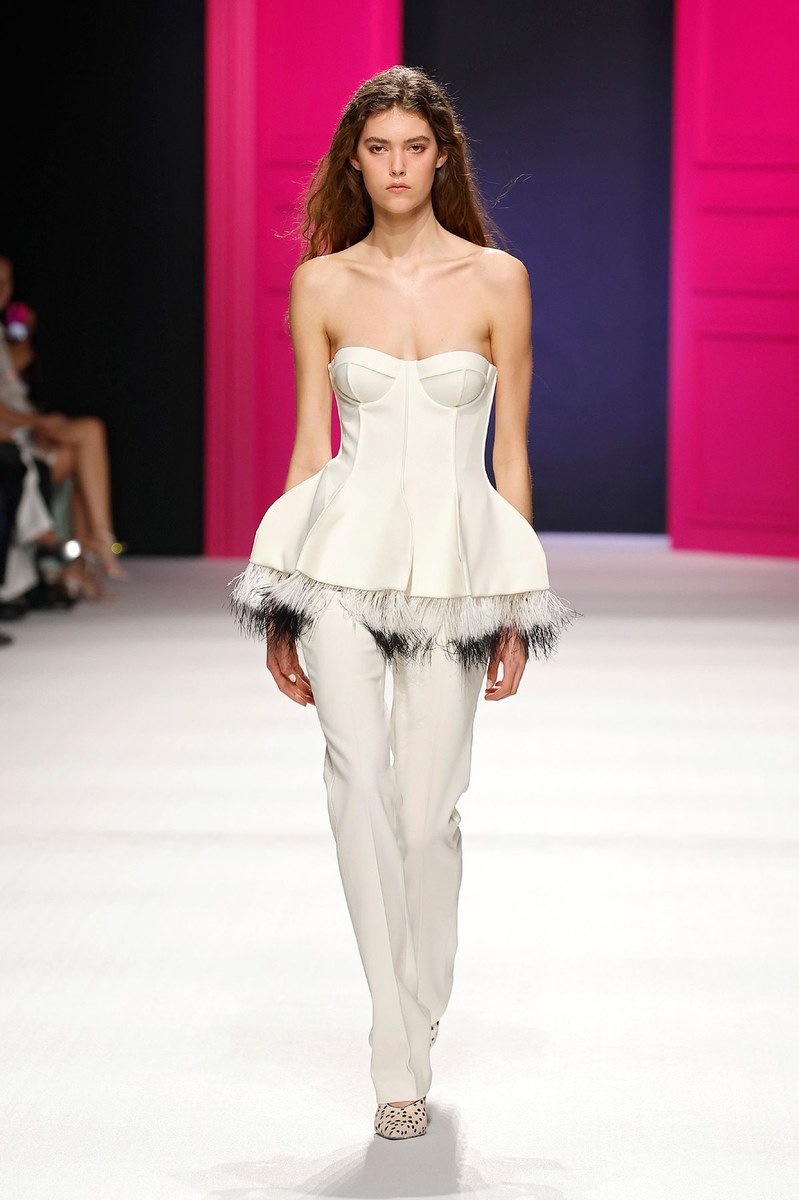
Fitted, boned-bodice silhouettes open the collection, then expand through a peplum waist that recurs in both white (Looks 1 and 4) and dark chocolate (Looks 8 and 11). Wide-leg trousers with a high, draped waistband appear in at least seven looks, maintaining a long vertical line even when the top half carries heavy decorative volume. Maxi skirts and full-length coat formats in the mid-collection section (Looks 13 and 16) push the volume outward at the hip or hem rather than the shoulder, keeping the silhouette grounded. Look 10 and Look 15 introduce asymmetric cascading ruffles that break the symmetry rule the rest of the collection follows.
Color Palette
Optical white flows through ecru and cream into sand and camel, then drops sharply into dark chocolate brown and finishes in full black. Looks 1 through 7 read as a unified white-to-ivory capsule that can be bought and sold as a group. Animal print, specifically a loose leopard spot on a fading ombré ground, bridges the neutral and dark chapters in Looks 9, 12, 13 and 14. A single deep burgundy-plum in Look 16 acts as a pivot before the collection closes in black.

Materials and Textures
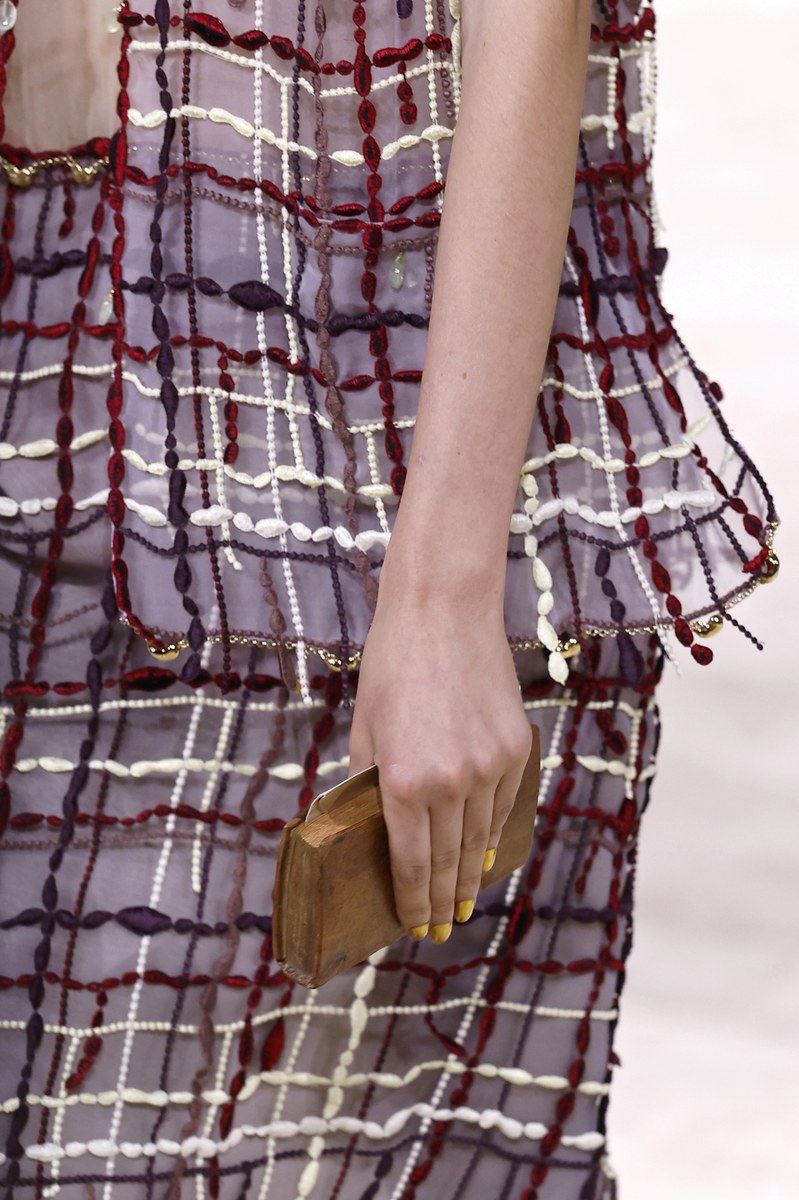
Bouclé wool appears in Look 3 and Look 4 with a dense, low-pile surface that gives the cream garments a matte, tactile weight appropriate for a cold-weather retail story. Silk organza and silk chiffon carry the transparency moment in Looks 6, 7 and 11, layered over opaque bases so the sheer reads as deliberate construction rather than exposure. Velvet in a flat, mid-weight finish handles the dark evening pieces, most clearly in the strapless bodice of Look 18 and the full suit of Look 16. Ombré leopard jacquard used for the trousers in Look 14 and the maxi dress in Look 13 has a compressed, satin-back handle that adds a reflective quality at the hem.

Styling and Layering
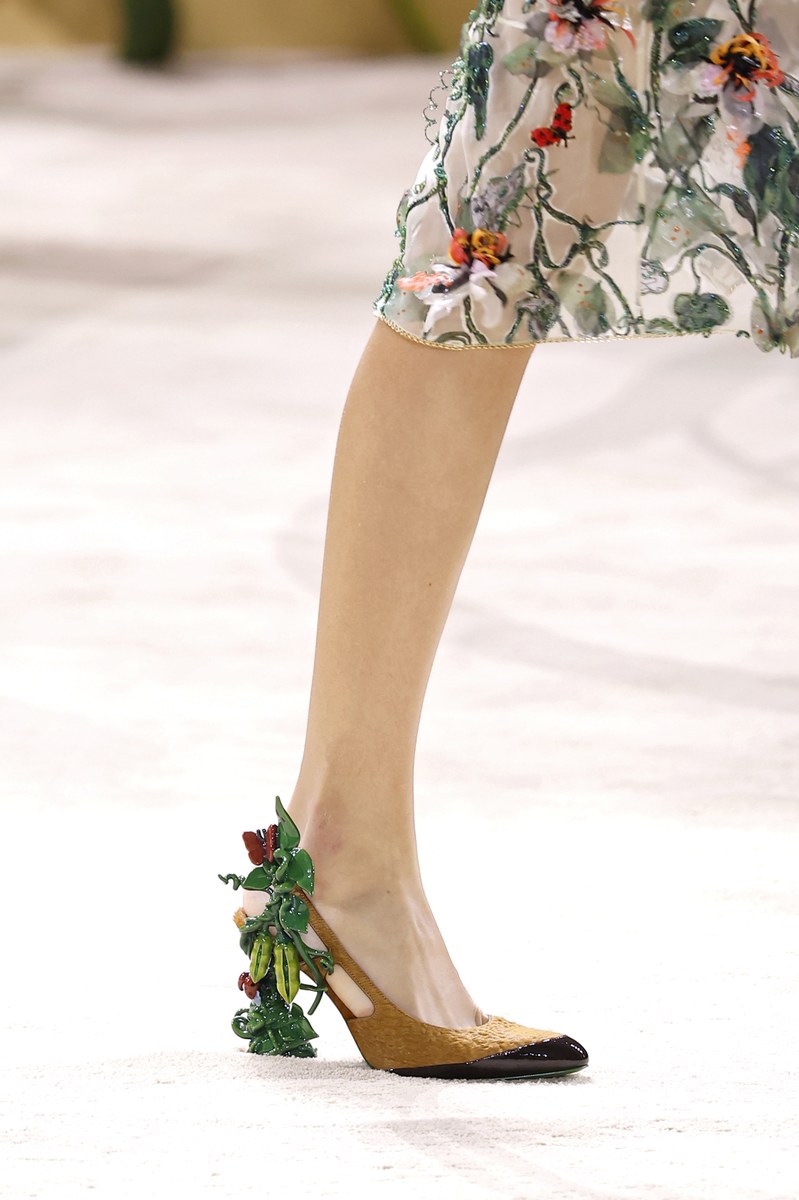
Ruffled high-neck blouses in white silk or sheer organza appear under outerwear, under velvet blazers and under structured coats, functioning as a recurring base layer that connects otherwise disparate looks. Crystal-set bow brooches pin the neckline of almost every look that carries a ruffle or an open collar, and this detail repeats often enough to register as a signature hardware piece with strong accessory buy potential. Footwear splits between leopard-print pumps or mules with an open toe (Looks 1, 2 and 7) and simple flat ballet shoes in white (Look 3), with the animal-print shoe acting as the primary bridge between the white and the darker chapters. Styling layers of gloves in Look 10 and Look 15 add a tonal extension to the all-dark looks.
Look by Look Highlights
Look 1 A white duchess-satin strapless peplum top edged in black-and-white feather trim paired with straight white trousers and leopard mules establishes the collection's core aesthetic equation in its first step.

Look 4 A strapless bouclé mini dress with a built-in peplum and tone-on-tone cream feather hem is the strongest single-unit buy in the opening chapter, crossing cocktail and cold-weather categories simultaneously.

Look 7 A floor-length ivory cape with ribbed tuck detailing worn open over a sheer high-neck blouse and wide-leg trousers represents the highest price-point outerwear statement and the clearest editorial moment in the collection.

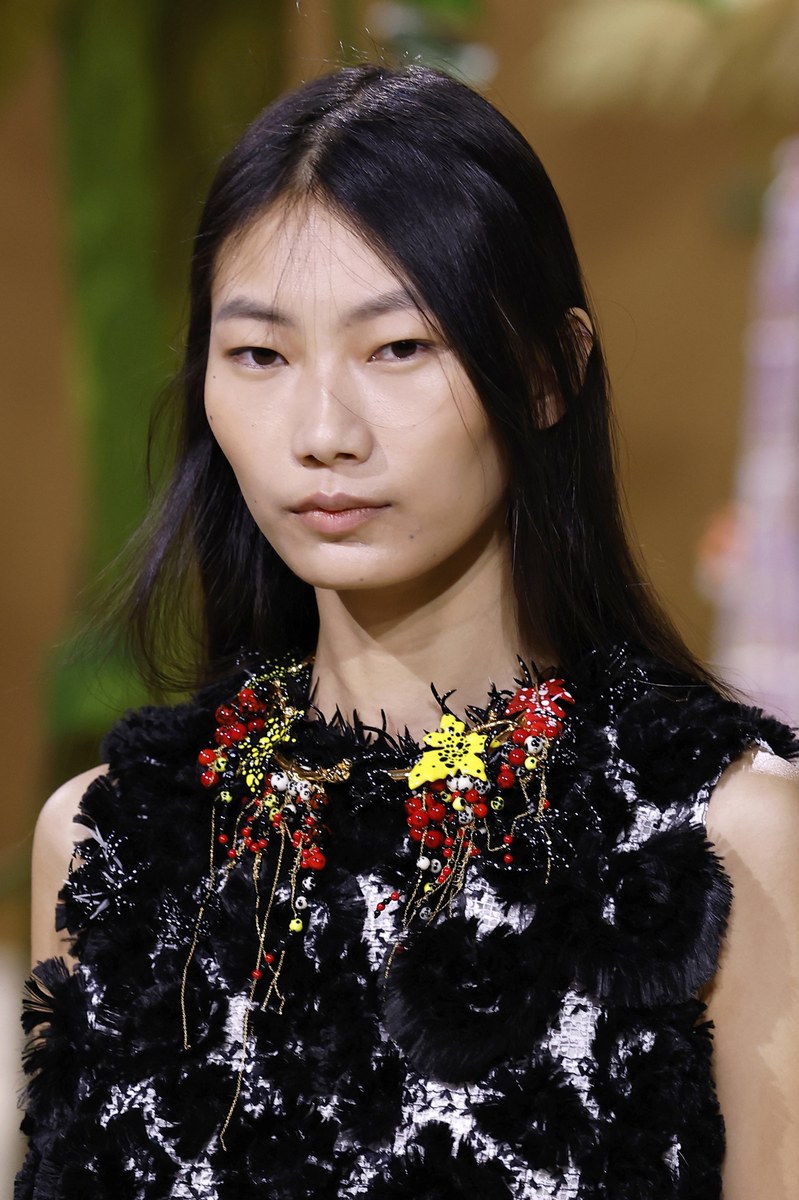
Look 11 A chocolate brown silk organza gathered dress with a cut-out chest, jewelled belt and yellow feather cuffs is the most directional dark piece, with the yellow feather cuff functioning as a detachable trim detail worth isolating for production.

Look 13 The full-length ombré leopard jacquard skirt paired with an oversized brown leopard-print coat and a gathered gold bow belt at the waist targets the maximalist luxury buyer and carries a strong trunk-show placement.

Look 16 A deep plum velvet blazer and wide-leg trouser suit worn over a pale lilac ruffle-front blouse is the most commercially transferable formal look in the collection, with the velvet weight and color suitable for a November delivery window.
Look 18 A strapless dark chocolate velvet bodice over a voluminous brown taffeta ballgown skirt cinched with a crystal bow buckle is the evening anchor, and the two-fabric construction makes it viable as a separates production strategy.

Look 19 A black halterneck column gown with a ruched high-neck insert and velvet bow details at the chest achieves the collection's most restrained evening silhouette, making it the most broadly placeable formal unit across multiple retail accounts.

Operational Insights
Crystal bow hardware: The recurring crystal-set bow brooch functions as a unifying signature accessory across at least ten looks. Buyers should assess it as a standalone SKU with gifting and add-on sale potential, priced as a fine jewelry-adjacent piece.
Feather trim positioning: Feather trim appears at hems, cuffs and collar edges across seven looks. Sourcing teams should confirm supplier capacity and CITES compliance early, as this trim volume requires lead time and affects landed cost calculations significantly.
Ombré leopard jacquard: The fading animal-print fabric recurs in trousers, a maxi skirt, coat lining and a full dress. Consolidating these SKUs under a single fabric order reduces cost per meter and supports a coordinated in-store display story.
White capsule buy: Looks 1 through 7 form a self-contained white and ivory group with consistent fabrication logic and a shared accessory language. Style directors should consider buying this chapter as a complete capsule for a January or February in-store moment rather than cherry-picking individual pieces.
Ruffle blouse as a category anchor: Ruffled high-neck blouses in white organza or silk appear under outerwear, blazers and standalone in the designer walk (Look 20). Low production complexity relative to its visual impact makes it carry the entry price point across multiple looks, and it remains the most defensible volume unit in the collection.

Complete Collection


About the Designer
Sara Cavazza Facchini grew up in Verona in a family whose livelihood ran on cloth. Her grandparents supplied fabric to home-based seamstresses, and as a child she would tag along on their rounds, absorbing the smell of fresh textiles, the scrape of chalk on wool, the way a piece of fabric would slowly assume the shape of a body. That early, tactile education never left her. Fashion, for Cavazza Facchini, was never an abstraction.
At sixteen she was spotted and photographed by Oliviero Toscani for the cover of Grazia, which launched a modeling career with the Fashion and Riccardo Gay agencies in Milan. It was a formative detour rather than a destination. In 1997 she appeared in Vanessa Beecroft's performance installation "VB 28" at the Venice Biennale, an experience that pointed toward something beyond the runway. She enrolled at IED Milan, completing a master's degree in press office and communications, then joined Swinger International, the Verona-based manufacturing group run by her husband Mathias Facchini. There she oversaw licensing and celebrity placement, developing an intimate understanding of how a fashion brand actually operates as a commercial and cultural object.
When Swinger acquired Genny in 2011, Cavazza Facchini handled special projects for the relaunched house, managing eyewear and fragrance licenses and reshaping its retail identity. Her appointment as creative director followed in 2013. She inherited a legacy built in large part by Gianni Versace, who served as Genny's first designer and set the house's template for impeccable fit, precious materials, and extreme femininity. Rather than burying that DNA, she worked within and around it, softening the silhouettes toward something more contemporary while holding onto the craftsmanship logic that made the original product so lasting. White became her signature color, orchids her recurring motif, and Italian mills her non-negotiable sourcing principle. Over twelve years at the helm she has grown the brand's footprint from Milan and Capri to Beverly Hills, while maintaining a design philosophy grounded in clothes that move with a woman through her actual day.
"My passion for fashion began when I was a child. My grandparents sold fabrics to seamstresses who worked at home, and I enjoyed going with them on those trips, seeing these women always with the tape measure wrapped around their necks."
"When a new fabric arrives at the company, first I try it on myself. I check if I like it and if it makes me feel good."
✦ This report was generated with AI — combining human editorial vision with Claude by Anthropic. Because the future of fashion intelligence is already here.