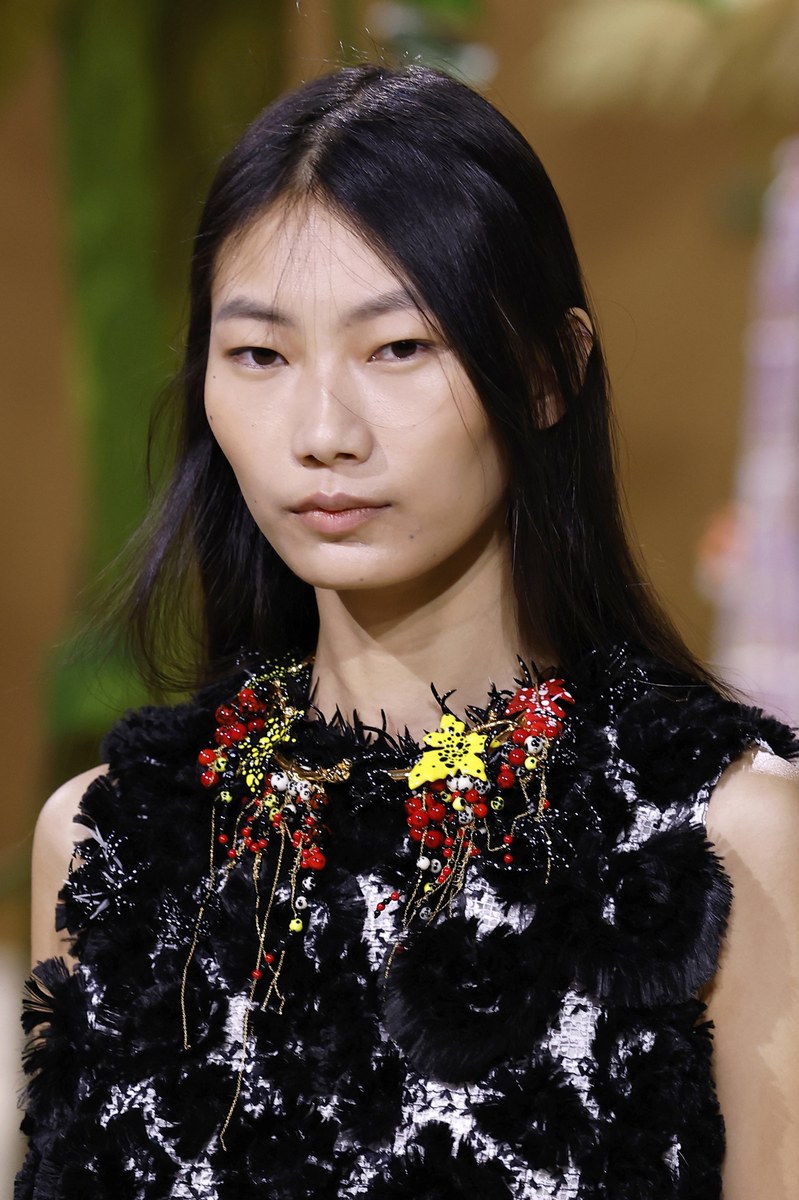
Giorgio Armani FW26 Details

Giorgio Armani FW26 Details
Did you know? Giorgio Armani established a vertically integrated manufacturing model in the 1980s by acquiring production facilities in Italy, allowing him to maintain direct control over fabric quality and construction techniques rather than outsourcing to third-party manufacturers. This strategy became a competitive advantage, enabling the brand to guarantee consistency and craftsmanship across collections while keeping production close to design innovation.

Giorgio Armani FW26 Details Report

Giorgio Armani FW26 builds its accessories language around restraint, with a single recurring belt design and two eyewear silhouettes doing the heavy lifting across an otherwise stripped-back accessories program. For buyers and product managers, this signals a deliberate move toward hero-item strategy, where one well-constructed accessory carries across the full collection rather than fragmenting the range.

Category Overview

Three categories appear across these nine details: belts (Details 1 through 4), dress details (Details 5 through 7), and eyewear (Details 8 and 9). The belt category is the most editorially consistent, with what appears to be a single SKU repeated across four entirely different outerwear contexts. From structured wool outerwear construction (Detail 5) to dramatic feather-trimmed sleeves (Detail 6) and ruched silk corseting with scarf layering (Detail 7), the dress details suggest the collection spans multiple commercial tiers. Two round-frame eyewear interpretations in muted, season-appropriate colorways round out the program.
Detail 5
Detail 5

Material and Construction

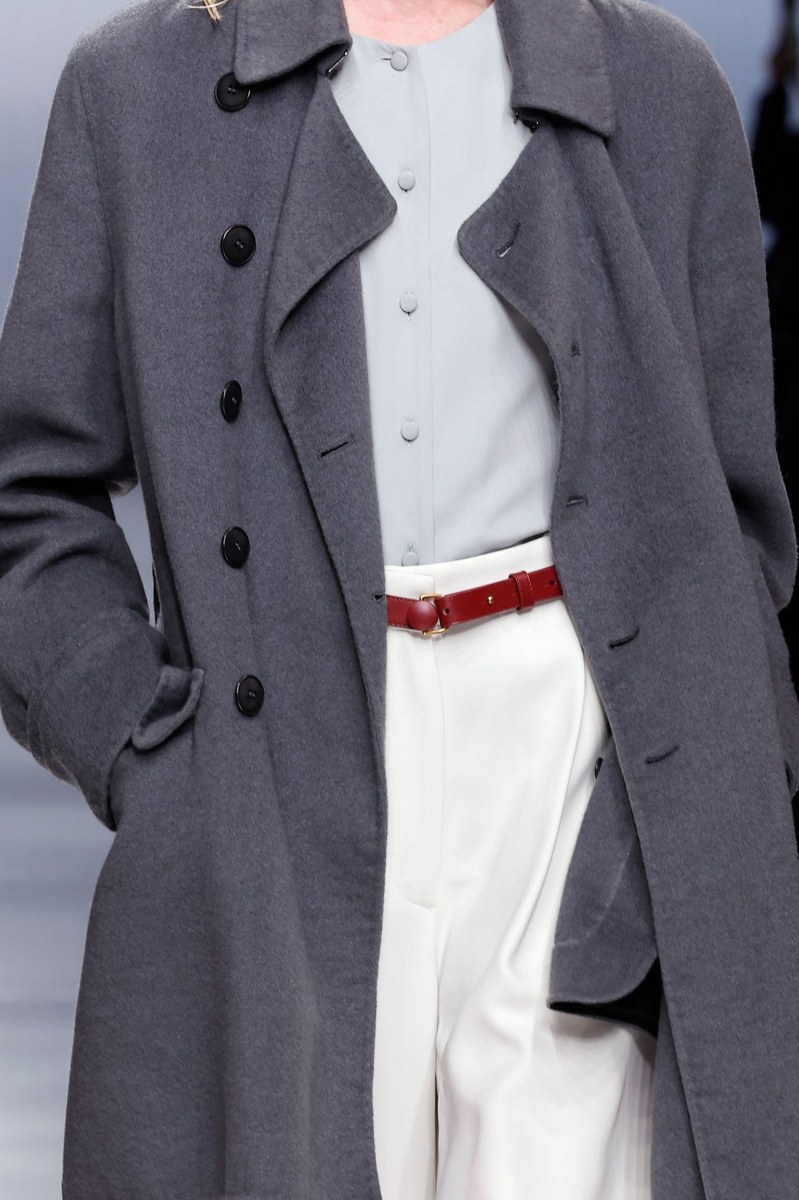
The belt (Details 1 through 4) reads as smooth, mid-weight leather, narrow in width at approximately 2 to 2.5 centimeters, with a circular D-ring or O-ring buckle construction rather than a traditional prong-and-hole closure. Unembossed leather finished with a semi-matte surface shows what looks like tonal stitching at the edges. Detail 5 presents a structured double-faced wool in charcoal, cut with volume through the sleeve head and finished with dark resin buttons. Deep burgundy and near-black feathers, most likely ostrich or ostrich-style, are applied densely across the shoulder and upper sleeve in Detail 6.

Color and Finish Direction

Grey anchors the dominant palette across all nine details, from the pale blue-grey of the trousers and knitwear to the mid charcoal of the outerwear in Details 1 and 5. White is the recurring base for the trouser pieces that ground the belt styling across Details 1 through 4. Burgundy or oxblood red with gold-tone hardware on the belt serves as the single warm accent across an otherwise entirely cool collection. Details 6 and 7 break into a separate palette entirely, deep wine, dusty blue-violet, and velvet burgundy, which positions those looks as evening or occasion-specific within the broader range.

Key Pieces and Details

The narrow burgundy leather belt with gold circular hardware is the clear commercial anchor of the accessories program. Grey wool outerwear, a zip-front technical coat, a structured feather-edged jacket, and a loose cashmere wrap all feature it across four different styling contexts, confirming its adaptability and low styling risk for buyers. Round-frame eyewear in Details 8 and 9, rendered in lavender-grey and olive-khaki respectively, reads as a considered double-down on the oversized circle frame trend. Acetate with a thick, sculptural temple means these are high-margin, low-SKU-count pieces built for broad wholesale placement.

Detail by Detail Highlights

Detail 1 (Belt) The narrow oxblood leather belt threads through white trouser loops beneath an open double-breasted grey wool coat, with its circular gold buckle sitting slightly off-center for an unstudied effect.

Detail 1
Detail 1

Detail 2 (Belt) Against white pleated trousers and a grey technical shell, this view confirms the belt's D-ring hardware in brushed or polished gold and the clean, unembossed leather surface with no visible texture variation.

Detail 2
Detail 2

Detail 3 (Belt) Worn beneath a dark charcoal feather-edged jacket with a white silk or satin blouse, the belt anchors an otherwise voluminous silhouette at the waist, confirming its function as a proportion-setting tool across full looks.

Detail 3
Detail 3

Detail 4 (Belt) Draped over a loose sage cashmere panel that wraps the torso, the belt sits at the natural waist and holds the knit in place, demonstrating a secondary styling function well beyond standard trouser wear.

Detail 4
Detail 4

Detail 5 (Dress Detail) A voluminous charcoal double-faced wool jacket with a high stand collar and dark resin buttons sits over a white base layer and grey scarf, with the jacket's cocoon sleeve cut adding strong commercial silhouette interest.

Detail 6 (Dress Detail) Layered burgundy and near-black feathers, most likely ostrich, cover the entire arm from shoulder to wrist in a full-sleeve application and create a high-drama texture contrast against the draped navy jersey body beneath.

Detail 6
Detail 6

Detail 7 (Dress Detail) A ruched silk or silk-effect strapless bodice in burgundy jacquard pairs with a looped blue-violet printed scarf worn as a necklace and a beaded chain, creating a multi-element layering composition that will require careful breakdown for buying decisions.

Detail 7
Detail 7

Detail 8 (Eyewear) Oversized round acetate frames in a milky lavender-grey with lightly tinted lenses sit high on the face, with a thick frame profile that reads sculptural without crossing into costume territory.

Detail 8
Detail 8

Detail 9 (Eyewear) A deeper olive-khaki round acetate frame with bronze or gold hinge detailing and a heavier brow bar creates a more directional, masculine-adjacent version of the same round silhouette seen in Detail 8.

Detail 9
Detail 9

Operational Insights

Hero SKU strategy: The belt's repetition across four looks confirms Armani is building around a single accessories investment piece this season. Buyers should prioritize depth of stock in oxblood with gold hardware rather than spreading open-to-buy across multiple colorways.

Trouser pairing dependency: Against white or ivory wide-leg trousers, the belt only reads correctly. Coordinate floor placement with the trouser pieces to communicate the full styling proposition and drive attachment rates.

Eyewear width sizing: Both eyewear frames run large and oversized relative to standard face fits. Detailed frame width and bridge measurements should be requested from product managers before confirming production minimums, as oversized round frames carry a narrower fit range and historically higher return rates at retail.

Evening tier separation: Details 6 and 7 sit in a distinct evening or occasion tier that requires separate merchandising from the grey daywear majority. Multi-category assortments should treat the feather and ruched silk pieces as a standalone capsule rather than integrating them into the core floor plan.

Feather construction risk: The dense ostrich or ostrich-style feather application in Detail 6 carries significant import regulation complexity depending on territory. Sourcing and compliance teams should verify species documentation and import classification before committing to that SKU for affected markets.

✦ This report was generated with AI — combining human editorial vision with Claude by Anthropic. Because the future of fashion intelligence is already here.