Giorgio Armani FW26 Women Looks Report

Giorgio Armani FW26 Women Looks Report
Did you know? Giorgio Armani revolutionized color theory in luxury fashion by introducing a restrained palette of neutrals, earth tones, and muted jewel tones in the 1980s, deliberately rejecting the bright, saturated colors that dominated high fashion at the time. This chromatic philosophy became a strategic business tool, allowing pieces to mix and match across seasons and reducing inventory complexity while establishing a distinctive brand identity based on sophisticated minimalism.

Giorgio Armani FW26 Women Looks Report

Milan Fashion Week

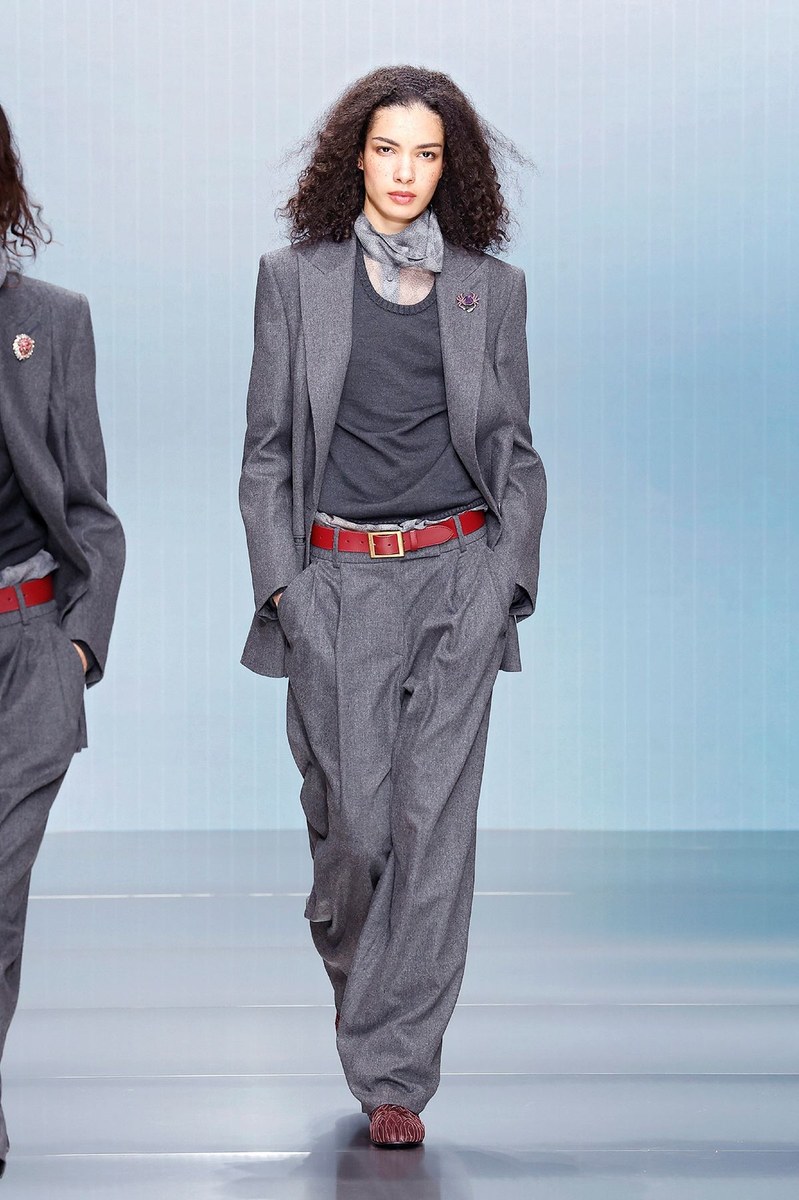
Giorgio Armani FW26 women's collection builds an entire wardrobe from a tightly controlled spectrum of charcoal, mid-grey, pale silver and off-white, broken only by a recurring burgundy leather belt and a single jewel-toned finale look. For buyers and style directors navigating a market fatigued by maximalism, this collection argues that considered volume and tonal restraint are the commercial path forward.

Silhouette and Volume

Two registers define the silhouette here: a broad, structured shoulder paired with wide-leg, pleated trousers in Looks 1 through 10, then a progressively more voluminous, softly draped shape that takes over from Look 11 onward. Sharp shoulders cut the jackets, but without padding excess. They sit deliberately oversized through the body while maintaining architectural intent. Trousers are uniformly wide and high-waisted, pooling or grazing the floor regardless of the top weight above them. Maxi coats anchor the outerwear story, appearing in Looks 3, 4, 7 and 15. Each reaches full-length with a relaxed, swinging hem.
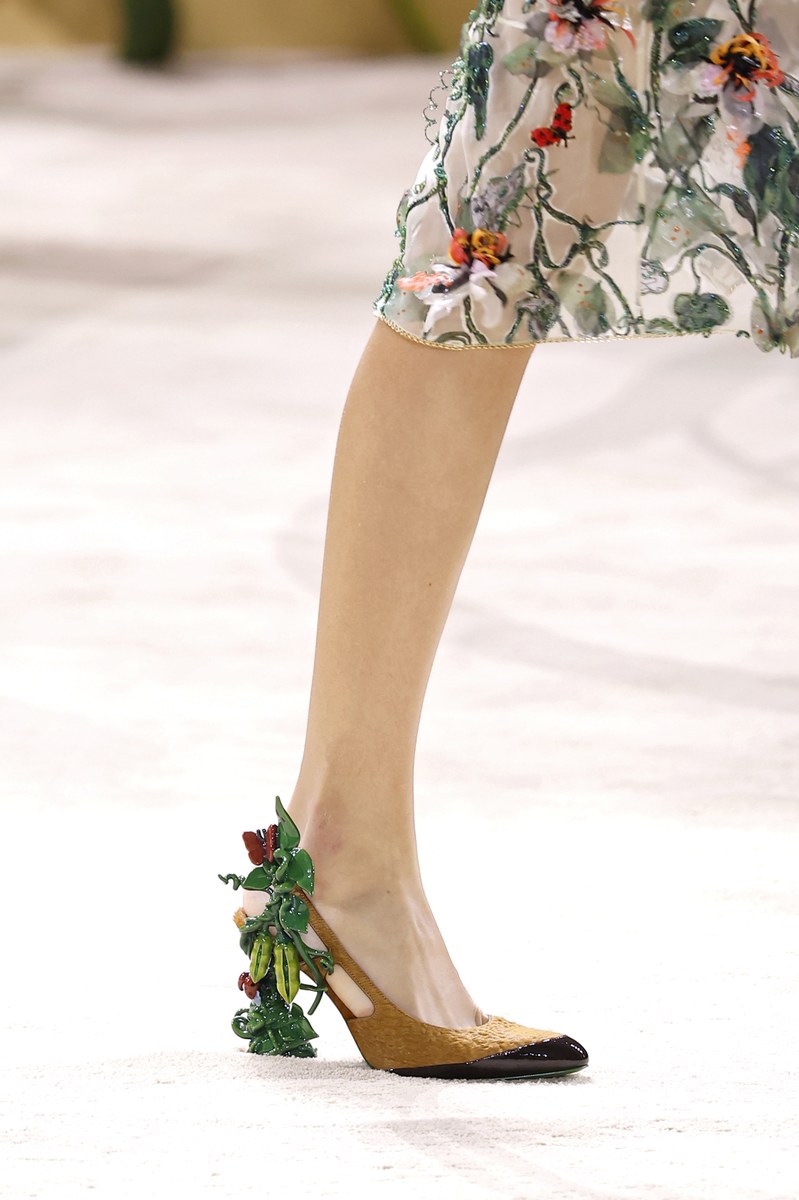
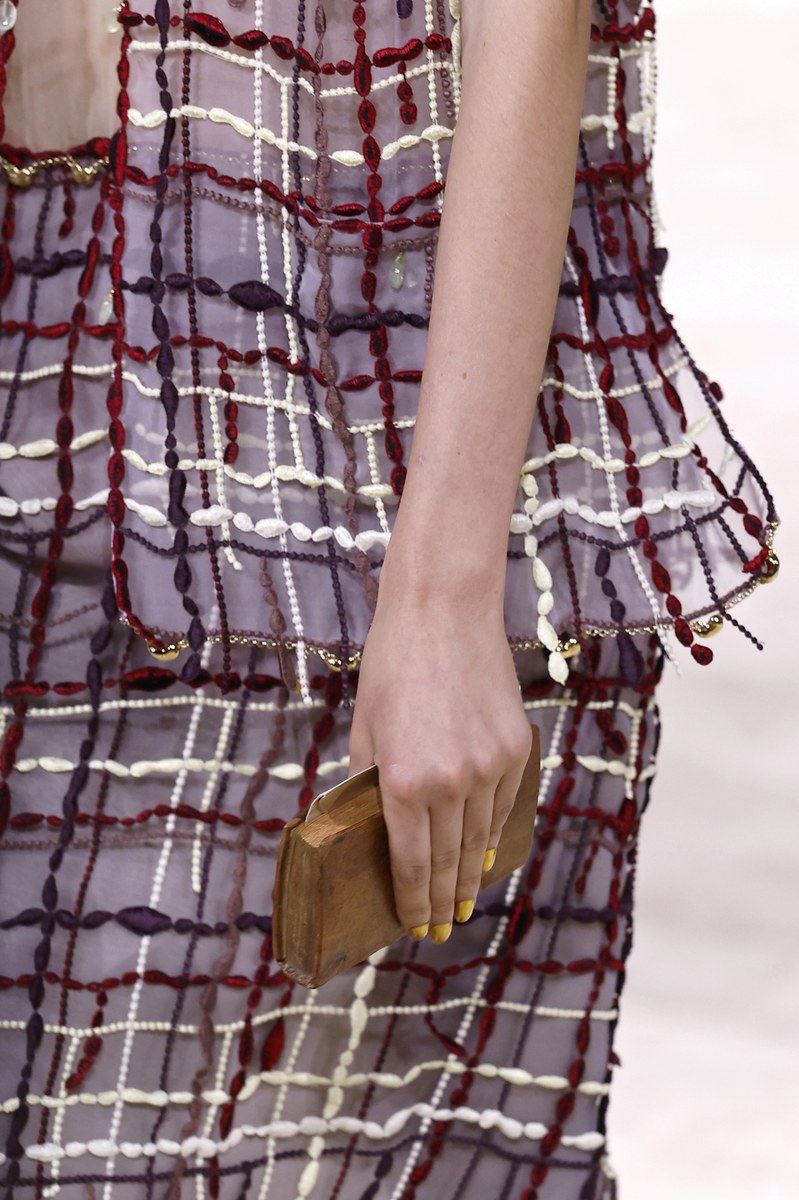
Look 11
Look 11

Color Palette

Medium heather grey opens the collection, deepening steadily through charcoal into near-black by Look 5. From Look 6 through 18, an off-white and pale grey-white combination takes over, reading almost clinical under runway light but carrying warmth in the fabric weight. Look 16 is the single departure into sage green, arriving as a tonal punctuation rather than a trend signal. Roughly half the looks thread the burgundy belt through, functioning as the collection's only consistent accent color and giving buyers a clear accessory anchor to build assortments around.

Look 5
Look 5

Materials and Textures

Heavy wool flannel and boiled wool carry the tailored pieces, giving jackets and trousers a matte, substantial surface that holds a pleat cleanly. Dense, brushed wool appears in the maxi coats of Looks 3 and 4, with almost no sheen, reading as pure weight and drape on the body. Look 15 introduces a long shearling or shearling-effect coat in dark charcoal with a tight, curly pile surface, adding the collection's primary tactile contrast. A quilted, satin-finish kimono jacket layers over white in Look 14, bringing the only light-reflective fabric into the mix before Look 19 closes with embroidered jacquard in deep violet and burgundy.

Look 15
Look 15

Styling and Layering

Consistent logic guides the layering: a fine knit or lace-patterned top sits closest to the body, a mid-layer jacket or cardigan sits over it, and a coat or wrap closes the look when present. Tucked or loosely knotted scarves at the neck appear in Looks 1, 2, 3, 5, 7, 8, 9, 10, 13, 14, 15 and 18, functioning as a consistent soft-collar substitute across tailored and casual builds alike. Footwear is almost entirely a low-heeled, round-toed loafer or ankle boot in burgundy or chocolate brown, with white loafers appearing in Look 8 and grey suede lace-ups in Look 16. Look 11 and Look 18 introduce oversized round sunglasses with nearly opaque lenses, signaling a deliberate styling mood rather than a summer-resort afterthought.

Look 8
Look 8

Look by Look Highlights

Look 1 Establishes the collection's grey-on-grey tailoring formula with a medium heather blazer, matching wide-leg trousers and a burgundy belt that will recur as the collection's through-line accessory.

Look 1
Look 1

Look 4 Dark charcoal in a collarless maxi coat with a clean A-line sweep in fine herringbone-type wool reads as the most commercially transferable outerwear piece in the show, legible for both luxury department store floors and independent boutique assortments.

Look 4
Look 4

Look 9 A horizontally quilted charcoal blazer with pronounced rib texture over white wide-legs and a red belt is the strongest separates proposition, functioning as a statement piece without requiring a full look purchase.

Look 9
Look 9

Look 12 Medium grey in a double-breasted short coat over a pale ice-blue cardigan and cream wide-legs is the collection's most accessible entry point, soft in color and proportion, with crossover appeal to a broader customer age range.

Look 12
Look 12

Look 14 The quilted kimono jacket in dark charcoal with a satin outer surface sits over an all-white ensemble and introduces an East-Asian tailoring reference that is specific enough to differentiate the look on the floor.

Look 14
Look 14

Look 15 A floor-length dark grey shearling-effect open coat is the highest-investment outerwear statement, with a shawl collar and no closure that positions it as a luxury wrapping garment rather than a protective coat.

Look 18 A sage grey cashmere wrap draped over both shoulders and belted at the waist with the collection's signature burgundy belt over white trousers makes the strongest argument for accessories-led selling and wrap-as-outerwear product development.

Look 18
Look 18

Look 19 An embroidered jacquard strapless dress over printed narrow trousers in violet, plum and burgundy functions as a formal evening capsule entirely separate from the rest of the collection and requires its own buying consideration.

Look 19
Look 19

Operational Insights

Burgundy belt as anchor SKU: A narrow burgundy leather belt with a gold buckle appears across at least ten looks and functions as the collection's single unifying accessory. Buyers should negotiate this as a standalone product with strong attach-rate potential at point of sale.

White trouser investment: Wide-leg, high-waisted cream and off-white trousers appear in nine or more looks from Look 6 onward, confirming that Armani is building a white bottom as a core commercial pillar for FW26 rather than a seasonal experiment. Product managers should plan depth in this silhouette and confirm fabric weight is sufficient to avoid transparency issues.

Look 6
Look 6

Outerwear tier strategy: Four distinct outerwear weights present themselves here: the structured blazer-coat, the short double-breasted wool coat, the full-length swinging maxi coat and the shearling statement piece. Style directors should build buy plans across all four tiers rather than concentrating in one, since the silhouette variety gives the range genuine floor range.

Scarf as category builder: The neck scarf or cowl appears in nearly every look and functions as a styling device that adds perceived layering without a separate garment. A coordinating scarf in lace-patterned knit or solid cashmere tied to the collection's grey and ivory palette represents a low-risk, high-visibility accessory category to develop alongside the ready-to-wear.

Look 19 requires separate treatment: The embroidered jacquard evening look sits outside the collection's dominant aesthetic and serves a distinct occasion-wear customer. Buyers targeting the eveningwear segment should evaluate Look 19 independently from the ready-to-wear assortment, as joint buying decisions risk diluting the clarity of both category presentations on the floor.

Complete Collection

Look 2
Look 2
Look 3
Look 3
Look 7
Look 7
Look 10
Look 10
Look 13
Look 13
Look 16
Look 16
Look 17
Look 17
Look 20
Look 20
Look 21
Look 21
Look 22
Look 22
Look 23
Look 23
Look 24
Look 24
Look 25
Look 25
Look 26
Look 26
Look 27
Look 27
Look 28
Look 28
Look 29
Look 29
Look 30
Look 30
Look 31
Look 31
Look 32
Look 32
Look 33
Look 33
Look 34
Look 34
Look 35
Look 35
Look 36
Look 36
Look 37
Look 37
Look 38
Look 38
Look 39
Look 39
Look 40
Look 40
Look 41
Look 41
Look 42
Look 42
Look 43
Look 43
Look 44
Look 44
Look 45
Look 45
Look 46
Look 46
Look 47
Look 47
Look 48
Look 48
Look 49
Look 49
Look 50
Look 50
Look 51
Look 51
Look 52
Look 52
Look 53
Look 53
Look 54
Look 54
Look 55
Look 55
Look 56
Look 56
Look 57
Look 57
Look 58
Look 58
Look 59
Look 59
Look 60
Silvana Armani

About the Designer

Silvana Armani was born the daughter of Sergio Armani, Giorgio's brother, and grew up in close but not always uncomplicated proximity to the empire being built around her family name. She has said that the family was not particularly united in her early years, and that the bond with her uncle deepened gradually, accelerated by the early death of her father and drawn tighter by the warmth of Sergio Galeotti, Giorgio's longtime partner and co-founder of the company, who was the one who persistently pulled her inside. She was around twenty-three when she first entered fashion, not through Armani but as a runway model for Walter Albini, Krizia, and the label Cadette, in the era she remembers as the time of the "bassine," the light-footed models of the late 1970s Italian ready-to-wear circuit. She was shy enough that she would destroy her nails biting them before going out on the runway. The modeling stopped quickly, and her entry into the house of Giorgio Armani was, by her own account, unglamorous: she was initially put on the switchboard and connected the wrong extensions within two days.

What changed the trajectory was a small assignment. Giorgio asked her to prepare a color palette for a swimwear collection. He liked what she gave him. From that point, in 1980, she began working with the women's design studio at Emporio Armani, where she remained for four-plus decades, rising through every level of the creative office without ever becoming publicly visible. She describes having spent more time with her uncle than with her father. The relationship had the specific texture of a creative hierarchy: Giorgio was the ultimate arbiter, and Silvana would prepare collections, present them, argue her position when she felt strongly, and then watch him occasionally incorporate her suggestions without quite acknowledging them as such. He was the perfectionist who always believed you could give more. She absorbed that standard, and the lesson he articulated most clearly, which she has repeated in interviews since his death: always go forward, carry out the work concretely, make clothes that are wearable. She has said she deliberately does not follow social media and has no interest in being influenced by what is circulating outside the house.

Giorgio Armani died on September 4, 2025, aged ninety-one. Within months, Silvana made her first public appearance as creative director, debuting the Armani Privé couture collection in Paris in January 2026, then presenting her first ready-to-wear collection at Milan Fashion Week in February 2026. She opened the FW26 show with a gray cashmere flannel suit bearing two zodiac brooches, one shaped like a lion for herself, one like a crab for Giorgio. The soundtrack ended with an unreleased song by Mina. The men's collections continue under Leo Dell'Orco, Giorgio's longtime partner, who has led that office since 1977. Silvana now holds the women's creative direction of the entire house.

"One of the most important things he taught me is to always go forward, to materially carry out the work in a concrete way and offer clothes that are wearable."

"Continuity is fundamental, and it's my objective. It's not easy, because there are so many outside elements that can condition our work, including social media, although I purposely don't follow them."

✦ This report was generated with AI — combining human editorial vision with Claude by Anthropic. Because the future of fashion intelligence is already here.