Gucci FW26 Women Looks Report

Gucci FW26 Women Looks Report
Did you know? Gucci's iconic GG monogram canvas, introduced in the 1960s, was originally developed as a cost-effective alternative to leather during a period of material scarcity, yet it became one of fashion's most recognizable and profitable textile innovations. The tightly woven pattern with coated finish proved so durable and versatile that it established a new category of luxury goods manufacturing and remains central to the house's production strategy today.

Gucci FW26 Women Looks Report

Milan Fashion Week

Gucci FW26 is built on body-conscious restraint, pairing second-skin jersey and liquid satin with precise tailoring to define a streamlined, sexually charged wardrobe that spans day suiting through eveningwear. For buyers and style directors, this directional clarity after years of maximalist Gucci signals a repositioning toward elevated commercial product with strong retail velocity potential.

Silhouette and Volume

Almost everything runs narrow. Fitted jersey dresses in Look 1 and Look 11 hug the body from shoulder to mid-thigh or mid-calf, while tailored suits in Looks 3, 5 and 13 cut close through the torso with minimal ease. One volumetric exception exists: the double-breasted cream wool coat in Look 15 reads as a deliberate counterpoint rather than a direction in itself. High-sitting trousers pull straight through the leg and break cleanly at the ankle throughout.
Look 1
Look 1

Color Palette

A binary of white and black dominates, with one loud exception. Ivory white appears in Look 1, Look 2, Look 7 and Look 15, creating cool, clinical purity against the matte black runway floor. Look 17 breaks the chromatic discipline entirely in full saturated red across a cropped polo and skintight trousers, functioning as a commercial punctuation mark within the otherwise monochromatic run. Grey jersey in Look 9 sits as the only neutral between the two poles, adding a quieter, wearable option for the core buyer.

Materials and Textures

Jersey is the workhorse. It appears in its most body-conforming, medium-weight form across the turtleneck mini in Look 1, the scoop-neck midi in Look 9, the long-sleeve black column in Look 11, and the finale gown in Look 19, where it is covered in fine black sequin for a heavy, light-absorbing surface. Silk satin or satin-backed crepe drives the tailoring in Looks 3, 5, 7 and 13, reading with a subtle sheen that shifts between structured and liquid depending on the light. A firm, smooth wool-blend in off-white appears in Look 15, the only true outerwear fabrication in the women's line.

Styling and Layering

Styling stays deliberately spare. Structured black leather top-handle bags and croc-embossed shoulder bags are carried in Looks 3, 5, 11, 13 and 18, while the bamboo-closure white bag in Look 9 and the logo-embossed ivory bag in Look 7 nod to house heritage. Pointed-toe kitten heels or low block pumps anchor every women's look, maintaining the elongated line without adding height that would distort the proportional story. GG monogram hosiery in Look 7 is the one layering device with strong accessory buy potential.

Look 9
Look 9

Look by Look Highlights

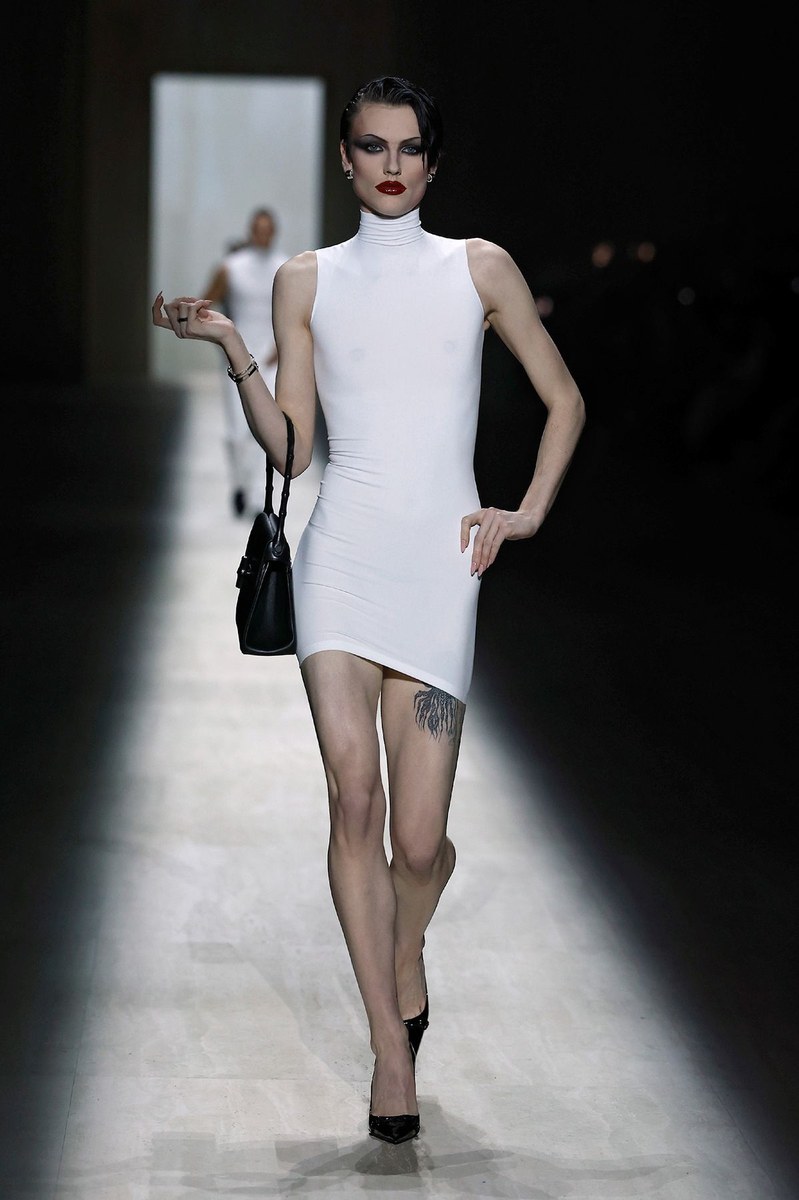
Look 1 The sleeveless white jersey turtleneck mini with visible tattoo through the skirt hem is the sharpest opener, and its simplicity makes it a strong early-season hero unit with broad size-range applicability.

Look 7 An ivory satin skirt suit with a draped pussybow neckline and GG monogram tights creates a complete look that can be retailed as separates and as a set, doubling its floor presence.

Look 7
Look 7

Look 9 Grey sleeveless jersey midi with diagonal ruched hemline and white croc-embossed bamboo bag is the most commercial women's dress in the lineup, accessible in price architecture and easy to style for multiple customer profiles.

Look 11 The full-length black jersey turtleneck dress with long sleeves and a brown croc shoulder bag is a wardrobe-builder piece with broad appeal, wearable for professional and social contexts without alteration.

Look 11
Look 11

Look 15 An off-white double-breasted wool coat with gold buttons and navy lapel facing worn over a black trouser is the strongest outerwear investment, with clear appeal to the contemporary luxury coat buyer who wants structure and occasion readiness.

Look 15
Look 15

Look 17 An all-red cropped polo and high-waisted skinny trouser set is the most aggressive commercial bet, designed to photograph well on social platforms and drive impulse conversion at the unit level.

Look 17
Look 17

Look 18 A white sheer short-sleeve crew-neck T-shirt worn over a black jersey high-waist pant is a replicable, entry-price formula that trades on the body-conscious mood without requiring complex construction.

Look 18
Look 18

Look 19 The black long-sleeve sequin column gown with side cutouts, worn by Kate Moss as the closing look, functions as an evening flagship and a press moment that will anchor the collection's campaign imagery through the retail window.

Look 19
Look 19

Operational Insights

Jersey investment: Reliance on fitted medium-weight jersey across at least six women's looks means buyers should plan depth in this fabrication. It carries the widest size range potential and the lowest production complexity relative to price yield.

Separates strategy: Looks 17 and 18 demonstrate a cropped top and high-waist bottom formula that can be developed into a separates program with mix-and-match retail logic, increasing average transaction value across the women's floor.

Accessories priority: The bamboo-closure bag in Look 9 and the GG monogram tights in Look 7 are the two accessories with the clearest repeat-purchase and gifting potential. Style directors should plan these as front-of-store and e-commerce hero placements from day one of the drop.

Outerwear constraint: With only one clear women's outerwear piece in Look 15, buyers will need to supplement this collection with carry-over or complementary outerwear from adjacent categories. Allocate the wool-blend coat conservatively and price it for full-margin sell-through rather than promotional use.

Color depth planning: Black and white together account for roughly 85 percent of the women's color story. Plan stock allocation accordingly and treat the red in Look 17 as a limited-depth statement color rather than a core replenishment color to protect margin and avoid markdown risk.

Complete Collection

Look 2
Look 2
Look 3
Look 3
Look 4
Look 4
Look 5
Look 5
Look 6
Look 6
Look 8
Look 8
Look 10
Look 10
Look 12
Look 12
Look 13
Look 13
Look 14
Look 14
Look 16
Look 16
Look 20
Look 20
Look 21
Look 21
Look 22
Look 22
Look 23
Look 23
Look 24
Look 24
Look 25
Look 25
Look 26
Look 26
Look 27
Look 27
Look 28
Look 28
Look 29
Look 29
Look 30
Look 30
Look 31
Look 31
Look 32
Look 32
Look 33
Look 33
Look 34
Look 34
Look 35
Look 35
Look 36
Look 36
Look 37
Look 37
Look 38
Look 38
Look 39
Look 39
Look 40
Look 40
Look 41
Look 41
Look 42
Look 42
Look 43
Look 43
Look 44
Look 44
Look 45
Look 45
Look 46
Look 46
Look 47
Look 47
Look 48
Look 48
Look 49
Look 49
Look 50
Look 50
Look 51
Look 51
Look 52
Look 52
Look 53
Look 53
Look 54
Look 54
Look 55
Look 55
Look 56
Look 56
Look 57
Look 57
Look 58
Look 58
Look 59
Look 59
Look 60
Look 60
Look 61
Look 61
Look 62
Look 62
Look 63
Look 63
Look 64
Look 64
Look 65
Look 65
Look 66
Look 66
Look 67
Look 67
Look 68
Look 68
Look 69
Look 69
Look 70
Look 70
Look 71
Look 71
Look 72
Look 72
Look 73
Look 73
Look 74
Look 74
Look 75
Look 75
Look 76
Look 76
Look 77
Look 77
Look 78
Look 78
Look 79
Look 79
Look 80
Look 80
Look 81
Look 81
Look 82
Look 82
Look 83
Look 83
Look 84
Demna Gvasalia

About the Designer

Demna Gvasalia was born in 1981 in Sukhumi, the capital of Abkhazia, a coastal city on the Black Sea that no longer exists in the form he knew it. When he was ten, the War in Abkhazia broke out and separatist forces bombed his family's home. He and his family fled on foot through the Caucasus Mountains to Tbilisi, joining the mass displacement of Georgians that the conflict produced. The family subsequently lived in Ukraine and Moscow before eventually settling. He grew up as a gay teenager in what he has described as a very religious, very macho country, and he carries both of those biographical facts, the exile and the alienation, visibly in everything he has made. They are not metaphors for his work. They are its raw material.

He studied international economics for four years at Tbilisi State University before pivoting entirely, enrolling at the Royal Academy of Fine Arts in Antwerp, where he graduated with a master's in fashion design in 2006. He arrived in Paris afterwards knowing nobody, his own description of himself at the time being "some Georgian weird guy" with no network and no connections. He worked with Walter van Beirendonck, then joined Maison Martin Margiela, where he led women's collections until 2013. A brief stint as senior women's ready-to-wear designer at Louis Vuitton under Marc Jacobs and then Nicolas Ghesquière followed, before he co-founded Vetements with his brother Guram in 2014: a collective that reframed the question of what fashion was supposed to be about, pulling from Soviet-bloc workwear, DHL uniforms, and the visual vocabulary of people who had never been dressed by luxury before. In 2015, he was named creative director of Balenciaga, the house that had rejected his internship application nine years earlier.

His decade at Balenciaga was defined by an ability to make the industry's own conventions look absurd without abandoning craft. The Triple S sneaker, the oversized suiting, the trash bag couture, the tape-wrapped stilettos: each piece operated as both a garment and a provocation. In March 2025 he was announced as creative director of Gucci, taking over from Sabato De Sarno, with his first runway show in February 2026. Preparing for the role, he visited the Uffizi in Florence and stood in front of Botticelli's "La Primavera," the painting that had inspired Gucci's original Flora motif, and felt something shift. He has said he wants to make everything lighter, that the luxury industry has become too heavy, too rigid, and that desirability rather than prestige is what he is after.

"What I want to do is to really define what the modern luxury product at Gucci means and I try to do everything lighter and lighter and lighter. This is like a mantra."

"Standing in front of it I felt overwhelmed. The beauty in it was unconditional, it was absolute. It made me realize how deeply the Italian Renaissance shaped everything I understand about art, about proportion, about desire and about beauty."

✦ This report was generated with AI — combining human editorial vision with Claude by Anthropic. Because the future of fashion intelligence is already here.