Hermès FW26 Details
Hermes FW26 Details Report
Hermes FW26 anchors its accessories strategy in leather craftsmanship that spans a precise tonal range, pairing architectural belts with chain hardware that reads simultaneously utilitarian and luxurious. For buyers and product managers, this collection maps a clear commercial path: invest in belts with hardware variation, because the category carries the weight of the entire accessories narrative here.
Category Overview
Belts dominate the accessories picture across 17 of the 20 detail shots. Headwear appears in Details 19 and 20, while a scarf functions as a dress detail in Detail 18. What emerges is not a monolithic approach but rather two distinct product families: wide-to-medium structured leather belts with square or rectangular silver or gunmetal buckles, and slim leather belts fitted with draped silver chainmail hardware. Buyers get two separate entry points from this division, one rooted in classic saddlery proportion and one aimed at a younger, more directional customer.
Material and Construction
Smooth calfskin and what appears to be Saffiano-grain leather show up across the slim chain belts, while the wider structured belts read as polished box calf or vegetable-tanned leather with visible single-needle topstitching along the edges. Forest green dominates Detail 9, a wide belt with particularly defined topstitching and a sharp square silver buckle that makes the construction quality legible even at retail distance. Across Details 2, 5, 7, 8, 14, 16, and 17, chainmail takes the form of a woven silver metal mesh draping in a double-chain formation, suspended from small pavé-set crystal or polished silver hardware components. The fur hat in Details 19 and 20 pairs sheared gray rabbit or lamb with a quilted leather crown panel, connecting the headwear material vocabulary directly to the leather-heavy garment layers beneath it.

Color and Finish Direction
Oxblood and burgundy are the dominant leather tones, appearing across Details 1, 3, 13, 14, and 18, and they ground the palette in a richly saturated warm red-brown. Forest green anchors Details 9, 11, and 12, functioning as the primary cool counterpoint. Tan, camel, and cognac appear on Details 8 and 10, adding warmth and commercial accessibility. Navy and near-black leathers, seen on Details 2, 6, 7, 12, 15, and 17, provide the neutral base. Silver hardware in both polished and brushed finishes threads through the entire collection, making gold hardware on Details 4 and 13 read as a deliberate accent rather than default.
Key Pieces and Details
The slim chainmail belt is the collection's most commercially urgent piece, recurring across at least seven looks. Its thin leather strap, Hermes-branded rectangular push-through buckle, and draped woven-metal chain make it a direct answer to the current appetite for belts that function as jewelry. Detail 9's wide square-buckle belt, rendered in forest green with contrast topstitching, and the matching oxblood iteration in Detail 1 both demonstrate how a classic silhouette can carry significant color and material specificity without relying on embellishment. Detail 10 adds commercial range by integrating a tan belt with attached suspender loops, a construction detail that broadens the belt's functional story for buyers sourcing coordinated separates.
Detail by Detail Highlights
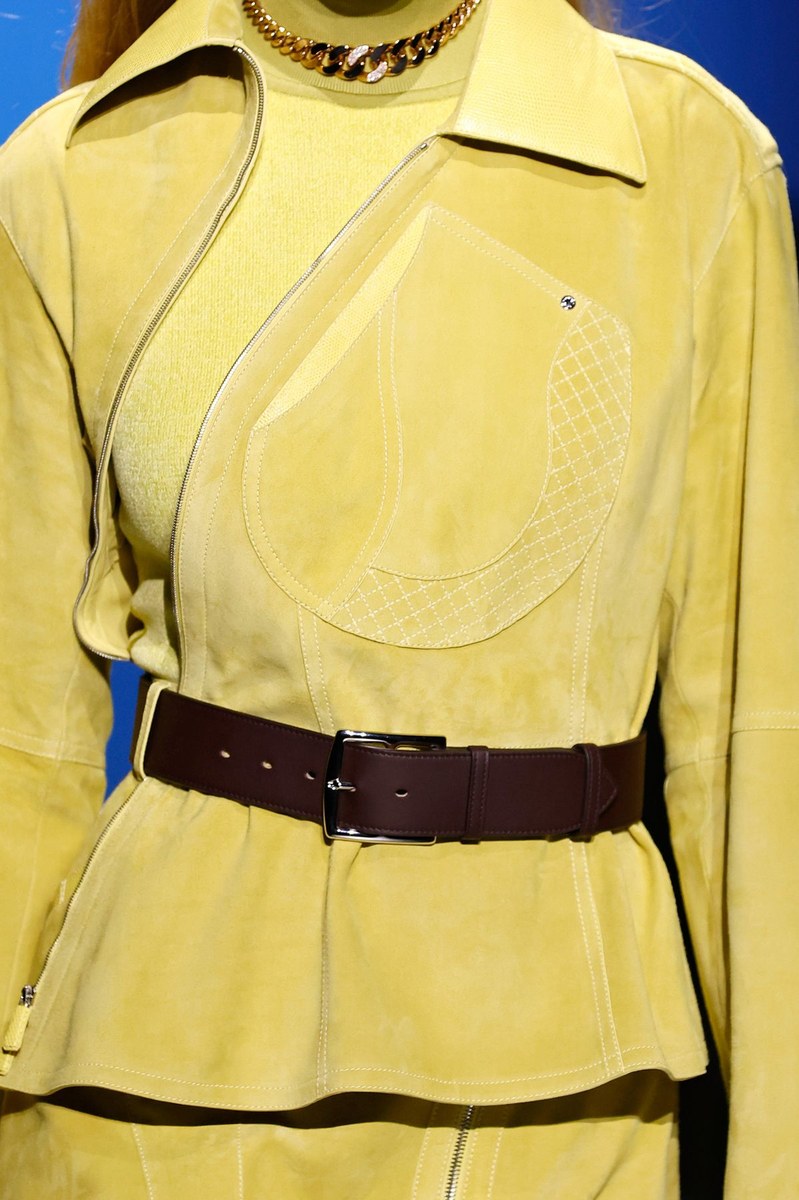
Detail 1 (Belt) A wide burgundy suede belt with a polished silver square buckle cinches a yellow suede jacket at the natural waist, establishing a high-contrast tonal pairing that translates directly into display merchandising.

Detail 2 (Belt) A slim navy Saffiano-grain belt carries draped silver chainmail with a pavé crystal connector bead and a small branded charm, presenting the chain belt template at its most layered and styled.

Detail 8 (Belt) The camel ostrich-embossed leather catsuit provides the cleanest backdrop for reading the slim chain belt's proportions, with the double-loop chainmail falling approximately 20 centimeters below the belt line.

Detail 9 (Belt) A forest green wide belt in polished leather with clear topstitching, a square silver buckle, and dark brown leather flap tabs beneath it delivers one of the collection's most construction-forward and color-specific statements.
Detail 10 (Belt) A mid-width cognac belt with white topstitching integrates two vertical suspender loops in matching leather, a functional construction choice that positions this piece as a key component in coordinated knit and trouser combinations.

Detail 12 (Belt) A black Saffiano-grain medium belt with a matte rectangular buckle cuts across a deep forest green wool coat over a quilted black leather inset panel, demonstrating how the belt functions as a structural layer rather than an afterthought.

Detail 18 (Dress Detail) A narrow silk satin scarf in pale yellow with a forest green and burgundy graphic border is knotted loosely at the neck over a burgundy leather coat with a fur collar, providing the collection's sole printed textile moment and a direct sell-through opportunity in gifting.
Detail 19 (Headwear) A structured hat combining a sheared gray fur brim band with a quilted gray leather crown panel bridges the collection's two primary material languages in a single winter-weight piece with strong visual authority.

Operational Insights
Chain Belt MOQ Planning: The slim chain belt appears across seven colorways and garment categories, signaling it as a hero SKU. Buyers should negotiate minimum order quantities per colorway rather than per style to maximize flexibility across the oxblood, navy, gray, and camel iterations.
Hardware Finish Segmentation: Silver hardware dominates approximately 85 percent of the belt assortment, with gold appearing only on Details 4 and 13. Product managers should treat gold-hardware belts as a smaller, premium tier rather than a parallel assortment, avoiding over-investment in that finish.
Wide Belt Proportions: The wide belts across Details 1, 6, 9, 11, and 15 range from approximately 6 to 9 centimeters in width. Retail display should present these folded flat or on a mannequin waist, as the topstitching and buckle construction are the primary quality signals and must be visible at point of sale.
Headwear as a Margin Driver: Only two headwear details appear, both in the same gray fur-and-leather construction. The hat reads as a limited, high-margin complement to the core leather goods. Accessories directors should plan limited floor depth with strong visual placement rather than broad size runs.
Color Story for Wholesale Packages: The burgundy, forest green, and navy grouping that threads through the belt category forms a self-contained color package. Buyers building curated assortments should consider ordering these three tones together to create coherent in-store color blocking without requiring additional product categories to complete the story.
More Details


✦ This report was generated with AI — combining human editorial vision with Claude by Anthropic. Because the future of fashion intelligence is already here.