Hermès FW26 Women Looks Report
Hermes FW26 Women Looks Report
Paris Fashion Week
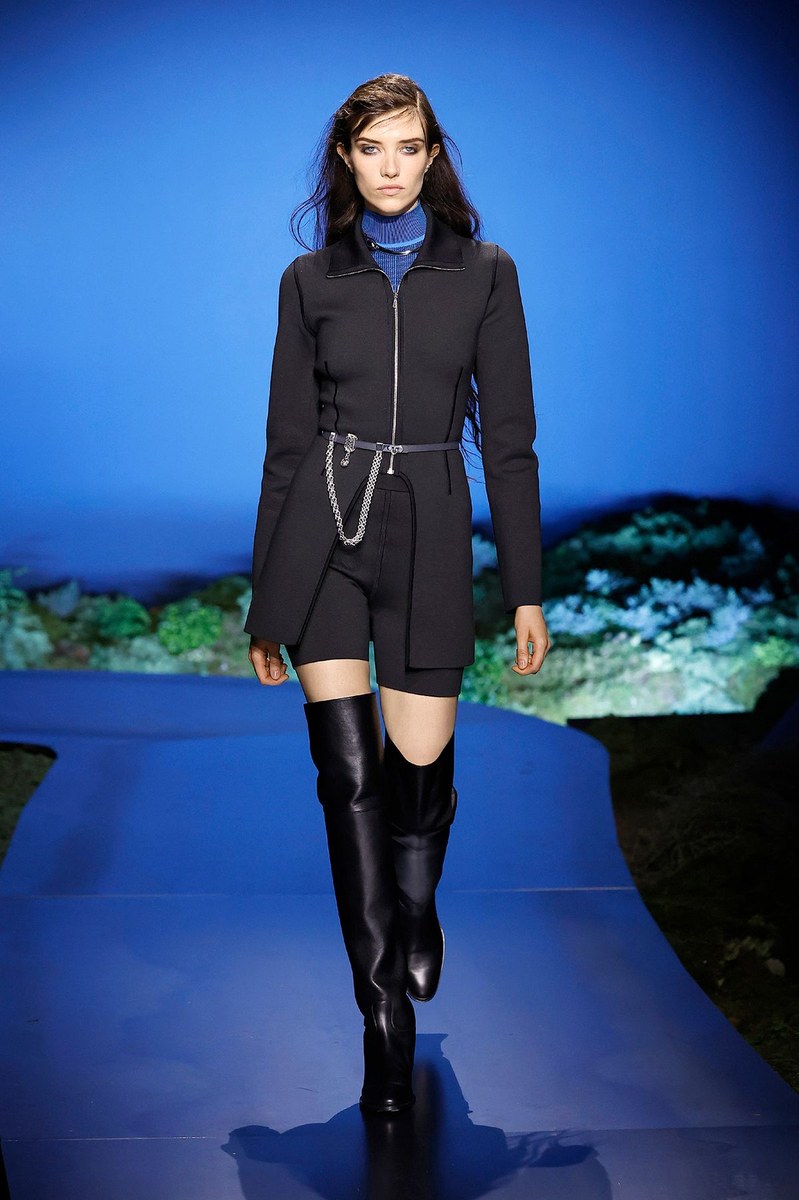
Hermes FW26 builds a wardrobe around the equestrian working body, treating leather, knit, and tailored wool as interchangeable armor for a woman permanently in motion. For buyers, this collection arrives at a moment when the market is hungry for elevated functional dressing that carries a clear identity rather than trend-chasing versatility.
Silhouette and Volume
Fitted through the torso and released at the hem. That's the dominant silhouette here, whether through a slit skirt, a belted coat opening over leather trousers, or a zip-front jacket worn over bike shorts. Coats and outerwear pieces carry structural shoulder lines without padding excess, landing closer to equestrian jacket architecture than traditional suiting. Look 4 and Look 30 push volume deliberately with oversized wool outerwear that then gets cinched hard at the waist with wide leather belts, keeping mass purposeful rather than shapeless.
Color Palette
Three distinct color worlds move through the collection: black and midnight navy to open, a warm middle passage in amber, ochre, mustard yellow and caramel tan, and a closing act in deep burgundy, oxblood, and slate grey. The amber-to-mustard range dominates the most commercially legible looks, appearing in Looks 7, 11, 14, 15, 16, and 44, and reads as the house's clearest commercial signal for the season. Navy and black function as the operational anchor, while the oxblood-to-grey transition in the final third adds a moodier, more directional close. Yellow-green surfaces in Look 37, Look 38, and Look 46 as a deliberate disruption rather than a core story.

Materials and Textures
Leather is the primary material language, arriving in at least six distinct treatments: smooth structured panels, quilted diamond stitch, ostrich embossed, suede, high-gloss finish, and matte supple drape. Ribbed knit functions as a technical underlayer throughout, appearing as turtlenecks, long-sleeved base pieces, and sleeve extensions that push out from leather jacket cuffs as in Look 28 and Look 41. Heavyweight wool coats with fur collar trim in Looks 4, 28, 29, 42, and 59 carry enough weight and construction to justify premium outerwear price points at retail. Quilted leather, seen across Looks 2, 17, 18, 19, 32, 43, and 61, reads as a signature surface that bridges sportswear adjacency with luxury material weight.

Styling and Layering
A ribbed knit turtleneck starts the consistent layering logic as the base, then a leather or wool mid-layer adds depth, and a belted coat or long jacket finishes as the outer shell. Belting is constant and deliberate, using either a wide leather buckle belt, a slim chain belt, or a D-ring leather cinch to define waist and create proportion regardless of volume. Knee-high and over-the-knee leather boots appear in nearly every look and are clearly a house priority rather than a styling afterthought. Bags stay structured and hand-carried, referencing equestrian luggage shapes across multiple looks.
Look by Look Highlights
Look 7 The head-to-toe ochre ostrich-embossed leather catsuit with matching ribbed knit sleeves and caramel tall boots is the collection's most complete material monochrome and will drive conversation in editorial without feeling unwearable as separates.

Look 11 The mustard yellow smooth leather column dress with integrated biker jacket construction and matching thigh-high boots collapses outerwear and dress into a single product, a high-risk design decision that pays off visually and signals clear product category thinking.

Look 17 Oxblood quilted leather mid-length jacket over bordeaux riding trousers and matching tall boots, with a slate grey ribbed turtleneck providing the only color break, shows precisely how the house builds within-family tonal dressing without falling into flat monochrome.

Look 37 The multicolor abstract patchwork zip-front mini dress in yellow, burgundy, and forest green over wine ribbed sleeves is the single most directional piece in the collection, and its placement in the show signals Hermes testing print and intarsia territory without abandoning the zip-front structural vocabulary.
Look 53 The color-blocked navy, periwinkle, grey, and black geometric poncho with fur collar over leather trousers and gloves stands apart from the rest of the collection and reads as a standalone hero outerwear investment piece for top-tier retail placement.

Look 59 The steel grey belted leather safari jacket with patch pockets, fur collar, and contrasting oxblood tall boots and olive leather gloves is the collection's most immediately commercial outerwear silhouette, balancing recognizable function with enough color tension to read as current.

Look 34 The oxblood leather catsuit with quilted yoke panel, slim chain belt, and ribbed knit sleeves mirrors Look 7 in construction logic and confirms the zip-front catsuit as a deliberate house silhouette that spans multiple colorways and leather treatments for range-building purposes.

Look 63 The pewter grey ostrich-embossed leather catsuit with matching cap, chain belt, and ribbed sleeves closes the grey passage with a look that mirrors the amber catsuit in Look 7, confirming that this silhouette is being developed as a multi-color franchise across the full collection.

Operational Insights
Leather treatment depth: At least six leather surface treatments appear as separate product stories throughout the collection. Buyers should read quilted, ostrich-embossed, suede, smooth, high-gloss, and matte as distinct SKU families rather than variations on a single theme, each requiring different care positioning and retail storytelling.
Catsuit as core category: Three separate colorways in Looks 7, 34, and 63 confirm the zip-front leather catsuit as a deliberate product category rather than a one-off statement. Style directors should plan display and editorial strategy around it as a signature hero, not a costume piece.
Belt as hardware priority: Chain belts and wide leather buckle belts appear across more than thirty looks and function as the collection's primary accessory anchor. Accessory buyers should prioritize these as standalone purchases that complete the silhouette logic seen throughout the show.
Color sequencing for floor planning: The amber-mustard-caramel family and the oxblood-bordeaux family are the two strongest commercial color stories. Floor planning should treat them as separate zones rather than blending them, since the collection itself presents them as distinct emotional registers.
Outerwear volume with belt architecture: Every oversized or high-volume coat in the collection, including Looks 4, 26, 28, 29, 30, and 42, is paired with a wide cinching belt that immediately resolves proportion. Product managers should ensure that outerwear pieces are sold or displayed with their corresponding belts to protect the silhouette intent and support full-look selling.
Complete Collection


Nadège Vanhée was born in 1978 in Seclin, a small town in French Flanders just south of Lille, close to the Belgian border, to a French father and an Algerian mother. Northern France, as she has described it, was a place without much style, and that absence pushed her toward fashion with more force than any abundance might have. Before clothes properly took hold, it was music: she spent her teens obsessed with post-punk and garage rock, bands like The Fall and Wire, drawn to their rawness and economy. She wrote about local concerts for a small amateur magazine, her first experience of translating enthusiasm into language. At eighteen she left France to study at the Royal Academy of Fine Arts in Antwerp, joining an institution that had already shaped Martin Margiela, Raf Simons, and the broader wave of conceptual Flemish design thinking. The Belgian education gave her a framework that treated fashion as a form of social and ethical inquiry, not simply a matter of aesthetics.
Her entry into the industry proper was as anonymous as the Margiela house itself. She worked at Delvaux in Brussels after graduating, then moved to Paris to join Maison Martin Margiela, where she learned patience and a deep respect for process. From Margiela she went to London to work under Phoebe Philo at Céline during the years when that house was redefining what a luxury wardrobe could mean for a certain kind of woman: precise, confident, stripped of ornamentation. In 2011 she moved to New York to become design director at The Row, the brand built by Mary-Kate and Ashley Olsen around the proposition that silence and quality were more compelling than noise. Across these three houses she built a sensibility anchored in material integrity, cut, and an almost allergic resistance to spectacle.
She was appointed creative director of Hermès women's ready-to-wear in 2014, succeeding Christophe Lemaire, and became the first woman to hold the position in over two decades. Her references at Hermès run from the equestrian origins of the house through the open road and the machine, often colliding them: stitching that echoes saddle construction appearing on a leather biker jacket, the silhouette of a rider feeding into the geometry of a coat. Earth tones, leather colors displaced into garment fabric, construction that prioritizes gesture and movement over decoration. She describes the Hermès heritage not as a weight but as a living vocabulary, transmitted through the craftspeople more than through any archive. After more than a decade, her tenure has coincided with significant commercial growth in the house's ready-to-wear and accessories divisions.
"We never talk about luxury inside Hermès. We talk about intelligence."
"Heritage is like DNA in a way. It's a code that is there, but it actually enables you to live today. It's a story of cut, function, discipline, and seduction."
✦ This report was generated with AI — combining human editorial vision with Claude by Anthropic. Because the future of fashion intelligence is already here.