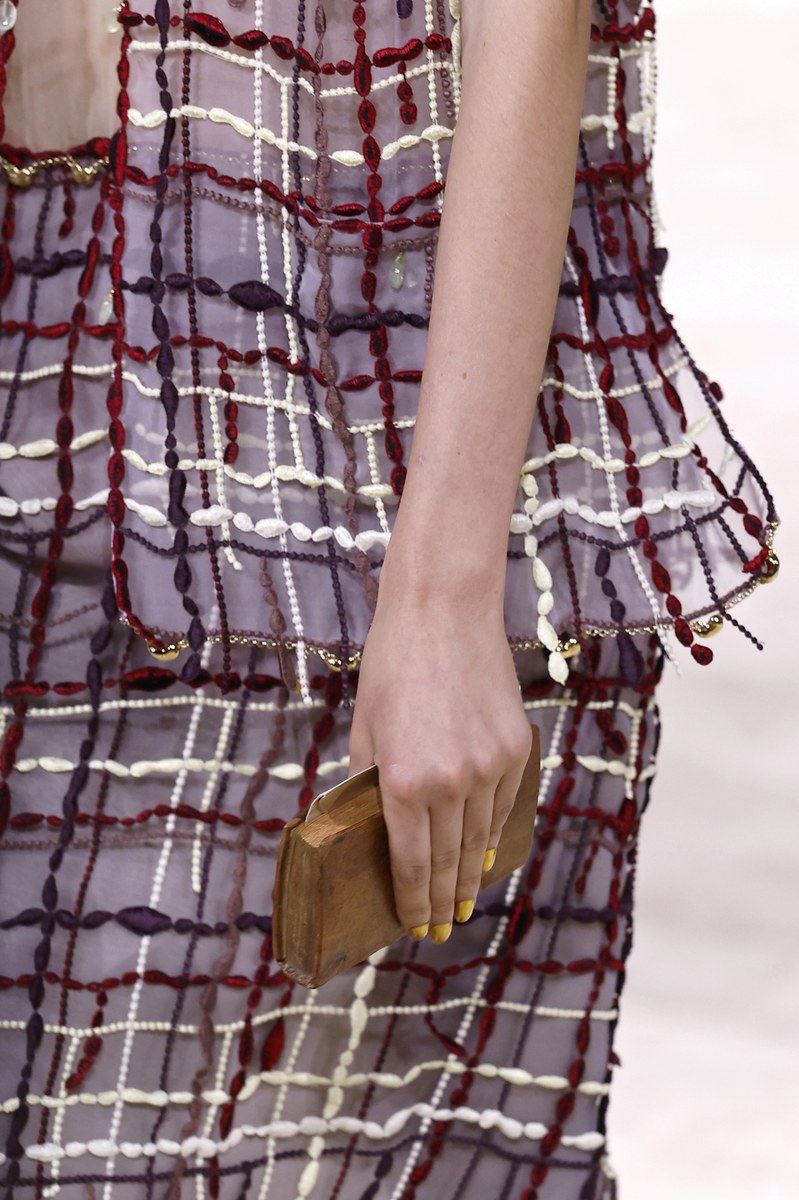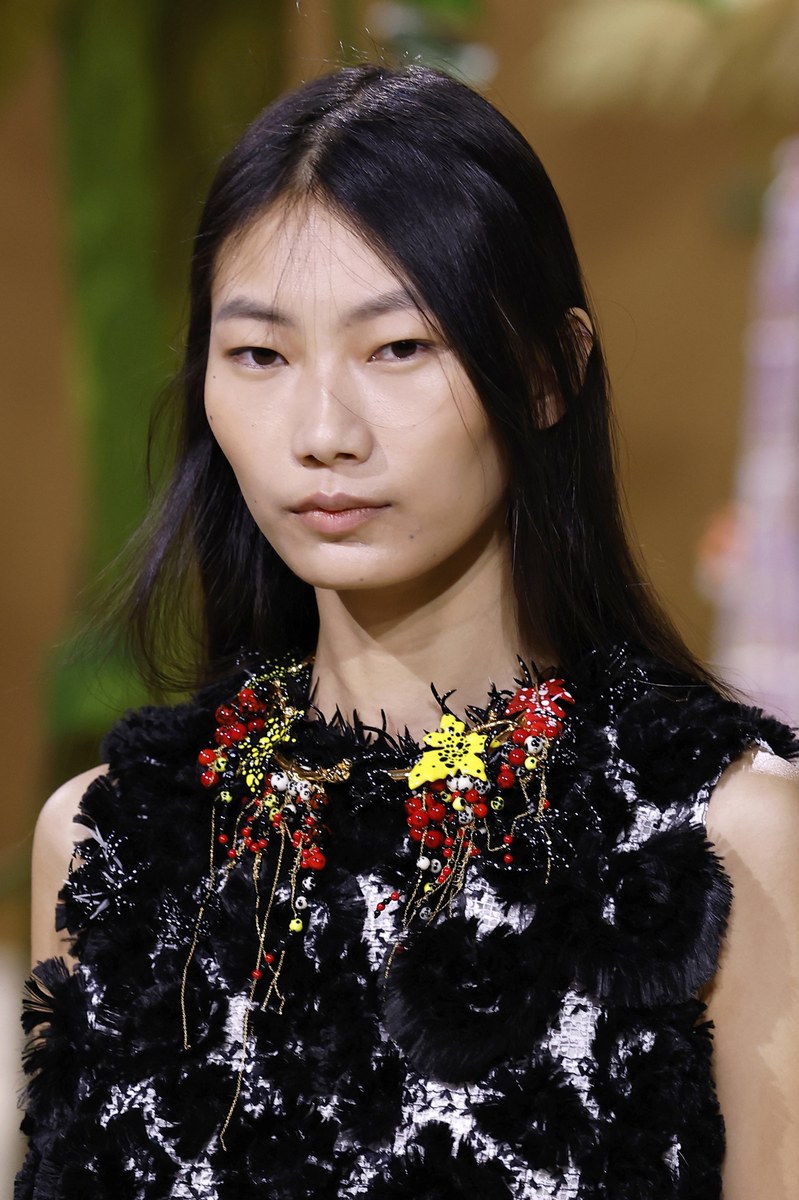
Hodakova FW26 Women Looks Report
Paris Fashion Week
Ellen Hodakova Larsson has built this collection around a simple but radical idea: domestic objects, raw materials, and the dressed body deserve equal footing. For buyers and style directors working a market that craves provocation with actual commercial teeth, she delivers on both counts.
Silhouette and Volume
The sleeveless longline vest dominates. It appears in fur, suede, leather, and tailored wool across Looks 1, 3, 4, 7, 9, 10, and 13, making a persistent argument that a shoulder-baring column can function as outerwear. Volume sits at the shoulder and drops straight to the mid-calf or floor, with no nipped waist except where a wide leather belt applies itself as a separate structural element. The chair-integrated pieces in Looks 46 and 47 take this volume logic to its breaking point, with antique wooden chair frames literally built into garment construction, transforming the body into a plinth. Shorter proportions appear in Looks 17, 18, 28, and 30, where coat-length jackets in brown checked wool or dark herringbone sit over micro-length skirts or bare legs entirely, creating a compressed silhouette that photographs with maximum contrast.
Color Palette
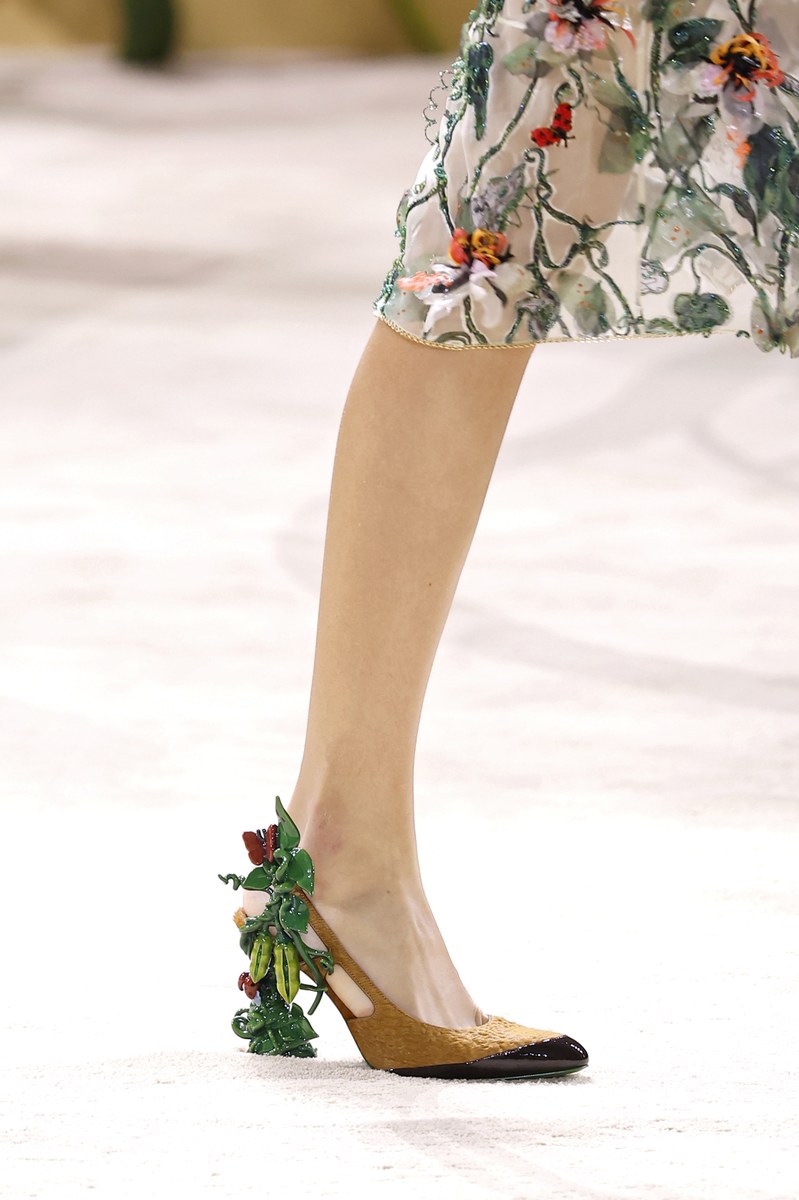
Black dominates the show's opening movement. It runs through Looks 1, 4, 5, 6, 7, 8, 21, 23, and 26 as matte wool, liquid velvet, and patent leather without relief, building a dense and authoritative opening statement. A warm tobacco-and-brown sequence arrives mid-collection through Looks 17, 18, 19, 29, and 44, pairing grey charcoal with taupe and dark chocolate in combinations that feel archival rather than seasonal. The carpet and brocade pieces in Looks 41, 42, 43, 46, and 47 introduce oxidized gold, dusty rose, cobalt, and terracotta simultaneously, functioning as a concentrated color burst after the tailored section's austerity. Ivory and optic white close things out in Looks 34 through 40, resetting the eye before the final object-garment pieces arrive.
Materials and Textures
Shearling and long-pile fur carry the heaviest visual weight. They appear as stoles in Look 1, a full shearling vest in Look 3, a dense black fur dress in Look 16, and a full-length brown fur coat in Look 29. Leather returns obsessively through a belted leather vest-dress in Look 9, a longer leather column in Look 10, and a strapless dress constructed from thick vertical strips of dark burgundy and black leather in Look 32, which demands significant production complexity but delivers clear commercial impact. Both black and olive gold velvet appear in Looks 21, 23, 26, and 47, with a deep crushed pile that absorbs light rather than reflecting it. Persian and floral carpet fabric, cut and draped as garments in Looks 41 and 42, brings a deliberately rough-woven hand to the body, contrasting sharply with the precision tailoring in the navy and charcoal looks that precede them.

Styling and Layering
A wide, flat belt in black or brown leather appears in nearly every look that exposes the torso, from Look 4 to Look 25, functioning as the collection's consistent punctuation mark. Footwear stays restricted to three shapes: a black platform loafer with a square toe, a tall black or dark brown riding boot to the knee, and a low block-heel black pump, all lacquered to a high shine that contrasts with the matte or textured garments above. Barefoot exits in Looks 36 through 42 strip the foot away entirely, shifting those looks from fashion into something closer to ritual or theater. Layering here is additive rather than concealing. A vest over a trench in Look 3, a hooded sweatshirt beneath a sleeveless trench in Look 2, a knitwear sweater under a navy bomber in Look 20, each layer stays individually readable.

Look by Look Highlights
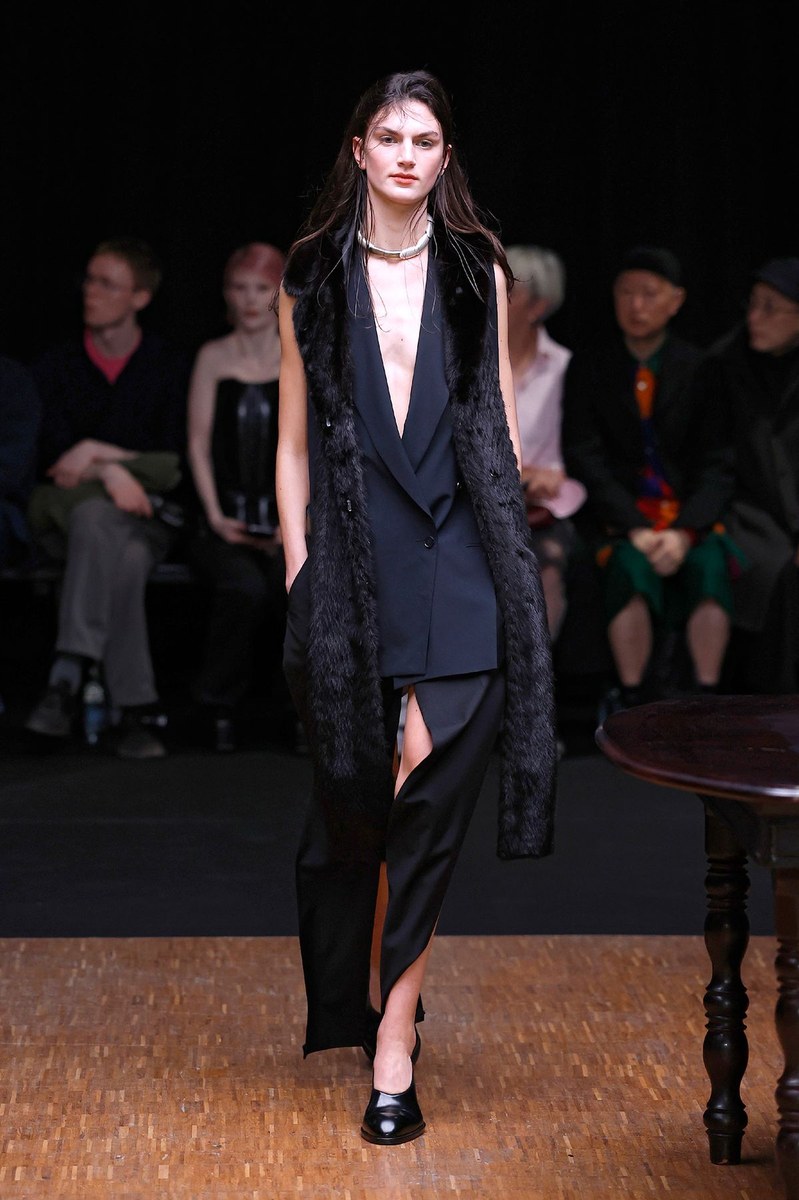
Look 1 A floor-length black fur stole worn open over a deep-V black suit dress with a slit skirt establishes the sleeveless vest as the collection's primary outerwear gesture, essential for buyers building a hero piece strategy.
Look 4 A charcoal wool sleeveless blazer worn open over bare skin with a wide gold-buckle belt and tall black riding boots is the most stripped-back commercial proposition in the collection, easy to isolate as a single SKU.
Look 11 A mini dress constructed entirely from knotted and clustered grey-green checked wool creates a three-dimensional bobbled surface that translates directly into conversations about artisanal fabric development for product managers.

Look 22 Long ivory human-hair-like fringe, gathered and pinned at the waist by a row of metal clips worn over black tailored trousers, is an editorial apex piece that will move press and campaign imagery without requiring retail translation.

Look 32 A strapless tube dress built from thick vertical strips of dark burgundy and black leather with visible raw seams, paired with a matching structured leather bag, is the clearest co-sell opportunity in the collection.

Look 43 A below-knee pale pink floral brocade dress worn beneath a black coat with the collar replaced by a large oval mirror frame around the face is a single-image look that generates maximum social traction for style directors planning editorial coverage.

Look 46 A structured pale pink jacquard top with the back legs of a carved antique chair forming the shoulder and neckline architecture over wide dark grey tailored trousers is the conceptual signature piece that defines the collection's critical reception.

Look 47 An upholstered olive-gold damask chair seat worn as a boxy mini dress with the chair legs visible beneath makes the domestic-object-as-garment thesis fully literal. While unwearable commercially, it secures the collection's place in season recaps and museum acquisition conversations.

Operational Insights
Hero SKU isolation: The sleeveless longline vest in shearling, leather, and tailored wool (Looks 1, 3, 4, 9, 10) is the most commercially extractable silhouette, suitable for production in four to six fabrications across price tiers without losing the collection's core identity.
Fabrication risk assessment: Both the leather strip dress (Look 32) and the bobbled wool surface dress (Look 11) carry high construction labor costs and should be evaluated against projected sell-through at the top price tier before committing to bulk production quantities.
Footwear program: The consistent use of three shoe silhouettes across 47 looks, all in black or dark brown with a high-polish finish, signals a clear footwear licensing or collaboration opportunity that aligns tightly with the collection's visual language.
Carpet and brocade development: The Persian carpet fabric skirt (Look 42), the fringed carpet cape (Look 41), and the brocade boxy tops (Looks 43, 46) suggest a dedicated made-from-found-material or dead-stock sourcing strategy that product managers can develop into a documented sustainability narrative for wholesale partners.

Press and buyer seeding strategy: The mirror-frame, chair-frame, and hair-fringe looks (Looks 22, 24, 25, 43, 45, 46, 47) function as editorial anchors rather than retail propositions, and style directors should plan dedicated press loans of these pieces to maximize column inches without diluting the retail-facing lineup.
Complete Collection


Fashion Designer

Ellen Hodakova Larsson grew up on a horse farm near Strängnäs, a small city about an hour west of Stockholm, and she means that literally: she got her first horse at four, competed in equestrian sports through her teens, and spent her childhood running barefoot between apple trees and stables. Her mother was a fur seamstress with the instincts of a mender, someone who would turn a tablecloth into a dress and drag her children through secondhand shops to find things worth transforming. Her father was a military man who returned from postings abroad with new project ideas and a certain fearlessness about making things. The house was defined by resourcefulness as a creative principle, not an economic constraint. It was her maternal grandmother whose surname she would eventually put on a label: Hodakova, a woman she describes as her biggest inspiration, someone who solved her own problems in a generation that offered women far fewer tools to do so.
Before fashion, there was art and sculpture. Larsson enrolled initially in a foundation year studying painting and sculpture at the Swedish School of Textiles at the University of Borås, and it was through that training that she understood her own instincts clearly for the first time. She wasn't interested in making flat objects; she wanted to build on the body. She stayed at the school and completed a fashion design degree, graduating in 2019. Her graduate collection caught attention immediately, and she spent a year developing her thinking before officially founding Hodakova in 2021, based in Stockholm.
Her method is as precise as it is unusual. She works almost exclusively with existing objects and discarded materials, approaching each one not as a limitation but as a structural challenge: thousands of ballpoint pens stitched into a fur-like texture; a military attaché case unzipped into a strapless leather dress; sewing needles gathered from the studio floor and sutured into a shimmering gown; leather belts woven into bags with the stiffness and curve of a baguette. The references run through her Swedish rural childhood, competitive equestrian culture, and a deep curiosity about the sentimental charge that objects carry. The pieces are made in Sweden, often in close collaboration with her production team, who are given creative latitude because the material itself demands decision-making at every seam. In 2024 she won the LVMH Prize for Young Designers, the first Swedish designer to do so.
"We grew up with the mind-set of: you can make whatever you want from nothing. She taught us how to look at things with imagination. I think that's the most important part of my journey."
"It's a magical moment when you see one thing become something else. Most people see a pile of belts and think, 'That's gross, nobody wants that,' but you put hours into it, creating a dress from them, with a mix of both stiffness and softness."
✦ This report was generated with AI — combining human editorial vision with Claude by Anthropic. Because the future of fashion intelligence is already here.