Hui FW26 Bags
Hui FW26 Bags Report
Hui FW26 plants the collection's bag identity firmly at the intersection of textile-forward construction and heritage pouch silhouettes, split between boxy top-handle camera bags with scarf embellishment and drawstring bucket styles built from brocade, jacquard, and mixed-panel fabrications. Buyers operating in the contemporary luxury and artisan-adjacent market should move quickly on these references, as the drawstring pouch category continues to accelerate at retail while the material-mixing approach gives merchants a clear differentiation story against cleaner minimalist competitors.
Silhouettes and Shapes
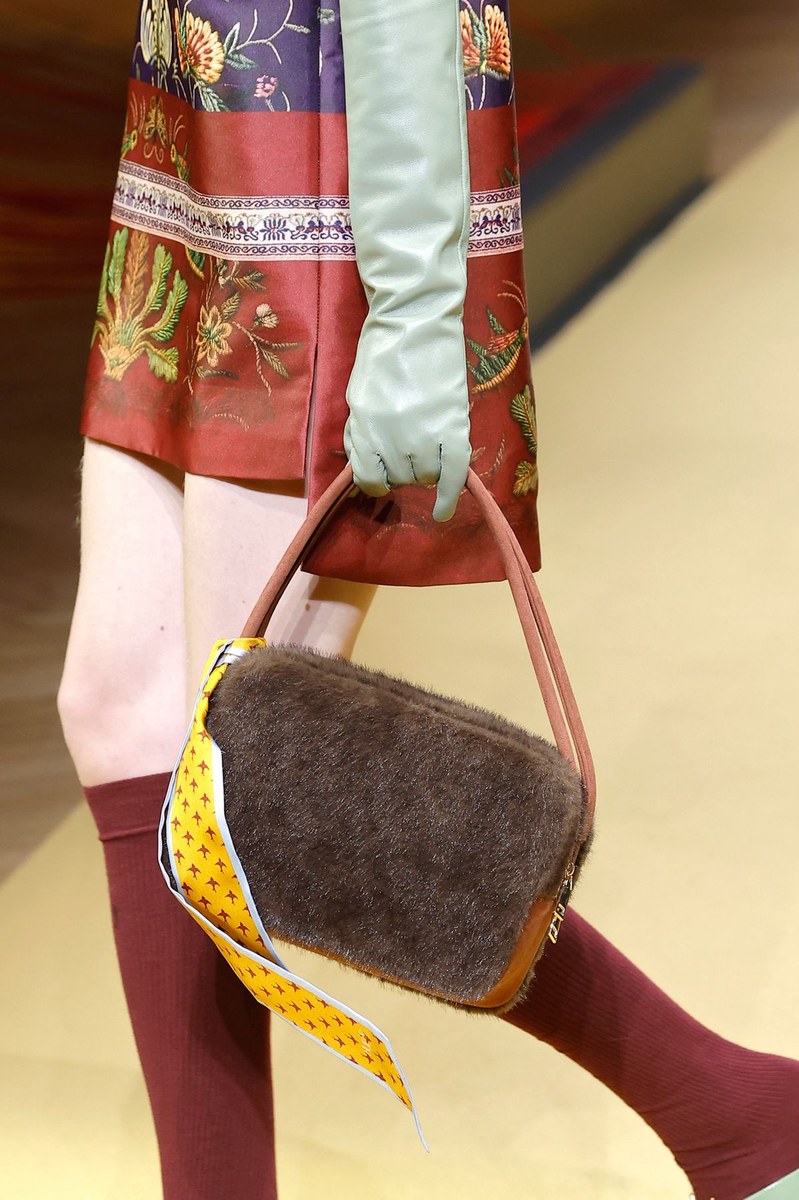
Two silhouette families anchor the collection. The first is a boxy, rounded-corner camera bag carried by a single top handle, appearing across Bags 1, 2, 7, and 8, with a compact footprint that reads closer to a medium clutch than a full shoulder bag. Drawstring bucket pouches of varying volumes make up the second family, seen in Bags 3, 4, 5, 6, and 9, ranging from a small wrist-held pouch to a fuller, rounder bucket with structural tassel pulls. While the camera bags maintain a consistent structured silhouette, the buckets trade structure for gathered softness at the drawstring opening.
Materials and Hardware
The camera bag group mixes mink fur panels (Bag 1), wool and felted textile patchwork (Bag 2), distressed denim with exposed jacquard underlining (Bag 7), and pony-hair calf in a solid red (Bag 8). Leather trim in tan and terracotta tones acts as a grounding frame around the fabric bodies across the structured group. Bags 3, 4, 5, and 6 rely on silk brocade, printed satin, and tone-on-tone jacquard with twisted cord handles and knotted or braided drawstrings. Hardware stays minimal and warm throughout: small gold-toned zipper pulls on the camera bags and satin-finish bead accents on the bucket cords, with no visible logo hardware anywhere in the lineup.
Color Direction
Amber gold, crimson red, and deep teal read as the dominant tones across the pouch group, with the brocade prints layering all three simultaneously in Bags 4 and 6. Bag 5 delivers a flat marigold jacquard against matte black cord, the most graphic and commercially direct color pairing in the lineup. Cooler, earthier tones define the camera bag group: mink brown, felted grey-green, pale denim blue, and pony-hair red. A recurring mustard yellow scarf accent in Bags 1, 2, and 8 functions as a unifying thread across otherwise distinct colorways, giving the assortment a cohesive merchandising signal without relying on a single brand color.
Key Models and Details
The top-handle camera bag is the collection's most commercially transferable model, with a zipper closure running the full top edge and a silk scarf tied through the zipper pull as a removable styling element. That scarf detail, printed with a small red star motif on a yellow field, appears across Bags 1, 2, and 8 and creates a ready-made add-on accessory opportunity. Twisted rope or braided cord handles with tassel finishes at the drawstring ends define the bucket group, and the closures are purely gathered fabric with no secondary snap or magnet visible. Bag 9 stands apart structurally, wrapping a gold jacquard pouch inside a macramé or knotted net exterior, which signals a layered or nested bag concept that other models in the collection do not explore.
Bag by Bag Highlights
Bag 1 A mink fur body in warm brown mounted on a terracotta leather frame with a yellow star-print scarf threaded through the zipper pull makes this the highest material-cost piece in the camera bag group and a strong candidate for a limited production run.

Bag 2 A two-panel felted textile face combining a grey woven upper and a mossy green lower section, trimmed in tan leather with the same star-print scarf, gives buyers a more accessible fabrication at a lower material cost than Bag 1 with comparable visual impact.

Bag 3 A red silk drawstring bucket with hand-painted or printed botanical motifs, sage green twisted cord handle, white tassels, and matte green satin beads at the cord ends pulls directly from Chinese decorative textile traditions and reads as the most gift-oriented piece in the lineup.

Bag 4 A small, hand-held brocade bucket in dark navy and gold with teal twisted cord and deep teal tassel pulls carries a tight, wrist-clutch volume that positions it as an evening or event bag for specialty retail placement.

Bag 5 The marigold jacquard bucket with black braided handle and black tassel drawstrings is the most graphic and the most season-agnostic silhouette in the pouch group, and its flat color approach makes it the easiest to photograph for e-commerce.

Bag 7 Distressed light-wash denim with intentional rips that expose a gold jacquard lining beneath is a production-intensive design that communicates a destructured luxury aesthetic, and the visible lining-as-detail concept could translate into a lower-cost version with printed lining.

Bag 8 A pony-hair calf body in solid crimson red with a tan leather top-handle frame and the star-print scarf at the zipper presents the cleanest and most immediately recognizable retail option in the camera bag group.

Bag 9 A pale gold jacquard drawstring pouch suspended within a knotted black macramé net structure with long black tassel pulls functions as an art-object bag and a proof-of-concept for the nested or double-layer format, best suited to editorial or trunk show distribution rather than broad wholesale.

Operational Insights
Scarf accessory strategy: The yellow star-print scarf threaded through zipper pulls on Bags 1, 2, and 8 is a removable piece that buyers should request as a separately available SKU, creating a low-cost entry-point accessory that drives attachment sales and extends the collection's brand narrative at checkout.
Material tiering: The camera bag silhouette appears in mink fur (Bag 1), textile patchwork (Bag 2), pony-hair calf (Bag 8), and distressed denim (Bag 7), which maps neatly to a four-tier price architecture within a single shape. Product managers should build this out as a deliberate good-better-best-limited framework rather than treating them as separate styles.
Pouch volume calibration: Bags 4 and 9 read as micro or event-only sizes, Bags 3 and 5 sit in a small-functional range, and Bag 6 is the fullest volume in the group. Stock the small-functional tier most heavily, as it covers the widest range of customer occasions without committing to the production complexity of the art-object pieces.

Fabrication risk assessment: Both the mink fur panels on Bag 1 and the distressed denim construction on Bag 7 carry elevated production risk, the fur through material sourcing and regulatory compliance in key markets, and the distressed denim through inconsistency in the rip patterning at scale. Both styles require explicit quality control benchmarks before committing to wholesale minimums.
Brocade sourcing concentration: Five of the nine bags rely on jacquard, brocade, or printed silk fabrications sourced from what appears to be a consistent textile family across the collection. Accessories directors should confirm whether the brand holds the textile exclusivity or sources from open-market mills, since the pattern repeats in Bags 3, 4, 5, and 6 appear closely related and a competitor could access the same cloth.
✦ This report was generated with AI — combining human editorial vision with Claude by Anthropic. Because the future of fashion intelligence is already here.