IFM Master of Arts FW26 Women Looks Report
Paris Fashion Week
This is a graduate showcase built entirely around material invention, where each student designer uses construction, texture and print as their primary design language rather than relying on traditional silhouette vocabulary. Buyers and style directors scouting for emerging talent will find a concentrated pool of technically ambitious designers working across knitwear, leather, outerwear and surface embellishment here. Many are ready for capsule collaborations or emerging brand development pipelines.
Silhouette and Volume
Extreme volume concentrates at the shoulder and hem rather than the waist. Look 1, Look 22 and Look 135 all push outward mass to theatrical proportions. Draped and wrapped constructions recur throughout the women's section, particularly in Looks 14, 65, 69 and 79, where fabric pools at the floor and trails behind the model in deliberate excess. Cropped and deconstructed jackets sit against floor-length skirts or full-length bodysuits, creating a consistent high-low proportion logic visible in Looks 12, 66 and 68. A few looks, notably Look 17 and Look 75, pull back entirely into structured, fitted suiting that reads almost restrained against the broader energy.
Color Palette
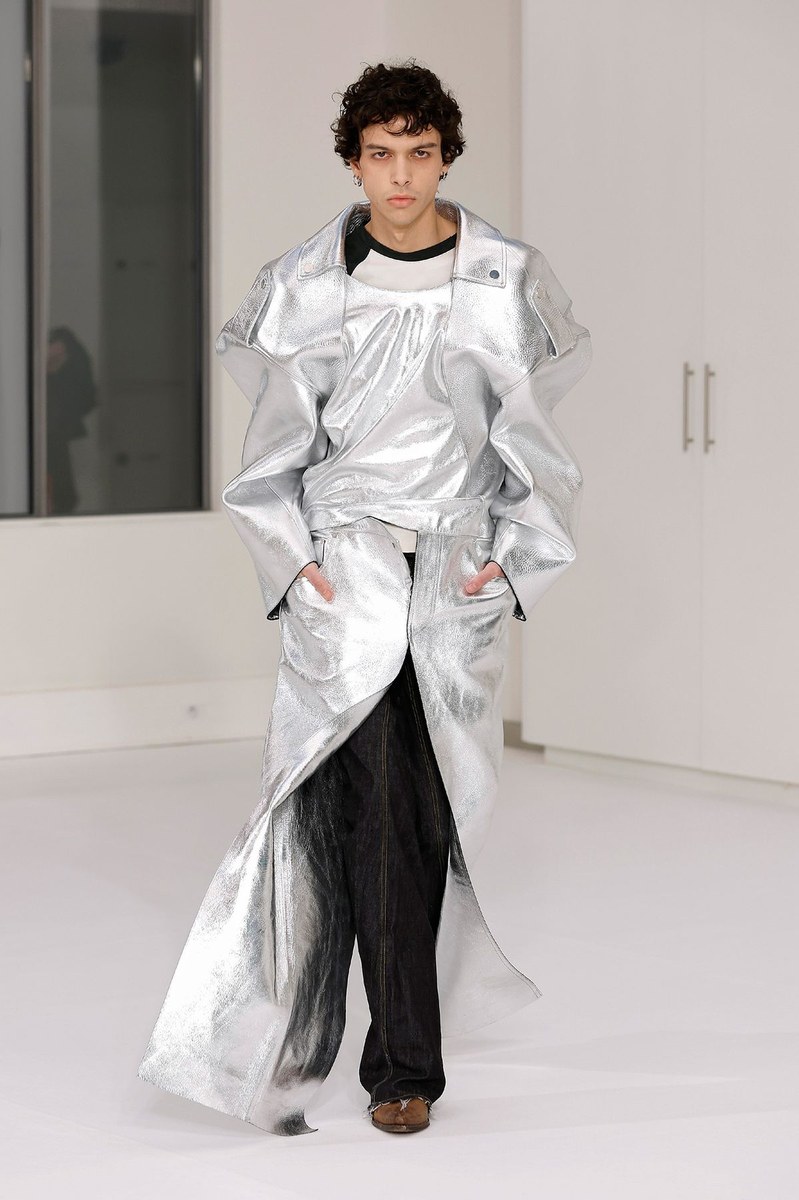
Orange saturates the strongest statement pieces, from the burnt sienna bodysuit and cape in Look 69 to the vivid coral of Look 80 and the brick red layering of Look 109. Magenta and fuchsia appear as accent disruptors across Looks 15, 16, 19 and 81, functioning as a chromatic throughline that connects sportswear-influenced construction to more formal draped silhouettes. Silver and white provide recurring reset moments in Looks 1, 3, 20 and 64, grounding the wilder color decisions with a cool, clinical base. Teal, cobalt blue and acid yellow cluster together in Looks 21, 22, 44 and 123, creating a palette that reads visually loud but technically consistent.

Materials and Textures
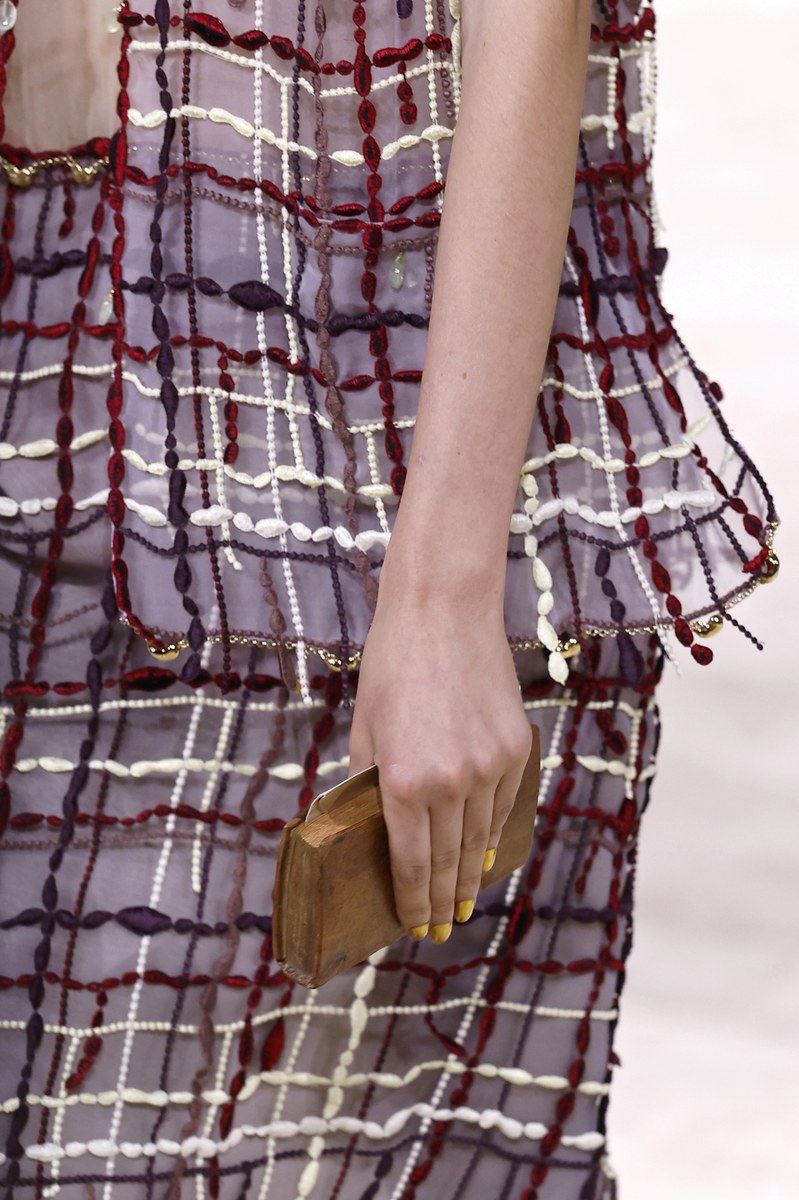
Handknit and chunky loop-pile knits carry significant weight across the selection, with Look 22, Look 84 and Look 119 all deploying oversized, sculptural knitwear that has substantial production cost implications. Sheer lace, open-mesh crochet and transparent organza appear in Looks 9, 20, 56 and 107, often layered over structured undergarments to create depth without full opacity. Leather, both matte and glossy, grounds Looks 18, 21, 23 and 65 with a harder material contrast against soft draped fabrics. Print-bonded and heat-transfer surface work on structured outerwear, visible in Looks 4, 36 and 54, suggests designers experimenting with industrial finishing processes beyond conventional weave or embroidery.

Styling and Layering
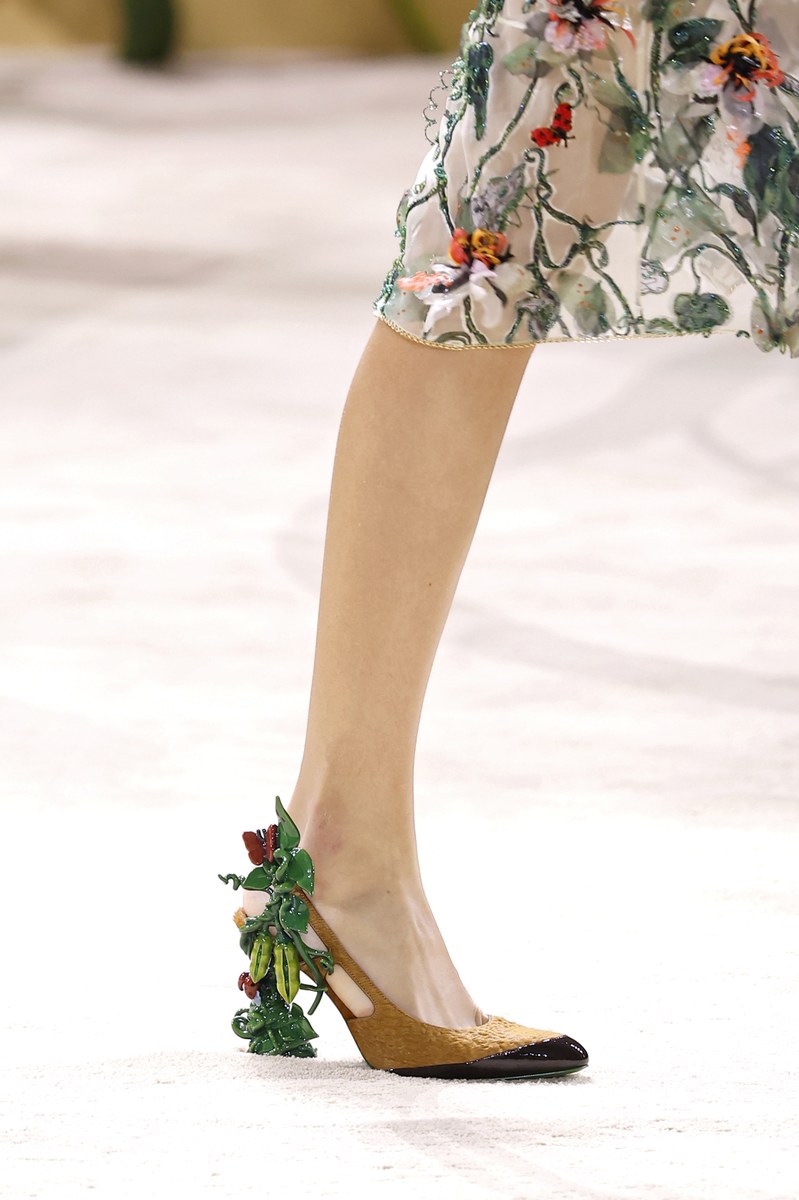
Deliberate accumulation dominates the assembly logic, where multiple distinct garments are worn simultaneously and allowed to show their seams, hems and construction at the same time, as in Looks 7, 24, 25 and 91. Footwear runs in two clear directions: flat thong sandals in black or transparent resin, worn across much of the women's section, and chunky platform shoes or knee-high boots that amplify the volume of heavily constructed skirts. Socks styled over tights or worn with open-toe shoes appear in Looks 41, 42, 43, 71 and 120, operating as a deliberate anti-polish signal. Accessories are either entirely absent or aggressively present, with bags in Look 10, Look 15 and Look 16 functioning as sculptural objects rather than functional carriers.

Look by Look Highlights
Look 19 deploys an entirely monochromatic orange construction from tiered mohair collar through knotted cord skirt to thigh-high boots. For buyers sourcing tonal dressing in statement fabrications, it's the single most color-disciplined look in the group.

Look 22 wraps a model in a floor-length, voluminous mohair coat in rust brown and cream with layered shearling-style tiers. As an outerwear hero with strong editorial pull, it presents a clear commercial path.
Look 51 constructs a blush pink sculptural dress from rigid pleated panels folded into a wheel-like form around the torso. Advanced pattern-cutting skill and craft-led eveningwear with a graphic silhouette make it directly relevant to buyers.

Look 56 pairs a sheer lace cap-sleeve top with a skirt made from hundreds of small organza circles graduating from dusty violet to pale yellow. Significant atelier labor and couture-adjacent capability signal through this construction.

Look 94 builds a fitted black jacket and circular skirt entirely from surface-printed and embroidered peacock-eye motifs in neon yellow, teal and pink, with coordinating tights. It's the strongest example of total-look print thinking in the graduate cohort.

Look 123 layers a yellow and black feather-trimmed jacket over a ribbed waist panel and a graphic diamond-check flared skirt, with teal tights and yellow heels completing the look. Confident color blocking with strong accessories alignment are on full display here.

Look 135 covers a model from shoulder to floor in densely layered red organza poppy flowers, each with a black velvet center. Extreme labor intensity gives it immediate press and exhibition value for an emerging brand launch.

Look 125 constructs an off-shoulder mini dress entirely from overlapping multicolored safety pins and metallic tubes. This wearable material experiment bridges jewelry, textile and garment, signaling a designer thinking across product categories simultaneously.

Operational Insights
Knitwear development: Multiple designers across Looks 22, 44, 84, 119 and 120 demonstrate advanced hand and machine knit construction with surface embellishment integration. This cohort is worth tracking for knitwear capsule co-development or brand acquisition conversations before they enter the market independently.
Print and surface technology: Looks 4, 36, 54, 94 and 96 all show print work applied directly to structured or knit grounds rather than woven fabric. Buyers should confirm that digital textile printing and heat-bonding processes are production-scalable before placing development orders.
Fabrication cost reality: Several standout pieces, particularly Look 135, Look 56 and Look 51, represent extremely high atelier labor costs. Either significant retail price positioning or volume reduction to a single hero SKU per season would be required to make them work commercially.
Gender-neutral signals: Looks 1 through 6, plus Looks 29 through 34, demonstrate that multiple designers in this cohort are building collections without a clear gender binary. Style directors should flag these for brands currently expanding into unisex or genderless category development.
Accessories white space: With the exception of a handful of sculptural bag moments in Looks 10, 15 and 16, footwear and accessories remain underdeveloped across the graduate selection. Accessories brands seeking designer partnerships with strong runway visibility but minimal accessories competition will find a direct collaboration opportunity here.
Complete Collection


Fashion Designer

✦ This report was generated with AI — combining human editorial vision with Claude by Anthropic. Because the future of fashion intelligence is already here.