Institution Galib Gassanoff FW26 Details

Institution Galib Gassanoff FW26 Details
Institution Galib Gassanoff FW26 Details Report

Institution Galib Gassanoff's FW26 collection builds its accessories and detail language around textile weight, cultural memory, and deliberate surface disruption, moving between monastic austerity and ethnographic maximalism. For buyers and product managers, this split signals a viable two-track commercial strategy, one anchored in versatile dark wardrobe staples, the other in statement craft pieces with strong editorial and collector appeal.

Category Overview

Two categories anchor the collection: Dress Details and Headwear. Their dialogue is tightly controlled. Headwear operates in near-total restraint, relying on draped fabric cowls with almost no ornamentation, while Dress Details swing between quiet textural abstraction and loud kilim-derived patchwork. Rather than attempting to reconcile these poles, the accessories strategy holds them in deliberate tension, asking buyers to think about the collection as two coherent sub-ranges rather than one unified offering.
Material and Construction

Dress Details span hand-knotted wool pile in kilim and Caucasian rug patterns (Details 4, 5, 7), dense boucle with scattered lurex flecks (Detail 1), chunky horizontal-ribbed mohair-blend knit (Detail 2), navy flat-braid fringe weighted with silver bugle beads (Detail 3), and a raw grey yarn cape constructed from looped, uncut thread clusters (Detail 6). Six distinct fabric handles appear across the headwear range in Details 8 through 13, including smooth dense felt, chunky boucle, raw-edge bouclette, basket-weave twill, and clean navy flannel, all cut into the same large draped cowl silhouette. Construction reads intentionally unfinished at the edges, with raw hems and pulled threads visible in Details 10 and 11. Actual hand-woven textile pieces appear to be integrated directly into garment construction for the rug-derived dress panels in Details 4, 5, and 7, with visible fringe edges left intact rather than bound.

Detail 1
Detail 1

Color and Finish Direction

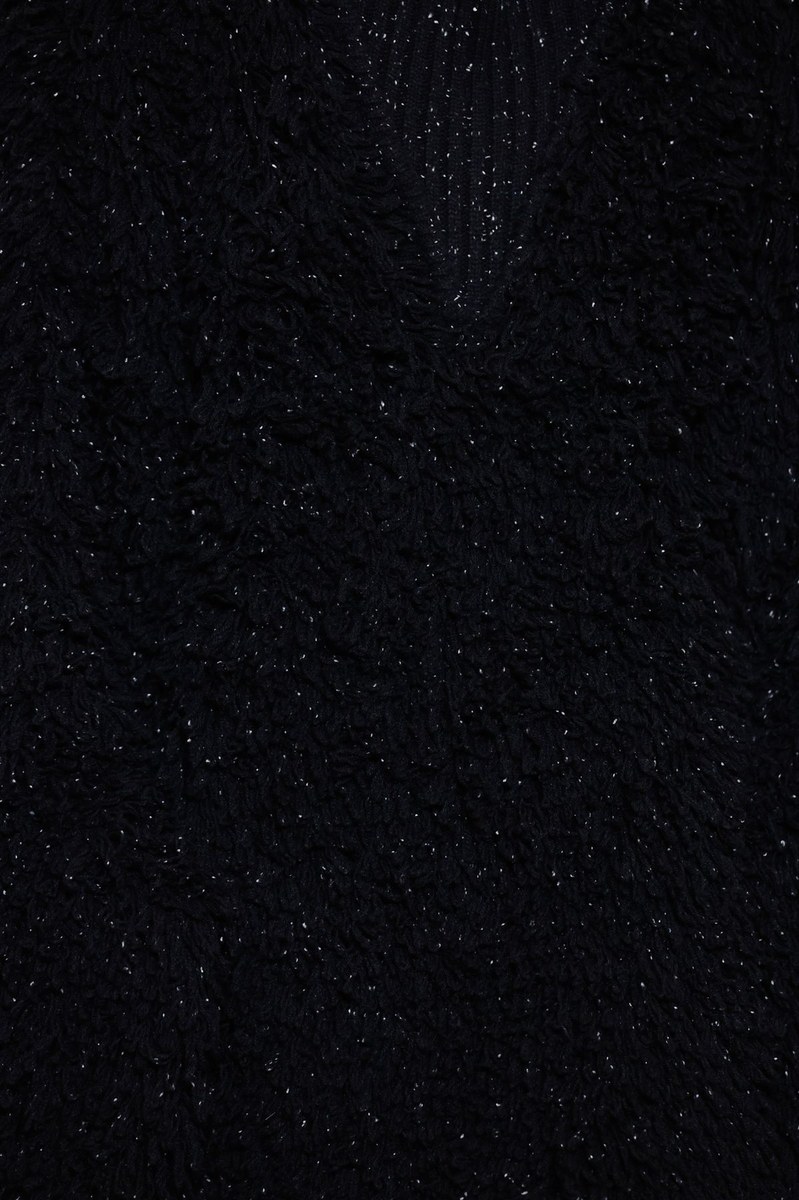
Near-black and deep navy dominate both categories, anchoring the headwear range and grounding the boucle and fringe dress details. Saturated primary combinations shift through the rug panels: cobalt blue, cadmium red, forest green, and warm gold across Details 4, 5, and 7. Detail 1 sits in a very deep navy that reads almost black, lifted only by sparse metallic flecks that create a low-key celestial surface effect. Grey appears in Detail 6 and Detail 2, functioning as a neutral bridge between the monochrome black garments and the kilim color explosions, giving buyers a mid-intensity option.

Key Pieces and Details

The kilim-panel skirt (Detail 7) presents the most commercially legible statement piece, showing a complete rug motif in yellow, green, navy, red, and white with intact fringe hem, positioned as a direct wearable craft object. Six models in six different black and navy fabrics demonstrate the draped cowl headwear's scalability (Details 8 through 13), with low construction complexity and strong styling versatility across multiple dress codes. Silver metal bugle beads arranged in irregular zigzag placement make the beaded fringe dress detail (Detail 3) the strongest candidate for licensed trim or embellishment development. Production complexity peaks in the looped raw-yarn cape surface of Detail 6, but so does its differentiation potential for luxury wholesale accounts.

Detail 7
Detail 7

Detail by Detail Highlights

Detail 1 (Dress Detail) The near-black boucle surface carries scattered silver lurex flecks that read as restrained shimmer rather than overt embellishment, positioning this fabric as a day-to-evening option for core range production.

Detail 3 (Dress Detail) Flat navy braid fringe carries silver metal bugle beads arranged in ascending and descending zigzag formations, with bead density concentrated at the upper register and fringe left bare below, creating a weighted, directional movement.

Detail 3
Detail 3

Detail 4 (Dress Detail) A hand-knotted wool panel in cobalt, crimson, ivory, black, and gold presents a full Caucasian medallion motif with geometric border work, constructed with enough structural integrity to function as a load-bearing garment panel rather than applique.

Detail 4
Detail 4

Detail 6 (Dress Detail) Dense clusters of looped, uncut yarn threads arranged in overlapping horizontal rows build the grey yarn cape's surface, producing a sculptural depth that reads differently in motion than at rest.

Detail 6
Detail 6

Detail 7 (Dress Detail) The full kilim skirt uses an intact woven textile panel in gold, forest green, navy, and red with white accents, fringe hem intact, and the scale of the central motif calibrated to the body so that it reads as intended rather than cropped or distorted.

Detail 9 (Headwear) The dark charcoal boucle cowl frames the face with the most volume in the headwear series, the thick loop pile adding mass at the crown and shoulder drop, making it the strongest silhouette statement among the six hood variations.

Detail 9
Detail 9

Detail 11 (Headwear) Visible warp and weft relief gives geometric rhythm to the basket-weave black twill cowl, carrying the most structured surface texture of the headwear group across an otherwise entirely draped form.

Detail 11
Detail 11

Detail 12 (Headwear) Clean smooth surface and minimal edge finishing characterize the navy flannel cowl, the most refined and retail-accessible piece in the headwear category, with a fabric weight that will translate directly into knitwear or outerwear hood applications.

Detail 12
Detail 12

Operational Insights

Dual range strategy: Buyers should treat the black and navy draped cowl headwear (Details 8 through 13) and the kilim-derived dress panels (Details 4, 5, 7) as separate commercial tracks, the former for broad distribution, the latter for limited or exclusive placements.

Trim development potential: The beaded fringe construction in Detail 3 translates directly into a licensable trim component for accessories, footwear, and bag categories, requiring conversation with the atelier about minimum yardage and bead sourcing.

Fabric handle variety within a single silhouette: One pattern block in six distinct textiles produces six meaningfully different retail propositions across the cowl headwear pieces, a production efficiency model worth replicating for capsule drops.

Rug textile sourcing: Details 4, 5, and 7 appear to integrate actual Caucasian hand-knotted textiles rather than printed or jacquard simulations, which affects lead times, unit cost ceilings, and ethical sourcing documentation requirements before any wholesale commitment.

Boucle and mohair weight: Details 1, 2, and 9 all work in heavyweight boucle or ribbed mohair adjacent structures, signaling that the designer is building around a specific yarn weight range, and fabric development conversations should begin with mills who can deliver bulk yardage in that handle before sampling begins.

More Details

Detail 2
Detail 2
Detail 5
Detail 5
Detail 8
Detail 8
Detail 10
Detail 10
Detail 13
Detail 13

✦ This report was generated with AI — combining human editorial vision with Claude by Anthropic. Because the future of fashion intelligence is already here.