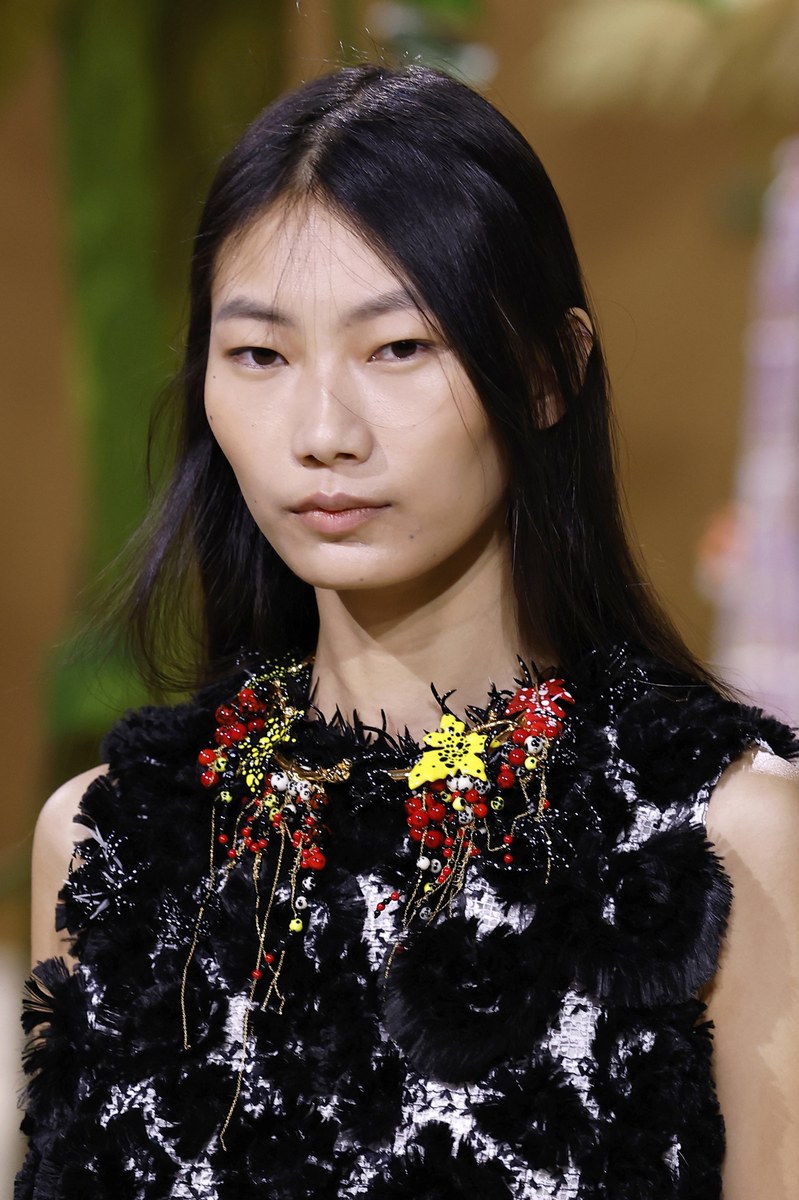
Institution Galib Gassanoff FW26 Women Looks Report

Institution Galib Gassanoff FW26 Women Looks Report
Institution Galib Gassanoff FW26 Women Looks Report

Milan Fashion Week

Institution Galib Gassanoff FW26 builds a wardrobe around deliberate concealment, pulling from monastic silhouettes, cocooning volume, and near-total chromatic restraint to construct garments that treat covering the body as a formal act. For buyers and style directors operating in a market fatigued by maximalist decoration, extreme minimalism and architectural drape emerge as a credible commercial and editorial direction.

Silhouette and Volume

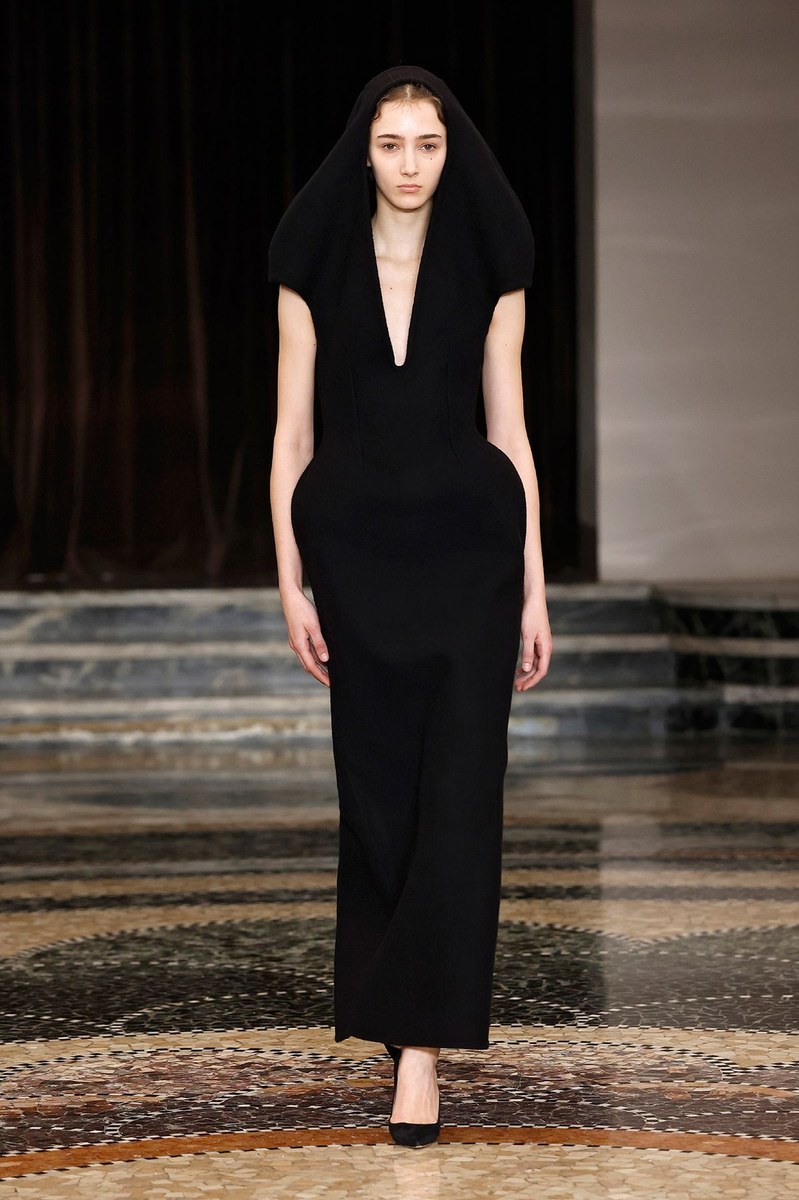
Two poles structure the collection: column-tight floor-length sheaths in Look 1 and Look 6, and enveloping cocoon forms that swallow the figure entirely in Look 2 and Look 3. Oversized hoods function as structural crown pieces rather than incidental accessories, appearing across Looks 1, 2, 4, 6, 9, 11, 12, and 13. The silhouette language reads consistently across genders, with menswear looks like Look 3 and Look 18 using the same draped robe logic applied to the women's pieces. Volume concentrates at the shoulder and collapses at the hem, creating a top-heavy mass that reads as sculptural on the runway and wearable in editorial contexts.
Look 1
Look 1

Color Palette

Black dominates the first half without variation, covering Looks 1 through 12 in a consistent matte-to-deep-charcoal range that reads as near-black depending on fiber content and surface texture. A cold navy enters at Look 11 and carries through Looks 13 and 14, sitting close enough to black to feel like a tonal shift rather than a color break. Look 13 introduces pure cobalt blue in chiffon, Look 15 moves into deep aubergine, and Look 16 introduces medium heather grey that softens the palette before returning to charcoal in Looks 17 and 18. Look 19 is the single chromatic rupture, a kilim-printed maxi skirt in red, gold, cobalt, and green that functions as a deliberate punctuation mark closing the collection.

Look 11
Look 11

Materials and Textures

Heavyweight boiled wool and dense felted coatings dominate, seen in Looks 2, 3, 12, 14, 17, and 18, where the fabric holds its three-dimensional form without internal structure. Contrast emerges through surface-altered materials: the fringe-covered robe in Look 5 uses what appears to be a looped yarn or knotted cord construction across the full body, while Look 10 places laser-cut or hand-cut rectangular tabs along the edges of a quilted textile. Look 7 introduces a shaggy bouclé with visible metallic thread, and Look 8 uses what reads as curly lamb or a lamb-effect faux fur in a floor-length coat. Chiffon and crêpe pieces in Looks 13 and 15 carry the palette shift with deliberate lightness, their drape and translucency sitting in sharp contrast to the weight of everything that precedes them.

Look 5
Look 5

Styling and Footwear

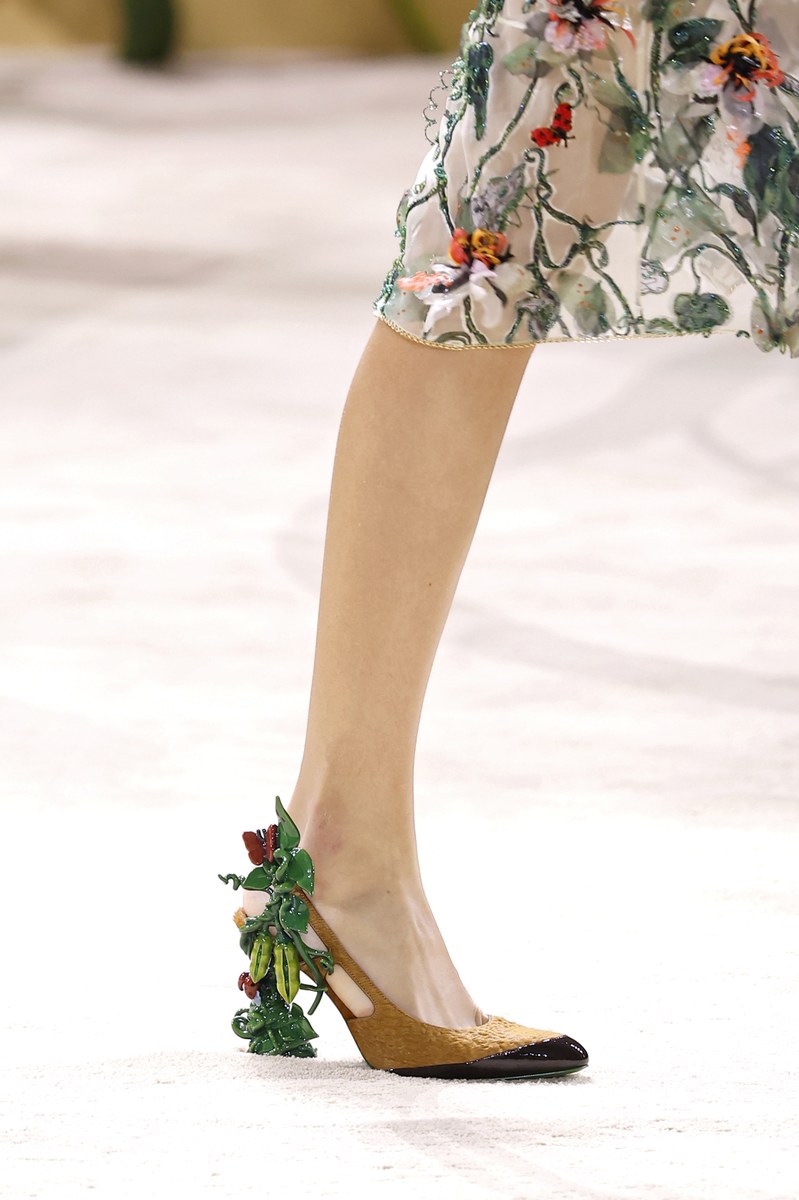
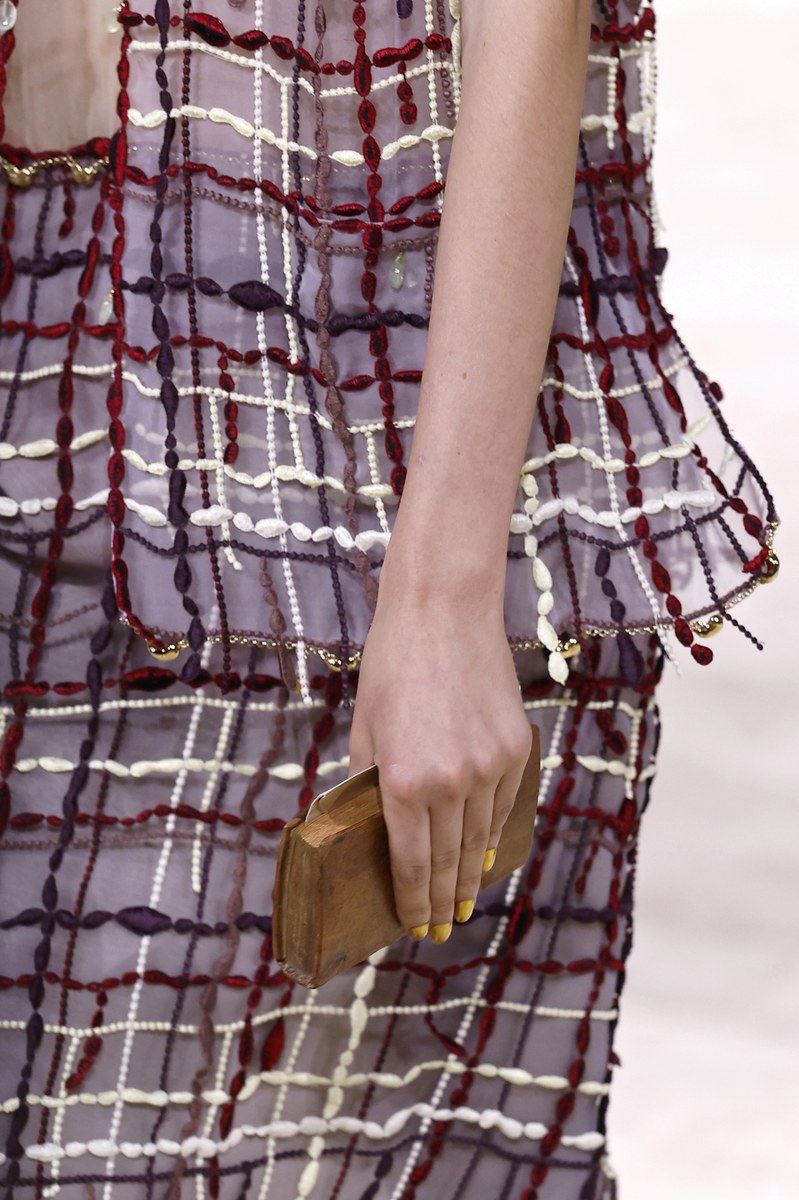
Footwear stays completely subordinate throughout. Pointed-toe pumps in black appear under almost every women's look, low-heeled and unadorned, chosen to disappear under floor-grazing hems rather than contribute visually. Men's looks use plain black leather derbies or oxfords with the same logic. Look 9 pairs the woven hood top with long fabric fringe gloves or sleeve extensions that fall past the knee, the one accessory decision that reads as directional rather than functional. No bags, no jewelry beyond faint chain necklaces on a handful of looks, no belts. Everything below the clavicle belongs to the garment alone.

Look 9
Look 9

Look by Look Highlights

Look 1 A sleeveless black column dress with an architectural stand-away hood in smooth boiled wool delivers the collection's thesis in its first minute: the body is the structure, the hood is the volume, nothing else competes.

Look 2 The full cocoon form in dark charcoal, fabric pulled from crown to floor in a single continuous oval, is the most commercially challenging piece and the most photographable, a distinction buyers should note for editorial placement potential.

Look 2
Look 2

Look 4 A boucle-textured hooded vest in charcoal over a straight black maxi skirt separates the hood-and-column idea into a two-piece buildable unit that has clear wholesale potential as a separates story.

Look 4
Look 4

Look 9 The woven basketweave hooded top with elongated fringe sleeves falls from cuff to below mid-thigh, making it a strong candidate for pre-order editorial and a high-cost limited production item. Construction here is the collection's most complex.

Look 11 A cold navy tailored blazer-and-trouser set draped with a matching structured veil translates the hood concept into suiting territory and represents the most directly wearable and commercially accessible look in the collection.

Look 13 A cobalt blue chiffon veil dress, sheer over a matching column slip, pivots the collection into evening territory and demonstrates that the designer's hood-and-drape logic scales across fabrication weight without losing its internal logic.

Look 13
Look 13

Look 15 A deep aubergine pleated cape dress in crêpe-weight fabric has the pleats radiating from a gathered neck yoke across a full cape back, coming closest to a gown silhouette and offering strong potential for the evening and occasionwear buyer.

Look 15
Look 15

Look 19 A plain black collarless cardigan paired with a kilim-woven tapestry maxi skirt in red, gold, cobalt, and green with fringe hem breaks the chromatic code entirely, functioning as both a collection closer and a signal that handcraft textile sourcing is part of the design vocabulary.

Look 19
Look 19

Operational Insights

Hood construction: Oversized structured hoods appear across at least eight women's looks in varied fabrications, from smooth wool to boucle to woven quilted textile. Buyers should confirm with the house whether the hood is integrated into the garment or a detachable component, as this affects production complexity and wholesale pricing tiers significantly.

Gender-neutral potential: Looks 3, 5, 7, 10, 16, and 18 were walked by male models but share fabrication, silhouette logic, and color range with the women's pieces directly. Style directors building fluid or genderless capsule buys should evaluate these looks alongside the women's assortment rather than separately.

Textile sourcing flag: Look 19's kilim-print skirt operates at a completely different supply chain level than the rest of the collection. Product managers should identify whether this is a commissioned weave, an archival textile, or a printed reproduction before committing to volume, as authenticity and lead time will vary dramatically between those three options.

Evening tier opportunity: Looks 13 and 15 establish a chiffon and crêpe evening category within a collection that is otherwise structured around heavy outerwear fabrications. These two looks could anchor a focused evening buy without requiring the full collection commitment, particularly for specialty and resort retailers.

Minimum order and production scale: The fringe construction in Look 5, the cut-tab embellishment in Look 10, and the fringe-glove detail in Look 9 are all labor-intensive surface treatments that will carry long lead times and high unit costs. Buyers should treat these as statement investment pieces and plan quantities conservatively, positioning them as full-price anchors rather than volume drivers.

Complete Collection

Look 3
Look 3
Look 6
Look 6
Look 7
Look 7
Look 8
Look 8
Look 10
Look 10
Look 12
Look 12
Look 14
Look 14
Look 16
Look 16
Look 17
Look 17
Look 18
Look 18
Look 20
Look 20
Look 21
Look 21
Look 22
Look 22
Look 23
Look 23
Look 24
Look 24
Look 25
Look 25
Look 26
Look 26
Look 27
Look 27
Look 28
Look 28
Look 29
Look 29
Look 30
Look 30
Look 31
Galib Gassanoff

About the Designer

Galib Gassanoff was born in the village of Karajalar, in the Borchaly region of Georgia, to Azerbaijani parents, and grew up on the outskirts of Tbilisi in a household that straddled two cultures, two languages, and the layered traditions of the Caucasus. The region he came from had its own particular historical density: in 1918, during the brief democratic republic of the South Caucasus, it had produced Peri-Khan Sofieva, the first Muslim woman elected democratically to any parliament, who became the subject of his FW26 collection decades later. He describes having been fascinated by aesthetics from very early on, absorbing the specific textures and craft traditions of the ethnic communities around him, including the carpet-making techniques of Borchaly, woven on vertical looms in patterns that carry genealogical and symbolic coding within their structure. His parents ran a shoe shop, and he has cited the shoelaces of his childhood as one of his earliest material obsessions, later turning them into a woven textile that became one of Institution's most recognizable signatures. At eighteen he moved alone to Milan on a scholarship to study fashion design, sustaining himself by selling merchandise at Expo stands because he spoke English and Russian.

In Milan, he met Luca Lin, the son of a Chinese family with an art and furniture collection, and together, operating from two rooms in Lin's parents' house in Reggio Emilia, they founded Act N.1 in 2016. The label mixed their respective Azerbaijani and Chinese heritages into a maximalist, multicultural aesthetic built around theatrical silhouettes in tulle and jacquard fabrics borrowed from interior design. Within a year the brand had won the Vogue Italia and Altaroma Who Is On Next contest and entered the official Milan Fashion Week calendar. Act N.1 grew considerably, eventually dressing Beyoncé and receiving backing from Valentino. In 2023, after seven years and a divergence in commercial vision, Gassanoff and Lin separated on good terms, and Gassanoff began building the project that had been forming in him as a separate necessity: a solo venture where the creative decisions would be entirely his, and where the commercial frame would not constrain what he wanted to say.

Institution debuted at Milan Men's Fashion Week in January 2024, staged in an art gallery rather than on a catwalk, with pieces mounted on walls and mannequins. A working loom stood in his Milan apartment, where he produces the textiles himself. The brand operates deliberately at a small scale, limiting collections to around thirty looks, working with women's communities in rural Azerbaijan and Georgia on handweaving techniques at risk of disappearing, including bulrush basket-weaving from the wetlands of the Caspian Sea and carpet knotting from Borchaly. He was a recipient of the CNMI Fashion Trust Grant 2025, a 2026 LVMH Prize semifinalist, and winner of the Zalando Visionary Award 2026. His three fashion references, which he has named explicitly, are Azzedine Alaïa, Martin Margiela, and John Galliano at Christian Dior. He still sews everything from his two-room apartment in Milan.

"I take inspiration from my childhood, from my roots. I work with the community on textiles, specifically in rural areas where there is a tradition of carpet making."

"This art is disappearing, there are very few women still handweaving. The collaboration intends to shed light on the craft, draw young people to it and urge the government to support it."

✦ This report was generated with AI — combining human editorial vision with Claude by Anthropic. Because the future of fashion intelligence is already here.