Isabel Marant FW26 Women Looks Report
Paris Fashion Week
Raw street energy collides with considered femininity across Isabel Marant's FW26 offering. Denim, leather, lace and fur merge into a single coherent vocabulary without any single category dominating the narrative. For buyers, the timing couldn't be better. Market appetite for dual-gender ready-to-wear with strong outerwear anchors and elevated casualwear shows no signs of slowing into fall retail.
Silhouette and Volume
Two clear volume registers alternate throughout. Oversized, padded or fur-heavy outerwear cut to the hip or just below sits against slim or barely-there underlayers, while wide-leg or balloon-cut bottoms pair with cropped or fitted tops. Bombers anchor the collection across leather, quilted satin, nylon and shearling, appearing in at least a dozen looks. The jacket serves as the collection's commercial spine. Trousers read wide throughout in leather, wool crepe and corduroy. Skirts split between micro lengths and floor-grazing bias cuts with lace or satin finishes. Structure is deliberately absent, even in the tweed coat in Look 26 and the long charcoal coat in Look 39, both carrying softened, slightly collapsed shoulders.
Color Palette
Black dominates across leather, knit, lace, denim and satin, keeping the eye moving between surfaces rather than colors. Red emerges as the primary accent: saturated crimson faux fur in Look 17, fire-engine quilted satin in Look 1 and Look 28, cherry leather in Look 38 and scarlet knitwear head-to-toe in Look 36. Electric cobalt blue anchors Look 10, Look 20, Look 41, Look 47 and Look 52, creating a secondary accent story with strong commercial repeatability. Warm bone, camel shearling and sand tones run through Look 13, Look 27, Look 40 and Look 56, softening harder edges and providing accessible entry points for broader retail audiences.

Materials and Textures
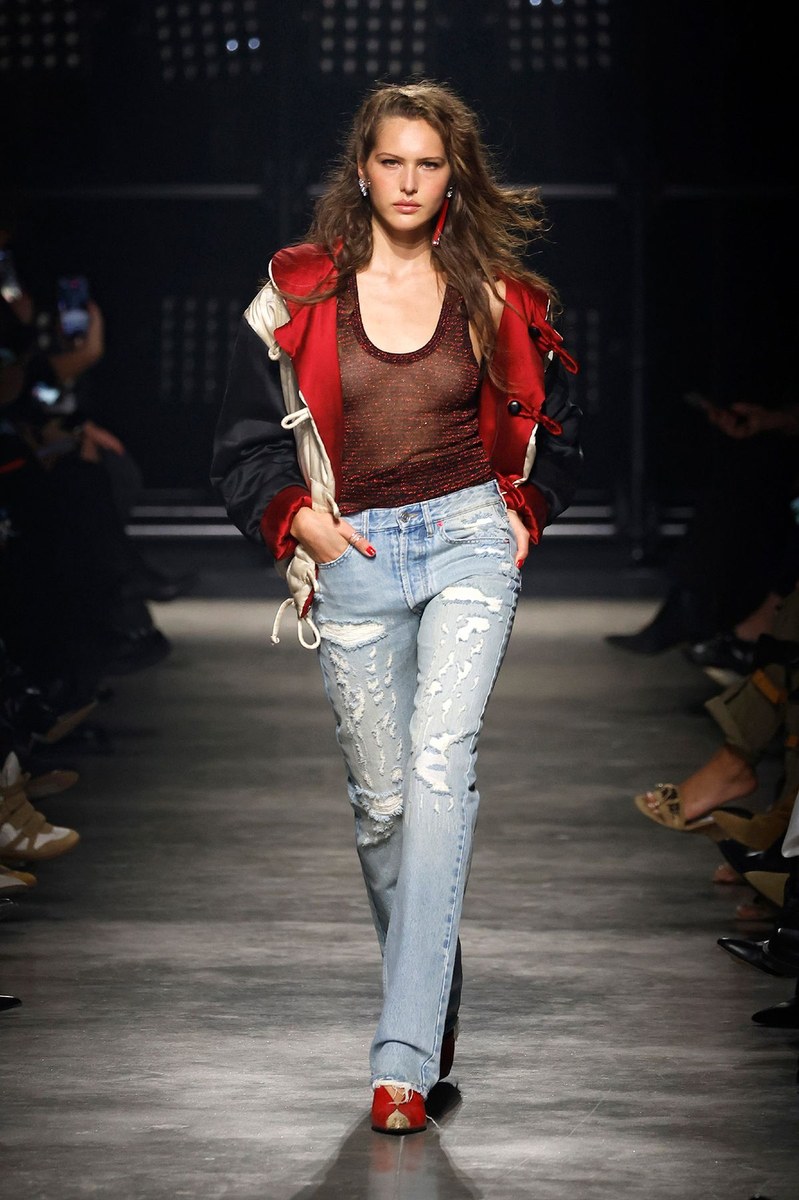
Leather works hardest throughout, appearing in bomber silhouettes, slim trousers, midi skirts, double-breasted jackets and a full red co-ord in Look 21. Surfaces range from matte black with shearling trim to high-gloss patent panels. Denim reads deliberately vintage and worn, with heavy distressing on straight-leg and barrel-cut jeans across Looks 1, 8, 14, 23 and 65. Red and cobalt denim in Looks 4 and 43 push the fabric into color territory. Sheer dotted tulle and lace recur as counterweight to heavier outerwear, appearing in tights, full-length skirts in Look 7 and Look 34, a body-length gown in Look 61 and as layering under structured jackets. Metallic and lurex fabrics deliver eveningwear options without abandoning the collection's grounded, rock-adjacent attitude, from the silver sequin shirt in Look 8 to the croc-embossed lamé dress in Look 42 and the gold-brown wrap jacket in Look 57.

Styling and Layering
Outerwear worn over deliberately underdressed bases drives the central styling logic. Sheer knit tanks, lace bralettes, satin slips and mesh tops sit beneath bombers, fur coats and leather jackets throughout. Zebra-print knee-high boots function as a recurring statement shoe across Looks 37, 38, 51, 54 and 62, tying disparate looks into a single collection narrative. Snakeskin boots in ivory and gold appear in Looks 43 and 57, while black knee-high leather boots handle the more grounded, utilitarian looks. Bags stay soft and slouchy in chain-strap leather, zebra-printed wristlets and fringe-edged pouches, reinforcing the intentionally undone quality that runs from first look to last.
Look by Look Highlights
Look 21 delivers the strongest co-ord proposition: a full oxblood red leather bomber and wide-leg trouser set with shearling collar trim that reads as a direct buy for outerwear-focused accounts.
Look 10 makes cobalt blue laser-cut leather work double duty, functioning as both a daywear midi dress and statement piece. The wide black belt provides the structure the fabric deliberately lacks.

Look 29 pairs a black patent double-breasted leather jacket with a leather midi skirt trimmed in floral lace at the hem and slit, targeting a customer who shops both edge and femininity in one transaction.

Look 42 closes the womenswear portion with a croc-embossed black metallic lamé shirtdress knotted at the waist. This singular evening piece justifies a small-run buy for occasion-focused retailers.

Look 57 wraps the body in a gold-and-bronze animal-patterned satin kimono jacket over a black bralette, cut extremely short, and pairs it with ivory snakeskin knee-high boots. It's the collection's highest-impact editorial look and the most obvious candidate for magazine placement.

Look 34 sends Irina Shayk down in a black lurex-striped oversized sweatshirt over a sheer dotted tulle maxi skirt with lace hem. Commercially safe yet visually strong, the pairing translates directly into a two-piece retail story.

Look 19 grounds the collection in a navy patent double-breasted leather jacket over straight light-wash jeans with zebra-print ankle boots. It's a cleaner, more accessible version of the collection's signature layering logic that should sit well in multi-brand accounts.

Look 36 runs a monochromatic red knit hoodie and matching knit short set with red ribbed leg warmers and brown lace-up boots. The tight color-blocked knitwear story carries strong wholesale potential for buyers looking for coordinated sets below the outerwear price tier.

Operational Insights
Outerwear depth: The bomber silhouette appears in at least twelve distinct fabrications across leather, shearling, quilted satin, nylon and faux fur, making this the clearest area for tiered buying across price points and fabrications within a single account order.
Co-ord opportunity: Full leather matching sets in oxblood red (Look 21) and black (Look 3), the cobalt knit dress (Look 52) and the red knit set (Look 36) demonstrate a deliberate co-ord strategy. Buyers can position these as both separates and sets, doubling SKU flexibility without doubling production complexity.
Footwear as collection currency: The zebra-print knee-high boot recurs across six looks in both womenswear and one menswear exit, signaling that this specific style serves as a hero shoe with strong sell-through potential when ordered alongside the corresponding looks.
Denim integration: Vintage-wash distressed straight-leg and barrel-leg denim appears in blue, red, cobalt and black across 15-plus looks, positioning denim not as a base layer but as an active design element. Buyers should plan it as a full category story rather than a supporting SKU.
Menswear crossover: Looks 6, 9, 11, 16, 18, 20, 33, 40, 46, 50 and 59 run as identifiable men's exits within the women's show. Shared materials (leather bombers, shearling jackets, wide wool trousers, lurex shirts) align closely with the women's range, giving style directors a direct path to a coordinated dual-gender floor presentation without sourcing two separate collections.
Complete Collection


Fashion Designer

Kim Bekker grew up in Nistelrode, a small village in the south of the Netherlands, far from any obvious pipeline into Paris fashion. She went on to study at the Arnhem Academy of Art and Design, an institution with an unusually strong track record: Viktor & Rolf and Iris Van Herpen are among its graduates, which says something about the kind of thinking encouraged there. What drew Bekker toward design rather than any other discipline was a particular feeling about clothes as objects that carry attitude, something she would spend the following two decades learning to make with precision. After finishing school she moved to Paris, where her first significant industry experience came at Chloé under Phoebe Philo, a formative environment for learning how to make clothes that are rigorous and desirable without being cold.
From Chloé she found her way to Isabel Marant in 2008, and stayed for a decade, working her way into the creative core of the house during the years when Marant's reputation reached its widest international scope. She left in 2018, spent a period as a consultant, then joined Saint Laurent as design director for pre-collections and finished products, gaining experience in a very different creative register before returning to Marant in March 2021 as artistic director. The second chapter was intentional. She came back with a specific plan: to learn the house again, build trust alongside its founder, and eventually take the lead. She describes the handover as something both women wanted to happen without forcing it.
Her references are grounded in a love of vintage, rock music, and the confident, slightly feral energy of women who dressed on their own terms regardless of the moment: Joan Jett, Siouxsie Sioux, early Kate Moss. Her mood boards run through punk, grunge, and the New Romantic into the particular strain of Parisian sensuality that Isabel Marant built. What anchors everything is a practical conviction about wearability as a non-negotiable: clothes that look strong on the body but can actually be lived in. At the Spring/Summer 2025 show, working alongside Marant, she noted that they deliberately resisted the full-bohemian expectation. By Autumn/Winter 2025/26, she had designed the entire collection independently. In October 2025, her role was formally confirmed as Creative Director, with Marant stepping back to focus on the store experience and brand development, working three days a week.
"I came back to the house four years ago with the plan to take over the creative lead eventually. But it's something we wanted to happen organically, so we really took our time."
"The whole point of what we're doing is to bring joy and to dress people. If it's unwearable, it's a shame."
✦ This report was generated with AI — combining human editorial vision with Claude by Anthropic. Because the future of fashion intelligence is already here.