Issey Miyake FW26 Bags
Issey Miyake FW26 Bags Report
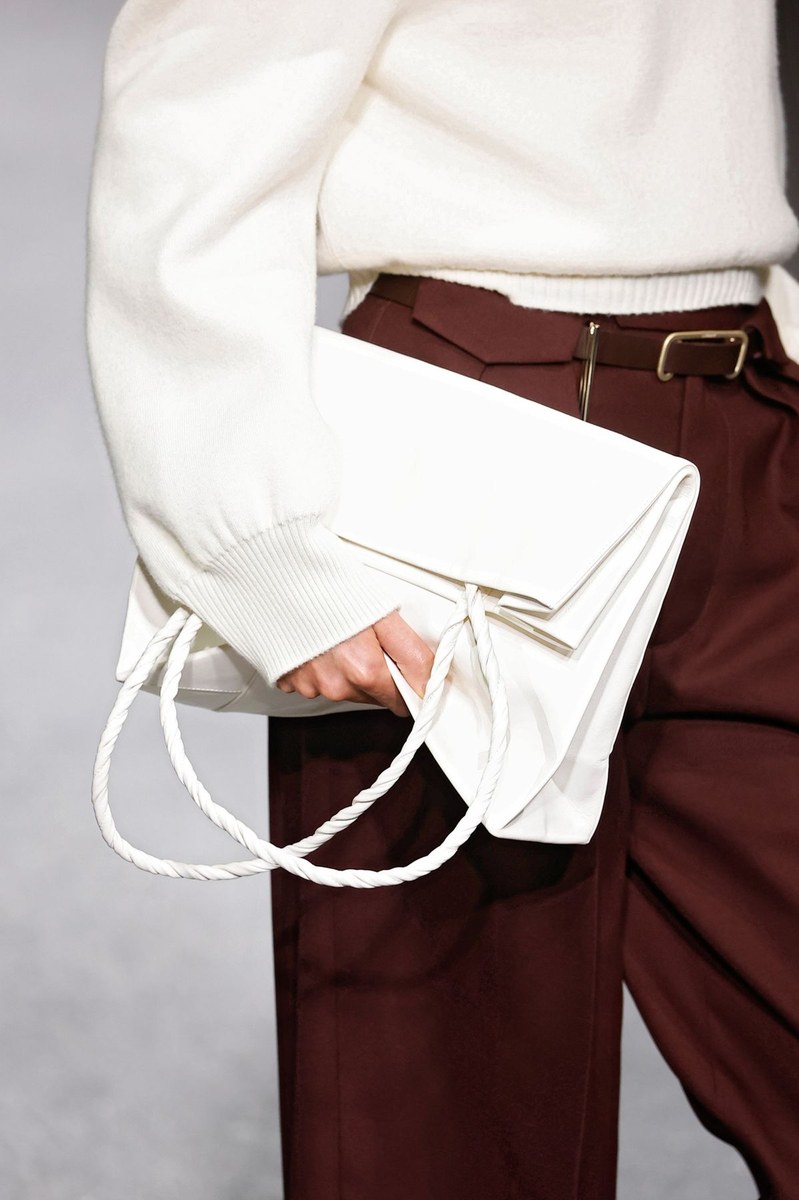
The FW26 accessory program at Issey Miyake centers on a single recurring bag architecture: a rigid, angular envelope clutch fitted with a braided rope handle, presented across a tight spectrum of colors and two size scales. For buyers and product managers, this level of silhouette discipline signals a deliberate hero-unit strategy, one that rewards depth of buy over breadth.
Silhouettes and Shapes
One dominant form runs through the collection: a flat-to-slightly-structured envelope bag with a squared-off body, a folded flap closure, and a twisted two-strand rope handle worn looped through the hand rather than over the shoulder. Two size readings emerge. Bags 1 and 5 read as larger clutches, approximately A4 in footprint, while Bags 3, 4, and 6 present as compact mini versions closer to a standard envelope size. Bag 2 introduces the only volumetric variation, with a puffier, more relaxed body that softens the otherwise architectural language of the lineup. All silhouettes sit in the hand or tuck under the arm, placing the entire collection firmly in the top-handle and hand-carry category with no shoulder or crossbody options visible.
Materials and Hardware
Smooth leather dominates across all seven bags, with a surface finish that reads as a mid-gloss calfskin or a high-quality leather alternative with consistent grain suppression. High-shine black leather with visible panel construction appears on Bags 3, 6, and 7, where rectangular sections are seamed together to build the body. Twisted into a two-ply braid, the braided rope handles appear to be leather or leather-wrapped cord, finished without any metal hardware at the attachment points. No visible metal hardware of any kind surfaces across the lineup, no clasps, no buckles, no chain links. This is a fully hardware-free accessories program.
Color Direction
Three clear groupings organize the palette: off-white and cream (Bags 1 and 5), matte black and high-shine black (Bags 2, 3, 6, and 7), and a single warm nude or unbleached natural tan (Bag 4). Black carries the majority of the color volume. Off-white and cream tones signal a quieter, wardrobe-neutral positioning, while the natural tan in Bag 4 reads closest to a raw or vegetable-tanned leather reference. Even though the styling places bags against vivid magenta knitwear and orange outerwear, no bold color appears in the bags themselves. This deliberate grounding choice positions the accessories as anchors rather than statements.
Key Models and Details
A two-model program appears to structure the collection: a large envelope and a small envelope, both built on the same folded-flap closure system where the flap tucks into itself rather than fastening with a clasp or magnet. Unifying the lineup is the braided rope handle, which serves as the sole unifying signature detail and the primary design marker across all seven pieces. Bag 2 stands apart as a possible third model with its inflated, pillow-like body, which may indicate a different internal construction such as padding or a separate interior pouch. Logo treatment does not appear visibly on any bag, placing this squarely in a logo-free, design-led positioning.
Bag by Bag Highlights
Bag 1 An off-white large envelope clutch with a crisp folded flap and a cream braided rope handle, styled against burgundy wool trousers to demonstrate its versatility as a neutral across warm-toned palettes.

Bag 2 A black leather puff-body version with a rounder, fuller silhouette that breaks from the flat envelope format, making it the most commercially approachable shape in the lineup for buyers targeting a broader consumer.

Bag 3 A compact black high-shine envelope in the mini size, worn tucked into a coat pocket, which proves the bag's wearability as a secondary piece or an add-on sale alongside outerwear.

Bag 4 The only piece in natural unbleached tan, with a matte finish and visible panel seaming, this mini reads closest to a craft or artisanal reference and will likely perform well in specialty and concept store environments.

Bag 5 A large off-white envelope in what appears to be a slightly softer leather than Bag 1, held loosely in hand against a cream trench, demonstrating the model's capacity to work within tonal, monochromatic dressing.

Bag 6 A black high-shine mini envelope styled against a magenta knit, with the flap visibly structured and the panel seaming more pronounced, confirming that the smaller format carries the same production quality as the larger model.

Bag 7 The large black high-shine envelope worn under the arm at a slight angle, revealing the bag's capacity to function as an oversized clutch with genuine carrying volume, relevant for buyers assessing real-world utility.

Operational Insights
Hero unit consolidation: Building around one silhouette in two sizes allows buyers to commit to a simplified assortment structure and reduce SKU complexity while maintaining visual range across the floor.
Hardware-free construction: Metal hardware is eliminated entirely, which removes a significant cost variable in production and avoids supply chain exposure to metal price fluctuations. For product managers building cost models, this represents an operationally efficient design choice.
Color depth over color breadth: With black representing four of seven bags and neutrals covering the remaining three, this collection calls for a depth-of-color buy strategy rather than a spread buy, prioritizing black first, off-white second, and natural tan as a limited tertiary.
Styling context as a sales signal: Multiple bags are styled inside coat pockets or tucked under arms rather than displayed open, which suggests Miyake is positioning these as discreet, wardrobe-integrated pieces. Retailers should consider how this affects display and table presentation in-store.
Logo-free positioning: With no branding visible on any piece, these bags require strong editorial and visual merchandising support to communicate brand provenance at retail. Buyers should budget for storytelling assets and confirm with the brand what, if any, interior branding or labeling exists before placing orders.
✦ This report was generated with AI — combining human editorial vision with Claude by Anthropic. Because the future of fashion intelligence is already here.